Andrew Ng and AI Education
Abstract
Andrew Ng co-founded Google Brain, ran AI research at Baidu, and co-founded Coursera, but his most distinctive contribution to computing history may be simpler than any of these: he systematically tried to put deep learning knowledge into as many hands as possible, at the moment when that knowledge was scarce and the gap between those who had it and those who didn’t was economically decisive. He coined the framing that would define a decade of AI expansion (“AI is the new electricity”) and built the education infrastructure to act on it. He remains consistently, sometimes stubbornly, optimistic about AI’s trajectory, and has been consistently correct about direction even when wrong about pace.
London, Hong Kong, Singapore, Carnegie Mellon
Andrew Ng was born on April 18, 1976, in London, to Chinese parents from Hong Kong. The family moved through Hong Kong and Singapore before Ng arrived in the United States for university. He completed his undergraduate degree at Carnegie Mellon in 1997, studying computer science, statistics, and economics, a combination that positioned him well for what would eventually be called data science. He went to UC Berkeley for his doctorate, working under Michael Jordan, one of the most influential statisticians and machine learning researchers of the era, completing his PhD in 2002.
His dissertation was on reinforcement learning applied to physical robots, specifically, training a model helicopter to fly aerobatic maneuvers. The helicopter work was technically ambitious and publicly striking: here was a machine learning system making a physical object do something that no one had written explicit rules for. It generated attention partly because it was impressive and partly because the gap between laboratory RL and real-world physical control had seemed enormous, and Ng’s group had crossed it.
He joined Stanford as an assistant professor in 2002, became director of the Stanford Artificial Intelligence Laboratory (SAIL), and established a research program in machine learning, robotics, and computer vision that was applied, prolific, and unusually well-connected to industry. Stanford’s position in Silicon Valley meant that his students moved into companies that were just beginning to build AI infrastructure, carrying the research practices of his lab with them.
Google Brain: What Happens When You Scale Up
In 2011, Ng co-founded Google Brain with Jeff Dean and Greg Corrado, one of the most consequential AI research organizations in history. The project began within Google’s semi-independent innovation lab and had a specific empirical question at its center: what happens when you train neural networks on unprecedented amounts of compute and data?
The question was motivated by a hypothesis (that scale itself might produce qualitatively new capabilities) that was not yet widely accepted in the research community. Most AI researchers in 2011 believed that algorithmic improvements drove progress, and that simply training larger networks would produce larger versions of the same capabilities. Ng’s intuition, which he shared with a small group that included Ilya Sutskever and others, was that this might not be true. Scale might be a source of emergence, not just interpolation.
The most famous early result was the “cat paper”: Ng and his team trained a neural network with 1.15 billion parameters on ten million frames extracted from YouTube videos, using 1,000 machines in parallel and no labels. The network, trained to reconstruct its inputs, spontaneously developed a neuron that responded strongly to cat faces, a concept that had never been explicitly labeled in the training data. The 2012 paper, “Building High-level Features Using Large Scale Unsupervised Learning,” was covered by every major newspaper, because the image of a neural network “inventing” the concept of a cat matched popular intuitions about what artificial intelligence should look like.
Info
The cat paper’s significance was less about cats than about the scale itself. Training 1.15 billion parameters required 16,000 CPU cores running for three days at Google, resources unavailable to academic researchers and most industrial labs. The result suggested that certain capabilities might only emerge above certain scales of computation and data. This hypothesis (the scaling hypothesis) would become central to the subsequent decade of AI development, driving the progression from GPT-1 to GPT-4 and the investment of hundreds of billions of dollars in AI compute infrastructure. Ng’s Google Brain project was an early, influential experiment in what that hypothesis implied.
Ng left Google Brain in 2014, parting on terms that were described publicly as cordial. He joined Baidu as Chief Scientist, working from a Silicon Valley office and running AI research for China’s dominant search company. The move reflected both his reputation (Baidu paid what was reported to be the largest AI research compensation package in the industry at the time) and the strategic importance that Chinese technology companies were beginning to assign to AI capability.
At Baidu, Ng’s team made significant advances in deep learning for speech recognition, natural language processing, and autonomous driving. He left in 2017, amid reports of disagreements with company leadership over research direction and autonomy. He has not discussed the specifics publicly.
The Stanford Course and the MOOC Revolution
In 2011, the same year he co-founded Google Brain, Ng made his Stanford machine learning course freely available online. This was not the first online course, but it was the first to demonstrate the scale of latent demand. Over 100,000 students enrolled from countries where Stanford education had been completely inaccessible. The demand was not for casual exposure; students completed problem sets, sat through hours of lectures, and wrote to Ng about how the course had changed their careers.
The experience was clarifying. The bottleneck in AI adoption was not the technology; it was knowledge distribution. The techniques being developed in a few universities and industrial labs could transform industries worldwide, but only if the people in those industries understood how to apply them. Traditional education (even very good traditional education) could not scale to the problem.
In 2012, Ng and Stanford colleague Daphne Koller co-founded Coursera, the massive open online course platform. Coursera launched with courses from Stanford, Princeton, Michigan, and Penn, and grew rapidly to partner with hundreds of universities and corporations worldwide. By 2025, it had enrolled over 100 million users, the largest online education platform by enrollment.
Info
The economic stakes of AI knowledge distribution in the 2013–2020 period were unusual. Machine learning engineers could command salaries three to five times median software engineering compensation. The gap between organizations that had ML expertise and those that didn’t was widening rapidly. Traditional education produced roughly a few thousand ML-capable graduates per year globally, while industry demand was growing by orders of magnitude faster. Coursera’s ML and deep learning courses didn’t close this gap, but they materially widened access to the knowledge that created it.
Ng’s personal course (the Machine Learning Specialization) became one of the most completed courses in online education history, with millions of learners. When he launched the Deep Learning Specialization in 2017, covering neural networks, convolutional networks, sequence models, and practical deployment through deeplearning.ai, the courses reached practitioners in places that had no access to university AI programs. Engineers in Nigeria, Vietnam, and Brazil who completed these courses entered a job market that could not fill its AI positions.
The impact was real but uneven. Courses made knowledge accessible but not equally distributed. Organizations with resources to hire trained ML engineers benefited more than those without. The democratization was genuine; so were its limits.
“AI is the New Electricity”
The phrase Ng used in a 2017 Stanford GSB lecture (“AI is the new electricity”) became the dominant metaphor for AI’s economic significance in the subsequent decade. Its power was analytical, not rhetorical. Electricity in the early twentieth century was not just a better lighting technology; it was a general-purpose input that transformed every industry it touched, from manufacturing to transportation to agriculture. The bottleneck was not the technology but adoption, getting every industry to reorganize its operations around the new capability.
Ng’s argument was that AI was the same kind of general-purpose technology. The question was not whether AI would transform healthcare, logistics, retail, and manufacturing (it clearly could) but how quickly those industries would build the organizational capability to adopt it. His subsequent companies, Landing AI and AI Fund, were both organized around this premise: the technical barriers to AI adoption were lower than the organizational and deployment barriers.
Landing AI worked specifically with industrial companies (manufacturers, agricultural businesses, healthcare systems) on computer vision deployment. Ng’s team had discovered that deploying AI in production in a steel mill or a pharmaceutical plant required managing not just the algorithm but the data pipeline, the edge case handling, the human-machine interface, and the organizational change management. These were not primarily technical problems, but they were the problems that determined whether AI created value or remained a proof of concept.
AI Fund, his venture studio, built AI-native companies in verticals where Ng identified an opportunity. Unlike a conventional VC fund, AI Fund employed teams to actively build companies rather than funding external founders. The model reflected his view that the barriers to AI deployment were organizational and required hands-on institution building, not just capital.
The Safety Debate: Optimism as Position
In the discourse about AI risk that intensified after 2022, Ng took a consistent and clearly articulated position: the existential risk concerns were overblown, and the preoccupation with them was distracting from more immediate, more tractable, and more certain harms.
His argument against AI doom framings compared them to worrying about overpopulation on Mars: the concern might be logically coherent at some level of generality, but it did not bear on decisions that needed to be made today. The actual consequences of AI deployment (job displacement, bias in high-stakes decisions, concentration of market power, misuse for surveillance) were happening now, had known interventions, and deserved the attention that was being redirected toward speculative long-term scenarios.
He was also critical of regulatory proposals that would slow AI development. His argument here was comparative: the benefits of faster AI deployment in medicine, agriculture, and education were measurable and large, and slowing development to mitigate risks that remained speculative traded certain large benefits for uncertain small risk reductions.
Warning
Ng’s optimism has a consistent empirical pattern: correct about direction, early about pace. In 2016, he predicted that AI would render radiologists largely obsolete within a decade; radiologists remain employed in 2026, though AI has significantly changed their work. He predicted autonomous vehicles would arrive quickly; they arrived, but more narrowly and more slowly than he suggested. He predicted AI would transform healthcare within a few years; the transformation is real but slower and more uneven than he described. The pattern is not that he is wrong about what AI can do (his technical instincts are usually sound) but that deployment in human institutions is consistently harder than the technology itself.
His disagreements with former colleagues (Hinton citing AI risks as reason for leaving Google, Bengio becoming an AI safety advocate, even LeCun arguing that LLMs are fundamentally limited) have not significantly changed his public position. He argues that the correct response to AI’s power is to distribute it more widely, not to slow its development, and that the people most alarmed about AI risk are, in some cases, those most positioned to benefit from restricting access to it.
This last argument has generated friction. The democratization framing that motivates his education work can coexist with concern about AI risk; whether it coherently rules out such concern is contested.
Legacy: The Educator’s Contribution
Ng’s claim on computing history is distinct from that of researchers who built specific architectural innovations. He did not invent the transformer or backpropagation. His distinctive contribution is institutional and educational: at the moment when deep learning knowledge was concentrated in a handful of labs and enormously valuable, he built the infrastructure to distribute it, through Coursera, through deeplearning.ai, through The Batch newsletter, through public lectures and course materials.
The counterfactual is hard to measure. How many engineers learned to deploy machine learning from his courses who would not have otherwise? How much AI adoption in industries outside technology was accelerated by his education work? These questions are real but difficult. What is clear is that his public career has been organized around a single consistent bet: that the primary bottleneck in AI’s impact is knowledge distribution, and that addressing it is valuable work.
The bet appears to have been correct. Whether the knowledge distribution he enabled was net positive, given the scale of AI deployment’s consequences, is a question that his own optimism forecloses engaging with as directly as his critics would like.
📚 Sources
- Le, Q.V. et al.: Building High-Level Features Using Large Scale Unsupervised Learning, ICML 2012
- Ng, A.: Machine Learning Yearning, deeplearning.ai, 2018
- Ng, A.: AI is the New Electricity, Stanford GSB lecture, March 2017
- Metz, C.: Genius Makers: The Mavericks Who Brought A.I. to Google, Facebook, and the World, Dutton, 2021
- Coursera: company history and impact reports
- Landing AI company overview
- Brynjolfsson, E. and McAfee, A.: The Second Machine Age, W.W. Norton, 2014
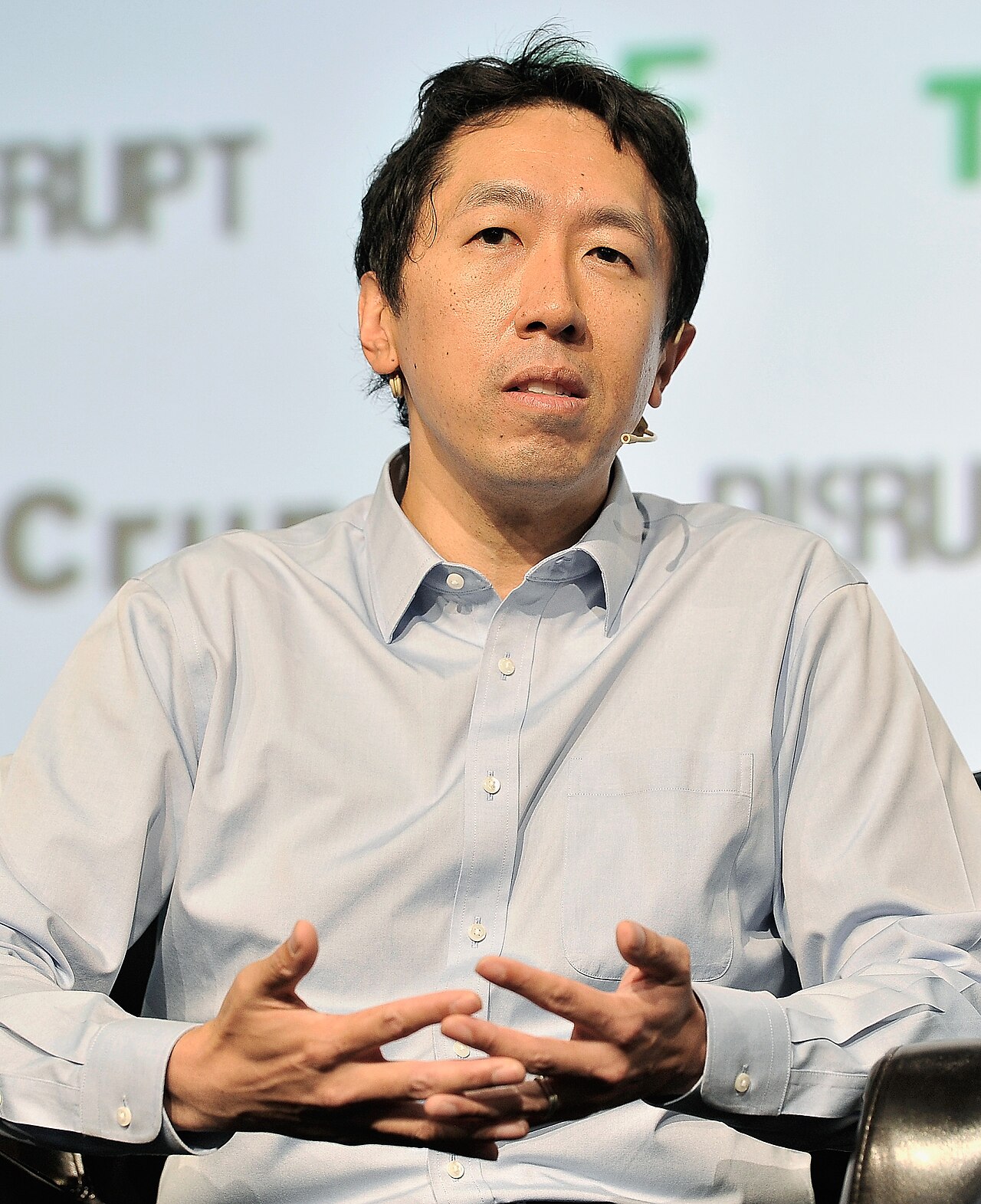
- Image: Andrew Ng at TechCrunch Disrupt SF 2017.jpg by TechCrunch (CC BY 2.0), via Wikimedia Commons