Sundar Pichai and Google
Abstract
Sundar Pichai grew up in a two-room apartment in Chennai where the arrival of a rotary telephone was a family event, and ended up running Alphabet, one of the most valuable companies in history. He joined Google on April 1, 2004 (the day Gmail launched) championed a browser his own CEO didn’t want to build, and rode Chrome’s success through Android and the product organization to the top job: CEO of Google in 2015, CEO of Alphabet in 2019. His tenure spans Google’s declaration that it is an “AI-first” company, the TPU and Gemini, the ChatGPT “code red,” employee revolts, and the largest US antitrust ruling against a tech company since Microsoft.
Madurai, Madras, and a Plane Ticket Worth a Year’s Salary
Pichai Sundararajan (born June 10, 1972, in Madurai, Tamil Nadu, India) grew up in Chennai (then Madras), where his father, an electrical engineer, saved for years of luxuries forgone. The family had no car; the telephone, when it finally arrived around Sundar’s twelfth year, was a rotary-dial party line, and the boy turned out to remember every number ever dialed on it, a party trick of numerical memory he retained as an adult. He studied metallurgical engineering at IIT Kharagpur, then won a scholarship to Stanford for a master’s in materials science; the plane ticket to California cost more than his father’s annual salary. A Wharton MBA, an engineering stint at Applied Materials, and consulting years at McKinsey followed, a résumé notable, among Google’s founder-engineer aristocracy, for containing no famous code.
April 1, 2004: Gmail Launch Day
Pichai interviewed at Google on April 1, 2004, the day Google launched Gmail with a free gigabyte of storage, so absurd by 2004 standards that interviewees, Pichai included, initially suspected an April Fools’ joke. He was hired to work on the Google Toolbar, the unglamorous browser add-on that kept Google as the default search box in Internet Explorer.
The Toolbar taught him the strategic lesson of his career: whoever controls the browser controls the front door to search. When Microsoft made its own search engine the default in Internet Explorer 7, the threat became concrete. Pichai argued that Google must build its own browser, over the explicit skepticism of CEO Eric Schmidt, who considered a browser war too expensive a fight to pick. Pichai built the team anyway, with the founders’ backing.
Chrome: The Bet That Made Him
Google Chrome launched on September 2, 2008, announced via a 38-page comic by Scott McCloud: a minimal interface, a fast new JavaScript engine (V8), and each tab as a separate sandboxed process. It was the first genuinely new force in browsers since the 1990s (see The Browser Wars). By 2012, Chrome had passed Internet Explorer to become the world’s most-used browser; it went on to exceed 60% share, and to carry Google’s $20-billion-a-year default-search economics with it.
Pichai’s reward was an expanding portfolio: ChromeOS and the Chromebook (see ChromeOS and the Browser-as-OS), then in March 2013 Android itself, taking over from its mercurial founder Andy Rubin, and by October 2014 essentially all of Google’s major products as product chief. Colleagues described his superpower in identical terms: the rare executive without enemies, able to navigate Google’s warring fiefdoms without leaving wounds.
CEO of Google, Then Alphabet
On August 10, 2015, Larry Page and Sergey Brin announced the restructuring of Google into a holding company, Alphabet, with Pichai becoming CEO of Google itself when the restructuring completed that October. In December 2019 the founders stepped back entirely and Pichai became CEO of Alphabet as well, the founders retaining, through super-voting shares, control without management.
Pichai’s defining strategic declaration came early: Google would move “from mobile-first to AI-first” (2016–2017). Under that banner came the Tensor Processing Unit (custom AI silicon, revealed 2016), Google Assistant, the acquisition-fueled growth of cloud, and the research that produced the Transformer architecture in 2017, the foundation of the entire LLM era, published openly by his own company (see The Transformer Architecture).
His tenure also normalized a new kind of corporate turbulence: in November 2018, some 20,000 Google employees walked out over the company’s handling of sexual-harassment cases; Pentagon contract Project Maven was dropped after internal protest; and the trust between management and Google’s famously empowered workforce never fully returned.
Code Red: The ChatGPT Shock
ChatGPT’s launch in November 2022 (see The LLM Race) hit Google harder than any competitor ever had, because it aimed at the search box itself. Management declared an internal “code red”; Page and Brin returned for strategy sessions. The rushed response, the chatbot Bard, demonstrated the danger of panic: a factual error about the James Webb Space Telescope in its launch demo (February 2023) coincided with roughly $100 billion falling off Alphabet’s market value in a day. Pichai then did what he is most consistently credited and criticized for, consolidating slowly and thoroughly: Google Brain and DeepMind were merged into a single unit under Demis Hassabis in April 2023 (see Demis Hassabis and DeepMind), and the unified Gemini models (from December 2023) put Google back into the front rank of the LLM race. Earlier and later alarms of the same kind are collected in Code Red: When Incumbents Panic.
The Antitrust Reckoning
On August 5, 2024, federal judge Amit Mehta ruled that Google had illegally maintained its search monopoly, centrally through the multibillion-dollar default agreements (about $20 billion a year to Apple alone) that Pichai’s Toolbar-and-Chrome career had been built around. It was the most significant US tech antitrust verdict since Microsoft in 2001 (see The Platform Antitrust Story). The remedies ruling of September 2025 spared Google the breakup scenario (no forced divestiture of Chrome) but banned exclusive default deals and ordered search-data sharing with competitors. A separate jury verdict (Epic v. Google, December 2023) had already found the Play Store an illegal monopoly. Pichai’s Google ended its third decade in the position its founders’ generation of companies once forced on IBM and Microsoft: dominant, profitable, and under court supervision.
⚠️ Dead End: Project Dragonfly
In August 2018, The Intercept revealed Project Dragonfly: a prototype search engine for China that would comply with state censorship, blacklisting queries about human rights and democracy, and linking searches to users’ phone numbers. Google had publicly left mainland China in 2010 over exactly this issue; the secret return attempt detonated internally. Over a thousand employees signed protest letters, human-rights organizations and US senators piled on, and Google confirmed in 2019 that Dragonfly had been terminated. The episode marked the practical end of the era in which Google’s “Don’t be evil” self-image and its market ambitions could be assumed compatible, and it established the limit of Pichai’s consensus management: some conflicts cannot be navigated, only decided. China’s search market stayed with Baidu; Google never re-entered (see China’s Tech Industry).
📚 Sources
- Wikipedia: Sundar Pichai
- Larry Page: G is for Google — the Alphabet founding letter (August 10, 2015)
- Sundar Pichai becomes CEO of Alphabet (December 2019) — Page & Brin letter
- Google Chrome comic by Scott McCloud (September 2008)
- StatCounter: Chrome overtakes Internet Explorer globally (May 2012)
- Sundar Pichai: Making AI work for everyone — the AI-first framing (Google I/O 2017)
- The Verge: Google’s Bard AI error wipes $100 billion off Alphabet shares (February 8, 2023)
- US v. Google: Judge Mehta’s ruling that Google is a monopolist (August 5, 2024)
- The Intercept: Google Plans to Launch Censored Search Engine in China (August 1, 2018)
- NYT: A New Chat Bot Is a ‘Code Red’ for Google’s Search Business (December 21, 2022)
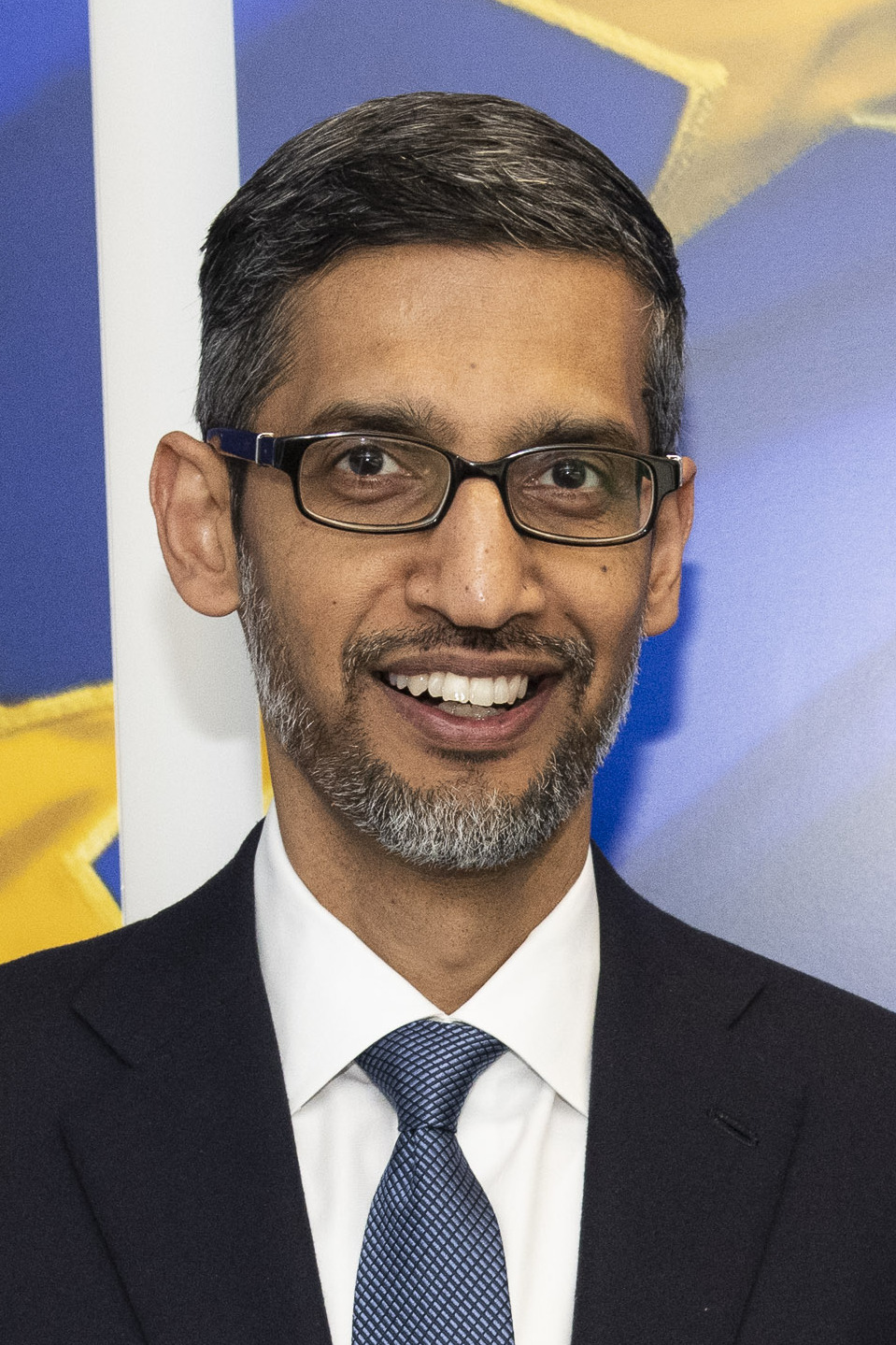
- Image: Sundar Pichai - 2023 (cropped).jpg by Lukasz Kobus, European Commission (CC BY 4.0), via Wikimedia Commons