Kevin Mitnick: The Most Wanted Computer Criminal in America
Abstract
Kevin Mitnick grew up in Los Angeles learning to manipulate systems (phone networks, computer networks, and people) with a skill that left law enforcement baffled and the public fascinated. By the mid-1990s, the FBI had named him the most wanted computer criminal in the United States, a manhunt that ended in February 1995 after a celebrated chase across digital and physical geography. He served five years in federal prison, including eight months in solitary confinement on the theory that he was so dangerous he could cause nuclear war by telephone. After his release, he became the country’s most famous security consultant, proof that the distance between criminal and expert is sometimes a matter of which side of the table you’re sitting on.
The Education of a Social Engineer
Kevin Mitnick was born in Los Angeles in 1963 and grew up in the San Fernando Valley, raised largely by his mother after his parents divorced. He was a bright, restless child who found that conventional schooling offered nothing to match the complexity of the systems available to him on the street and over the wire.
His first documented social engineering exploit came at age twelve. Fascinated by the Los Angeles bus system’s punch card transfers, Mitnick convinced a bus driver to tell him where he could buy his own ticket punch, then began creating his own transfers, riding the bus system for free across the city. The technique (finding the human weakness in a bureaucratic system, rather than attacking its technical machinery) would define his approach to every subsequent target.
At sixteen, he discovered phone phreaking through a classmate and joined the world of blue boxes and COSMOS, Pacific Bell’s Customer and Office Support Master Automation System, a computer that controlled subscriber records and telephone switching. Mitnick learned the COSMOS system’s procedures by posing as a Pacific Bell employee, calling telephone company offices and asking technicians to walk him through their systems. The information he extracted was entirely verbal; the intrusion was entirely social. He never needed to be in the building.
His first serious computer intrusion came in 1979, at sixteen, when he got into the network of Digital Equipment Corporation (DEC) and copied the company’s software, a feat that required genuine technical skill alongside the social engineering. The charges caught up with him years later: convicted in 1988, he was sentenced to twelve months in prison followed by three years of supervised release. He was twenty-five.
The Escalation
The mid-1980s through the early 1990s saw Mitnick cycle through arrests, release, and resumed hacking, a pattern that frustrated law enforcement and suggested, to those who studied him, that the hacking was less about profit than compulsion. He took source code from DEC, Motorola, Nokia, and Sun Microsystems (code worth, by government estimates, millions of dollars) but did not sell it. He collected it. He hacked because the ability to move through systems that were supposed to be inaccessible was, by his own later description, an addiction.
His methods were a combination of technical sophistication and social engineering, with social engineering doing the heavier work. He would call a company’s help desk pretending to be an employee, obtain a temporary password reset, and use that access as a foothold for deeper penetration. He memorized system administrator procedures, employee hierarchies, and the organizational conventions that telephone company employees used to authenticate each other. His social engineering was indistinguishable from legitimate access because it used the same words, the same procedures, and the same institutional authority, the difference was that the authority was fabricated.
He spent time as a fugitive in the early 1990s, living under assumed identities and moving between cities while federal arrest warrants accumulated. The FBI and Pacific Bell’s security team were pursuing him intermittently; the chase was low-intensity but persistent.
The Shimomura Incident
The events that led to Mitnick’s final arrest began on Christmas Day, 1994. Tsutomu Shimomura, a computational physicist and security researcher at the San Diego Supercomputer Center (SDSC), discovered that someone had broken into his home computer while he was away for the holidays. The intrusion was technically elegant: the attacker had used an IP spoofing attack, forging the source addresses of network packets to impersonate trusted machines in Shimomura’s network and subvert the authentication that his systems used. The attacker stole security tools, proprietary software, and Shimomura’s collection of cellular phone firmware, tools that could be used to clone mobile phones and intercept calls.
Shimomura took the attack personally. He was one of the country’s best computer security researchers, and someone had compromised his home network on Christmas morning. He made it his mission to identify and locate the attacker.
The IP spoofing technique was well-documented in the academic literature, a 1985 Bell Labs paper by Robert T. Morris (who would later write the Morris worm) had described it years earlier, but executing it in practice required genuine skill. Security researchers who analyzed the attack’s packet logs recognized it as the work of someone who knew exactly what they were doing. The attack pointed to Kevin Mitnick.
Mitnick had been cloning cellular phones to make untraceable calls, using the firmware stolen from Shimomura’s machines. Over the following weeks, Shimomura worked with cellular carriers and the FBI to triangulate the source of the cloned phone calls, narrowing the search to Raleigh, North Carolina. Shimomura flew to Raleigh, drove through neighborhoods with a cellular signal direction-finder in his rental car, and on February 15, 1995, identified the apartment building where the calls were originating.
FBI agents arrested Kevin Mitnick in his apartment in the early morning hours. He was sitting at his computer. He did not resist.
Journalist John Markoff had been covering the Mitnick story for the New York Times, and the arrest was front-page news nationally. Shimomura and Markoff later co-wrote Takedown: The Pursuit and Capture of Kevin Mitnick, America’s Most Wanted Computer Criminal (1996), a book that presented the story largely from Shimomura’s perspective. Mitnick later disputed several of its details.
The Social Engineering Vector
Mitnick’s own account of his methods, described in The Art of Deception (2002), emphasized that his most valuable intrusions rarely required exploiting software vulnerabilities. A person who understood organizational procedures, spoke confidently in the right jargon, and constructed a plausible pretext could obtain almost any credential from almost any employee. The technical exploits were often just the final step in a chain of social manipulation. Mitnick argued that this made social engineering the most dangerous attack vector: you cannot patch a human being.
Five Years and Eight Months in Solitary
The federal charges were extensive: wire fraud, computer fraud, and the interception of wire communications. The prosecution argued that Mitnick had caused damages in the tens of millions of dollars, the estimate was contested, but the number supported severe sentencing.
The most unusual aspect of Mitnick’s pre-trial detention was the argument, accepted by the court, that he was so dangerous he should be denied access to a telephone. Law enforcement officials persuaded a judge that Mitnick had the ability to “start a nuclear war by whistling into a pay phone.” This claim was technically absurd; nuclear launch systems are air-gapped from the telephone network. But it succeeded in keeping Mitnick in solitary confinement for eight months while he awaited trial.
He pleaded guilty in 1999 to four counts of wire fraud, two of computer fraud, and one of intercepting a wire communication, and was sentenced to 46 months, plus 22 months for violating the supervised release from his 1989 conviction: sixty-eight months in all, with credit for time served. He had been in custody since February 1995 and was released on January 21, 2000. Through the supervised release that followed, until January 21, 2003, he was barred from using any communications technology other than a landline telephone. For a man whose entire intellectual life had been organized around the manipulation of networks, the restriction was designed to be experienced as punishment.
His supporters, including a significant portion of the computer security community, organized a sustained campaign for his release, arguing that the sentence was disproportionate, that the damages had been wildly overstated, and that the “nuclear launch codes” argument reflected a public hysteria about hackers that bore no relationship to reality. Free Kevin became a slogan on T-shirts and websites. The campaign did not shorten his sentence but kept his case in public view.
Transformation: The Security Consultant
After his release and the expiration of his supervision conditions, Mitnick did what several of his generation’s hackers did: he professionalized. Mitnick Security Consulting became a legitimate business offering exactly the services his criminal career had demonstrated he could provide, penetration testing, social engineering assessments, and security awareness training. Companies paid him to attempt to break into their systems and report the results.
His books translated the criminal career into commercial products. The Art of Deception (2002, co-written with William Simon) described social engineering attacks in detail (how attackers construct pretexts, exploit helpfulness and authority, and move through organizational hierarchies) and how to defend against them. The Art of Intrusion (2005) collected case studies of real intrusions, including several by Mitnick himself. Ghost in the Wires (2011) was his memoir, presenting his own account of events Shimomura and Markoff had described differently. All three became widely read in the security industry.
His transformation was commercially successful but never entirely uncomplicated. Some in the security community never forgave what they saw as the exploitation of his criminal notoriety as a marketing asset. Others argued that he had served his time and deserved the same opportunity to rebuild as any former prisoner. The security industry, which had always had a complicated relationship with the hacker tradition, absorbed him as a celebrity consultant and moved on.
The Mythology Problem
The Kevin Mitnick story is difficult to tell accurately because it exists in at least three versions: the law enforcement version (a dangerous criminal who caused millions in damages and needed to be stopped), the hacker community version (a curious explorer persecuted far beyond what his actions warranted), and Mitnick’s own version (a technically brilliant but impulsive young man who paid an excessive price for hacks that were never primarily about money or malice).
All three versions contain truth. The damages claims were almost certainly overstated, source code that companies valued at millions of dollars may have been worth much less if Mitnick had never actually used it. The “nuclear launch codes” argument was genuinely absurd. The eight months in solitary were a disproportionate response to what was, at its core, a compulsive but non-violent information theft. These criticisms are valid.
But Mitnick also broke into systems without authorization, repeatedly and after multiple arrests, taking proprietary code that companies had invested substantial resources to create. He was not a security researcher finding and responsibly disclosing vulnerabilities; he was accumulating access for the pleasure of having it. The romantic hacker narrative, in which curiosity entirely excuses intrusion, does not quite fit.
What his story documents most clearly is the inadequacy of both extremes, the law enforcement framework that treated him as a uniquely dangerous criminal capable of starting wars, and the hacker mythology that treated any restriction on computer access as political persecution. He was something more mundane and more interesting: a person of exceptional talent in a category of skill that society had not yet learned to evaluate, arrested in the gap between what he was and what the law could understand him to be.
Kevin Mitnick died on July 16, 2023, from pancreatic cancer. He was fifty-nine years old. The obituaries noted that he had become, improbably, a symbol of computer security in both its criminal and defensive incarnations.
📚 Sources
- Mitnick, Kevin D. & Simon, William L.: The Art of Deception: Controlling the Human Element of Security (2002), Wiley
- Mitnick, Kevin D. & Simon, William L.: The Art of Intrusion: The Real Stories Behind the Exploits of Hackers, Intruders, and Deceivers (2005), Wiley
- Mitnick, Kevin D. & Simon, William L.: Ghost in the Wires: My Adventures as the World’s Most Wanted Hacker (2011), Little, Brown
- Shimomura, Tsutomu & Markoff, John: Takedown: The Pursuit and Capture of Kevin Mitnick, America’s Most Wanted Computer Criminal by the Man Who Did It (1996), Hyperion
- Littman, Jonathan: The Fugitive Game: Online with Kevin Mitnick (1996), Little, Brown
- Hafner, Katie & Markoff, John: Cyberpunk: Outlaws and Hackers on the Computer Frontier (1991), Simon & Schuster — includes Mitnick’s early career
- United States v. Mitnick, Case No. CR 95-230 WDK (C.D. Cal. 1995). Federal court record; available through PACER, no public URL.
- Electronic Frontier Foundation: Free Kevin campaign archive
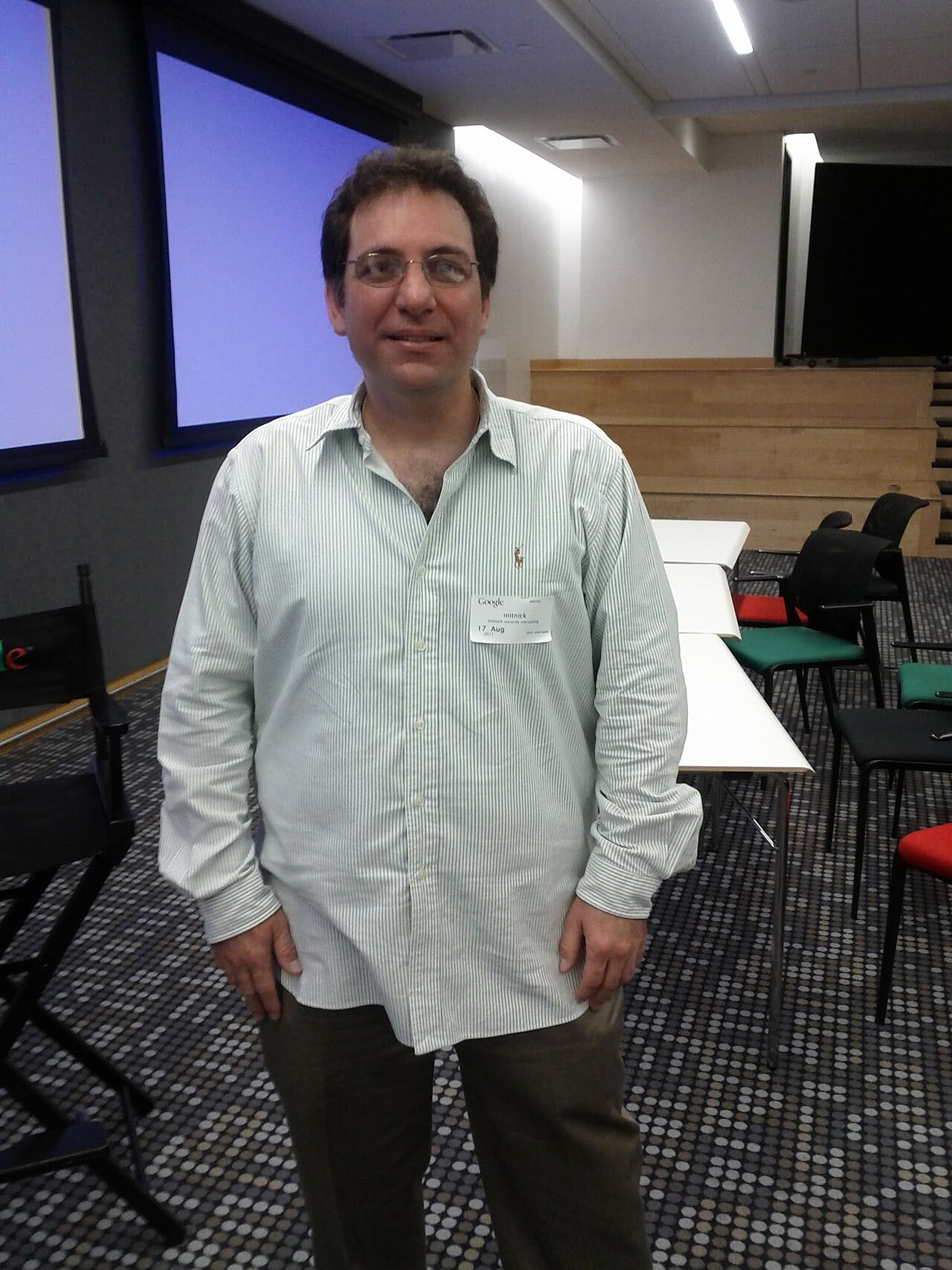
- Image: Kevin Mitnick at Google.jpg by Grendelkhan (CC BY-SA 4.0), via Wikimedia Commons