Nokia: The Mobile Empire That Couldn't Become a Software Company
Abstract
Nokia is the most dramatic rise-and-fall story in the history of consumer technology. From a Finnish paper mill founded in 1865, Nokia became, by 1998, the largest mobile-phone maker in the world, a position it held for fourteen years, at its peak selling more than 40% of all mobile phones on Earth and accounting for a substantial share of Finland’s entire economy. Then, in the span of about five years after Apple launched the iPhone in 2007, Nokia’s phone business collapsed almost completely, ending with a fire-sale to Microsoft in 2014. Nokia’s fall is the canonical case study in disruption: a company that dominated mobile hardware failed to understand that the phone had become a software and ecosystem product, and its internal culture, fragmented operating systems, and complacency destroyed a seemingly invincible lead.
From Paper Mill to Conglomerate
Nokia began in 1865 when engineer Fredrik Idestam built a wood-pulp mill on the banks of the Nokianvirta river in southern Finland. The company that took the river’s name spent its first century in paper, rubber (boots and tires), and cables. After mergers in 1967, Nokia became a Finnish industrial conglomerate spanning rubber, cable, electronics, and even televisions and computers.
Nokia’s electronics and cable divisions positioned it to enter telecommunications. In the 1980s, the Nordic countries pioneered the world’s first international mobile-phone network, NMT (Nordic Mobile Telephone), and Nokia built both network equipment and car phones for it. This early, government-backed head start in mobile telephony was crucial: while the US fragmented across incompatible standards, the Nordics and then Europe coordinated.
The GSM Bet and Global Domination
In the late 1980s, under CEO and later chairman Jorma Ollila, Nokia made a decisive strategic choice: it sold off everything else (rubber, cable, paper, consumer electronics, televisions) to focus entirely on mobile telecommunications. The bet was on GSM, the new pan-European digital cellular standard, which launched in 1991 (Nokia equipment carried the world’s first GSM call).
GSM became the dominant global mobile standard, and Nokia rode it to the top. The Nokia 2110 (1994) and especially the Nokia 3210 (1999) and 3310 (2000) became some of the best-selling phones ever made. Nokia phones were famous for their durability (the 3310 became an internet legend for surviving abuse), long battery life, intuitive interface, the Snake game, and customizable ring tones (the “Nokia tune” became one of the most-played pieces of music in the world).
By 1998, Nokia was the world’s largest mobile-phone manufacturer, overtaking Motorola. At its peak in the mid-2000s it commanded roughly 40% of the global handset market and was Europe’s most valuable company. In Finland, Nokia at one point accounted for a large share of GDP, of exports, and of the entire Helsinki stock exchange’s value, an extraordinary concentration of national fortune in one firm.
Symbian and the Smartphone That Almost Was
Nokia was not blind to the future. It was, in fact, an early leader in smartphones. The Nokia 9000 Communicator (1996) was an early smartphone with a keyboard and email. Nokia co-founded and controlled Symbian, the leading smartphone operating system of the early 2000s, and shipped touchscreens and app concepts years before Apple.
This makes the fall harder to explain, and more instructive. Nokia had the technology; what it lacked was the organizational ability to turn it into a coherent software platform.
Why the Lead Evaporated: The Anatomy of Disruption
When the iPhone launched in 2007 and Android in 2008, Nokia’s leadership underestimated them, viewing the iPhone as an overpriced niche device with poor battery life and a weak network business case. The deeper problems were structural:
- Symbian was a hardware-era OS. It had been designed for low-power devices with tiny memory and was extraordinarily difficult to develop modern touch applications for. Nokia tried to retrofit touch onto an OS architected for keypads, and the result was clumsy.
- Fragmentation and internal politics. Nokia ran multiple, competing operating systems (Symbian, the Linux-based Maemo/MeeGo, S40) and a notoriously siloed, internally competitive organization. Engineers spent more energy fighting each other than the iPhone. A famous study described a culture of “temporal myopia” and fear, where managers withheld bad news.
- No ecosystem. The iPhone and Android won on apps, developers, and integrated software, not hardware specs. Nokia thought like a manufacturer optimizing devices; Apple and Google thought like platform companies cultivating ecosystems. Nokia had no answer to the App Store.
- Misjudging the product category. Nokia’s leadership saw phones as hardware to be specced and shipped in dozens of models per year; the smartphone had become a pocket computer defined by its software experience.
The Microsoft Alliance and the End
In 2010 Nokia hired Stephen Elop, a former Microsoft executive, its first non-Finnish CEO. In February 2011 he circulated the famous “Burning Platform” memo, comparing Nokia to a man standing on a burning oil platform who must jump into icy water to survive (see Code Red: When Incumbents Panic). Days later he announced Nokia would abandon Symbian and MeeGo and adopt Microsoft’s Windows Phone as its primary smartphone platform.
The decision is one of the most debated in business history. Critics argued the announcement itself was fatal: by publicly declaring its current products dead months before Windows Phone devices were ready, Nokia destroyed demand for the Symbian phones that were still its only revenue, the “Osborne effect” at planetary scale. Nokia’s market share went into freefall. The Lumia Windows Phones that followed were well-built and well-reviewed but could not overcome Windows Phone’s tiny app ecosystem, caught between the iOS and Android duopoly.
In 2013, Microsoft acquired Nokia’s handset business for about €5.4 billion. The acquisition was a failure; Microsoft wrote off most of the value within two years, laid off tens of thousands, and effectively exited the phone business, taking Windows Phone down with it. The Nokia phone brand was later licensed to HMD Global, a Finnish company that makes Android phones under the Nokia name. For Microsoft’s side of this disaster, see Dead End: Microsoft’s Mobile Failures.
What Survived: Nokia the Network Company
The Nokia that exists today is not the phone maker; it is the network-equipment business that was always the company’s other half. Nokia retained its telecommunications-infrastructure division, and in 2016 it acquired Alcatel-Lucent (which included the legendary Bell Labs). Today Nokia is one of the world’s three major makers of mobile-network infrastructure (alongside Sweden’s Ericsson and China’s Huawei), a key supplier of 4G and 5G equipment to carriers worldwide.
So Nokia did not die; it lost its consumer face entirely and reverted to being a business-to-business engineering company, the role it had played for most of its 150-year history.
Significance
Nokia is the definitive lesson that dominance in hardware does not protect against a platform shift to software. A company can hold 40% of a market, possess the relevant technology in its labs, and still be destroyed in five years when the basis of competition moves from devices to ecosystems and its culture cannot adapt. Business schools teach Nokia alongside Kodak and Blockbuster as a warning that the most dangerous moment for a market leader is the one when its current model is most profitable. For the transition that killed it, see The Mobile Computing Revolution; for the company that did it first, see Steve Jobs and Apple.
📚 Sources
- Vuori, Timo O. & Huy, Quy N.: “Distributed Attention and Shared Emotions in the Innovation Process: How Nokia Lost the Smartphone Battle” — Administrative Science Quarterly (2016)
- Doz, Yves & Wilson, Keeley: Ringtone: Exploring the Rise and Fall of Nokia in Mobile Phones (Oxford University Press, 2017)
- Cord, David J.: The Decline and Fall of Nokia (Schildts & Söderströms, 2014)
- Elop, Stephen: “Burning Platform” internal memo (February 2011), as reported by Engadget
- Nokia Corporation: “Our history”
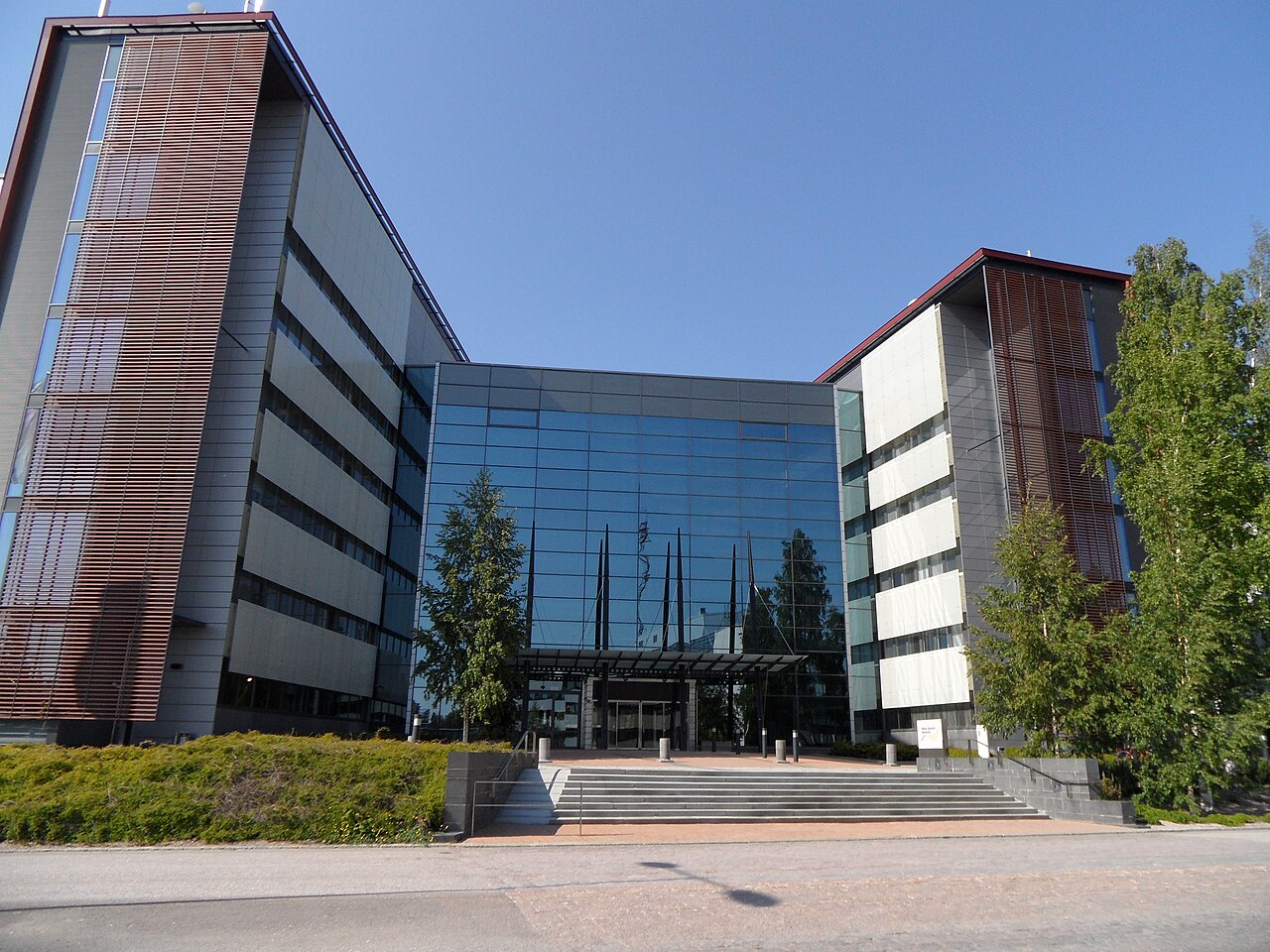
- Image: Nokia headquarters in Espoo.jpg by Villeke (CC BY-SA 3.0), via Wikimedia Commons