The Personal Computing Explosion
Abstract
This is the spine of the personal computer story: how a machine went from a kit with no keyboard in 1975 to an appliance in 1977, a business tool in 1981, a graphical product in 1984, a commodity by the late 1990s, and a declining category after 2011, when smartphones outsold PCs for the first time. Each stage has its own article in this encyclopedia; what follows is the order they happened in, what changed at each step, and where the money went. Two facts explain most of the arc. The parts got cheaper every year, and the part that could not be copied, first IBM’s name and then Microsoft’s and Intel’s position, is where the profit ended up.
The Precondition
Until a processor could be bought for a few hundred dollars, a personal computer was an argument rather than a product. Intel’s 8080 and its competitors turned the central processor into a component with a catalogue price, which is the point at which a small company could design a computer without designing a processor. That story is in The Microprocessor Revolution.
The other precondition was a working idea of what such a machine should be. Xerox PARC had built one in 1973: the Alto, a machine per person, with a bitmapped screen, a mouse and overlapping windows, connected by Ethernet to a laser printer. Xerox built around 2,000, used them internally, and sold the commercial version at a price that reached almost nobody (see The Xerox PARC Revolution).
Kits, 1975 to 1977
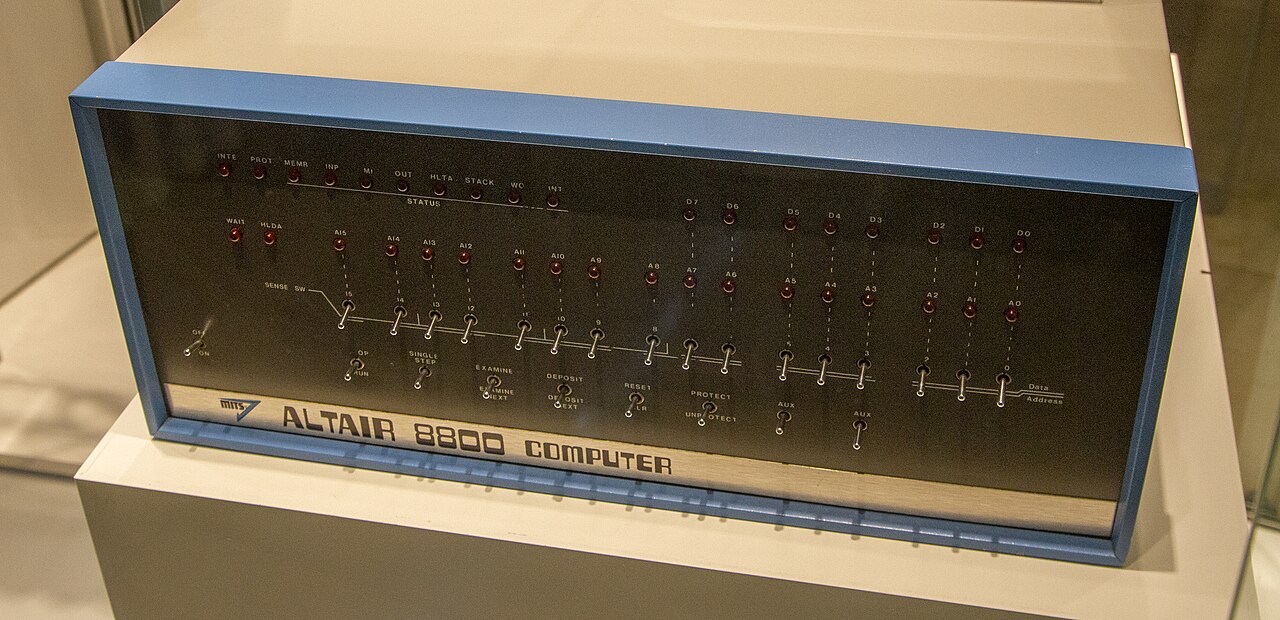
The Altair 8800 of January 1975 was a box of switches and lights with no keyboard, no screen and no software, and it sold thousands within months to people who wanted to own a computer more than they wanted to use one. Its bus became the S-100 standard, its clone the IMSAI 8080 sold 17,000 to 20,000 units, and the software business it created (Microsoft’s first product was a BASIC for it) outlived the hardware.
The kit era answered a question that the industry had been arguing about for a decade: whether there was a market for a computer that one person could own. There was, and it was larger than the machine deserved.
The Appliance, 1977
Three machines shipped in 1977 that worked out of the box: the Apple II in June at $1,298, the Commodore PET 2001 from October at $795, and the Radio Shack TRS-80 in August at $599. They had keyboards, they had BASIC in ROM, and two of the three were sold in shops that ordinary people already walked into.
What followed was a mass market built on two components nobody had to pay for: the television set as a display and the audio cassette as storage. Prices fell to $299 and below, Commodore and Texas Instruments fought a price war in 1983 that ended with TI leaving the business after losing $111 million in one quarter, and the C64 sold somewhere between 12.5 and 17 million units. The full account is in The Home Computer Boom, with the British end of it in Clive Sinclair and The UK Computing Industry and the Japanese market, which went its own way entirely, in NEC PC-98 and Japan’s Domestic PC.
Software Sells the Hardware, 1979
VisiCalc, written by Dan Bricklin and Bob Frankston and released for the Apple II in 1979, was the first spreadsheet program for a personal computer, and it was the first time people bought a particular computer in order to run a particular program. Every platform decision after it was made with that dynamic in mind: the machine is a means of access to its software library, and a library is much harder to move than a customer. See Dan Bricklin and VisiCalc.
The Business Machine, 1981
IBM built its personal computer in about a year by buying the parts, including the operating system, and publishing the technical documentation. It gave the machine legitimacy in offices that would not buy from a company called Apple, and it gave away the two things that mattered: the architecture, which anyone could copy, and the licence to MS-DOS, which Microsoft could sell to anyone who did. The IBM PC covers the decision and Gary Kildall and the OS IBM Didn’t Take covers the alternative that did not happen.
Compaq proved in 1983 that the copy was legal if the BIOS was written without looking at IBM’s, and after that the standard belonged to the industry rather than to IBM.
The Interface Reaches the Price, 1984
Xerox shipped the graphical interface first and priced it at $16,595. Apple shipped the Lisa at $9,995 in 1983 and failed with it, then shipped the Macintosh on 24 January 1984 at $2,495 and nearly failed with that too, because 128 KB of memory could not hold the system and a document at the same time. What rescued it was the LaserWriter and PageMaker, which gave the machine a profession that would pay for it. See The Macintosh and The Desktop Publishing Revolution.
Microsoft needed three versions and five years, from Windows 1.0 in 1985 to Windows 3.0 in 1990, to make the same interface normal on hardware that cost half as much, which is covered in The Windows Story.
The Commodity, 1992 to 1999
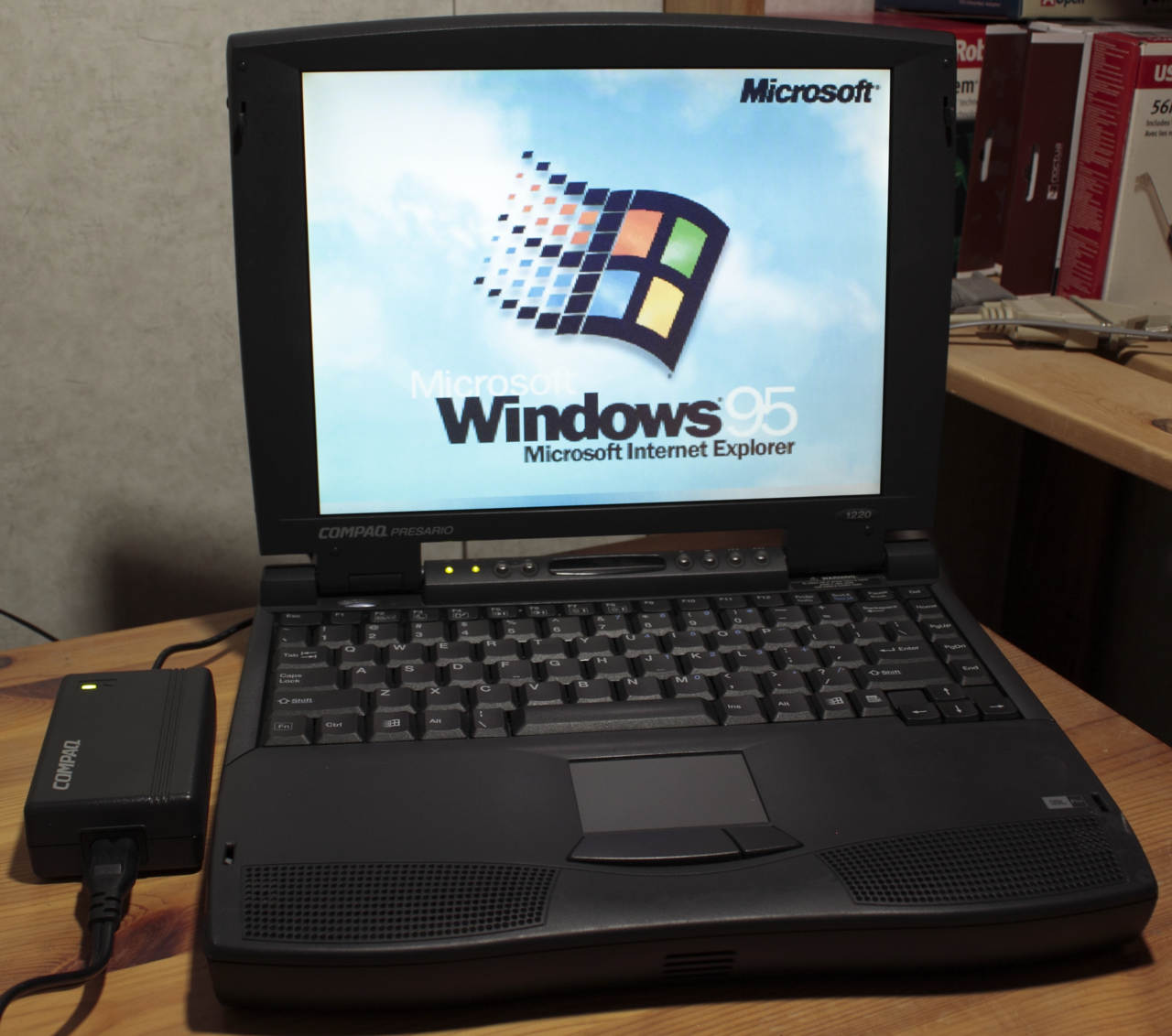
Compaq abandoned premium pricing, Dell removed the dealer and built machines only after they were ordered, Gateway sold by post, Packard Bell put PCs in department stores, and eMachines sold a working computer for $399 from late 1998. Intel spent 3% of its processor revenue teaching buyers to ask for a component they could not see. The assembly business was competed down to a few points of margin while Microsoft and Intel kept theirs. The Commodity PC follows the money.
Off the Desk, 1981 to 2008
The portable line runs in parallel the whole way: the 24.5-pound Osborne 1 in 1981, the GRiD Compass clamshell in 1982, the battery-powered Toshiba T1100 in 1985, the PowerBook layout in 1991 that every notebook still copies, and the third quarter of 2008, when notebooks outsold desktops worldwide for the first time. See The Portable Computer.
Dead End: The Platforms That Lost
Three of the era’s alternatives were technically ahead of what beat them.
CP/M was the dominant operating system for 8-bit business machines before MS-DOS, and Digital Research lost the IBM contract in circumstances that are still argued about. The Amiga of 1985 had hardware-accelerated graphics, real multitasking and a sound system that nothing on a PC matched for years, and Commodore could not sell it. OS/2, IBM’s attempt to take the operating system back, was more robust than Windows 3.x and lost the developers anyway.
The common factor is not technical. A platform wins the buyers who want the software that already exists for it, and the software gets written for the platform that already has the buyers. Once that loop is running, the machine’s specifications stop deciding anything, which is why the era’s best engineering is mostly found in the products that failed.
What Happened to the Desktop
PC shipments peaked in 2011, at about 352 million units by IDC’s count, with the largest single quarter, 96.1 million, in the third quarter of that year; they fell 4% in 2012 and further in 2013. In that same year smartphones outsold PCs worldwide for the first time, 488 million against 415 million on Canalys’s numbers (and the PC figure already included 63 million tablets), and the computing most people did moved to a device they did not think of as a computer (see The Mobile Computing Revolution). The work that stayed on a desk increasingly ran somewhere else, on machines rented by the hour (see The Cloud Computing Era).
The personal computer did not disappear; it stopped being the interesting question. A category that took fifteen years to go from a switch panel to a commodity took another fifteen to become infrastructure.
📚 Sources
- Freiberger, Paul & Swaine, Michael: Fire in the Valley: The Birth and Death of the Personal Computer (2000), McGraw-Hill
- Levy, Steven: Insanely Great: The Life and Times of Macintosh, the Computer that Changed Everything (1994), Viking
- Wallace, James & Erickson, Jim: Hard Drive: Bill Gates and the Making of the Microsoft Empire (1992), Wiley
- Bricklin, Dan: “VisiCalc: Information from its Creators” — the 1979 release for the Apple II and the spreadsheet’s origin
- Apple II (original) — Wikipedia (on sale 10 June 1977 at $1,298)
- Commodore PET — Wikipedia (first units October 1977, $795 introductory price)
- TRS-80 — Wikipedia (announced 3 August 1977 at $599 with monitor and cassette recorder)
- Xerox Star — Wikipedia (27 April 1981, $16,595 per workstation, about 25,000 sold)
- Macintosh 128K — Wikipedia (24 January 1984 at $2,495 with 128 KB of RAM)
- Apple Lisa — Wikipedia (19 January 1983 at $9,995)
- Windows 1.0 and Windows 3.0 — Wikipedia (first retail release 20 November 1985; Windows 3.0 launched 22 May 1990)
- IDC: PC shipments slumped as 2011 ended — Computerworld, 12 January 2012, citing IDC (352.4 million PCs shipped in 2011, up 1.6% on 2010)
- Peak PC and Microsoft’s dilemma — Computerworld, citing IDC (the peak quarter of 96.1 million in Q3 2011, the 4% decline in 2012 and the larger dip in 2013)
- Smart phones overtake client PCs in 2011 — Canalys press release 2012/021, 3 February 2012 (487.7 million smart phones against 414.6 million client PCs, of which 63.2 million were pads)
- Image: 2019-08-04 Altair 8800 computer.jpg by Maksym Kozlenko (CC BY-SA 4.0), via Wikimedia Commons
- Image: Compaq Presario 1220.png by Pirozhkebab (CC BY-SA 4.0), via Wikimedia Commons