SAP: The Enterprise Software Giant Europe Built
Abstract
SAP is the largest software company Europe has ever produced and, for decades, the backbone of how the world’s biggest corporations run themselves. Founded in June 1972 by five former IBM engineers in Weinheim, Germany, SAP pioneered the idea that a single integrated software system could manage a company’s finances, manufacturing, logistics, and human resources in real time. Its R/3 system defined the enterprise resource planning (ERP) category in the 1990s, and by the 2010s SAP software touched an estimated 77% of the world’s transaction revenue. Yet SAP’s story is also one of a company nearly broken by the shift to the cloud, a maker of monolithic on-premise systems forced to reinvent itself while competitors who were born in the cloud, like Salesforce and Workday, attacked from above.
Five Engineers Who Left IBM
In 1972, five engineers (Dietmar Hopp, Hasso Plattner, Klaus Tschira, Hans-Werner Hector, and Claus Wellenreuther) left IBM Germany. They had been working on an order-processing project for the chemical company ICI, and IBM reassigned the work in a way that sidelined them. They believed in a different idea: that business software should process data in real time and interactively, rather than in the overnight batch runs that dominated 1970s mainframe computing.
In June 1972 they founded Systemanalyse und Programmentwicklung (“System Analysis and Program Development”) in Weinheim: SAP. Their first customer was Imperial Chemical Industries’ German branch at Östringen, where they built payroll and accounting systems. The first product, the RF financial accounting system of 1973 (retrospectively R/1, the “R” for real-time), ran on a single mainframe.
The breakthrough idea was integration. Before SAP, a company ran separate, disconnected programs for accounting, inventory, payroll, and purchasing, each with its own data, requiring constant reconciliation. SAP’s vision was a single database that all business functions wrote to and read from. When a warehouse recorded a shipment, the accounting ledger, the inventory count, and the customer invoice all updated from the same transaction.
R/2 and R/3: Defining ERP
SAP R/2 (1979) extended the system to handle multiple currencies and languages, essential for the multinational corporations that became SAP’s core market. R/2 ran on IBM mainframes and made SAP a serious force in German and then European industry.
The defining product was SAP R/3, launched in 1992. R/3 moved SAP off the mainframe and onto client-server architecture: the software ran on Unix servers and workstations from vendors like HP, Sun, and later Windows NT, with the business logic split across a three-tier architecture (database, application, presentation). This timing was perfect. Corporations in the early 1990s were migrating off expensive mainframes toward cheaper client-server hardware, and R/3 gave them a way to run their entire business on the new platform.
R/3 turned SAP into a global company. The enterprise resource planning (ERP) category it defined became one of the largest software markets in the world. By the late 1990s, implementing SAP was a rite of passage for any large corporation, and a notoriously expensive, multi-year undertaking.
Why SAP Implementations Were So Hard
SAP R/3 shipped with thousands of configurable business processes encoding “best practices.” Adopting SAP usually meant a company had to change its own processes to match SAP’s model, or pay for extensive customization. Implementations routinely ran for years and cost more in consulting fees than in software licenses. An entire industry of system integrators (Accenture, Deloitte, Capgemini) grew up around SAP deployment. Failed or runaway SAP projects became infamous business-school case studies, from FoxMeyer Drug’s 1996 bankruptcy (partly blamed on a botched SAP rollout) to numerous public-sector overruns.
The ABAP Language and the Y2K Boom
SAP systems were programmed and extended in ABAP (Advanced Business Application Programming), a proprietary fourth-generation language. ABAP made SAP deeply customizable but also locked customers in: a company’s business logic became encoded in ABAP programs that ran only on SAP.
The Year 2000 problem was a windfall. Rather than patch aging legacy systems for Y2K compliance, many corporations chose to replace them wholesale with SAP R/3, which was Y2K-ready and modern. The late-1990s ERP boom, driven partly by Y2K and partly by the euro currency conversion in Europe, made SAP one of the most valuable software companies in the world.
SAP HANA and the In-Memory Bet
By the late 2000s, SAP faced a strategic problem. Its software was built on traditional disk-based relational databases, and the dominant database under SAP installations was Oracle, its emerging rival. SAP was paying a tax to a competitor and was constrained by disk-database performance.
Hasso Plattner, by then chairman, championed a radical bet: SAP HANA (2010), an in-memory column-store database. By keeping the entire dataset in RAM and organizing it in columns optimized for analytics, HANA could run reports and transactions on the same data orders of magnitude faster than disk databases. HANA was both a technical achievement and a strategic weapon, a way to free SAP from Oracle.
SAP S/4HANA (2015) was the next-generation ERP suite rebuilt to run only on HANA. SAP announced it would end support for its older ERP systems, pressuring its enormous installed base to migrate. The migration deadline became a recurring source of customer anxiety; SAP repeatedly extended mainstream maintenance for legacy ECC systems (most recently to 2027, with extended support to 2030) as customers resisted the cost and risk of moving.
The Cloud Reckoning
SAP’s deepest crisis was the cloud. Its business was built on selling perpetual licenses for software that customers installed and ran in their own data centers, high-margin, slow-moving, and lucrative. A new generation of competitors was born in the cloud and attacked SAP’s core markets:
- Salesforce (founded 1999) took the customer-relationship-management (CRM) market with subscription software-as-a-service, making SAP’s on-premise CRM look obsolete.
- Workday (2005), founded by ex-PeopleSoft executives, attacked SAP’s human-capital-management stronghold with cloud-native HR software.
SAP responded with a series of large acquisitions to buy its way into the cloud: SuccessFactors (2011, $3.4 billion, HR), Ariba (2012, $4.3 billion, procurement), Concur (2014, $8.3 billion, travel and expense), and Qualtrics (2018, $8 billion, experience management). These deals gave SAP cloud revenue but also a patchwork of separately built systems that did not integrate as cleanly as SAP’s traditional all-in-one promise.
The Innovator’s Dilemma at Scale
SAP exemplifies the classic incumbent’s bind: its on-premise license-and-maintenance model was enormously profitable, which made it painful to cannibalize by pushing customers toward lower-margin (initially) cloud subscriptions. SAP’s stock fell sharply in 2020 when management announced that the cloud transition would depress margins for years. The company has since committed fully to “RISE with SAP,” a program that moves customers to S/4HANA in the cloud, but the transition remains the central challenge of SAP’s survival as a relevant platform rather than a legacy maintenance business.
Significance
SAP is the clearest proof that the dominant story of computing (American firms in Silicon Valley) is incomplete. From a town in Germany’s Rhine-Neckar region, SAP built the operational nervous system of global capitalism. When a multinational closes its books, manufactures a car, or ships a container, there is a strong chance an SAP system records the transaction. For the broader European context, see Germany’s Computing Pioneers. For the cloud-native competitors that reshaped enterprise software, see Marc Benioff and Salesforce and The Rise of SaaS. For the database rivalry that drove HANA, see The Database Wars.
📚 Sources
- SAP SE: “SAP History — From Startup Software Vendor to Market Leader”
- Plattner, Hasso & Zeier, Alexander: In-Memory Data Management: Technology and Applications (Springer, 2012)
- Leukert, Bernd et al.: “The In-Memory Revolution: How SAP HANA Enables Business of the Future” (Springer, 2016)
- “FoxMeyer Drug’s ERP Disaster” — Journal of Information Technology, case analysis (1999)
- SAP SE: RISE with SAP — official programme documentation
- SAP — Wikipedia, founding date and place, first customer, product timeline, acquisition prices
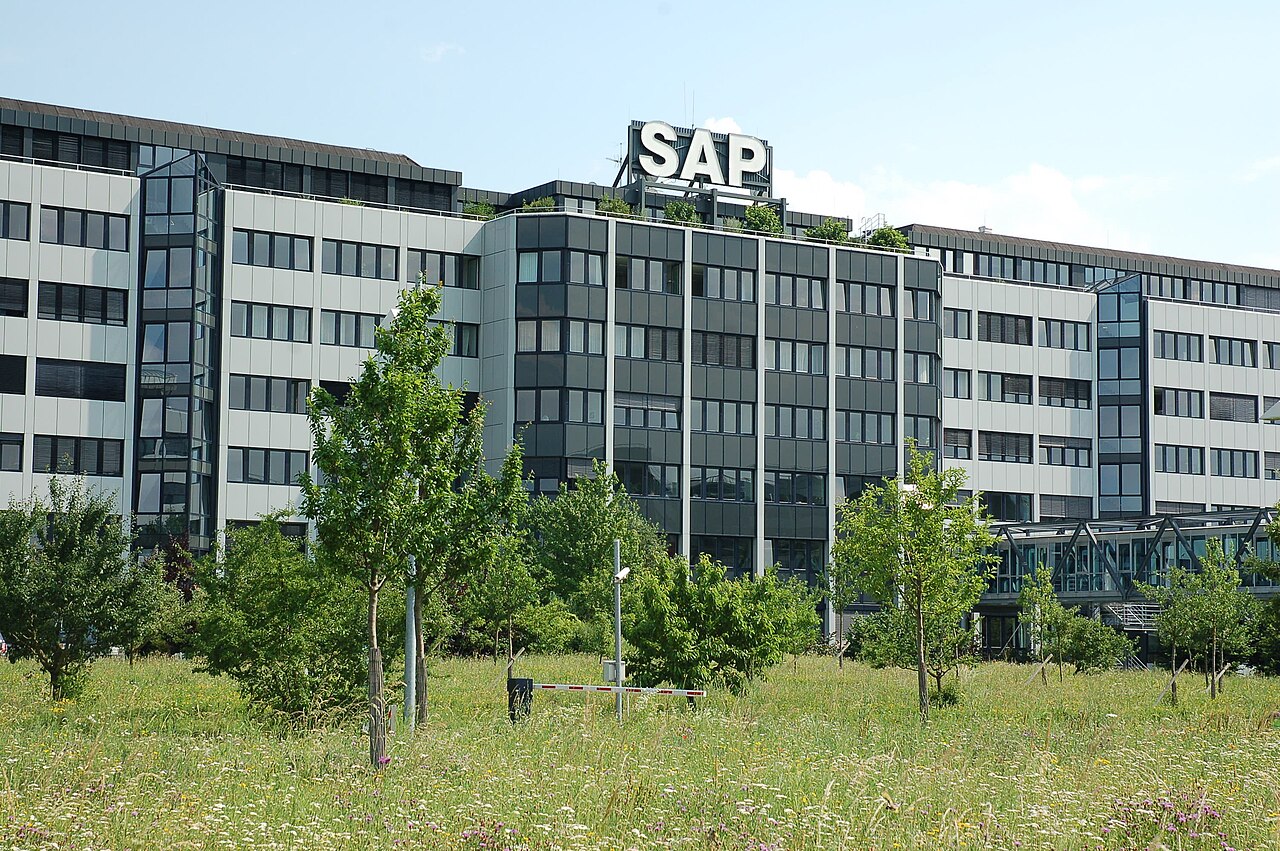
- Image: SAP AG headquarter Walldorf building 1.jpg by Vladislav Bezrukov (CC BY 2.0), via Wikimedia Commons