Peter Thiel and the PayPal Mafia
Abstract
Peter Thiel co-founded PayPal in 1998, sold it to eBay for $1.5 billion in 2002, and used his share of the proceeds to become one of the most consequential investors in Silicon Valley history, the first outside investor in Facebook, an early backer of LinkedIn, Yelp, Palantir, SpaceX, and Airbnb, and co-founder of Palantir Technologies (data analytics for government and enterprise). Thiel is also the author of Zero to One (2014), a contrarian business philosophy arguing that competition is for losers and that successful companies create monopolies. His intellectual positions (technologically optimistic, politically heterodox, institutionally skeptical) made him both an influential thinker and a polarizing figure, particularly after his public support for Donald Trump in 2016 represented an unusual political alignment for a prominent Silicon Valley figure.
PayPal: The Company and the Mafia
Confinity was founded in December 1998 by Thiel and Max Levchin to develop a cryptographic payment system for Palm Pilots. The Palm Pilot payment system failed; the team pivoted to email-based payments. The resulting product allowed anyone with an email address to send money to anyone else, a P2P payment system usable without a bank account or merchant terminal.
X.com, founded by Elon Musk in March 1999, was a competing online financial services company. Both companies were burning through users and money in a race for market share, using cash bonuses to attract new signups ($10 per new user, $10 per referral). In March 2000, Confinity and X.com merged. The merged company was initially called X.com before being renamed PayPal at employee insistence.
Thiel and Musk had an uneasy relationship from the start. In September 2000, while Musk was away on his honeymoon, the board replaced him as CEO with Thiel. The stated reason was disagreement over technical direction: Musk wanted to rebuild PayPal’s systems on Windows; Thiel and Levchin preferred Unix. The real reasons were also about personality and management style. Musk and Thiel have maintained a complex, sometimes hostile relationship ever since.
PayPal went public in February 2002 and was acquired by eBay in October 2002 for $1.5 billion in stock. The PayPal founders and early employees dispersed with money and networks that would make them among the most influential investors of the next decade:
- Elon Musk: Tesla, SpaceX
- Reid Hoffman: LinkedIn (co-founder)
- Jeremy Stoppelman and Russel Simmons: Yelp (co-founders)
- Steve Chen, Chad Hurley, Jawed Karim: YouTube (co-founders)
- David Sacks: Craft Ventures (investor), Yammer (founder)
- Keith Rabois: Square (executive), Founders Fund (partner)
- Roelof Botha: Sequoia Capital (partner)
This group became known as the “PayPal Mafia”, a network of former colleagues who invested in, founded, and advised each other’s subsequent ventures, creating a remarkable concentration of successful technology companies from a single company’s alumni.
Palantir: Data Analytics and Surveillance
In 2003, Thiel co-founded Palantir Technologies with Alex Karp, Joe Lonsdale, Stephen Cohen, and Nathan Gettings. The name came from the seeing stones in The Lord of the Rings. The company’s mission was to build software for analyzing large, complex datasets, initially focused on intelligence and law enforcement applications.
An early backer was the CIA’s venture capital arm, In-Q-Tel, which invested roughly $2 million around 2004–2005 and helped Palantir win its first government users. The company subsequently worked with the NSA, the FBI, the Department of Homeland Security, the US Army, and dozens of other government agencies. Its platforms, Gotham (government, intelligence, law enforcement) and Foundry (enterprise), integrated disparate data sources into unified analytical environments.
Palantir became one of the most controversial software companies in Silicon Valley. Its government work raised civil liberties concerns: systems used for tracking immigrants by ICE, pre-crime analytics for police departments, and surveillance tools for authoritarian governments. The company’s responses to criticism were generally dismissive. Thiel has argued that liberal democracy requires strong state power and intelligence capability, and that technology companies’ refusal to work with the US government while competing globally created a strategic disadvantage.
Palantir went public in September 2020 via a direct listing, with a valuation of approximately $22 billion. Its stock price was volatile; the company became consistently profitable in 2023. By 2025, Palantir was a major supplier to the US government and a growing enterprise software company, with revenues exceeding $3 billion annually.
The Facebook Investment and Venture Capital
Thiel invested $500,000 in Facebook in June 2004, receiving approximately 10.2% of the company, the first outside investment in Facebook. Mark Zuckerberg was 20 years old; Thiel was 36 and had sold PayPal two years earlier.
The investment returned approximately $1 billion when Facebook went public in 2012. More significantly, it established Thiel as one of the first serious investors to recognize that college social networks were building something of lasting value, at a moment when most observers were still dismissing them.
Founders Fund was established by Thiel, Ken Howery, and Luke Nosek in 2005. Its investment thesis was explicitly contrarian: Founders Fund would invest in companies doing things that seemed crazy: SpaceX (private rockets), Lyft (rides from strangers), Airbnb (strangers in your house), Stemcentrx (cancer treatments from stem cells), because consensus investments were already priced too high. The fund’s 2009 manifesto, “What Happened to the Future?”, argued that technology had stagnated while the financial industry absorbed talent that should have been building things.
Zero to One and the Monopoly Thesis
Thiel’s 2014 book Zero to One: Notes on Startups, or How to Build the Future (based on notes from a Stanford startup class) articulated a distinctive philosophy:
“Competition is for losers. If you want to create and capture lasting value, look to build a monopoly.”
The argument: competitive markets destroy profits (firms compete on price, margins approach zero, nobody makes money). Monopolies can charge above-market prices, invest in the future, and treat employees well. The goal of a startup should be to build a product so good, in a market so well-defended, that competition becomes irrelevant.
Thiel distinguished creative monopolies (Google’s search monopoly, Apple’s iPhone ecosystem) from rent-seeking monopolies (cable companies, government contractors), arguing that creative monopolies were produced by genuine innovation and were socially beneficial because they advanced technology and generated surplus profits that funded further innovation.
The book was widely read and influential, particularly among startup founders who found it gave intellectual justification for strategies that conventional competitive business analysis would caution against. Critics noted that Thiel’s framework provided limited guidance on how to build a monopoly versus how to benefit from one.
Politics and Heterodoxy
Thiel’s political views evolved through the 2000s from libertarianism into a more complex, sometimes difficult to categorize position. He wrote in 2009: “I no longer believe that freedom and democracy are compatible”, an argument about the incompatibility of financial democracy (government-controlled money) with economic freedom. He has invested in charter cities and alternative governance models as experiments in escaping what he considers the constraints of conventional democratic institutions. The exit movement and its neighbors are described in Silicon Valley Philosophies.
His 2016 public support for Donald Trump at the Republican National Convention was extraordinary in Silicon Valley terms: the tech industry was nearly uniformly Clinton-supporting, and Thiel’s endorsement and $1.25 million donation was a highly visible dissent. Thiel argued that Trump’s disruption of establishment politics was analogous to his investment thesis, betting on unconventional approaches that the consensus considered crazy.
Thiel’s funding of the Hulk Hogan lawsuit against Gawker (which resulted in a $140 million verdict that bankrupted Gawker Media in 2016) was defended by Thiel as a matter of principle (Gawker had outed him as gay in 2007) and criticized as a demonstration that wealthy individuals could weaponize litigation to destroy publications they disliked, with implications for press freedom.
📚 Sources
- Thiel, Peter and Blake Masters: Zero to One: Notes on Startups, or How to Build the Future (2014), Crown Business
- Chafkin, Max: The Contrarian: Peter Thiel and Silicon Valley’s Pursuit of Power (2021), Penguin Press
- Vance, Ashlee: Elon Musk: Tesla, SpaceX, and the Quest for a Fantastic Future (2015) — PayPal context
- Kirkpatrick, David: The Facebook Effect (2010) — Thiel investment context
- Palantir Technologies: SEC S-1 filing, August 2020
- Masters, Blake: “Peter Thiel’s CS183: Startup” — class notes, Stanford University, 2012
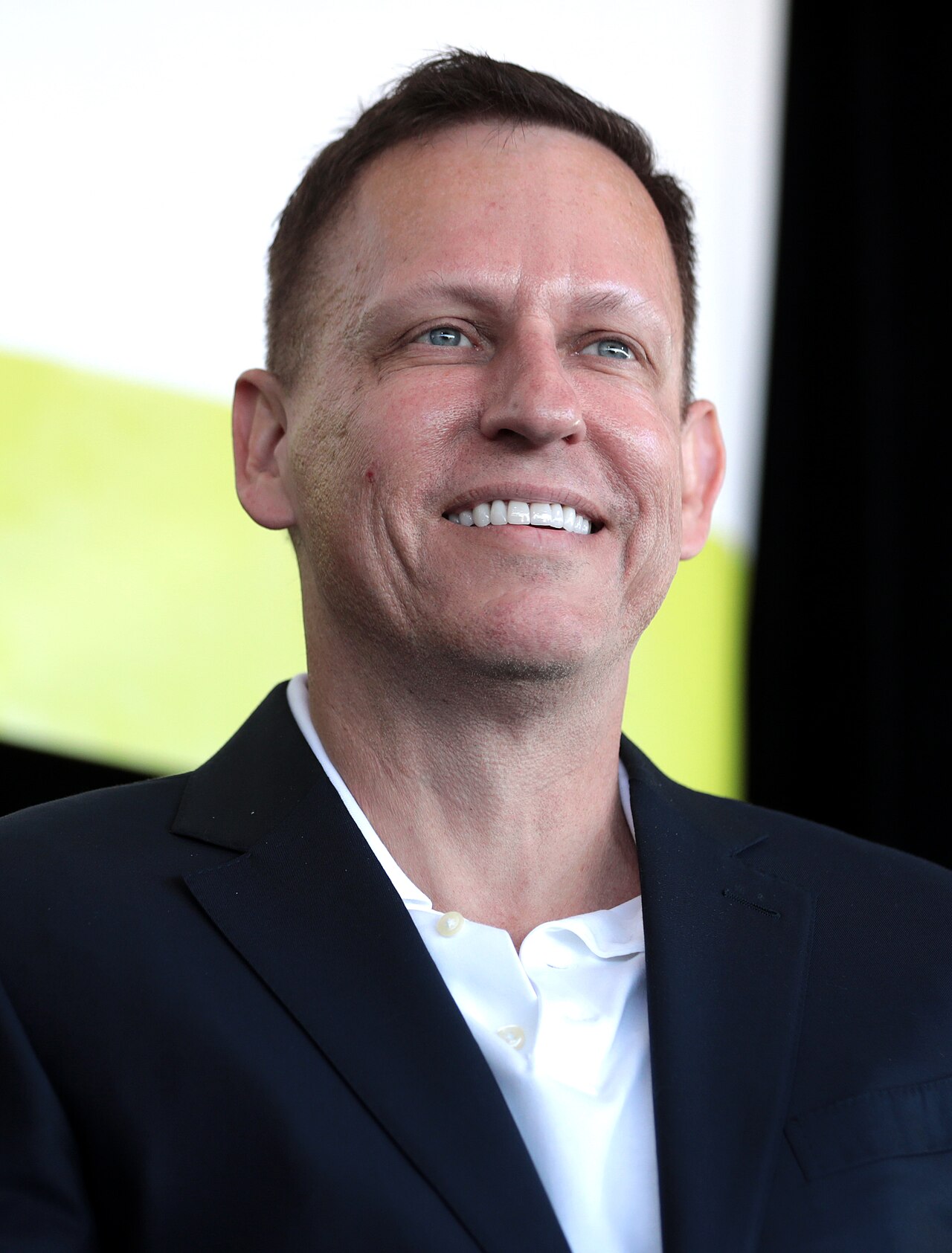
- Image: Peter Thiel by Gage Skidmore.jpg by Gage Skidmore (CC BY-SA 3.0), via Wikimedia Commons