Jack Tramiel and Commodore
Abstract
Jack Tramiel was a Holocaust survivor who built Commodore International into one of the world’s most significant personal computer companies on a philosophy of relentless cost reduction: “computers for the masses, not the classes.” The Commodore 64, released in 1982, became the best-selling single desktop computer model in history, somewhere between 12.5 and 17 million units depending on whose count you take. At $595, roughly half the price of competing machines, it brought computing to working-class and middle-class homes that could not afford an Apple II or an IBM PC. Tramiel walked out of Commodore in January 1984 after a final clash with the man who financed it; within months he had bought Atari and started a second personal computing dynasty.
Łódź to Long Island
Idek Trzmiel (some sources give Jacek) was born on December 13, 1928, in Łódź, Poland, into a Jewish family. When the Germans occupied Poland in 1939, he was ten years old. He worked in a garment factory in the Łódź ghetto, was deported to Auschwitz with his family, and was sent with his father to the Ahlem labour camp near Hanover, where his father died. Soldiers of the US 84th Infantry Division liberated the camp in April 1945; Tramiel was sixteen.
He emigrated to the United States in November 1947 and joined the US Army, where he learned to repair office machines, typewriters among them. In 1953, while driving a taxi in New York, he bought an office-machine repair shop in the Bronx, and in 1954 he founded Commodore in Toronto, Canada, beginning with typewriters, then moving to adding machines and, in the 1970s, electronic calculators.
Commodore’s business in the early 1970s was importing Japanese calculators and selling them in North America. When Texas Instruments and Bowmar began manufacturing calculators at prices that undercut importers, Commodore was nearly destroyed. Tramiel responded by acquiring MOS Technology in 1976, the semiconductor company that had designed the 6502 microprocessor (used in the Apple I, Apple II, and the Atari 2600), giving Commodore control of its own chip supply and the ability to design hardware around components it manufactured itself.
The PET, VIC-20, and the Philosophy of Price
Commodore entered the personal computer market with the PET (Personal Electronic Transactor) in 1977, the same year as the Apple II and the TRS-80, the three machines that defined the personal computer market’s first generation. It came from MOS: the 6502’s designer Chuck Peddle had convinced Tramiel in 1976 that the future lay in microcomputers, became Commodore’s chief engineer after the takeover, and showed a PET prototype in January 1977; shipments began that October. The PET was a complete unit: keyboard, monitor, and cassette storage in a single case, with 4 KB of RAM at first and BASIC licensed from Microsoft. It was popular in Europe and with educational institutions.
Tramiel’s guiding principle was price. His manufacturing philosophy, distilled to the phrase “computers for the masses, not the classes,” held that the computer business would be won by whoever drove prices low enough to reach the mass market rather than just affluent early adopters. This was not a moral position; it was a competitive strategy: the company that got to mass-market prices first would dominate volume, and volume would make further cost reduction possible.
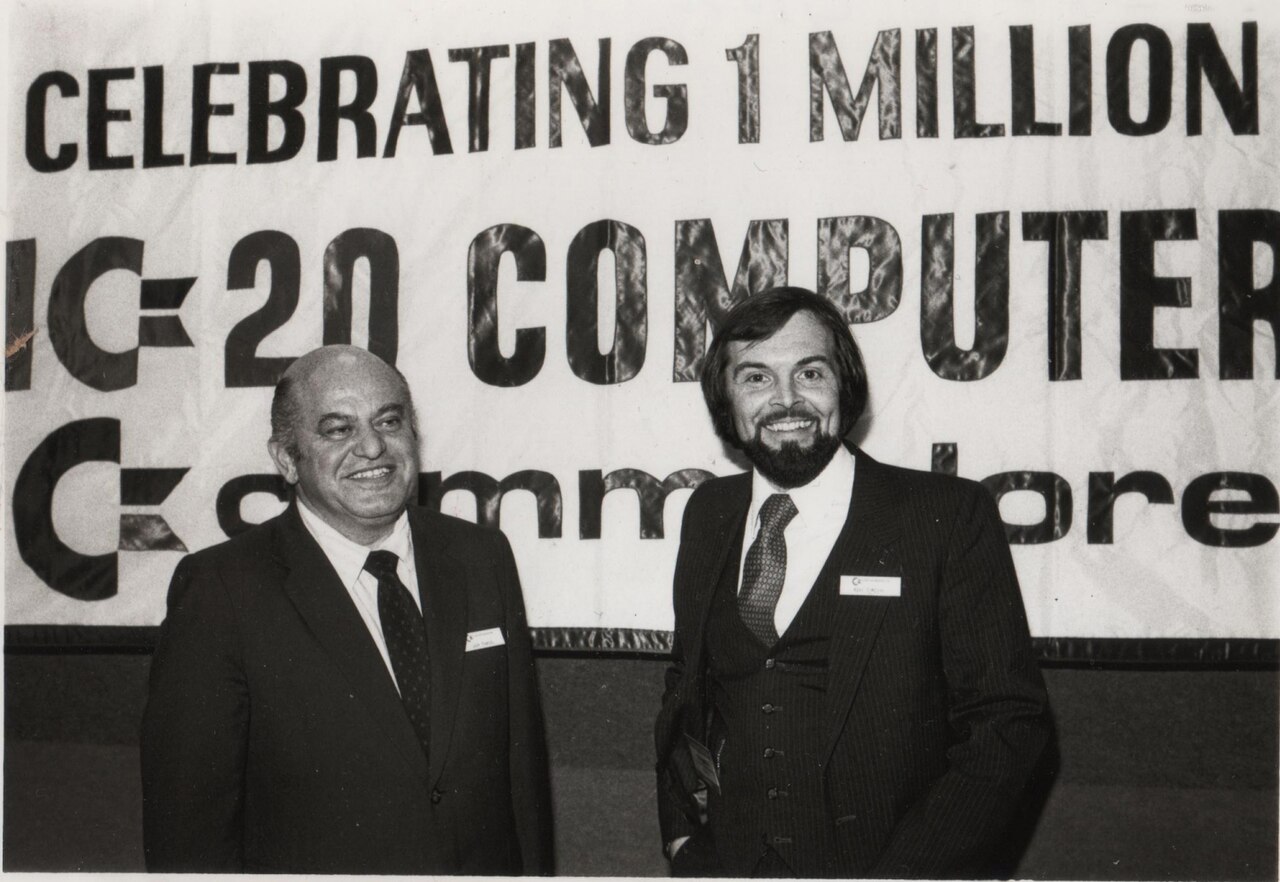
The VIC-20 began at a meeting near London on 15 April 1980, where Tramiel, afraid that Japanese makers would take the home market, demanded a colour computer under $300 and ended the argument with “The Japanese are coming, so we will become the Japanese.” Commodore already had the colour chip, the MOS 6560 VIC; Michael Tomczyk ran the project, and Commodore’s Japanese division gave the machine its rounded case. It went on sale in Japan as the VIC-1001 in October 1980, was shown at CES in Las Vegas in January 1981, reached US shops in May 1981 at $299 with William Shatner in the TV advertising, and arrived in West Germany that October as the VC-20 at 899 DM. It was the first computer to sell one million units, and about 2.5 million had been sold when production ended in 1985. Its successor, the Commodore 64 (1982), began as a pair of chips: from January 1981 a team at the former MOS plant in Norristown under Albert Charpentier designed the VIC-II and SID for a games console, and when they were ready in November 1981 Tramiel ordered a home computer built around them instead, in the VIC-20’s case. It was shown at CES on 7 to 10 January 1982 and reached US shops in August. It pushed the technology further: a 6510 microprocessor (a 6502 derivative), the SID (Sound Interface Device) sound chip (one of the most sophisticated consumer audio chips of the era) and the VIC-II graphics chip, all manufactured by Commodore’s MOS Technology subsidiary. At launch the C64 sold for $595. It cost about $135 to make, so Tramiel could cut the price in 1983, to $300 by June, with some stores selling it for $199. West Germany got it in January 1983 at 1,495 DM; by November it cost 675 DM, by 1984 the Braunschweig plant was turning out 4,000 a day, and Commodore had sold a million in Germany by 1986.
The Commodore 64
The Commodore 64’s specifications were extraordinary for a mass-market consumer computer in 1982:
- 64 KB of RAM (the name was descriptive)
- The MOS 6581 SID chip: a synthesizer on a chip, with three independent oscillators offering programmable waveforms (sawtooth, pulse, triangle, noise), ring modulation, a filter, and ADSR envelopes. Composers such as Rob Hubbard, Martin Galway and Chris Hülsbeck defined its sound, a lineage of what is now called chiptune
- The VIC-II chip: hardware sprites (moveable objects), smooth scrolling, 16 colors, 320×200 or 160×200 resolution modes
- A keyboard with function keys and Commodore-specific graphics characters (no numeric keypad)
- CBM-DOS for disk operations
The C64 dominated the home computer market in the mid-1980s; sales peaked in 1984 at about 2.6 million units. Its installed base of games (thousands of titles, many converted from or simultaneous with arcade versions) made it the platform of choice for gaming in Europe and the United States. Programming books, magazines, and user groups proliferated.
The total is disputed. Commodore’s own sales records support about 12.5 million; independent estimates reach 17 million, and claims of 22 and 30 million have also circulated. Guinness World Records lists it as the best-selling desktop computer model of all time.
The Boardroom Coup and Atari
Tramiel’s relationship with Irving Gould, Commodore’s chairman and financier, was permanently adversarial. The Canadian businessman had bought 17 percent of the company in 1962 and controlled it from 1966. Tramiel ran operations; Gould ran finances and usually let Tramiel have his way.
The conflict escalated over the winter of 1983–1984, after a price war that Tramiel had fought as a personal battle against Texas Instruments, which left the home computer market in October 1983. The timing made the break stark: on January 10, 1984, at CES, Commodore announced record results, three million computers sold in 1983, over a billion dollars in revenue, and a C64 market share roughly three times that of the Apple II. Three days later, Tramiel left a board meeting before it ended and never came back; he resigned, or was forced out, depending on whose account one accepts. He walked out of Commodore and, within months, negotiated to buy the Consumer Electronics Division of Atari from Warner Communications, which had taken catastrophic losses in the 1983 video game crash and wanted to exit the market.
In July 1984 Tramiel’s new company, Tramel Technology, bought Atari’s consumer division and renamed it Atari Corporation. He immediately cut costs, fired most of the staff, and brought in his sons and former Commodore executives to run the company: Sam Tramiel became Atari’s president and ran it until a heart attack in 1995 put Jack briefly back in charge, while Leonard Tramiel oversaw software development. The result was the Atari ST (1985), a machine using the Motorola 68000 processor (the same chip as the Apple Macintosh), with a graphical user interface, a built-in floppy disk drive, and MIDI ports. The ST was priced at $799 for the 520ST with 512 KB of RAM, again, dramatically cheaper than comparable machines.
The ST competed directly with the Commodore Amiga (1985), which used a different 68000-based architecture with hardware-assisted graphics and audio. The war between the Atari ST and the Commodore Amiga (bitter, tribal, conducted through enthusiast magazines and playground arguments) was one of the defining cultural conflicts of late-1980s home computing in Europe. Tramiel was now fighting the company he had founded.
Dead End: The Commodore and Atari Declines
Commodore continued without Tramiel, acquiring Amiga Corporation in 1984, outbidding Tramiel’s own Atari, which had loaned Amiga money while courting the same technology, and prompting a Tramiel lawsuit, then releasing the Amiga and expanding into the 16-bit era. Without Tramiel’s cost discipline and strategic focus, Commodore struggled to compete against the IBM PC clone market and Apple. It filed for bankruptcy in April 1994.
Atari under Tramiel extended through the late ST series, the TT030 workstation, and the Atari Falcon (1992), technically innovative machines that arrived too late and were priced too high to compete against the now-dominant IBM PC clone ecosystem. In 1996 Atari merged into the disk-drive maker JTS.
Jack Tramiel died of heart failure on April 8, 2012, in Stanford, California, at age eighty-three. He had lived in Monte Sereno.
📚 Sources
-
Heinz Nixdorf MuseumsForum blog, “Die Computer des Chuck Peddle” (2 June 2017) (Peddle and the PET, the January 1977 prototype, October 1977 shipments)
-
Heinz Nixdorf MuseumsForum blog, “Commodore VC-20 – der erste „Brotkasten“” (8 January 2021) (the April 1980 meeting and Tramiel’s quote, VIC-1001, CES 1981, prices, 2.5 million sold)
-
Heinz Nixdorf MuseumsForum blog, “Das war der Commodore 64” (4 August 2022) (Charpentier’s chip team, CES 1982, $135 cost, German prices and Braunschweig output)
-
Bagnall, Brian: Commodore: A Company on the Edge (2010), Variant Press
-
Atari Corporation — Wikipedia (Sam Tramiel’s presidency, 1995 heart attack, 1996 JTS merger)
-
Jimmy Maher: The Future Was Here: The Commodore Amiga (2012) — MIT Press
-
Image: Commodore Founder Jack Tramiel and VIC20 Product Manager Michael Tomczyk, 1982 by Michael Tomczyk (CC BY-SA 4.0), via Wikimedia Commons