Tommy Flowers and Colossus
Abstract
Tommy Flowers was a Post Office engineer who built Colossus (the world’s first large-scale programmable electronic computer) for Bletchley Park in 1943 to break the Lorenz cipher used by the German high command. He used 1,500 vacuum tubes when everyone told him vacuum tubes were too unreliable to work at that scale. He was right and they were wrong. After the war, his work was classified for thirty years. While Flowers lived in relative obscurity, ENIAC was celebrated as the first electronic computer, and when Flowers finally told his story in the 1970s, computing history had to be substantially revised.
The Engineer from Poplar
Thomas Harold Flowers was born on December 22, 1905, in Poplar, east London, a working-class neighborhood of dockworkers and small tradesmen. He served an apprenticeship in mechanical engineering at the Royal Arsenal at Woolwich and earned a degree in electrical engineering through evening classes at the University of London. In 1926 he joined the telecommunications branch of the General Post Office.
In 1930, Flowers joined the Post Office Research Station at Dollis Hill in north London, where he worked on telephone exchange technology. The Post Office ran Britain’s telephone network, and its research laboratory was one of the world’s most advanced centers for electronics. By the late 1930s, Flowers was working on electronic telephone exchanges, systems that used vacuum tubes for switching, at a time when the engineering consensus held that vacuum tubes were inherently unreliable for large-scale applications.
Flowers’s experience contradicted this consensus. He discovered that vacuum tube failure was mostly caused by thermal stress during power cycling, turning tubes on and off. If tubes were left permanently powered, they ran for years without failure. This observation, counterintuitive to those who understood vacuum tubes primarily as laboratory devices, was the key insight that made Colossus possible.
Bletchley Park and the Lorenz Cipher
Bletchley Park was Britain’s wartime code-breaking center, staffed with mathematicians, linguists, chess players, and crossword solvers (anyone with evidence of puzzle-solving ability. The center’s best-known work was breaking Enigma) the cipher machine used by German Army and Navy forces, using electromechanical Bombe machines designed by Alan Turing.
But there was a second, harder problem: the Lorenz SZ40/42 cipher machine, used for communications between Hitler and his senior commanders. While Enigma produced output that looked like random letters, the Lorenz machine used a teletype-compatible bitstream encoding and a complex system of twelve rotors operating in concert. Breaking it required analyzing streams of bits (hundreds of thousands of bits per message) and the volume was beyond what the Bombes could address.
The mathematical framework for attacking Lorenz was developed by Bill Tutte (who reconstructed the machine’s logical structure from a single operator error, without ever seeing the physical device: on August 30, 1941 a German operator in Athens sent the same long message twice on the same key setting, abbreviating the second version, which let John Tiltman recover the key stream and Tutte deduce the twelve wheels behind it) and Max Newman, who recognized that the attack required high-speed comparison of bit streams and that a machine was needed.
The first attempt was Heath Robinson (in service from June 1943), a machine using paper tape loops to represent both the ciphertext and the pattern wheel settings. It worked, but the paper tapes were fragile, the synchronization unreliable, and the speed insufficient.
Building Colossus Against Expert Opinion
Max Newman approached Tommy Flowers in February 1943 with the Heath Robinson problem. Flowers proposed a radical solution: eliminate one of the paper tape loops by implementing the Lorenz wheel patterns electronically, in vacuum tubes. The machine would read ciphertext from one tape at high speed and compare it electronically against simulated wheel patterns stored in tube circuits.
The proposal required approximately 1,500 vacuum tubes, an order of magnitude more than any machine then in existence. The expert consensus at Bletchley was that this was technically impossible: 1,500 vacuum tubes would fail constantly, the machine would never work reliably, and the project would be a waste of scarce wartime resources.
Bletchley greeted the proposal with, in the standard account, great scepticism, and did not commission it. Flowers was working at Dollis Hill, not Bletchley, and had no champion there.
He built it anyway. W. Gordon Radley, director of the Post Office Research Station, backed him, and Flowers built Colossus at Dollis Hill with Post Office resources and staff. When materials were not otherwise available, he paid for some of them out of his own pocket.
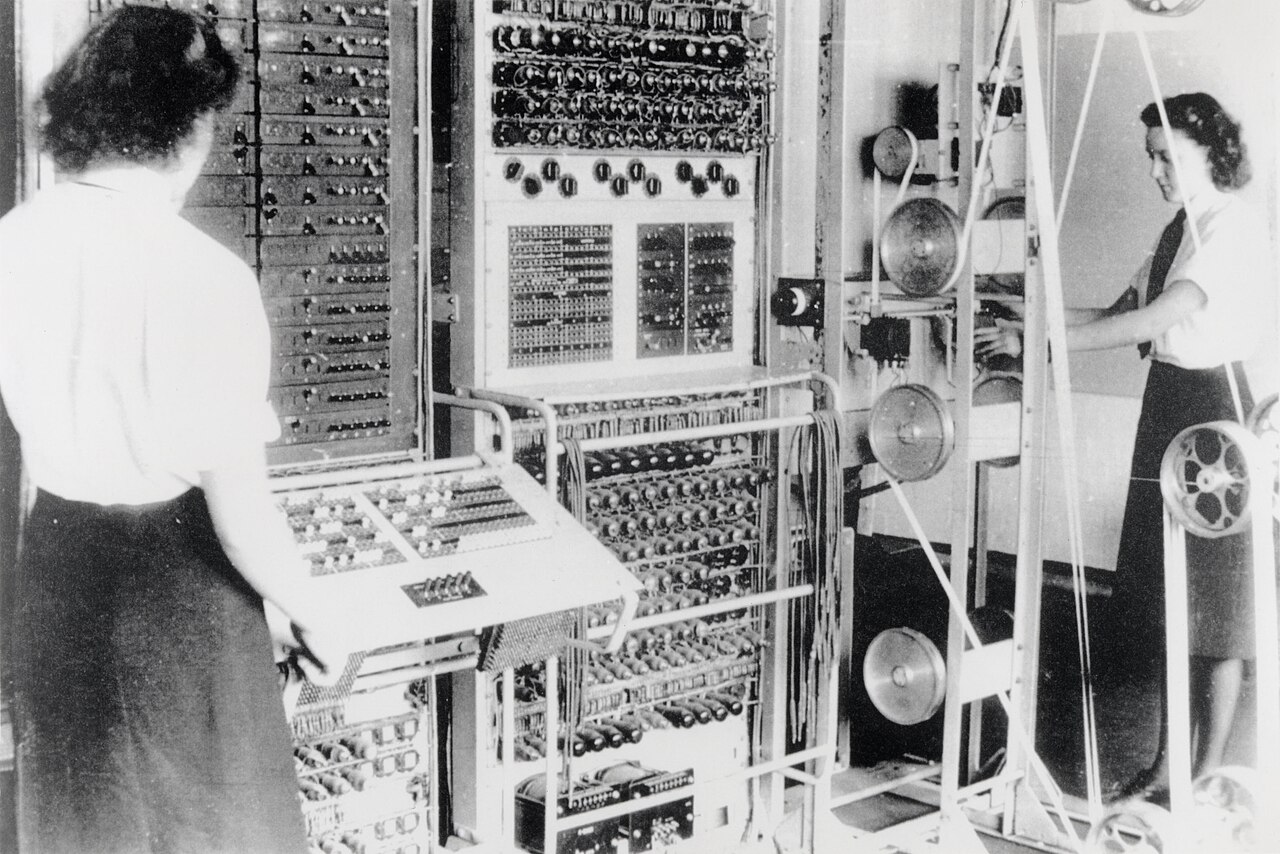
The first machine ran at Dollis Hill in December 1943, was taken apart, and as Colossus Mark 1 arrived at Bletchley Park on 18 January 1944 and attacked its first message on 5 February. The machine used about 1,600 vacuum tubes, read paper tape at 5,000 characters per second, and could perform Boolean logic operations at electronic speed on the comparison results. It did not break the Lorenz cipher directly (the code-breaking logic was implemented on its plugboard by human operators) but it performed the exhaustive statistical analysis that made breaking possible, in hours rather than weeks.
Colossus Mark 2, with 2,400 tubes and five parallel processing streams, was operational by June 1, 1944, three days before D-Day. By the war’s end, ten Colossus machines were running at Bletchley, processing intercepted German high-command communications. How much the Lorenz decrypts, part of the intelligence called Ultra, shortened the war cannot be measured; the official historian F. H. Hinsley put the effect of Ultra as a whole at two years or more.
Info
Colossus was not a general-purpose computer. It could not be programmed to perform arbitrary computations, its Boolean logic operations were fixed in hardware and its plugboard configuration determined what comparison it performed on the tape data. It had no stored program, no arithmetic unit for general calculation, and no means of branching on computed results in the modern sense. The question of whether Colossus counts as “the first computer” depends on definitions that historians continue to debate. What is not debatable: it was the first large-scale electronic digital device capable of conditional operations, operating at electronic speeds, that processed real-world data to produce actionable results.
The Thirty-Year Silence
When the war ended, eight of the ten machines were broken up and their parts returned to the Post Office; the surviving two went to GCHQ in 1946, where one was dismantled in 1959 and the other in the 1960s. Everyone who had built or operated them was sworn to secrecy under the Official Secrets Act. The reasons were strategic: Britain wanted potential adversaries to believe the Lorenz cipher had been broken by other means, and the ability to read ciphertext that others believed secure was a permanent intelligence advantage worth protecting.
Flowers was not permitted to speak about Colossus or claim credit for his work. After the war the government gave him an award of £1,000, which did not cover what he had spent of his own money; he shared much of it with his staff. When he tried to apply his wartime experience to postwar projects, he could not describe what he had done.
After the war Flowers wanted to build a general-purpose computer, but the Bank of England turned down his request for a loan; bound by the Official Secrets Act, he could not tell the bank that he had already built such machines. He went back to telephone exchanges, headed the switching division at Dollis Hill, worked on ERNIE, the Premium Bond number generator, and from 1964 until 1969 ran advanced development at Standard Telephones and Cables.
Meanwhile, ENIAC (completed at the University of Pennsylvania in 1945, a year after Colossus Mark 1) was publicly celebrated as the world’s first electronic digital computer. Flowers and his colleagues watched in silence.
The secrecy began to lift in the 1970s. The computer scientist Brian Randell pieced together what he was allowed to publish in a 1972 paper and a 1976 conference talk, and the BBC series The Secret War (1977) put Flowers on screen. F.H. Hinsley’s official history of British intelligence acknowledged Colossus’s existence in 1981. Flowers spoke publicly for the first time in the late 1970s. A replica of Colossus Mark 2, begun in 1993 by the engineer Tony Sale and built by volunteers at The National Museum of Computing at Bletchley Park, was completed in 2007 and is operational. It was inaugurated on November 15–16, 2007 with a “Cipher Event”: the Heinz Nixdorf MuseumsForum in Paderborn transmitted messages enciphered on a real Lorenz SZ42, and the rebuilt Colossus broke one in 3 hours 35 minutes. A radio amateur in Bonn, Joachim Schüth, was faster: his own program, written in Ada, decrypted the message on a laptop in under a minute. After Sale’s death in 2011 the Computer Conservation Society named a biennial award for computer restoration after him. In January 2024 GCHQ released photographs of a Colossus still in existence in 1963.
Legacy
Tommy Flowers died on October 28, 1998, at age ninety-two, having lived long enough to receive some recognition: an MBE (Member of the Order of the British Empire, 1943, secret), an honorary Doctor of Science from Newcastle University (1973), a blue plaque (2023) at the former Post Office Research Station, and the recognition of historians who revised computing’s canonical narrative when the Colossus story emerged.
Max Newman, who had brought Flowers the problem and whose section ran the machines, moved to the University of Manchester in 1945, obtained the Royal Society grant that funded its Computing Machine Laboratory, and in 1948 recruited Alan Turing there, a direct line from Colossus to the Manchester Baby. Computing stayed in the Newman family: his son William Newman co-wrote Principles of Interactive Computer Graphics (1973) with Robert Sproull, the standard graphics textbook of its decade, and spent the late 1970s at Xerox PARC working on interactive systems.
Colossus showed that a machine with thousands of valves could run reliably if the valves were kept powered on. The ENIAC team in Philadelphia, which knew nothing of Colossus, reached the same result independently, running its 17,468 tubes well below their rated values.
📚 Sources
- Heinz Nixdorf MuseumsForum blog, “80 Jahre Colossus” (2 February 2024)
- Heinz Nixdorf MuseumsForum blog, “Lorenz gegen Colossus” (15 November 2022)
- Heinz Nixdorf MuseumsForum blog, “Tony Sale und sein Preis” (17 November 2016)
- Wikipedia: Tommy Flowers
- Wikipedia: Ultra (cryptography) (Hinsley’s estimate of Ultra’s effect on the war’s length)
- Wikipedia: Colossus computer
- The National Museum of Computing: Colossus — tnmoc.org
- World War II cryptography — Wikipedia
- B. Jack Copeland (ed.): Colossus: The Secrets of Bletchley Park’s Codebreaking Computers (2006) — Oxford University Press
- Flowers, Thomas H.: “The Design of Colossus” (foreword by Howard Campaigne) — Annals of the History of Computing 5(3): 239–252 (1983)
- Bletchley Park — Wikipedia
- Max Newman — Wikipedia (Colossus, the Manchester chair, and the Royal Society Computing Machine Laboratory)
- William Newman — Wikipedia (son; Principles of Interactive Computer Graphics, Xerox PARC)