Bruce Schneier: The Public Intellectual of Security
Abstract
Bruce Schneier arrived in computer security in the early 1990s and spent three decades doing something almost no one else in the field managed: translating the technically complex and politically sensitive world of cryptography and security into language that legislators, executives, journalists, and ordinary citizens could understand and use. His 1994 book Applied Cryptography taught a generation of developers to implement encryption correctly; his subsequent career as essayist, critic, and activist made him the security field’s most visible public voice. Where other cryptographers published papers, Schneier published op-eds. Where others consulted quietly, he testified loudly.
From the NSA to Applied Cryptography
Bruce Schneier was born in New York in 1963 and studied physics at the University of Rochester before completing a master’s degree in computer science at American University. His early career included work for the U.S. Department of Defense, not at the NSA directly, but adjacent to it, on classified communications systems in the early 1980s. This gave him a rare perspective: he understood how the government approached cryptography, which systems it trusted and which it did not, and how wide the gap was between what was known inside classified programs and what was available to the civilian world.
The civilian cryptographic literature of the late 1980s was thin and technically demanding. Diffie and Hellman’s 1976 paper, the RSA algorithm, DES; these were accessible to researchers but not to working software developers who needed to implement encryption in products. Developers who tried to build secure systems frequently made catastrophic mistakes: implementing textbook RSA without padding schemes that made it actually secure, using block ciphers in modes that destroyed their security properties, inventing their own random number generators with disastrous results.
Schneier’s response was Applied Cryptography (1994), a 784-page technical reference that described the algorithms, protocols, and implementation considerations that any developer building a cryptographic system needed to know. It was not a theoretical text; it was a practitioner’s manual. It covered symmetric and asymmetric ciphers, hash functions, digital signatures, key management, and random number generation, and for each topic, it described not just the algorithms but the attacks, the failure modes, and the implementation traps. Within the security community, it became the standard reference almost immediately. The second edition alone sold more than 150,000 copies, making it one of the best-selling cryptography books ever published.
The book’s most important contribution may have been making developers stop inventing their own cryptography. Before Applied Cryptography, a developer who needed encryption would often reach for a home-grown cipher, something they had invented, or found in a book, and had not analyzed for cryptographic weaknesses. After Schneier’s book, there was no excuse: the well-analyzed, peer-reviewed algorithms were documented in plain English, and the book was explicit about why amateur cryptography should never be trusted.
Blowfish and Twofish: The Algorithm Designer
While teaching others to use existing cryptography, Schneier was also designing new algorithms. In 1993, he published Blowfish, a symmetric block cipher intended as a free, unpatented alternative to DES. Blowfish was designed for software implementation, was fast on 32-bit processors, and had no known cryptographic weaknesses in its standard form. It was widely adopted in the late 1990s for applications ranging from password hashing to file encryption, and derivatives of it (particularly bcrypt) remain standard for password storage decades later.
In 1998, Schneier and a team of collaborators (John Kelsey, Doug Whiting, David Wagner, Chris Hall, and Niels Ferguson) submitted Twofish to the AES competition, the NIST process to select a replacement for DES. Twofish made it to the final round, competing against four other algorithms. The winner was Rijndael (which became AES), but Twofish was a strong contender and the competition’s evaluation noted no significant weaknesses. Schneier’s team published their analysis not just of their own algorithm but of all the finalists, demonstrating a transparency about cryptographic evaluation that influenced how algorithm competitions have been conducted since.
Blowfish and Twofish demonstrate something distinctive about Schneier’s approach: he was not primarily interested in priority or commercial advantage. Both algorithms were released without patents, freely implementable by anyone. The goal was better security for everyone, not intellectual property.
Counterpane and the Security Business
In 1999, Schneier co-founded Counterpane Internet Security with Tom Rowley, who became its first CEO while Schneier served as CTO, offering managed security monitoring, the then-novel idea that organizations could outsource the continuous monitoring of their network traffic to specialists. Counterpane was a credible business: it attracted enterprise clients who needed security monitoring but lacked the staff and expertise to do it themselves. British Telecom acquired Counterpane in 2006, and Schneier joined BT as Chief Security Technology Officer, a role he held until 2013.
The consulting and business experience deepened his understanding of how security actually worked (or failed) in organizational settings. The technical cryptographic vulnerabilities he had described in Applied Cryptography were, he came to understand, rarely the proximate cause of real-world security failures. The real causes were economic, organizational, and human: companies that understood the risks but could not justify the cost of addressing them, employees who circumvented security controls to get work done, incentive structures that rewarded shipping products over securing them.
Schneier’s Law and Security Theater
Schneier’s Law, a name coined by writer Cory Doctorow in a 2004 speech, drawn from an idea Schneier had put in print in a 1998 Crypto-Gram essay (“Memo to the Amateur Cipher Designer”), states: “Anyone, from the most clueless amateur to the best cryptographer, can create an algorithm that he himself can’t break.” The law is a warning about the limits of individual cryptographic intuition: the fact that you cannot find a flaw in your design is not evidence that the design is sound. It is evidence only that you have looked at it from your own perspective, with your own blind spots. The history of cryptography is littered with “unbreakable” ciphers that fell to attacks their designers had not imagined.
The law applies beyond cryptography. Schneier extended it to the broader observation that security theater (security measures that feel protective but provide little actual protection) is the dominant failure mode of security policy. The term became particularly associated with post-September 11 airport security measures: rules requiring travelers to remove shoes (a response to a single 2001 incident), restrictions on liquids (a response to a 2006 plot), random additional screening procedures that could be trivially gamed by a sophisticated attacker. Schneier argued, in Beyond Fear (2003), that these measures optimized for the appearance of security rather than its substance, and that the appearance-substance gap was itself a security risk because it consumed resources and attention that could be applied to measures with actual effect.
The argument was politically unpopular; it could be (and was) characterized as soft on terrorism, but it was analytically rigorous. Schneier applied cost-benefit analysis to security measures: what is the probability of the threat? What is the cost if it occurs? What does the countermeasure cost? What is the reduction in probability the countermeasure actually achieves? Most security theater failed this analysis badly: extremely expensive countermeasures providing extremely small reductions in extremely rare risks.
The Countermeasure Trap
Schneier’s framework identified a systematic bias in security decision-making: after any publicized attack, the pressure to respond is overwhelming, and responding to the specific attack that just happened is far easier than addressing the class of vulnerabilities of which it is an instance. Shoe checks at airports are a response to Richard Reid’s shoe bomb; they do not address the category of “innovative concealment methods” in any general way. A rational security program asks what broad capabilities an adversary has and addresses those; security theater asks what the last attacker did and prevents exactly that.
The Surveillance State Critic
Schneier’s career shifted after September 11. The expansion of government surveillance capacity, the PATRIOT Act, the NSA’s warrantless wiretapping program (revealed publicly in 2005), and the full scope of what Edward Snowden disclosed in 2013, turned him from a security technologist into a political critic of the security state.
His books from this period, Secrets and Lies (2000), Liars and Outliers (2012), Data and Goliath (2015), and Click Here to Kill Everybody (2018), engaged with questions of power, trust, and the relationship between surveillance and social control. Data and Goliath was the most direct: it argued that the mass collection of personal data by both governments and corporations represented a fundamental threat to privacy as a social good, and that the risks were systematically underweighted in public discussion because surveillance’s costs fell on diffuse populations while its benefits accrued to concentrated actors.
The Snowden revelations in June 2013 confirmed many of the arguments Schneier had been making about government surveillance for a decade. He worked directly with journalist Glenn Greenwald to help interpret the technical significance of the NSA documents, and his public analysis (in the Atlantic, the Guardian, and on his blog) helped translate what were highly technical programs into terms that non-technical audiences could evaluate politically.
His position on surveillance was not pacifist: he acknowledged that intelligence agencies had legitimate functions and that some surveillance was justified. His argument was about proportionality, oversight, and the institutional incentives that led agencies to collect more data than they could analyze on the theory that storage was cheap and you never knew what might be useful. A system designed to store everything has no mechanism for deciding what matters.
Crypto-Gram and the Newsletter Tradition
In 1998, Schneier began publishing Crypto-Gram, a free monthly email newsletter covering security news, analysis, and commentary. It was one of the first security newsletters in the modern sense, predating blogs, RSS feeds, and the subsequent explosion of security media. By the early 2000s it had hundreds of thousands of subscribers; it remains in publication as of this writing.
Crypto-Gram established a voice that became distinctively Schneier’s: technically rigorous but accessible, skeptical of vendor claims and government assurances, willing to take clear positions rather than hedge indefinitely. The newsletter made him the first person in the security field who was genuinely famous outside it, cited in congressional testimony, quoted in newspapers, invited onto television panels alongside generals and politicians.
His blog, launched in 2004, extended the newsletter format to shorter, more frequent commentary. The combination of Crypto-Gram and the blog created something unusual in the security world: an intellectual presence with a wide public audience, covering not just technical vulnerabilities but the political economy of security, who benefits from which security measures, whose interests are served by particular policy choices, and how the security industry’s incentives shape the security it produces.
Harvard and the Security Policy World
Schneier joined the Harvard Kennedy School’s Belfer Center for Science and International Affairs as a Fellow, and later became a Fellow at the Berkman Klein Center for Internet & Society at Harvard Law School. These affiliations placed him in direct conversation with policymakers, legal scholars, and national security experts, giving his technical arguments audiences that pure technologists rarely reach.
His work on the intersection of technology and public policy addressed questions that neither the technical community nor the policy community had fully engaged: How should governments regulate critical infrastructure security? What obligations do software vendors have for the security of their products? How should international norms for offensive cyber operations be developed? These were questions that required both technical understanding and policy fluency, a combination that remained rare.
His criticism of AI security hype (the tendency to claim that artificial intelligence would either solve computer security or make it apocalyptically worse) has been consistent: AI provides incremental improvements to both attack and defense, but the fundamental economic and incentive problems that produce insecure systems are not altered by improvements in pattern recognition. Security is not primarily a technical problem; it is a problem of human and organizational behavior, and machine learning cannot fix organizational incentives.
Dead End: The Patch-and-Pray Paradigm
Schneier identified what he called the fundamental failure mode of the software industry: the patch-and-pray paradigm, in which software is shipped with known vulnerabilities, security updates are issued reactively as vulnerabilities are discovered and exploited, and users are expected to apply patches promptly, a process that, empirically, most users and many organizations do not actually follow.
The patch-and-pray model is economically rational for software vendors: shipping faster is more profitable than shipping securely, the costs of insecurity fall primarily on users rather than vendors, and liability for software vulnerabilities is (in most jurisdictions) effectively zero. Schneier argued that this liability structure was the central security policy problem of the software industry. Until vendors bore real costs for insecure software, the incentive to ship quickly would always outweigh the incentive to ship securely.
His proposed solution, extending product liability principles to software, making vendors legally responsible for security vulnerabilities in their products, has been politically difficult to implement but has gradually moved into the mainstream of security policy discussion. The EU’s Cyber Resilience Act (2024) began moving in this direction, requiring manufacturers of connected devices to meet minimum security standards.
📚 Sources
- Schneier, Bruce: Applied Cryptography: Protocols, Algorithms, and Source Code in C (1994, 2nd ed. 1996), Wiley
- Schneier, Bruce: Secrets and Lies: Digital Security in a Networked World (2000), Wiley
- Schneier, Bruce: Beyond Fear: Thinking Sensibly About Security in an Uncertain World (2003), Copernicus Books
- Schneier, Bruce: Data and Goliath: The Hidden Battles to Collect Your Data and Control Your World (2015), Norton
- Schneier, Bruce: Click Here to Kill Everybody: Security and Survival in a Hyper-connected World (2018), Norton
- Schneier, Bruce: Crypto-Gram Newsletter archive, schneier.com (1998–present)
- NIST: AES Competition Final Report — Twofish analysis (2001)
- Schneier, Bruce; Kelsey, John; et al.: “Twofish: A 128-Bit Block Cipher” (1998), Counterpane Internet Security
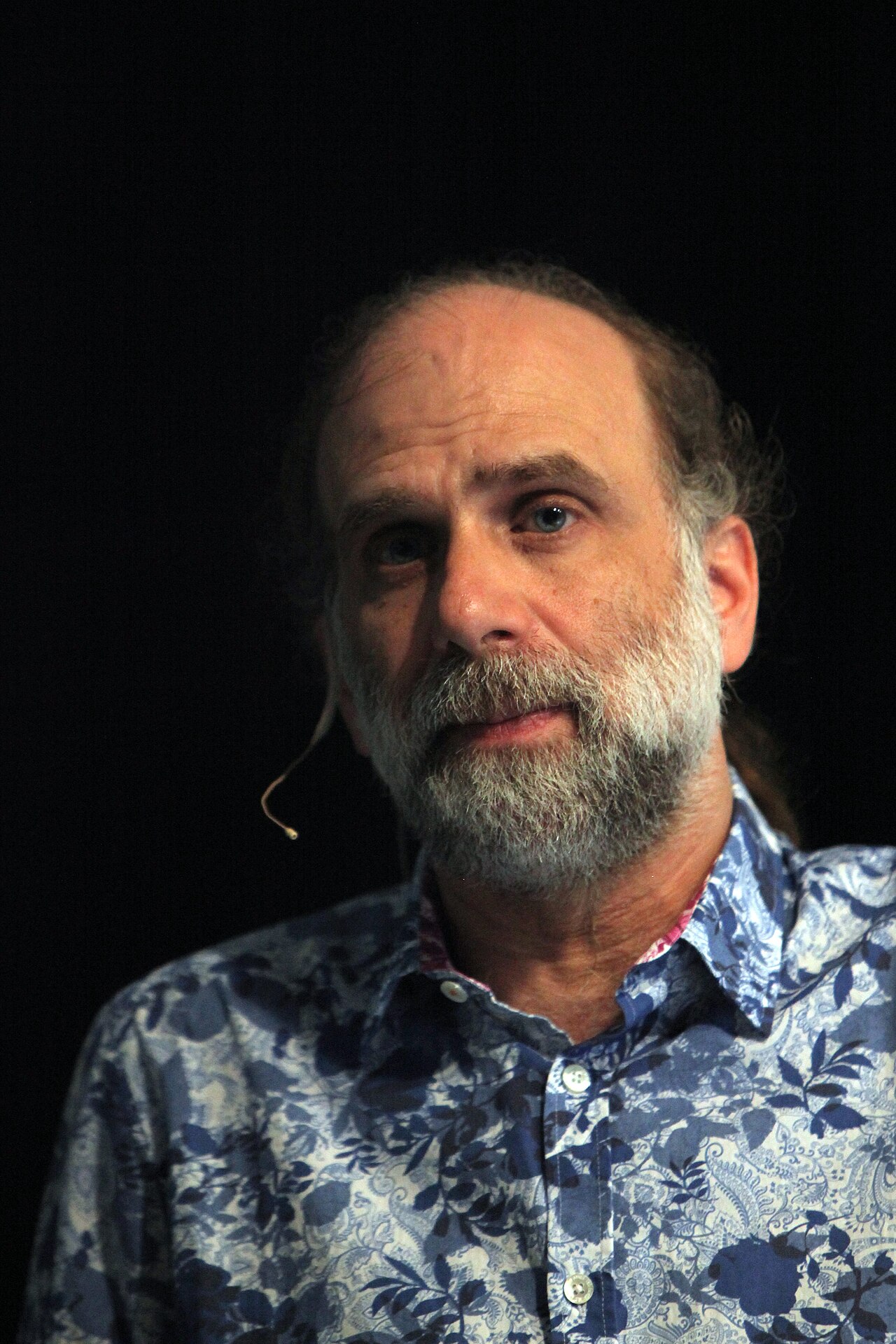
- Image: Bruce Schneier at CoPS2013-IMG 9247.jpg by Rama (CC BY-SA 2.0 fr), via Wikimedia Commons