Sam Altman and OpenAI
Abstract
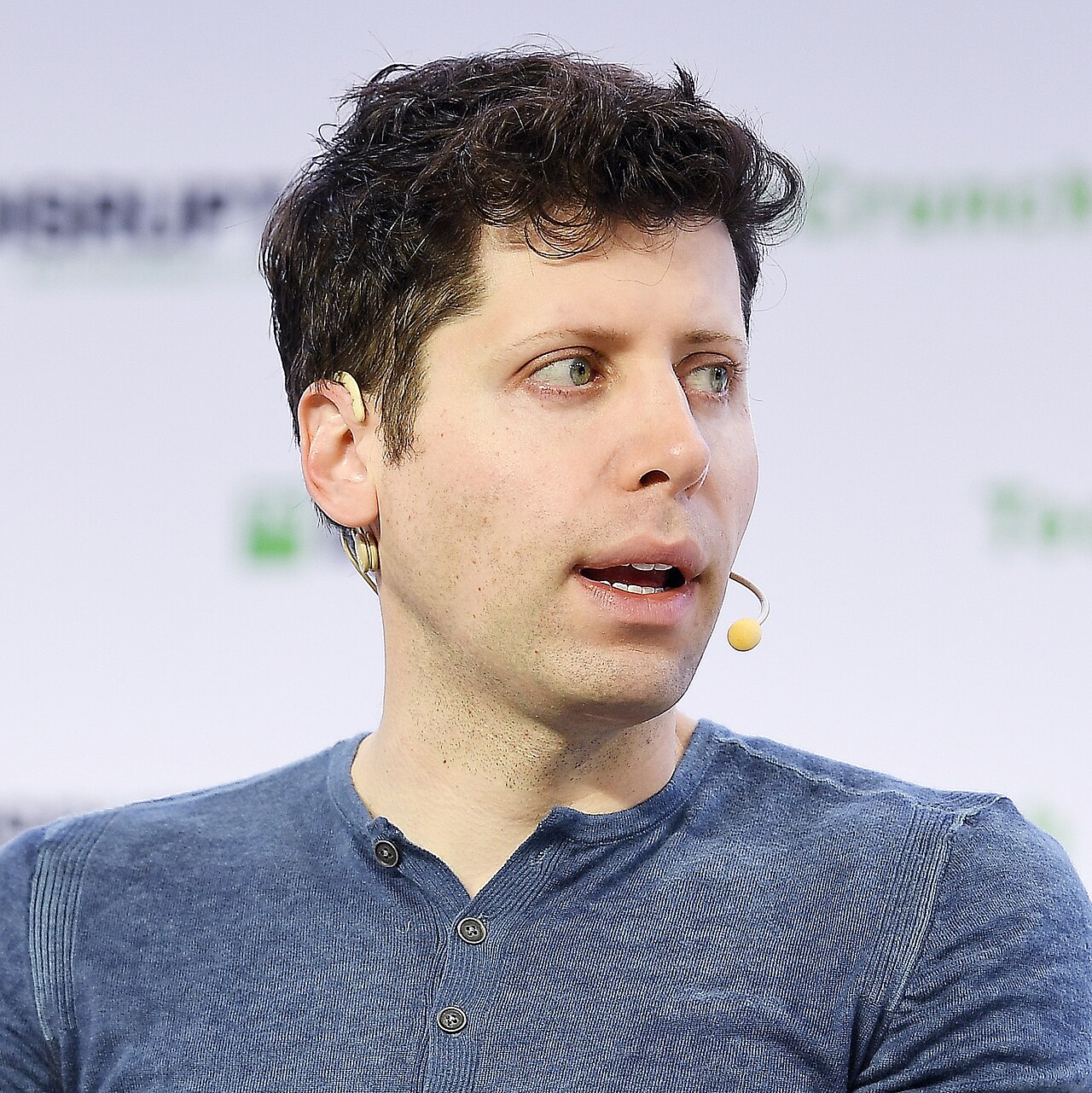
Sam Altman dropped out of Stanford at nineteen, built and sold a mobile location app, ran Y Combinator for five years, co-founded OpenAI as a nonprofit in 2015, oversaw its restructuring into a capped-profit company in 2019, launched ChatGPT in November 2022 to the fastest consumer product adoption in history, was fired by his own board in November 2023, and was reinstated four days later with a reconstituted board and a reinforced mandate. He is the person most responsible for bringing artificial general intelligence from a research aspiration to an industrial project, and the ongoing argument about what building AGI responsibly actually means is, in large part, an argument about whether what he is doing qualifies.
St. Louis to Sand Hill Road
Samuel Harris Altman was born on April 22, 1985, in Chicago and grew up in St. Louis, Missouri. He received his first computer (a Macintosh) at age eight, taught himself to program, attended John Burroughs School, and enrolled at Stanford in 2003 to study computer science. He dropped out in 2005, following what had by then become a recognizable Silicon Valley pattern, to work full time on his first company.
Loopt was a mobile location-sharing application, one of the first social apps built around the concept of showing friends their mutual locations on a map. Altman co-founded it while still at Stanford and brought it to Y Combinator’s inaugural batch in 2005, becoming, thereby, one of the first founders to go through what would become the world’s most influential startup accelerator. Loopt was technically early: the iPhone did not yet exist, the App Store did not exist, and the social mapping concept Loopt was pursuing would not find its mass market until Foursquare, Google Maps, and Snapchat arrived years later. The company raised $30 million in venture capital and was acquired by Green Dot Corporation in 2012 for $43.4 million, a modest outcome, but positive for investors.
Altman joined Y Combinator as a part-time partner in 2011. In 2014, Paul Graham (YC’s founder, stepping back from day-to-day operations) named Altman president. He ran YC from 2014 to 2019, overseeing a period of substantial growth: the company expanded from funding a few dozen companies per year to hundreds, added later-stage funding programs, launched YC Research as a nonprofit arm, and grew its alumni network into one of the most connected communities in technology.
At YC, Altman developed a reputation as a strategically sophisticated operator who thought unusually long-term about technology’s trajectory. He was known for identifying capability in founders early, for directness about what was working and what wasn’t, and for an earnestness about the transformative potential of technology that was unusual in an environment that ran more on commercial pragmatism. He was also known for a set of political views (support for nuclear power, basic income, immigration reform) that were unusual for a tech CEO and that he expressed without the hedging that characterizes most Silicon Valley public communication.
OpenAI: Nonprofit, Capped Profit, and the Race
In December 2015, Altman co-founded OpenAI with Elon Musk, Greg Brockman, Ilya Sutskever, Wojciech Zaremba, and several other researchers. The founding structure was a nonprofit, a choice that was deliberate and philosophically significant. The founders believed that artificial general intelligence (AI that could perform any intellectual task a human could perform) was coming, that its development was too consequential to be driven solely by commercial incentives, and that a nonprofit structure would allow the organization to prioritize safety and broad benefit over shareholder returns.
The initial funding came primarily from Musk and other founders, plus early donations including $1 billion pledged (though not all received) from a group of tech entrepreneurs. The organization hired serious researchers (Sutskever as Chief Scientist, Brockman as CTO) and began working on foundational questions in machine learning and AI safety.
Musk departed from the board in 2018, citing potential conflicts with Tesla’s own AI development. His departure removed the largest donor and the most prominent public face, and the financial limitations of nonprofit funding became acute as it became clear that training competitive AI systems required investment in compute that no nonprofit could sustainably sustain. In 2019, OpenAI restructured into a “capped profit” hybrid: a for-profit arm, OpenAI LP, that could raise outside investment, with investors’ returns capped at 100 times their investment and profits above the cap flowing to the nonprofit. Altman became CEO of the restructured organization.
The restructuring attracted Microsoft, which invested $1 billion in 2019 in exchange for a significant partnership and priority access to OpenAI’s technology. The relationship would prove the most consequential commercial partnership in AI history.
Info
The “capped profit” structure was genuinely novel and, critics argued, genuinely ambiguous. The nonprofit retained ultimate control over the for-profit arm through its board. But the board’s fiduciary duties ran to the nonprofit’s mission (“ensuring AGI benefits all of humanity”) not to investors. This created an unusual governance structure in which the organization could raise billions in commercial investment while remaining technically accountable to a mission that could override commercial considerations. Whether this structure actually constrained commercial behavior, or merely created the appearance of constraint, would become the central question of the November 2023 crisis.
GPT-3, ChatGPT, and the Moment Everything Changed
Altman oversaw the development of GPT-2 (2019), which OpenAI initially declined to release in full citing concerns about misuse for disinformation (a decision that attracted both attention and skepticism) and GPT-3 (2020), the 175-billion-parameter language model that first demonstrated the qualitative capabilities of large-scale transformers. GPT-3’s ability to perform tasks from a few examples in the prompt (without fine-tuning) surprised researchers and was interpreted by some as early evidence of emergent general capabilities.
But GPT-3 remained largely a research artifact, accessible via API to developers but invisible to ordinary users. ChatGPT changed this. Launched on November 30, 2022, ChatGPT wrapped a fine-tuned version of GPT-3.5 (improved with reinforcement learning from human feedback, a technique developed by OpenAI to make models more helpful and less harmful) in a free conversational interface. The results were immediate and unprecedented.
One million users in five days. One hundred million users in two months. These were the fastest product adoption numbers in the history of the internet, surpassing Instagram (two months to 1 million), TikTok (nine months to 100 million), and every other consumer product that had previously held these records. ChatGPT did not require a network effect, a hardware purchase, or a subscription. It required only that someone hear about a tool that could write code, answer questions, draft emails, and explain complex topics, and that they try it.
The ChatGPT moment transformed OpenAI from a well-funded research organization into the most prominent technology company in the world. It also transformed Altman from an AI insider into the industry’s most visible public spokesperson, a role he inhabited with evident comfort.
The November 2023 Board Crisis
On the afternoon of Friday, November 17, 2023, Altman received a message asking him to join a video call with the OpenAI board. The board, comprising Adam D’Angelo (Quora CEO), Tasha McCauley (technology entrepreneur), Helen Toner (Georgetown CSET), and co-founder Ilya Sutskever, informed him that he was being fired as CEO. The stated reason, communicated in a public announcement minutes later, was that Altman had “not been consistently candid in his communications with the board,” preventing the board from exercising its oversight responsibilities. No specific incidents were cited.
The subsequent four days were extraordinary by any measure of corporate drama. Mira Murati, OpenAI’s CTO, was named interim CEO. Within hours, senior employees and investors were communicating frantically behind the scenes, trying to understand what had happened and to reverse it. Greg Brockman, OpenAI’s President and co-founder, resigned from the board and then from the company. Microsoft CEO Satya Nadella announced on Saturday that Altman would be hired to lead a new AI research division at Microsoft if he did not return to OpenAI.
By Sunday, nearly 700 of OpenAI’s 770 employees had signed an open letter threatening to resign and join Altman at Microsoft unless he was reinstated. The letter included Sutskever, who had been among the board members who voted to fire Altman and who now wrote publicly: “I deeply regret my participation in the board’s actions. I never wanted to harm OpenAI. I love everything we’ve built together.”
On Monday, November 21 (four days after the firing) Altman was reinstated as CEO. The three board members who had voted for his removal (Sutskever, McCauley, and Toner; D’Angelo remained) were replaced. The new board, eventually constituted, included Bret Taylor as chair, Larry Summers, and Adam D’Angelo, along with later additions, a board oriented toward commercial governance rather than the safety-focused backgrounds of the outgoing members.
Warning
The board crisis revealed, with unusual clarity, the tension at the center of OpenAI’s structure. The nonprofit mission (ensure AGI benefits humanity) and the commercial imperative (build and deploy the most capable AI systems to generate revenue and justify the billions in investment) are in genuine conflict. The board members who fired Altman believed they were fulfilling the safety mandate by exercising oversight over a CEO they felt was not transparent with them. The employees and Microsoft who backed Altman’s reinstatement were prioritizing commercial continuity. The resolution (Altman reinstated, safety-oriented board members replaced) clarified which imperative had won, at least for this round. Whether this was the right outcome, or a dangerous one, depends entirely on how dangerous one believes continued rapid AI development to be.
The specific content of the board’s concerns about Altman’s candor has never been disclosed. Reporting suggested disagreements about safety research timelines, product decisions, and the pace of capability development relative to safety work. Altman denied any safety or ethical violation; the dispute, in his account, was about communication style and governance mechanics, not substance.
AGI as Industrial Project
Altman’s post-crisis position was, if anything, stronger than his pre-crisis position. The demonstration that OpenAI could not function without him (that 700 of 770 employees would resign rather than continue without him) was a form of validation unusual in corporate history. Microsoft’s declared willingness to hire him was a commercial backstop that prevented the usual consequences of board dismissal.
He has used the subsequent period to accelerate rather than consolidate. OpenAI raised $6.6 billion at a $157 billion valuation in late 2024, one of the largest private funding rounds in history. The company restructured into a conventional for-profit corporation, shedding the nonprofit governance structure that had produced the November crisis. Altman has discussed plans for compute investments of a scale (in the hundreds of billions of dollars) that would dwarf any previous private-sector investment in technology infrastructure.
His public statements about AGI and its consequences are worth taking seriously as statements of genuine belief, not merely strategic positioning. He has said he believes AGI will arrive within the current decade. He has said it will likely “break capitalism” by making resources essentially unlimited. He has described it as the most important development in human history. He has also said he is scared. These statements are not mutually exclusive; the pattern they describe is a person who genuinely believes he is building something transformative and dangerous and who has concluded that the right response is to build it as carefully as possible while building it as quickly as possible, because if OpenAI doesn’t, someone else will, and “someone else” might not be careful at all.
Whether “iterative deployment” (releasing increasingly capable systems to learn about their effects before they become catastrophic) is a coherent safety strategy or a rationalization for commercial necessity is the central unresolved question of his tenure.
For the broader competitive context of the LLM era, see The LLM Race (2022–). For the RLHF technique that made ChatGPT useful, see Reinforcement Learning.
📚 Sources
- Altman, S.: Moore’s Law for Everything, personal blog, March 2021
- Roose, K.: OpenAI’s Altman Is Ousted by the Board, New York Times, November 17, 2023
- Suleyman, M.: The Coming Wave, Crown, 2023
- Metz, C.: Genius Makers: The Mavericks Who Brought A.I. to Google, Facebook, and the World, Dutton, 2021
- OpenAI: Our structure, openai.com/charter
- ChatGPT — Wikipedia
- Brown, T. et al.: Language Models are Few-Shot Learners (GPT-3), NeurIPS 2020
- Image: Sam Altman CropEdit James Tamim.jpg by TechCrunch (CC BY 2.0), via Wikimedia Commons