Frances Allen and Compiler Optimization
Abstract
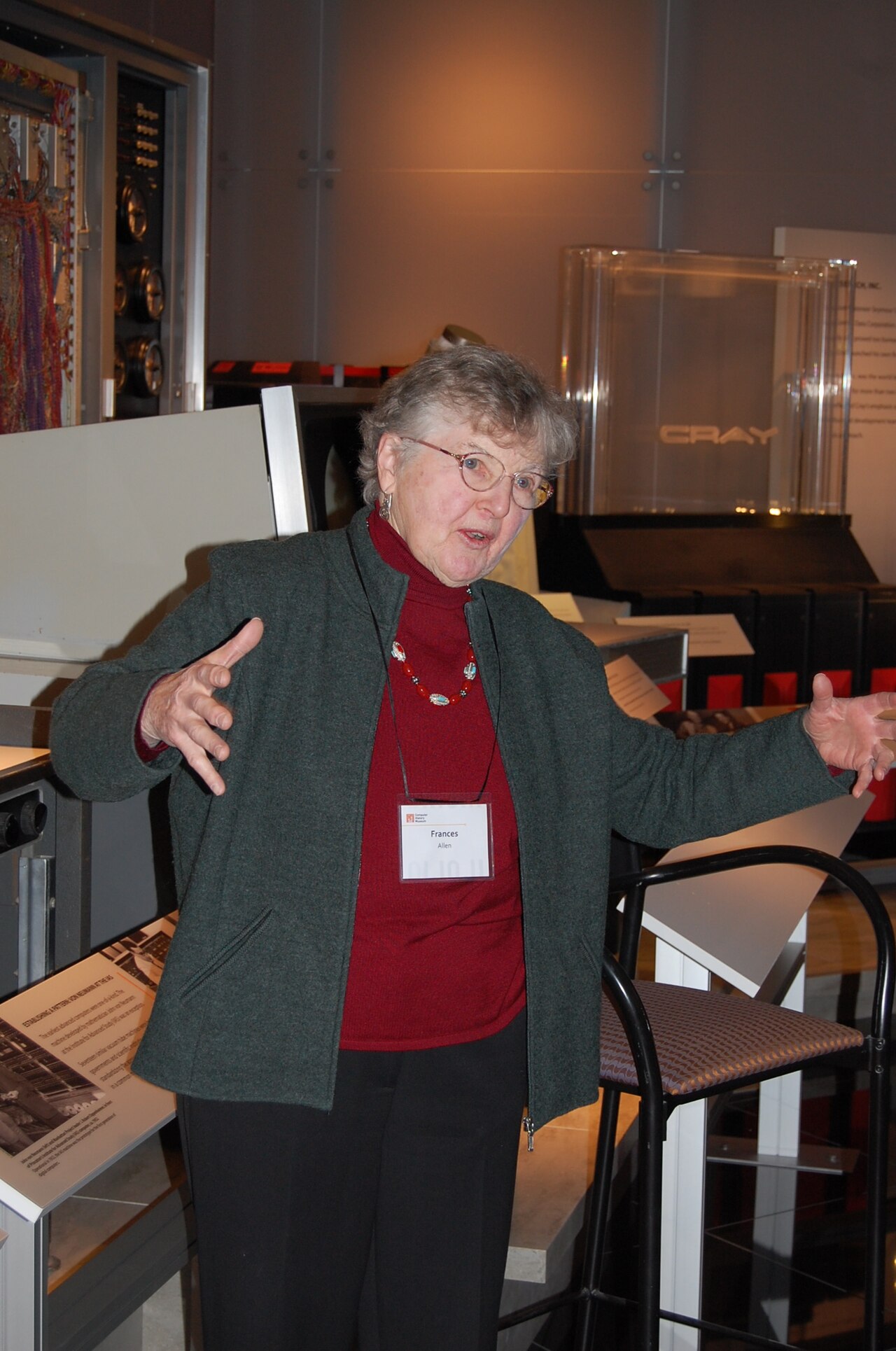
Frances Allen spent her entire career at IBM Research, where she developed the theoretical and practical foundations of compiler optimization, the techniques that allow compilers to transform programs written for human readability into machine code that executes efficiently. Her work on program flow analysis, data-flow analysis, and automatic parallelization defined what modern compilers do. In 2006 she became the first woman to receive the ACM Turing Award. She was seventy-four years old when the Turing committee called. She had been doing the work that earned it for forty years.
Teaching FORTRAN, Learning Research
Frances Elizabeth Allen was born on August 4, 1932, in Peru, New York, and grew up on a farm. She took a mathematics degree at Albany State Teachers College in 1954, taught school, and earned a master’s in mathematics from the University of Michigan in 1957. She joined IBM in 1957 with a specific plan: earn enough money to pay off her student loans and then return to teaching.
Her assignment at IBM Research was to teach the newly created FORTRAN programming language to IBM’s own scientists. FORTRAN had just been developed by John Backus’s team; Allen was to help IBM’s own scientists learn it. To teach a language effectively, she reasoned, she needed to understand its implementation deeply. She studied the FORTRAN compiler (the program that transformed FORTRAN source code into machine instructions) and became fascinated by the problem of making it generate better code.
She never returned to school teaching. She remained at IBM for forty-five years.
Program Flow Analysis
Allen’s first major contribution addressed a fundamental question in compiler design: before a compiler can optimize a program, it needs to understand how the program executes, which statements are executed before which others, which variables are used where, what the possible paths through the program are.
In 1966, Allen wrote “Program Optimization” (distributed as an IBM internal report in 1966 and published in 1969 in Annual Review in Automatic Programming) the first paper to formally define the concept of a flow graph, a directed graph representing the possible execution paths through a program, with basic blocks (sequences of instructions with no branches within them) as nodes and branches as edges. The flow graph gave compilers a mathematical object to analyze rather than a linear sequence of instructions to process left-to-right.
In 1970, she published “Control Flow Analysis” in the SIGPLAN Notices, defining the algorithms for computing the flow graph and deriving information from it. These algorithms (dominators, post-dominators, back edges, natural loops) are the mathematical tools that every optimizing compiler uses to understand program structure. The vocabulary she established in 1970 is still the vocabulary used to teach compiler construction.
Her 1971 IFIP paper “A Basis for Program Optimization”, together with her subsequent collaborations with John Cocke, “A Catalogue of Optimizing Transformations” (1972) and “A Program Data Flow Analysis Procedure” (1976), established the framework for data-flow analysis: algorithms that compute, for each point in a program, what values variables might have and what information is available. Data-flow analysis underlies:
- Dead code elimination: identifying and removing code that can never affect program output
- Constant propagation: replacing variables with their known values where possible
- Common subexpression elimination: identifying repeated computations and computing them once
- Register allocation: assigning program variables to processor registers to minimize memory accesses
These optimizations are the difference between code that compilers generate naively and code that actually executes efficiently. Without them, high-level language programs run several times slower than equivalent hand-written assembly. With them, high-level language programs can approach or match assembly performance.
Automatic Vectorization and Parallel Computing
Allen’s later work addressed a problem that became increasingly important as computer architectures evolved: how to automatically identify portions of a program that could be executed in parallel, and restructure the program to take advantage of parallel hardware.
Vectorization, transforming loops that process one element at a time into operations that process multiple elements simultaneously using SIMD (Single Instruction Multiple Data) hardware, requires proving that successive iterations of a loop are independent: that iteration N does not depend on the result of iteration N-1. Proving independence requires data-flow analysis.
Allen’s work in the 1970s and 1980s on dependence analysis (systematic algorithms for determining when statements in a loop depend on each other) made automatic vectorization possible. Her 1971 report on automatic translation of FORTRAN programs to vector form set out the approach, and it fed IBM’s vectorizing compilers for machines such as the 3090 vector facility. The theoretical framework she developed is the basis of the vectorization that modern C and Fortran compilers perform on numerical code.
Her earliest compiler work had been at the other end of the machine spectrum: from 1959 she managed the compiler-optimization team for STRETCH, IBM’s 1961 supercomputer, and for Harvest, the code-breaking system built on it for the National Security Agency. From 1980 to 1995 she led PTRAN (Parallel Translation), IBM’s research program on automatically restructuring sequential programs to run on parallel processors, which established much of the framework for scientific computing on vector and later multicore hardware.
Info
The significance of compiler optimization is invisible to most programmers, which is a measure of how well it works. A programmer writes a loop in Python, C, or Java at the level of human readability; the compiler transforms it into machine code that uses registers efficiently, eliminates redundant computation, takes advantage of vector hardware, and schedules instructions to minimize pipeline stalls. The ten-fold or hundred-fold difference in performance between naive and optimized code is the compiler’s contribution, and the theoretical framework for that contribution is substantially Frances Allen’s work.
IBM Research and Scientific Collaboration
Allen’s career at IBM Research positioned her at the center of the collaboration between compiler research and computer architecture. IBM’s machines (the System/360, the 3090 vector facility, the POWER architecture) were designed with compilers in mind, and the compilers were designed to exploit architectural features. Allen participated in both sides: understanding the architecture well enough to design compilers for it, and understanding compilation well enough to influence architecture design.
She became the first female IBM Fellow in 1989 and led IBM Research’s work on programming language theory and compiler construction through her retirement in 2002, guiding a research agenda that influenced IBM’s commercial products and the academic compiler community simultaneously. She stayed on as a Fellow Emerita.
First Woman to Receive the Turing Award
In 2006, the ACM announced that Frances Allen would receive the Turing Award. She was the first woman to receive computing’s highest distinction in its forty-year history.
The Turing Award citation recognized her “pioneering contributions to the theory and practice of optimizing compiler techniques that laid the foundations for modern optimizing compilers and automatic parallel execution.”
Allen’s response to the award reflected her characteristic directness: she noted that the work had been done in collaboration with many colleagues over many years, that the theoretical framework was built cumulatively rather than in single breakthroughs, and that the recognition came late, not just for her but for the field of compiler optimization, which had produced commercially essential technology without the public visibility of operating systems, databases, or programming languages.
She continued to speak publicly about computing and women in technology after her Turing Award, arguing that the barriers to women’s participation in computing were structural rather than natural: that they could be changed by institutional decisions rather than waiting for cultural change.
Frances Allen died of complications of Alzheimer’s disease on August 4, 2020, her eighty-eighth birthday. Every program compiled by any modern compiler uses the theoretical tools she developed.
📚 Sources
- Wikipedia: Frances Allen
- ACM Turing Award: Frances Allen (2006)
- Allen, Frances E.: “Program Optimization” — IBM internal report (1966), published in Annual Review in Automatic Programming Vol. 5 (1969), pp. 239–307 (print; no online edition)
- Allen: Control Flow Analysis — SIGPLAN Notices Vol. 5 No. 7 (1970)
- Allen & Cocke: A Catalogue of Optimizing Transformations (1971) — in Rustin, Randall (ed.): Design and Optimization of Compilers, Prentice-Hall, 1972
- Allen: Automatic Translation of FORTRAN Programs to Vector Form — IBM Research Report RC 3503 (1971)
- Frances Allen — IBM History
- Image: Frances Allen, CHM 2011 2.jpg by vonguard (CC BY-SA 2.0), via Wikimedia Commons