Marc Benioff and Salesforce
Abstract
Marc Benioff worked at Oracle for thirteen years, rising to senior vice president before he had turned thirty, and then left to build a company whose entire premise was that Oracle’s model of selling software was wrong. Salesforce was not the first company to deliver software over the internet, but it was the first to build a complete enterprise software business on that premise, to market the model as a philosophy with a slogan (“No Software”) and to survive long enough that every enterprise software vendor was eventually forced to follow. The SaaS revolution Benioff started remade the economics of the software industry: from one-time licenses to monthly subscriptions, from on-premise installations to cloud-hosted services, from IT departments managing servers to IT departments managing vendors.
San Francisco and Oracle
Marc Russell Benioff was born on September 25, 1964, in San Francisco, California. His father ran a chain of clothing stores; his maternal grandfather, Frank Zimmerman, was a California state assemblyman. He grew up in the Bay Area, interested in computers, programming on an Apple II, selling a simple game he had written to a magazine at fifteen for $75.
He studied business administration at the University of Southern California, graduating in 1986. While still at USC, he worked at Apple as a summer intern, an experience he later described as formative, though Apple did not hire him full-time. He joined Oracle in 1986 as a salesperson.
Oracle’s sales culture was the most aggressive in the enterprise software industry, and Benioff thrived in it. He was named Oracle’s Rookie of the Year in his first year, received the company’s most prestigious salesperson awards multiple times, and rose to senior vice president by the time he was in his late twenties. He had Larry Ellison (Oracle’s founder and CEO) as a mentor. Ellison took him sailing and taught him to think about technology markets in terms of power dynamics: who controlled the infrastructure, who set the price, who had leverage.
It was also Ellison who, in 1999, gave Benioff a six-month sabbatical to think about what he wanted to do next.
The End of Software
Benioff spent part of his sabbatical in India, meditating and reading. The idea that crystallized was simple: enterprise software did not need to be installed, maintained, and upgraded on customers’ own servers. It could be delivered over the internet as a service, the way water was delivered through pipes or electricity through wires. The customer would pay a subscription fee; the software company would manage the infrastructure.
The model had structural advantages over the Oracle model. Installation was instantaneous rather than requiring months of consulting. Upgrades happened automatically. The barrier to adoption was a monthly payment rather than a capital purchase requiring board approval. Customers who were unhappy could cancel; this forced the software vendor to actually keep them happy, unlike the perpetual license model where a dissatisfied customer was still a paying customer for years.
Benioff founded Salesforce in March 1999 with Parker Harris, Dave Moellenhoff, and Frank Dominguez, working initially from his San Francisco apartment. The product was customer relationship management software, the category of tools that salespeople used to track leads, customers, and deals. It was a market Oracle sold into and Siebel Systems dominated.
Siebel Systems, founded by Tom Siebel (himself an Oracle alumnus and Ellison protégé), had become the dominant CRM vendor through the late 1990s by selling complex, highly configurable enterprise software at high prices. A typical Siebel deployment cost millions of dollars in licenses, required months of consultants to install and customize, and then required an internal IT team to maintain. It was software as a capital project, the same model that had defined enterprise computing since the mainframe era. Companies bought Siebel because they needed CRM, endured the implementation, and then stayed because switching was even more expensive than remaining.
Salesforce’s CRM product was deliberately simpler. It did not try to do everything Siebel did. What it did do was available in a browser within minutes, required no server installation, and cost $50 per user per month, a figure that a sales manager could approve without a board meeting. The first paying customer, in early 2000, was Blue Martini Software, a small software company. By the end of 2000, Salesforce had 3,500 customers.
The marketing was combative. Salesforce protesters showed up at Siebel conferences with signs reading “The End of Software.” Their website displayed the Salesforce logo (a cloud) with a red circle and line over the word “software,” as if software were a bad practice to be abolished, like smoking in restaurants.
The 1-1-1 Model
At founding, Benioff committed Salesforce to giving away 1% of its equity, 1% of its product, and 1% of its employees’ time to charitable causes. The idea was to embed social responsibility in the company’s structure before it was large enough to resist it. The model (later branded the Pledge 1% program) was eventually adopted by thousands of technology companies, seeded by Salesforce’s example and Benioff’s active evangelism.
IPO and the SaaS Proof
Salesforce went public on June 23, 2004, on the New York Stock Exchange. The IPO raised $110 million. The company was not yet profitable; its pitch to investors was the recurring revenue model, the growth rate, and the customer retention metrics. Investors who had been burned by dot-com startups with no revenue were cautious, but the Salesforce model was different: it had paying enterprise customers, contracted for terms of one to three years, paying monthly fees.
The IPO established Salesforce as the proof of concept for SaaS as a viable business model for enterprise software. Companies that had been building subscription software businesses without a clear framework for what they were doing now had a public market comparable and a vocabulary for describing their businesses: SaaS, ARR (Annual Recurring Revenue), churn, net retention.
Benioff was relentless about expanding the Salesforce platform beyond CRM. The AppExchange, launched in 2005, was a marketplace for third-party applications built on Salesforce’s platform, a model that predated Apple’s App Store by three years. Force.com, launched in 2007, allowed developers to build custom applications on Salesforce’s infrastructure, turning Salesforce from a product into a platform.
The Acquisition Machine
By the mid-2010s, Salesforce had grown large enough to acquire its way into new markets:
Exact Target / Marketing Cloud (2013, $2.5 billion): digital marketing automation. MuleSoft (2018, $6.5 billion): API integration platform, allowing companies to connect disparate software systems, the infrastructure problem that every enterprise Salesforce customer faced. Tableau (2019, $15.7 billion): data visualization and analytics, the largest acquisition in Salesforce’s history at the time. Slack (2021, $27.7 billion): workplace communication platform, acquired during the pandemic when remote work had made Slack essential for millions of workers.
The Slack acquisition was the most controversial. Salesforce paid a significant premium at the peak of pandemic-era software valuations; Slack’s revenue growth subsequently slowed, and the strategic rationale (integrating Slack as the conversational layer of the Salesforce platform) proved harder to execute than the acquisition thesis suggested.
Time Magazine and the Culture Wars
In 2018, Benioff purchased Time magazine for $190 million, with his wife Lynne. He described the acquisition as a responsibility to support journalism. Critics noted that owning one of the world’s most recognizable media brands amplified Benioff’s public voice considerably.
Benioff engaged visibly in business culture debates: he led the campaign against Indiana’s Religious Freedom Restoration Act in 2015, threatening to cancel Salesforce events in the state over what he argued were discriminatory provisions against LGBT people. He required equal pay audits at Salesforce, acknowledged pay gaps, and spent $3 million in two rounds to equalize salaries between men and women in comparable roles.
He has described Salesforce’s internal culture through the Hawaiian concept of Ohana, the idea that employees, customers, partners, and communities are all part of an extended family with obligations to each other. Critics argued this was glossy corporate culture designed to obscure that Salesforce was, at its core, an aggressive software vendor with high prices and complex contracts.
Succession Uncertainty
In November 2022, co-CEO Bret Taylor resigned. Salesforce’s stock had fallen significantly from its 2021 peak; activist investors, including Elliott Management and Starboard Value, took positions and demanded cost cuts and profitability improvement. Benioff announced a restructuring that eliminated 10% of Salesforce’s workforce, roughly 7,000 people.
The tension between Benioff’s public emphasis on stakeholder capitalism (the idea that companies owe obligations to employees, communities, and society, not just shareholders) and the layoffs was widely remarked upon. His response, in interviews, was to acknowledge the tension directly rather than explain it away: the company had hired too aggressively during the pandemic boom, the market had changed, and the responsible action for employees who remained was to make the company financially sound. It was an unusually honest acknowledgment from a CEO more accustomed to speaking in values frameworks.
Dead End: On-Premise Enterprise Software
Warning
Siebel Systems (the CRM giant that Salesforce set out to disrupt) was acquired by Oracle in 2006 for $5.8 billion, a fraction of its late-1990s peak valuation of over $18 billion. The on-premise model did not disappear; Oracle still licenses its software in traditional models. But the center of gravity in enterprise software shifted definitively toward subscription and cloud delivery. SAP, the German ERP giant, spent billions and years building its cloud platform, often acquiring cloud vendors rather than building from within. Microsoft transformed its Office suite into Microsoft 365 subscriptions. Even Salesforce’s model became the baseline expectation: enterprise software was now presumed to be cloud-delivered, subscription-priced, and continuously updated, unless there was a specific reason otherwise.
The Legacy: What SaaS Changed
Salesforce’s real accomplishment was not defeating Siebel: that was a competitive result. It was establishing a new financial architecture for the software industry. The vocabulary of SaaS (Annual Recurring Revenue, Net Revenue Retention, Customer Acquisition Cost, Lifetime Value) replaced the older vocabulary of licensed software. These metrics measured customer relationships over time rather than point-in-time transactions, which changed how software companies were built, staffed, and valued.
The subscription model also shifted power in the buyer-seller relationship. A perpetual software license was a bet placed once; a subscription renewed annually was a relationship subject to constant renegotiation. Software companies that once treated customer success as an afterthought built entire departments around it; a churned customer was lost revenue forever, while a satisfied customer could expand into additional seats and modules. The economics demanded ongoing attention to the customer in a way the one-time license never had.
Benioff’s insistence on the cloud delivery model, which seemed eccentric in 1999 during the dot-com hysteria when enterprise CIOs were still nervous about putting sensitive sales data on servers they did not control, looked prescient by 2010 and obvious by 2020. The pandemic accelerated every trend toward cloud software, remote access, and subscription pricing that Salesforce had been building for twenty years.
Info
The SaaS model Salesforce pioneered operated on the same infrastructure principles that Jeff Bezos and Amazon built into AWS, cloud computing infrastructure that made it cheap and fast to deploy software globally without owning physical servers. AWS and Salesforce were, in a sense, complementary innovations: Salesforce proved that enterprise software could be delivered as a service; AWS provided the infrastructure on which a generation of SaaS companies built their own services.
For the broader SaaS model Salesforce pioneered, see The Rise of SaaS. For the cloud infrastructure that enabled it, see The Cloud Computing Era.
📚 Sources
- Benioff, Marc, and Monica Langley: Trailblazer: The Power of Business as the Greatest Platform for Change (2019), Currency
- Benioff, Marc, and Carlye Adler: Behind the Cloud: The Untold Story of How Salesforce.com Went from Idea to Billion-Dollar Company — and Revolutionized an Industry (2009), Jossey-Bass
- Salesforce — Wikipedia
- The Pledge 1% initiative — pledge1percent.org
- Marc Benioff — Wikipedia
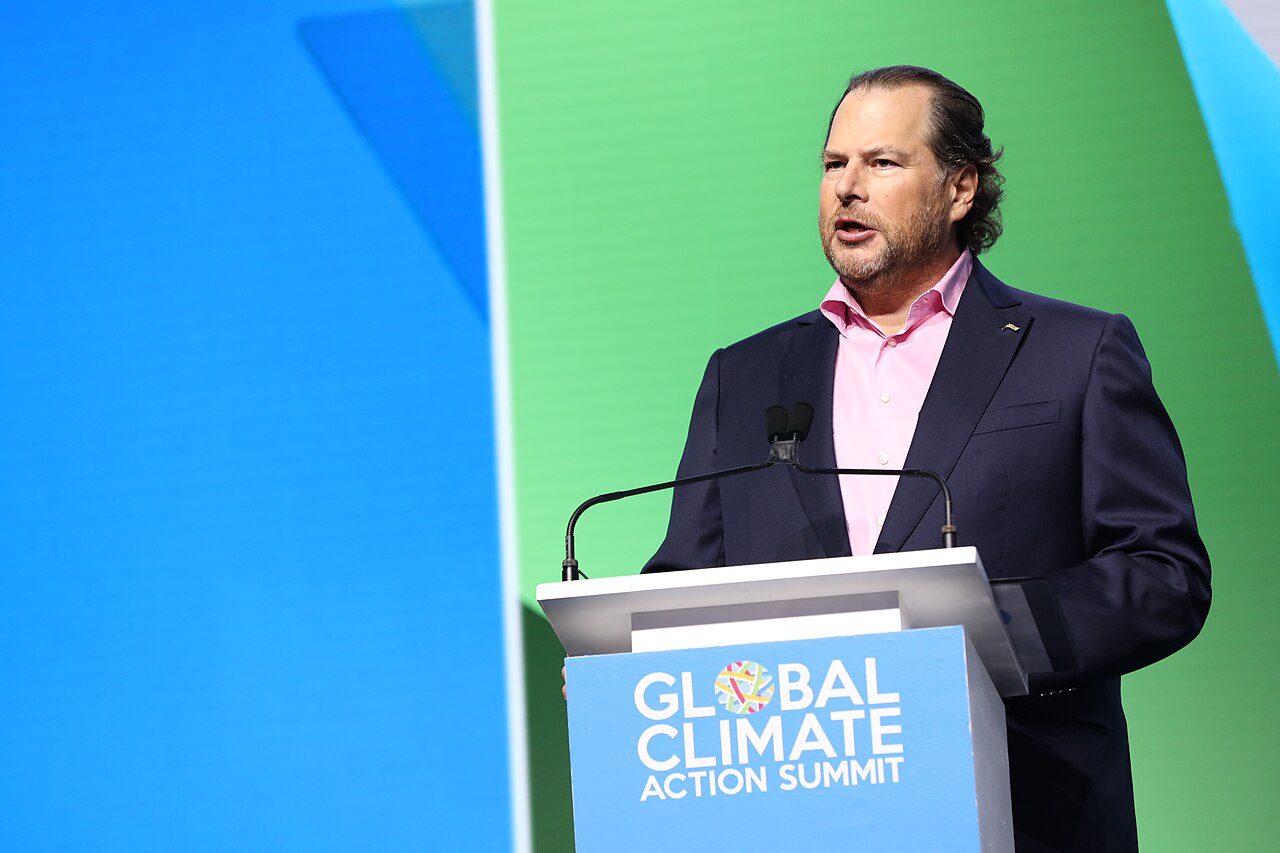
- Image: Salesforce CEO, Marc Benioff (44739769131).jpg by Global Climate Action Summit 2018 (CC BY 2.0), via Wikimedia Commons