Switzerland's Tech Industry: Neutrality, Precision, and the Birthplace of the Web
Abstract
Switzerland is a small, landlocked, multilingual country with no major hardware industry and no Silicon Valley, yet a disproportionate amount of computing history runs through it. The World Wide Web was invented on its soil. The world’s largest computer-mouse maker was founded in a Swiss farmhouse. Its banks created a software industry, ETH Zürich produced the Pascal designer Niklaus Wirth, and its reputation for neutrality and discretion attracted privacy-focused services. The same reputation covered one of the longest-running espionage operations of the Cold War: from 1970 the Swiss cipher-machine maker Crypto AG was secretly owned by the CIA and West German intelligence.
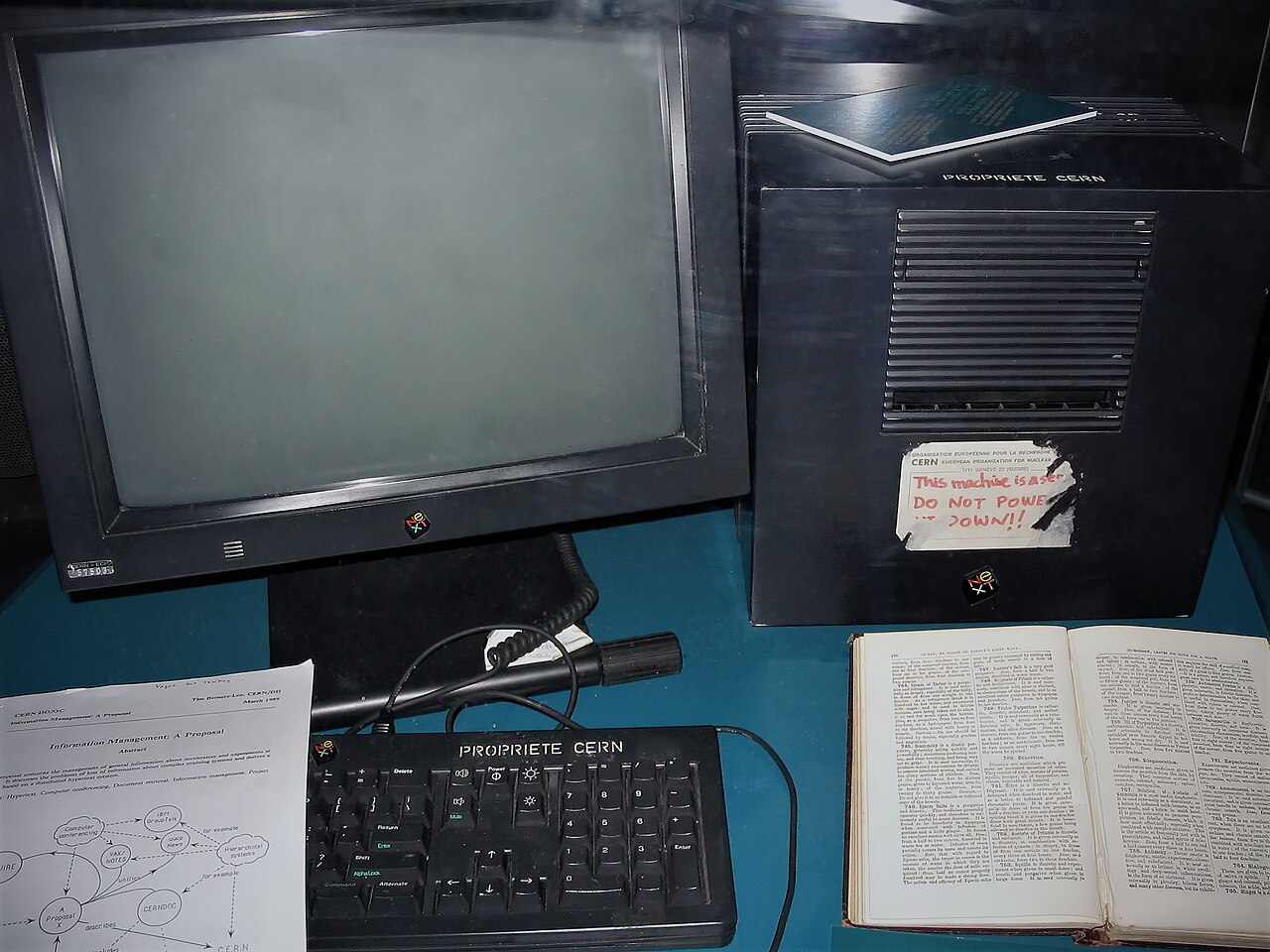
CERN and the Birth of the Web
The biggest event in Swiss computing history was not a Swiss project. CERN, the European Organization for Nuclear Research, sits on the French–Swiss border just outside Geneva. It is a physics laboratory, not a computing lab, but its scale created a computing problem: thousands of researchers worldwide, using incompatible systems, needed to share documents and data.
In March 1989 a British software engineer at CERN, Tim Berners-Lee, wrote a memo titled “Information Management: A Proposal.” His manager Mike Sendall scrawled “vague but exciting” on the cover and let him pursue it on the side; it was never an official CERN project. Berners-Lee combined three ideas, HTML, HTTP, and the URL, into a working system, and by 20 December 1990 the first website and web server were running on a NeXT machine at CERN.
On 30 April 1993 CERN released the Web’s underlying code into the public domain, royalty-free, at a time when the University of Minnesota had just started charging licence fees for its rival Gopher server. The technology itself is covered in Tim Berners-Lee and the World Wide Web.
ETH, EPFL, and Niklaus Wirth
Switzerland’s deepest contribution to computer science as a discipline came through ETH Zürich (the Swiss Federal Institute of Technology) and its French-speaking sister school EPFL in Lausanne, two of continental Europe’s strongest technical universities.
Computing at ETH began with the Institute for Applied Mathematics, founded in 1948 under Eduard Stiefel, who toured American computer projects with his assistants Heinz Rutishauser and Ambros Speiser from October 1948. From July 1950 the institute rented Konrad Zuse’s relay computer Z4 (see Konrad Zuse and the Z3) while it built its own machine, the ERMETH, with about 2,000 vacuum tubes (other sources give 1,500 or 1,700). It was shown around ETH’s centenary in October 1955, though it could only display digits entered beforehand, ran from July 1956, received its full drum memory for 10,000 fourteen-digit numbers in 1957, and worked until October 1963. Speiser left in 1955 to run IBM’s new research laboratory near Zurich, which ended plans for a commercial version; the ERMETH, Switzerland’s only home-built large computer, is now in the Museum für Kommunikation in Bern.
At EPFL Jean-Daniel Nicoud built early computer mice in the 1970s and the Smaky (“smart keyboard”) microcomputers. The Z80-based Smaky 6 of 1978, produced by Epsitec in Belmont near Lausanne under Cathi Nicoud, was probably the earliest European desktop system, and the Smaky 8 of 1981 used Motorola’s 68000; about 4,000 Smakys were built up to the Smaky 130 of 1992, half of them for schools.
ETH’s defining figure was Niklaus Wirth, who designed a lineage of programming languages that shaped how computing was taught and built: Pascal (1970), then Modula-2 and the Oberon system. Pascal became the language a generation learned to program in, and its descendants ran everywhere from classrooms to the early Macintosh and Apple Lisa toolchains. Wirth received the Turing Award in 1984 and is remembered for the maxim now called Wirth’s law: software grows slower faster than hardware grows faster. He died on 1 January 2024.
ETH and EPFL later built strong groups in machine learning and robotics, and Zurich became the site of large research offices of IBM (since 1956) and Google.
Logitech
Logitech was founded in 1981 in the village of Apples, near Lausanne, by Daniel Borel, Pierluigi Zappacosta, and Giacomo Marini, Borel and Zappacosta having met while studying at Stanford. The name fused logiciel (French for software) with technologie: they wanted to be a software company like Microsoft, and initially considered the mouse beneath them.
The company was founded on 2 October 1981 on the farm of Borel’s father-in-law, first to write graphics software for the Japanese firm Ricoh. Its mouse came from EPFL: Nicoud and the precision mechanic André Guignard had designed the P4 in 1979, and from 1980 it served Wirth’s Lilith workstation. Logitech marketed it from 1982, had it made by the watch-component maker Dubois Dépraz, and showed it at Comdex in Las Vegas at the end of 1982 for $299; in 1983 it was shipping 500 a month to Apollo. Its first retail mouse, the C7, went on sale in December 1985 for $99. Logitech grew with the graphical interface, when every PC needed a pointing device. It became the world’s largest maker of computer mice, passing 100 million in 1996 and a billion in 2008, then diversified into keyboards, webcams, gaming gear (Logitech G), and audio (Ultimate Ears). Today it is a dual-headquartered multinational (Lausanne and California) and one of the few European PC-peripheral brands to achieve global scale.
Banking Software
Switzerland’s identity as a global banking center had a software consequence: someone had to write the systems that ran the banks. The result is a quietly large financial-software industry. Temenos, founded in Geneva in 1993, became one of the world’s leading vendors of core banking software, its platform running retail and private banks across dozens of countries. Avaloq (Zurich) built banking and wealth-management software used by private banks worldwide; NEC agreed to buy it in 2020.
A parallel specialty grew in digital security and conditional access. Kudelski Group (Nagra), based near Lausanne, became a global supplier of the encryption systems that protect pay-TV and digital content,
Privacy as a Product
The modern Swiss privacy reflex has a domestic origin. On 22 November 1989 a parliamentary commission, set up after the resignation of Justice Minister Elisabeth Kopp, reported that the federal political police kept a central card index of some 900,000 fiches on about 750,000 people, roughly a tenth of the population, from leftists and trade unionists to Max Frisch, whose file ran from 1948 to 1990. The “Fichenaffäre” led to a reorganised domestic intelligence service and, in 1994, a database called ISIS in place of the cards. The army’s cipher machine had a similar afterlife: the Nema, a Swiss improvement on the Enigma built by Zellweger, served from 1947 to 1979 and was sold off to collectors in 1994.
Switzerland’s strong privacy and data-protection laws, plus its political neutrality and stability, made it a natural jurisdiction for privacy-focused internet services, and here the CERN connection reappears. Proton was founded in 2014 in Geneva by Andy Yen, Jason Stockman, and Wei Sun, scientists who had met at CERN. Its first product, Proton Mail, offered end-to-end encrypted email; it grew into a suite (VPN, calendar, drive, password manager) and became a flagship example of “Swiss-hosted, privacy-first” computing. The pitch is explicitly geographic: your data sits under Swiss law, outside the reach of foreign surveillance demands.
⚠️ Dead End: Crypto AG
For decades, governments that did not trust American or Soviet encryption bought their cipher machines from a neutral third party: Crypto AG, a Swiss firm based in Zug. Founded by the Swedish cryptographer Boris Hagelin (who moved to Switzerland in 1948 and founded the company there in 1952; see Crypto AG and Operation Rubicon), Crypto AG sold encryption equipment to some 120 countries, whose governments, militaries, and diplomats believed Swiss neutrality guaranteed that no great power was reading their traffic.
From 1970, Crypto AG was secretly owned by the CIA and West Germany’s BND in a 50-50 arrangement (the BND sold its share to the CIA in 1993), under a program code-named “Thesaurus” and, from the late 1980s, Rubicon; inside the program Crypto AG itself was code-named “Minerva”. The roots went back further, to a 1950s understanding between Hagelin and the NSA’s William Friedman. The owners rigged the machines: the encryption was deliberately weakened so that the CIA and BND could read the supposedly secret communications of Crypto AG’s customers at will.
The intelligence haul was vast. Rigged Crypto AG equipment let the agencies read traffic during the Iran hostage crisis, the Falklands War, and Libya-linked terrorism investigations, among many others, across decades. A leaked internal CIA history called it the “intelligence coup of the century.” The operation was finally exposed in February 2020 by a joint investigation from The Washington Post, Germany’s ZDF, and Swiss broadcaster SRF.
Customers had bought the machines because they were Swiss: the assurance that a neutral country would keep their secrets was part of the product, and it was used against them. The security of a system depends on who controls its supply chain.
📚 Sources
- Heinz Nixdorf MuseumsForum blog, “ERMETH – der Computer aus Zürich” (26 July 2021)
- Heinz Nixdorf MuseumsForum blog, “Smaky aus der Schweiz” (16 February 2024)
- Heinz Nixdorf MuseumsForum blog, “Mehr als Mäuse – 40 Jahre Logitech” (1 October 2021)
- Heinz Nixdorf MuseumsForum blog, “Ein Land auf Karteikarten” (22 November 2019)
- Heinz Nixdorf MuseumsForum blog, “Nema – die Schweizer Enigma” (21 May 2021)
- CERN: A short history of the Web
- Wikipedia: History of the World Wide Web
- Wikipedia: Niklaus Wirth · Logitech · Daniel Borel
- Wikipedia: Temenos · Proton AG
- CERN: CERN inspires entrepreneurs for email encryption (Proton Mail)
- The Washington Post: How the CIA used Crypto AG to spy on the world
- Wikipedia: Crypto AG · Operation Rubicon
- Image: First Web Server.jpg by User:Coolcaesar at en.wikipedia (CC BY-SA 3.0), via Wikimedia Commons