Motorola: The Company That Built the Cell Phone and Then Lost It
Abstract
Motorola is one of the foundational companies of 20th-century electronics, a firm whose inventions defined wireless communication for ninety years. It built the car radios that gave it its name, the two-way radios that ran World War II and the Apollo Moon landings, the 68000 microprocessors that powered the original Macintosh, Amiga, and Sun workstations, and (most famously) the first handheld cellular telephone in 1973. For a time Motorola was the world’s largest mobile-phone maker. Yet across the 1990s and 2000s it repeatedly fumbled the very industries it had created: it lost mobile phones to Nokia and then to Apple and Android, lost microprocessors to Intel, and spent billions on the spectacular failure of the Iridium satellite-phone constellation. By 2011 the company had split apart and its phone business was sold to Google and then to China’s Lenovo.
Galvin’s Battery Eliminator and the Car Radio
The company was founded in Chicago in 1928 by brothers Paul and Joseph Galvin as the Galvin Manufacturing Corporation. Its first product was a “battery eliminator” that let battery-powered radios run on household current. Its breakthrough was the car radio, at the time a difficult engineering problem because of engine electrical noise. The Galvins branded it “Motorola,” combining “motor” (for the automobile) with “-ola” (a popular suffix for audio products, as in Victrola). The brand became the company name in 1947.
War, Space, and Two-Way Radio
Motorola became the world leader in two-way radio communication. During World War II it built the SCR-300 backpack radio (the original “walkie-talkie”) and the handheld SCR-536 “Handie-Talkie,” which became iconic battlefield equipment. This wireless expertise made Motorola a key contractor for the space program: a Motorola radio transponder aboard Apollo 11 carried the astronauts’ voices (including Neil Armstrong’s first words from the Moon) back to Earth in 1969.
Motorola also became a major semiconductor manufacturer. Its 6800 (1974) and especially the 68000 family of microprocessors were enormously influential: the 68000 powered the original Apple Macintosh, the Commodore Amiga, the Atari ST, early Sun workstations, and countless other systems. For a period in the 1980s, the 68000 was the premier 16/32-bit processor and a genuine rival to Intel’s x86. Motorola later co-founded (with IBM and Apple) the PowerPC alliance.
The First Cell Phone
Motorola’s most historic contribution to computing and communications came on April 3, 1973, when Motorola engineer Martin Cooper stood on a New York sidewalk and placed the first call from a handheld cellular telephone, to Joel Engel, his opposite number at AT&T’s Bell Labs, to rub in that Motorola had gotten there first. Cooper made the call on Sixth Avenue outside the New York Hilton, routed through a base station Motorola had put on the Burlington House roof. The prototype, nicknamed “the brick,” weighed 1.1 kg.
A decade of development later, the Motorola DynaTAC 8000X (1983) became the first commercially available handheld cell phone, priced at nearly $4,000, the phone famously brandished by Gordon Gekko in the film Wall Street. Motorola followed with the MicroTAC (1989) and the sleek StarTAC (1996), the first true clamshell “flip phone” and one of the most desirable gadgets of its era. Motorola had invented the personal mobile phone and led its market.
The Slide: Analog to Digital, and the RAZR Trap
Motorola’s decline began with a technology transition it was slow to make. In the 1990s the industry shifted from analog cellular to digital standards (GSM and CDMA). Motorola, dominant and profitable in analog, was complacent and slow to embrace digital, and Nokia, betting everything on digital GSM, overtook it as the world’s largest handset maker by 1998. (See Nokia.)
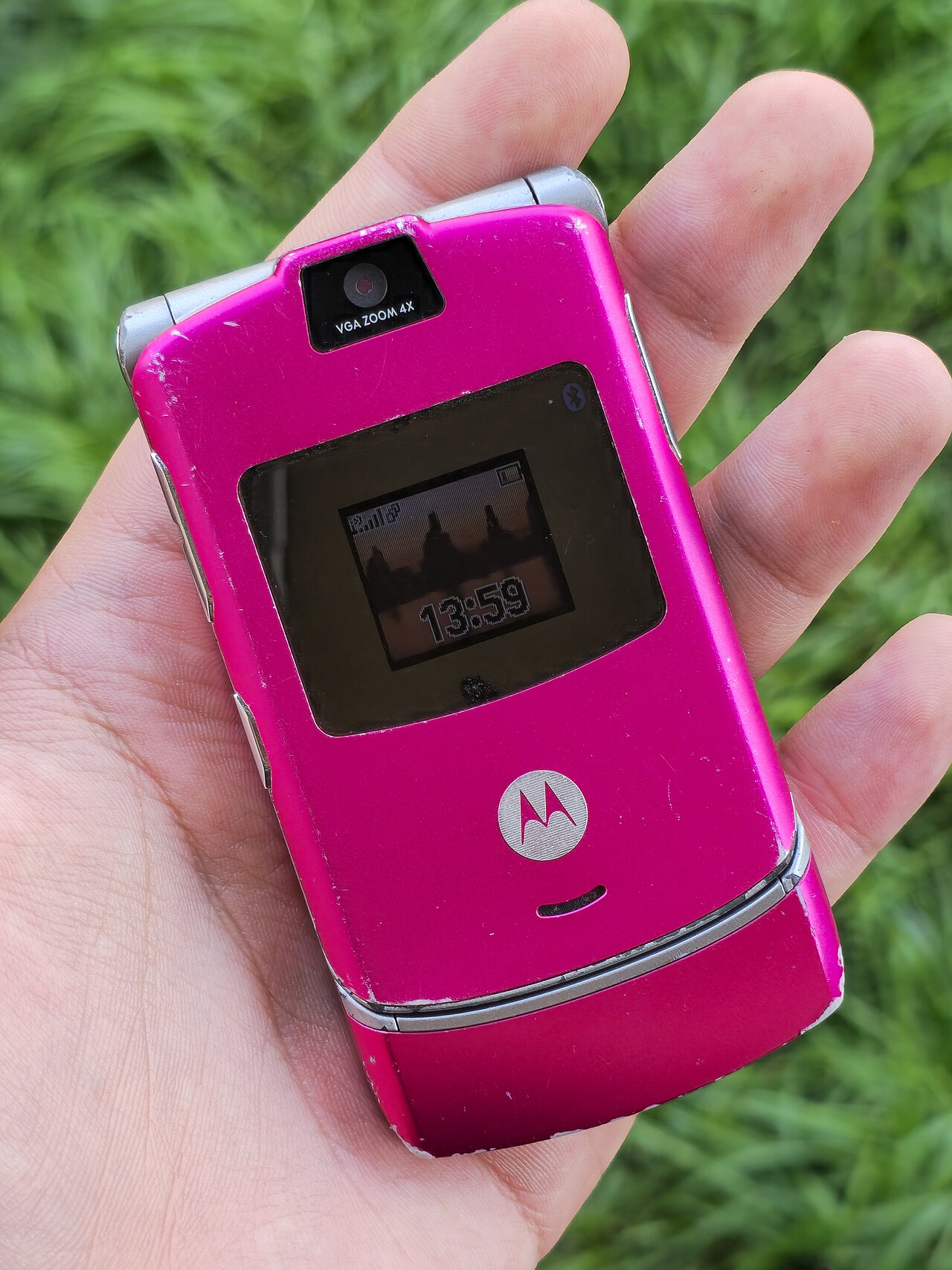
Motorola had one more huge hit: the RAZR V3 (2004), an ultra-thin metal flip phone that became a global fashion sensation; the RAZR line sold around 130 million units over its four-year run, making it the best-selling clamshell phone. But the RAZR was a trap. Motorola milked the design for years with minor variations instead of investing in next-generation software, and it discounted the RAZR so aggressively to keep volume up that margins collapsed. When the smartphone era arrived, Motorola had a beautiful feature-phone and no platform.
Iridium: A $5 Billion Sky Full of Failure
Motorola’s most spectacular failure was Iridium, a constellation of 66 low-Earth-orbit satellites designed to provide telephone coverage anywhere on the planet, including the open ocean and the poles. Conceived in the late 1980s and launched in 1998 after roughly $5 billion in investment, Iridium was an engineering marvel and a business catastrophe. By the time it launched, terrestrial cellular networks had spread far faster and cheaper than anticipated; Iridium’s handsets were brick-sized, expensive, didn’t work indoors, and cost several dollars a minute. Iridium signed up a tiny fraction of its projected customers and declared bankruptcy in 1999, just nine months after going live, one of the largest bankruptcies of its era. The system was later bought for a pittance and survives serving militaries, aviation, and remote industries. Iridium became the textbook example of a technically sound system overtaken by a cheaper alternative before it could reach market. The full arc, including the constellation’s rescue and its second life as critical infrastructure, is told in Dead End: Iridium.
Breakup and the Google–Lenovo Endgame
The smartphone era finished Motorola as an independent consumer power. The company bet on Android relatively early, the Motorola Droid (Verizon, November 2009) was an important early Android flagship that helped establish the platform in the US, but it could not compete with Samsung’s scale or Apple’s brand, and it lost money heavily.
On January 4, 2011 Motorola split into two companies: Motorola Solutions (the original business of two-way radios, public-safety, and government communications, still a healthy company today) and Motorola Mobility (phones and set-top boxes). In August 2011 Google announced it would buy Motorola Mobility for $12.5 billion, closing the deal on May 22, 2012, a purchase driven largely by Motorola’s vast portfolio of mobile patents, which Google wanted as defensive ammunition in the smartphone patent wars. Google ran Motorola’s phone business briefly and unsuccessfully, then sold it to China’s Lenovo for $2.91 billion, a deal completed on October 30, 2014, keeping most of the patents. Under Lenovo, the Motorola brand continues to make Android phones, particularly in Latin America and budget markets.
Significance
Motorola embodies a recurring pattern in computing history: the company that invents a category is often not the one that dominates it long-term. Motorola created the cell phone, led two-way radio for generations, and built processors that ran the most important personal computers of the 1980s, yet it lost handsets to Nokia, then to Apple and Android; lost microprocessors to Intel; and burned billions on Iridium. The pieces that survive (Motorola Solutions in professional radio, the brand on Lenovo phones, the patents inside Google) are fragments of what was once one of the most important electronics companies in the world. For the chips that were its other legacy, see The Integrated Circuit Revolution; for the mobile shift that ended it, see The Mobile Computing Revolution.
📚 Sources
- Petrakis, Harry Mark: The Founder’s Touch: The Life of Paul Galvin of Motorola (McGraw-Hill, 1965)
- Agar, Jon: Constant Touch: A Global History of the Mobile Phone (Icon Books, 2013)
- Cooper, Martin: oral history and interviews on the first handheld cellular call — IEEE / Marconi Society
- Iridium satellite constellation — Wikipedia (Motorola’s $5bn build, the 1998 launch, and the 1999 bankruptcy)
- Finkelstein, Sydney & Sanford, Shade H.: “Learning from Corporate Mistakes: The Rise and Fall of Iridium” — Organizational Dynamics 29(2), November 2000, 138–148
- Motorola Solutions: “Our History”
- Motorola Solutions: “First Words from the Moon” (Apollo 11 unified S-band transponder)
- Wikipedia: Motorola Droid (Verizon launch, November 6, 2009)
- Wikipedia: Motorola Mobility (2011 split, Google and Lenovo transactions)
- Wikipedia: List of best-selling mobile phones (RAZR V3 sales)
- Image: Motorola RAZR V3 (Pink) - Front (Closed).jpg by Beamish4 (CC BY-SA 4.0), via Wikimedia Commons