Dave Cutler and Windows NT
Abstract
Dave Cutler is the rare engineer who built foundational operating systems at two different companies in two different eras: VMS at Digital Equipment Corporation in the 1970s, and Windows NT at Microsoft in the 1990s, the kernel that still underlies every copy of Windows shipped today. When DEC cancelled his PRISM/Mica project in 1988, Bill Gates personally recruited him; the portable, secure, from-scratch kernel his team delivered in 1993 quietly replaced the DOS lineage and became one of the most-deployed pieces of software in history. Cutler never stopped: in his sixties he led the AMD64 port of Windows, in his seventies he built the Azure hypervisor and the Xbox One host OS, and into his eighties he remained a Senior Technical Fellow at Microsoft, still writing code.
From DeWitt to DuPont
David Neil Cutler (born March 13, 1942, in Lansing, Michigan) grew up in nearby DeWitt and went to Olivet College on the strength of his athletics, graduating in 1965 with degrees in mathematics and physics. Football, he later said, taught him the work ethic; a knee injury ended any thought of playing professionally. He joined DuPont as an engineer, and it was there (running customer simulations in IBM’s GPSS-3 language on an IBM 7044) that he discovered he cared less about the simulations than about the machine running them. He resolved to get as close to the metal as possible: he wanted to build operating systems.
The DEC Years: RSX-11M and VMS
Cutler joined Digital Equipment Corporation in Maynard, Massachusetts in 1971. His first major system was RSX-11M (1973), a real-time operating system for the PDP-11 minicomputer that became famous for fitting a multitasking, multi-user kernel into brutally small memory, discipline that marked everything he built afterward.
In June 1975, DEC made Cutler, Dick Hustvedt, and Peter Lipman technical project leaders of “Starlet,” the software side of the 32-bit VAX program. The result was VMS, released with the VAX-11/780 superminicomputer in 1977–78: a system prized for reliability so extreme that VMS clusters would later post uptimes measured in years. VMS made the VAX the machine of choice for a generation of engineering and science, and made Cutler’s reputation. Along the way he also built PL/I and C compilers with a common runtime, kernel architect and compiler writer in one person, a combination that stayed rare.
Chafing at Massachusetts and at DEC management, Cutler extracted a concession in 1981: his own engineering lab, DECwest in Bellevue, Washington, which produced the MicroVAX I and the real-time system VAXELN. From 1986 DECwest worked on DEC’s next bet: PRISM, a RISC architecture, and Mica, its from-scratch operating system.
1988: The Most Consequential Hire in Microsoft’s History
In June 1988 DEC cancelled PRISM and Mica in favor of a MIPS-based workstation strategy. Cutler prepared to leave, and Bill Gates, who needed exactly what Cutler had just been building, recruited him personally. On October 31, 1988, Cutler joined Microsoft, negotiating to bring a core group of his DEC engineers (roughly twenty, including hardware designers) with him.
Their mission: a portable, from-scratch operating system for the 1990s. Cutler set three architectural goals that defined the project:
- Portability, written in C, hardware-dependent code isolated in a hardware abstraction layer (HAL), targeting multiple CPU architectures from day one
- Reliability, full protected memory; no application could take down the system, the structural opposite of DOS and Windows 3.x
- Personalities, subsystems allowing one kernel to present multiple APIs (OS/2, POSIX, and eventually Win32)
The project began as “NT OS/2” (the planned successor to the OS/2 system Microsoft was co-developing with IBM) initially targeting Intel’s i860 RISC chip, codenamed N10 (“N-Ten”), the most commonly cited origin of the letters NT (officially backronymed to “New Technology”). A persistent legend notes that incrementing each letter of VMS yields WNT, 2001-style; Cutler’s team treated it as a good joke, but the i860 story is the documented one. When Windows 3.0 became a runaway hit in May 1990, Microsoft pivoted: the new kernel would carry the Windows API, not OS/2’s, the final break with IBM (see Dead End: OS/2).
Windows NT 3.1 shipped on July 27, 1993, about 250 programmers, 5.6 million lines of code, roughly $150 million in development cost, supporting x86 and MIPS at launch with DEC’s Alpha following that September. G. Pascal Zachary’s book Showstopper! documented the death march and Cutler’s volcanic leadership style; he was as famous for profanity and punched walls as for the quality of his code. NT was initially a heavyweight niche product; a decade of hardware progress and the Windows XP merger of 2001 made Cutler’s kernel the one every Windows user runs (see The Windows Story).
The Engineer Who Wouldn’t Stop
Cutler refused every path into management that didn’t involve code. In his sixties he was instrumental in porting Windows to AMD64, the 64-bit x86 extension that beat Intel’s Itanium (see RISC vs. CISC), shipping in Windows XP Professional x64 and Server 2003 SP1. In 2006 he moved to what became Windows Azure, building the hypervisor underneath Microsoft’s cloud (see The Cloud Computing Era); he was publicly named a lead developer of Azure at the 2008 Professional Developers Conference. In 2012 he joined the Xbox team and architected the Xbox One host OS, the Hyper-V-based design that runs games and apps in separate virtualized partitions.
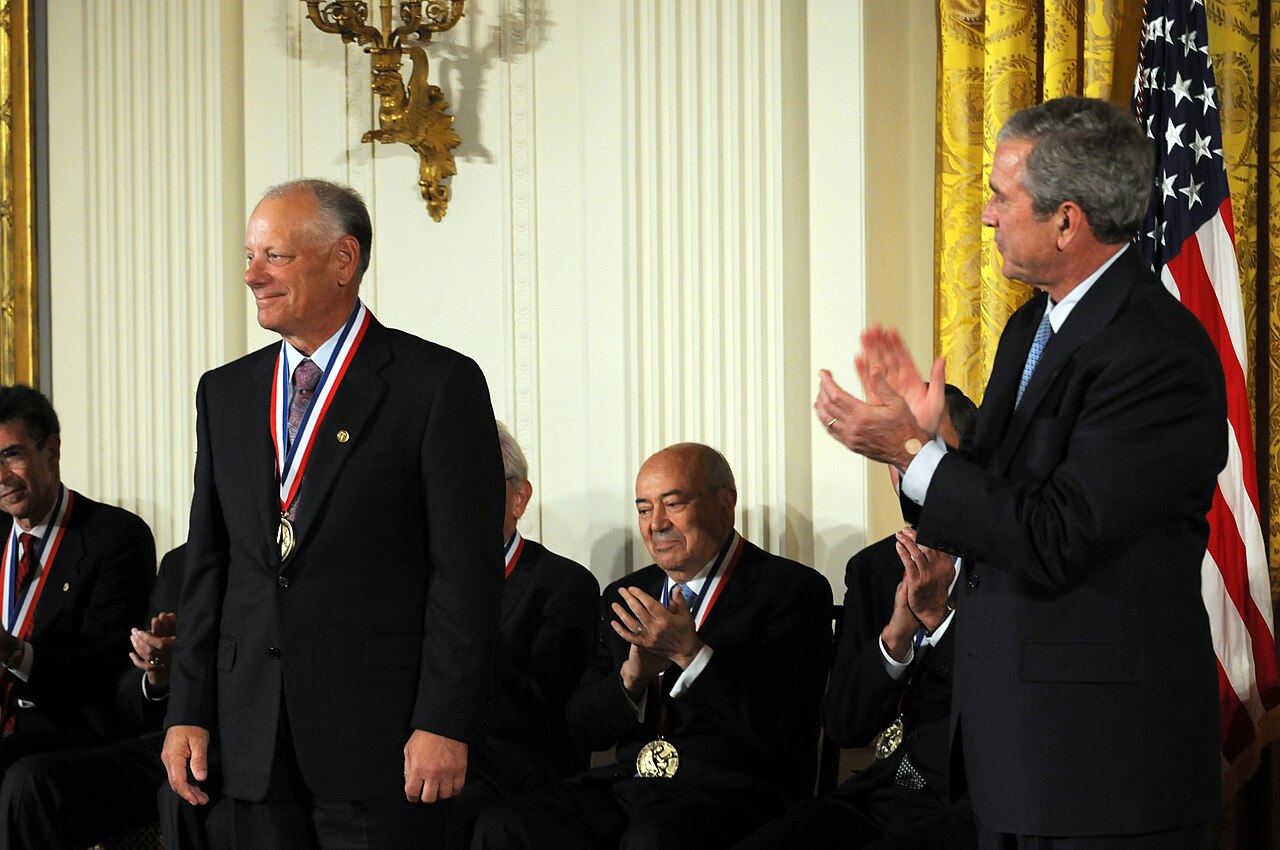
He was elected to the National Academy of Engineering in 1994, received the National Medal of Technology and Innovation for 2007 (presented at the White House in 2008), and was named a Computer History Museum Fellow in 2016, cited for fundamental contributions to computer architecture, compilers, operating systems, and software engineering. As of the mid-2020s he remained a Senior Technical Fellow at Microsoft, the company’s highest engineering rank, still checking in code in his eighties.
The other race
Engineering was not Cutler’s only outlet for intensity: from 1996 to 2002 he raced open-wheel cars in the Atlantic Championship series, with a career-best 8th place at the Milwaukee Mile in 2000, a fifty-something kernel architect competing against professional drivers half his age.
⚠️ Dead End: PRISM and Mica
DEC’s cancellation of PRISM/Mica in 1988 is one of computing’s great own goals. To save money and consolidate around a stopgap MIPS strategy, DEC killed its own next-generation RISC architecture and operating system, and lost the engineer who had built its crown jewel, VMS. The ideas didn’t die: PRISM’s lineage informed DEC’s Alpha (1992), and Mica’s design went to Redmond inside Cutler’s head, where it became Windows NT. DEC thus funded the R&D for its competitor’s future server OS, then watched NT-on-cheap-x86 eat the proprietary minicomputer market through the 1990s. Compaq bought what was left of DEC in 1998. The lesson recurs throughout the industry: cancelling a project does not cancel its engineers; they take the next decade of your roadmap out the door with them.
📚 Sources
- Computer History Museum: David Cutler — Fellow biography (2016)
- Computer History Museum: Dave Cutler oral history (2016)
- Microsoft: The engineer’s engineer — industry luminaries salute Dave Cutler
- G. Pascal Zachary: Showstopper! The Breakneck Race to Create Windows NT (1994)
- Wikipedia: Dave Cutler · Windows NT 3.1 · DEC PRISM · OpenVMS
- David N. Cutler — 2007 National Medal of Technology and Innovation Laureate