Cisco: The Company That Routed the Internet
Abstract
Cisco began as a workaround for a romance: a Stanford couple who could not email each other across campus built a box to connect incompatible networks. That box (the multi-protocol router) became the load-bearing hardware of the internet, and Cisco grew into a company so central that in March 2000 it was, briefly, the most valuable company on Earth. Along the way its founders were pushed out by their own investor, its certifications trained a generation of network engineers, and its growth-by-acquisition machine swallowed dozens of rivals. The technology of routing and the physical internet are covered in The Networking Hardware Story; this article is about the company.
A Router Born of a Love Story
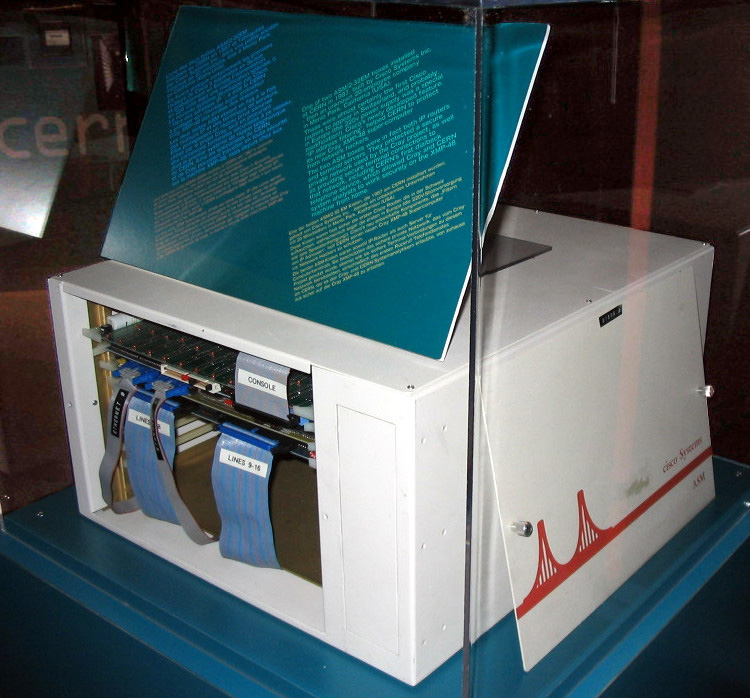
Cisco Systems was founded in December 1984 by Leonard Bosack and Sandy Lerner, a married couple who had met at Stanford. Both ran computer facilities in different buildings, and the networks in those buildings could not talk to each other, so they could not exchange email across campus. With colleagues they built a device that could forward packets between networks running different protocols: the multi-protocol router.
The hardware drew on work done at Stanford (which later led to a licensing settlement with the university over the technology’s origins). The name came from San Francisco; the logo is a stylized rendering of the city’s Golden Gate Bridge.
The timing was ideal. ARPANET had switched to TCP/IP in 1983, universities and corporations were wiring up fast, and nobody else sold a box that glued mismatched networks together. Cisco sold routers as quickly as it could build them, at first literally run out of the couple’s home.
Don Valentine and the Founders’ Exit
To scale, Cisco needed capital, and in 1987 the founders took $2 million from Don Valentine of Sequoia Capital, the financier behind Atari and Apple. The price was control. Sequoia took effective control of the company in late 1987 and installed a professional CEO, John Morgridge, in 1988.
The clash between the founders and professional management was bitter. On August 28, 1990, Morgridge asked Lerner to leave; Bosack quit in solidarity. The two sold their entire stake in December 1990 for about $170 million, a fortune, but a fraction of what the shares would soon be worth. Lerner later founded the cosmetics brand Urban Decay; Bosack funded scientific research. It is the archetypal Silicon Valley story: founders create the company, take the money, and lose the company to the people they hired to run it.
Cisco had gone public on February 16, 1990, months before the founders departed.
The Acquisition Machine and the Backbone Monopoly
Through the 1990s, under Morgridge and then John Chambers (CEO 1995–2015), Cisco did something unusual for a hardware maker: it grew mainly by buying technology rather than only inventing it. The 1993 acquisition of Crescendo gave Cisco its Catalyst switch line and pulled it beyond routers into the entire enterprise network. Over the decade Cisco acquired dozens of companies, absorbing whole product categories (switching, IP telephony, security, optical) and stitching them into one catalog.
By the mid-1990s Cisco controlled over 80% of the enterprise router market, and its IOS software was the de facto operating system of the internet’s backbone. It locked in that dominance through people as much as products: the CCNA and CCIE certifications trained and credentialed a generation of network engineers on Cisco gear, so that “knowing networking” came to mean knowing the Cisco command line.
Most Valuable Company on Earth
The dot-com boom turned the backbone supplier into the era’s emblem. If the internet was the future and Cisco sold the picks and shovels, then Cisco was the future. Its stock soared, and on March 27, 2000, Cisco passed Microsoft to become the most valuable company in the world, with a market capitalization of roughly $579 billion, trading at around 220 times earnings.
It was a bubble. When the dot-com crash came, Cisco’s customers (telecoms and startups that had massively over-ordered equipment) collapsed or stopped buying. In 2001 Cisco wrote off $2.2 billion in excess inventory and its share price fell by more than 80%. Cisco survived and remained the dominant networking company, but it never regained that peak valuation; its stock did not close at a new record again until December 2025, a quarter-century later. Cisco became Wall Street’s standard cautionary tale about confusing a great company with a great stock price, a comparison later revived against AI-boom hardware darlings.
⚠️ Dead End: Linksys and the Consumer Detour
Cisco’s instinct was always to buy its way into adjacent markets, but not every market fit. In 2003 it bought Linksys to enter the consumer home-networking business: Wi-Fi routers on the shelf at the electronics store. The idea was to put the Cisco brand in living rooms, and Cisco even rebranded some home gear under its own name.
It did not work. Consumer networking was a low-margin, commodity business with retail dynamics alien to a company built on selling six-figure boxes to corporate IT departments. A 2010 attempt to turn home routers into a cloud-managed service drew a backlash from customers who did not want their router tied to a Cisco account. In 2013 Cisco sold Linksys to Belkin and retreated to the enterprise and service-provider markets it understood. The episode marked Cisco’s limits: dominance in selling infrastructure to professionals did not translate into selling gadgets to consumers, and the company was better off conceding the living room.
The Huawei Rivalry
Cisco’s most serious long-term challenger came not from Silicon Valley but from China. Huawei entered networking selling lower-cost routers and switches, and in 2003 Cisco sued it for copying Cisco’s IOS source code and documentation, a case settled in 2004. Huawei grew into a global infrastructure giant anyway, and the rivalry later became entangled in US–China security politics, with Huawei’s networking gear banned from several Western telecom networks on national-security grounds.
Legacy
Cisco no longer defines the internet the way it did in 2000, software-defined networking, cloud providers building their own hardware, and white-box switching have all eroded the old monopoly. But the basic shape of the network it built endures: the routers, the switches, the certified engineers, and the assumption that connecting the world is a thing you buy from a vendor. A box two people built so they could send each other email became, for a moment, the most valuable company on the planet, and remains the company through which much of the internet still flows.
📚 Sources
- Britannica Money: Cisco Systems, Inc. — History & Facts
- Business Insider / Yahoo Finance: How Cisco’s Founders Were Ousted
- Wikipedia: Don Valentine · Cisco · Linksys
- Harding Loevner: Nvidia and the Cautionary Tale of Cisco Systems
- CNBC: Cisco’s stock closes at record for first time since dot-com peak in 2000
- Image: Ciscosystemsrouteratcern.jpg by Coolcaesar (CC BY-SA 3.0), via Wikimedia Commons