Sony: From Rice Cooker to PlayStation
Abstract
Sony is the company that taught the world to take Japanese electronics seriously. Founded in the ruins of postwar Tokyo in 1946, it began by trying to build a rice cooker and ended up defining consumer technology for half a century: the transistor radio that put electronics in a pocket, the Trinitron television, the Walkman that invented personal music, the Compact Disc, and the PlayStation, the console that reduced Nintendo to second place and turned a film-and-music conglomerate into the dominant force in gaming. Sony’s history is a study in industrial design, marketing genius, and a recurring weakness: a tendency to bet on proprietary formats (Betamax, MiniDisc, Memory Stick, UMD) that lost to open standards, and a slowness to adapt to software, the internet, and the smartphone.
Tokyo Tsushin Kogyo
In May 1946, in a bombed-out department store in Tokyo, engineer Masaru Ibuka and physicist Akio Morita founded Tokyo Tsushin Kogyo (Tokyo Telecommunications Engineering Corporation). One of their first product ideas was an electric rice cooker; it failed. Their first commercial success was a tape recorder.
The turning point came in 1953, when Morita negotiated a transistor license for $25,000 from Western Electric, the AT&T subsidiary that held the Bell Labs patents. The fee was close to the company’s entire capital, and the contract only took effect in 1954 after Japan’s MITI released the foreign currency. In August 1955 the company released the TR-55, one of the first commercial transistor radios, and in 1957 the TR-63, a pocket-sized transistor radio that became a global hit. To sell it in America, Morita coined a brand name that was easy to pronounce in any language: Sony, from the Latin sonus (sound) and the slang “sonny boy.” The company renamed itself Sony in 1958.
Akio Morita’s insistence on a single global brand and his decision to establish Sony in America early made Sony the first Japanese consumer-electronics company to become a household name in the West, and a symbol of Japan’s transformation from maker of cheap goods to maker of premium technology.
The Walkman and a Culture Shift
Sony’s defining product was not a technical breakthrough but a behavioral one. The Walkman, released in 1979, was a portable cassette player with no recording function and no speaker, just headphones. Sony’s own marketers doubted a playback-only device would sell. It became one of the best-selling consumer products in history and, over its life, sold hundreds of millions of units across cassette, CD, and digital versions.
The Walkman invented personal, mobile music, the idea that listening could be a private experience carried anywhere. It reshaped how a generation related to music and prefigured the iPod and the smartphone. The word “Walkman” entered dictionaries as a generic term.
Trinitron, the CD, and Format Wars
Sony’s Trinitron color television (1968) used a distinctive aperture-grille picture tube that produced brighter, sharper images than competing shadow-mask sets. Trinitron dominated premium television and computer-monitor markets for three decades. In 1973 it won Sony a technical Emmy, the first ever given to a consumer-electronics product.
In partnership with Philips, Sony co-developed the Compact Disc, launched in 1982, the first mass-market digital consumer format, which displaced the vinyl record and the cassette and became the foundation of the digital music era. The CD was Sony’s great triumph in open standards: by collaborating with Philips and licensing the format widely, Sony made it a universal standard.
Myth: Betamax lost to VHS despite being technically better
Sony’s Betamax (1975) did launch with an edge over JVC’s VHS (1976): about 250 lines of horizontal resolution to VHS’s 240, with less noise. The edge was marginal and brief. A Betamax cassette held only one hour, too short for a feature film or a football game. When Sony added a two-hour mode (Beta II) to match VHS, resolution dropped to 240 lines and the advantage vanished. The feature buyers actually wanted, recording time, was VHS’s genuine technical lead, and JVC licensed the format broadly (RCA, Panasonic, Korean makers who pushed VCR prices under $200 by 1986) while Sony kept Betamax proprietary. VHS held 60% of North America by 1980 and 90% by 1987; Sony started building VHS machines itself in 1988. “Better technology beaten by marketing” is the comforting version; VHS was better at the thing that mattered. Sony ran the proprietary-format pattern again with MiniDisc (1992), Memory Stick (1998), ATRAC audio, and UMD discs for the PSP, all losing to open alternatives (MP3, SD cards, standard codecs), before finally winning one with Blu-ray over Toshiba’s HD DVD in 2008. See Myths and Misconceptions.
Content: Music and Movies
Akio Morita concluded that hardware alone was vulnerable: Sony needed content to drive its devices. Sony bought CBS Records in 1988 (becoming Sony Music) and Columbia Pictures in 1989 for $3.4 billion. The film purchase was, at the time, a controversial symbol of Japanese money buying American culture, and Sony Pictures lost enormous sums in its early years under poor management.
Over the long run, however, the content strategy paid off. Sony Music and Sony Pictures became major global entertainment businesses, and Sony’s later success rested on the combination of hardware, content, and services, a vertical integration that prefigured Apple’s and Amazon’s media strategies.
The PlayStation Empire
Sony’s most consequential move into computing came from a broken partnership. In the late 1980s, Sony engineer Ken Kutaragi worked with Nintendo on a CD-ROM add-on for the Super Nintendo. Nintendo abruptly killed the deal in 1991, humiliating Sony publicly by announcing a rival partnership with Philips. Kutaragi convinced Sony’s leadership to turn the abandoned project into a standalone console.
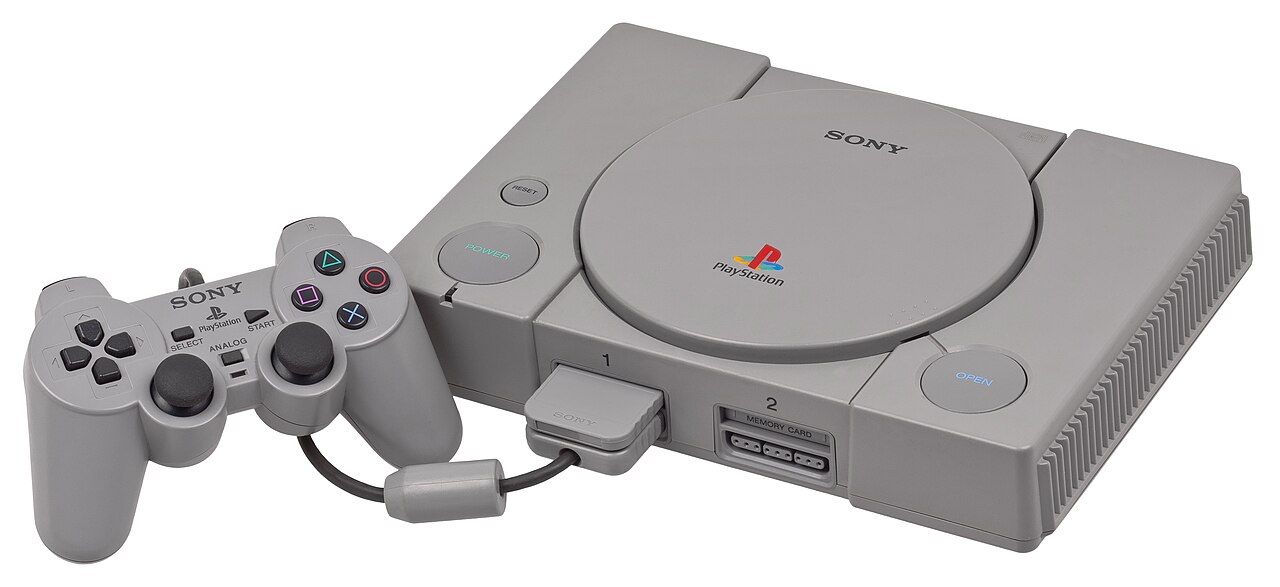
The PlayStation launched in 1994 (Japan) and 1995 (West). It used CD-ROMs instead of cartridges, cheaper to manufacture, higher capacity, and friendlier to third-party developers. Sony courted developers aggressively, marketed the console to adults rather than children, and made gaming culturally cool. The PlayStation outsold Nintendo and drove Sega from the console hardware business.
- The PlayStation 2 (2000) became the best-selling video game console of all time, with 160 million units sold by the end of production in 2013. It doubled as an affordable DVD player, which accelerated DVD adoption.
- The PlayStation 3 (2006) stumbled at launch, expensive, hard to program (the Cell processor), and late, but its inclusion of a Blu-ray drive helped Sony win the high-definition disc format war.
- The PlayStation 4 (2013) and PlayStation 5 (2020) restored Sony’s dominance, anchored by exclusive games and a strong developer ecosystem.
PlayStation transformed Sony’s identity. By the 2010s, the games division (Sony Interactive Entertainment) was one of the company’s largest profit sources. For the broader rivalry, see The Video Game Console Wars and The Video Game Industry.
The Lost Decade and Reinvention
The 2000s were difficult. Sony, the company that invented the Walkman, lost the portable-music market to Apple’s iPod, beaten by Apple’s combination of the iTunes Store and a simple device, while Sony fragmented its efforts across proprietary ATRAC formats and infighting between its hardware and music divisions (the music side feared piracy and crippled the hardware side’s products). Sony’s televisions lost ground to Samsung and LG; its phones never became a global force.
A low point was the 2005 BMG copy-protection rootkit scandal, in which Sony Music CDs secretly installed hidden software on customers’ Windows PCs that created security vulnerabilities, a public-relations disaster that symbolized a company prioritizing content control over customers. In 2014, the Sony Pictures hack (attributed to North Korea, in retaliation for the film The Interview) leaked vast amounts of internal data.
Under CEOs Howard Stringer and especially Kazuo Hirai and Kenichiro Yoshida, Sony restructured around its strengths: gaming, image sensors, music, and movies. Today Sony is the world’s dominant maker of CMOS image sensors (the chips in most smartphone cameras, including the iPhone’s) a quiet, highly profitable business that makes Sony a critical supplier even to its rivals.
Significance
Sony’s arc runs through the entire consumer history of electronics and computing: the transistor that miniaturized hardware, the personal-music revolution, the optical-disc formats that carried software and media, and the game console that became one of the most important computing platforms in the home. Its recurring failure (betting on closed formats and being slow to embrace software and the internet) is as instructive as its triumphs. For the music-format transitions Sony helped drive and then lost, see The Digital Music Revolution. For Sony’s place in Japanese industry, see Japan’s Computing Industry.
📚 Sources
- Morita, Akio: Made in Japan: Akio Morita and Sony (E.P. Dutton, 1986)
- Nathan, John: Sony: The Private Life (Houghton Mifflin, 1999)
- Sony Group Corporation: “Sony History”
- Russell, Jeff: “The Rise of the PlayStation” — IGN retrospective
- “Sony BMG CD copy protection scandal” — Electronic Frontier Foundation analysis
- Computer History Museum: “1952: Bell Labs Licenses Transistor Technology” — Western Electric licensing terms and the $25,000 fee
- IEEE Spectrum: “The Consumer Electronics Hall of Fame: Sony Trinitron” — 1968 launch and the 1973 technical Emmy
- PlayStation 2 — Wikipedia — 160 million lifetime units
- Videotape format war — Wikipedia — Betamax vs VHS resolution figures, recording-time tradeoff, licensing, and market-share timeline