John Hopfield and Neural Networks
Abstract
John Hopfield is a Princeton physicist who in 1982 described associative memory as an energy minimization problem, drawing on concepts from the physics of spin glasses to explain how a network of neurons could store and retrieve patterns. His work inspired Geoffrey Hinton’s Boltzmann machine, laid mathematical foundations that would not be fully appreciated for decades, and was ultimately recognized as the conceptual ancestor of the self-attention mechanism powering modern Transformer networks. In 2024, at age 91, he shared the Nobel Prize in Physics with Geoffrey Hinton, a recognition awarded forty-two years after the paper that earned it.
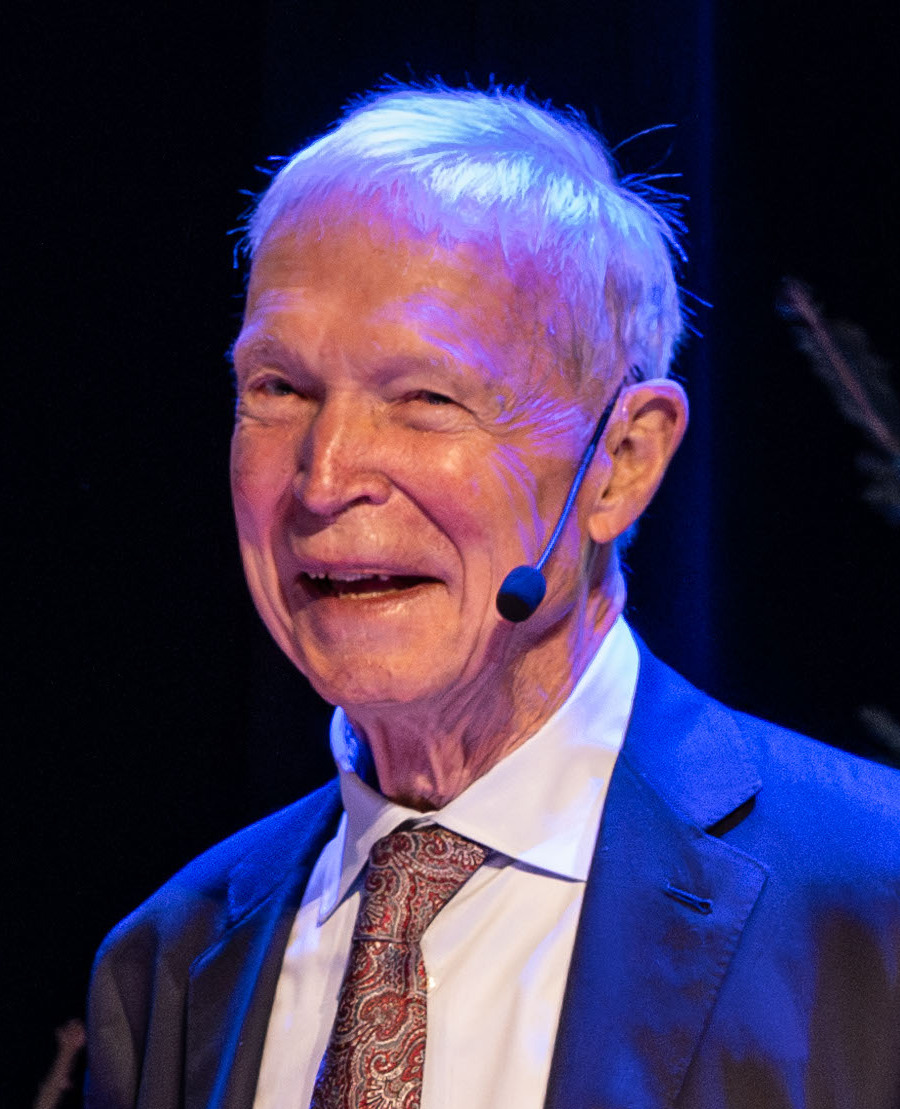
A Physicist Who Followed His Curiosity
John Joseph Hopfield was born on July 15, 1933, in Chicago, the son of a physicist. The career that followed was the career of a serious theorist who moved freely between problems: condensed matter physics at Cornell (where he earned his doctorate in 1958), biophysics at Bell Labs, molecular biology at Berkeley, and eventually neuroscience at Caltech and Princeton. He was known among colleagues as someone who could look at a biological system and ask the physicist’s question: what energy function is this minimizing?
That question (deceptively simple, enormously powerful) would eventually produce the work for which he became famous. But in the 1970s, when Hopfield began thinking seriously about memory, there was no obvious reason to expect a physicist to contribute anything important to a problem that had occupied psychologists, neurophysiologists, and the nascent field of artificial intelligence for decades. He was an outsider by every measure that academia tracks.
The outsider status turned out to be the point.
Hopfield had become interested in how biological systems (sensory systems, brains) processed information in ways that were robust to noise and capable of completion from partial inputs. The smell of bread recalling a whole childhood scene. A half-heard melody completing itself in the mind. These were phenomena of associative or content-addressable memory: the ability to retrieve a complete pattern from a fragment of it, without knowing in advance where the pattern was stored. Digital computers stored information at explicit addresses and retrieved it by address. Biological memory seemed to work entirely differently, and the theoretical account of how it worked was unsatisfying.
What Hopfield saw, looking at this problem from a physicist’s perspective, was a relaxation problem. He had spent years studying systems that evolved toward equilibrium, magnetic materials finding their minimum-energy configuration, proteins folding to their lowest free-energy state. Memory retrieval, he suspected, might be the same kind of process. Present a partial pattern; let the system relax to equilibrium; the equilibrium state is the stored memory.
The 1982 Paper: Memory as an Energy Landscape
The paper that made Hopfield’s name appeared in the Proceedings of the National Academy of Sciences in April 1982. Its title was characteristically measured: “Neural Networks and Physical Systems with Emergent Collective Computational Abilities.” It was eight pages long and mathematically elegant. It has been cited more than 20,000 times.
The model was simple enough to describe in a paragraph. Consider a network of N neurons, each of which can be in one of two states: firing (+1) or silent (-1). Every pair of neurons is connected by a symmetric weight. Hopfield defined an energy function for the network (analogous to the Hamiltonian of a physical system) such that the network’s total energy depended on the product of connected neurons’ states and the weight between them. The dynamics were simple: each neuron updated its state to minimize its local contribution to the total energy. The key result was that these local updates were guaranteed to decrease the global energy monotonically. The network always moved downhill and always settled at a local energy minimum.
Info
The analogy Hopfield drew was to spin glasses, disordered magnetic materials in which the interactions between magnetic spins are random and sometimes contradictory. A spin glass settles into one of many possible low-energy configurations depending on initial conditions, and retrieving a stored configuration is analogous to converging to a particular energy minimum. This connection imported the entire mathematical apparatus of spin glass theory (developed by Sam Edwards, Phil Anderson, Giorgio Parisi, and others through the 1970s) into the study of neural networks. Parisi would himself win the Nobel Prize in Physics in 2021 for work on spin glasses.
The memories were the energy minima. To store a set of patterns, you chose the weights using a Hebbian rule, strengthen connections between neurons that are both active in the stored pattern, weaken connections between neurons that differ. Done correctly, each stored pattern became a local minimum of the energy function. To retrieve a memory, you initialized the network in a state close to one of the stored patterns (a partial or corrupted version) and let it evolve. The network would converge to the nearest energy minimum and thereby complete or correct the input.
This was content-addressable memory: you queried it by content, not by address. The storage capacity was quantitative and testable: a network of N neurons could reliably store approximately 0.14N patterns. Beyond that threshold, the energy minima would begin to overlap and retrieval would fail.
The paper arrived at a difficult moment for neural network research. The Minsky-Papert book of 1969, Perceptrons, had demonstrated fundamental limitations of single-layer networks and had effectively driven funding away from connectionist approaches through most of the 1970s. Hopfield’s paper did not directly address those critiques (his networks were recurrent and associative, not the feedforward classifiers that Minsky and Papert had analyzed) but it demonstrated that rigorous, productive science could be done in this framework. It gave the field renewed credibility and a precise mathematical language.
The Boltzmann Machine: Extending the Framework
The 1982 paper described a deterministic network converging to stored memories. It was a retrieval system, not a learning system: the weights had to be programmed by hand using the Hebbian rule. The extension to learning (to discovering patterns in data rather than being told what to store) required something more.
Geoffrey Hinton read Hopfield’s paper and saw the extension he wanted to build. In 1985, Hinton and Terrence Sejnowski published the Boltzmann machine: a Hopfield network extended with hidden units (neurons not connected to input or output, representing internal features of the data) and trained using a stochastic learning rule derived from statistical mechanics.
In a Boltzmann machine, neurons did not update deterministically to minimize energy. They accepted higher-energy states with a probability governed by a temperature parameter, an approach borrowed from simulated annealing, the optimization technique derived from the physical process of slowly cooling a material to its ground state. This stochasticity allowed the network to escape local minima during learning, searching for better energy configurations rather than settling in the first valley it found.
The learning rule was elegant: adjust weights to reduce the difference between the statistics of the network running freely (the model’s distribution) and the statistics of the network running with data clamped to the visible units (the data distribution). At equilibrium, these two distributions matched, meaning the network had learned the structure of the data.
Info
The computational cost of training Boltzmann machines was prohibitive on 1985 hardware. Bringing the network to thermal equilibrium required running it for many time steps twice per weight update. Hinton spent the following two decades looking for tractable approximations, ultimately arriving at the Restricted Boltzmann Machine and the contrastive divergence learning algorithm, which made deep belief networks practical in 2006. The Boltzmann machine was the step that made the program concrete; the efficiency came later.
The Boltzmann machine established a lineage: Hopfield (1982) provided the energy framework and the physics vocabulary; the Boltzmann machine added hidden units and statistical learning; restricted Boltzmann machines and deep belief networks made large-scale training possible; deep learning transformed industry. Hopfield’s physics intuition was at the root of this entire chain.
The Long Wait: Forty Years to Full Recognition
Through the 1990s and 2000s, the Hopfield network occupied an honored but somewhat historical place in the neural network literature. It was taught in courses as a beautiful theoretical result, cited in reviews of the field’s history, but not actively developed as a research program. The energy landscape framework had fertilized the connectionist revival of the mid-1980s and then receded as backpropagation and, eventually, gradient descent on feedforward networks became the dominant paradigm.
The revival came unexpectedly. In 2016, Dmitry Krotov and Hopfield published “Dense Associative Memory for Pattern Recognition,” showing that by using polynomial rather than quadratic energy functions, Hopfield networks could store exponentially more patterns, storage capacity could scale as an exponential function of N rather than linearly. The paper was a direct extension of the 1982 framework and went largely unnoticed outside the neural network theory community.
Then, in 2020, came the paper that made the connection explicit. Hubert Ramsauer and colleagues at the Johannes Kepler University Linz published “Hopfield Networks is All You Need”, a title deliberately echoing the Transformer paper “Attention is All You Need” from 2017. The paper showed something remarkable: the update rule for a continuous-state Hopfield network with an exponential energy function was mathematically identical to the scaled dot-product self-attention mechanism used in Transformer neural networks.
Info
In a Transformer, self-attention computes, for each position in a sequence, a weighted average of value vectors from all positions, where the weights are computed as the softmax of dot products between a query vector and a set of key vectors. The 2020 paper proved that this is precisely the fixed-point update of a modern Hopfield network: the stored patterns are the keys, the query is the retrieval cue, and the attention weights are the energy-gradient-derived retrieval probabilities. The Transformer’s central mechanism, invented in 2017 for practical engineering reasons, was a rediscovery of Hopfield’s 1982 theoretical framework.
This was a retroactive unification of two research traditions that had developed independently. The engineers at Google who designed the Transformer in 2017 were not thinking about energy minimization or spin glasses; they were looking for a mechanism that could relate distant positions in a sequence efficiently. Hopfield’s framework, derived from condensed matter physics in 1982, turned out to describe exactly what they had built.
Nobel Prize in Physics: The Physicist’s Vindication
On October 8, 2024, the Royal Swedish Academy of Sciences awarded the Nobel Prize in Physics to John Hopfield and Geoffrey Hinton “for foundational discoveries and inventions that enable machine learning with artificial neural networks.” Hopfield was 91 years old, one of the oldest Nobel laureates in the prize’s history.
The choice of Physics rather than Computer Science (there is no Nobel in Computer Science; the ACM Turing Award is the field’s highest honor) generated immediate commentary. Some physicists argued that the work was not physics but applied mathematics or computer science. Some AI researchers found it apt but mildly ironic that the Nobel Committee had chosen to honor connectionist neural networks (the paradigm that the AI mainstream had spent twenty years dismissing) with physics’s highest honor.
The Nobel Committee’s reasoning was explicit and worth quoting: Hopfield and Hinton had used “tools from physics to build methods that form the foundation of today’s powerful machine learning.” The energy landscape. The spin glass analogy. The statistical mechanics of the Boltzmann distribution. These were not decorative metaphors; they were the tools that made the mathematical work rigorous and productive.
In his Nobel lecture, Hopfield emphasized this point. He had not been trying to build an AI system in 1982. He had been trying to understand a physical system, a system that happened to be biological and happened to compute. The AI applications emerged from the physics, not the other way around. This, he argued, was exactly why the work belonged in physics.
The Outsider’s Framework
Hopfield’s career arc (from solid-state physics to biophysics to neuroscience to computation and back) illustrates a pattern that recurs throughout the history of computing and artificial intelligence. The most transformative conceptual advances have frequently come from researchers who arrived with frameworks from outside the field. Claude Shannon brought communication theory from electrical engineering. Norbert Wiener brought control theory from applied mathematics. Alan Turing brought mathematical logic. (See Alan Turing and the Enigma for another instance of this pattern.) Hopfield brought statistical mechanics.
What physicists bring specifically is a set of habits: looking for conserved quantities, for functions that are minimized, for symmetries that constrain the possible. These habits are not automatically useful (most physical intuitions about biological systems are wrong in detail) but they are productive in a specific sense: they generate precise, testable predictions before the experiments are done. Hopfield’s 1982 paper was not vague about what the network could do; it predicted a specific storage capacity, described specific failure modes, and gave a mathematical account that could be compared directly with experimental results on real neural systems.
The AI field in 1982 was not well-equipped to receive this kind of contribution. The dominant paradigm was symbolic (logic, explicit representation, search) and the connectionist revival was still small. Hopfield’s paper landed in the PNAS, not in an AI or computer science journal, and was more immediately influential in neuroscience than in computation. The AI community picked it up slowly, through the work of Hinton and others, and the full implications were not apparent until the Transformer connection in 2020.
This is a familiar story in the history of ideas: contributions that are recognized in retrospect as foundational were often received as peripheral at the time. The Nobel Prize awarded in 2024 for work done in 1982 is a record of that delay.
Legacy
The Hopfield network’s legacy is threefold. First, it demonstrated that rigorous physics could illuminate neural computation: that the brain’s information-processing properties could be analyzed with the same tools used to analyze magnetic materials. This legitimized the physics-of-computation research program that Hopfield pioneered and that continues today in statistical physics, information theory, and theoretical neuroscience.
Second, through the Boltzmann machine and its descendants, Hopfield’s energy framework provided the conceptual foundation for the deep learning revolution. Hidden units, probabilistic learning, generative models; these ideas run directly from Hopfield through Hinton and into the deep learning paradigm that now dominates the rise of artificial intelligence.
Third, the 2020 connection to Transformer self-attention showed that Hopfield’s physics was not just historically important but structurally present in the architectures running the AI systems of the 2020s. Every large language model, every vision transformer, every multimodal system uses attention mechanisms that are mathematically equivalent to Hopfield network retrieval. The physicist who looked at memory as energy minimization in 1982 described the mechanism that would eventually underpin systems processing hundreds of billions of words per day.
At 91, receiving a prize for work done at 49, Hopfield embodied a particular kind of scientific patience, not strategic patience, waiting for the right moment, but genuine patience, doing the work because the problem was interesting and letting the recognition come when it would.
📚 Sources
- Hopfield, J.J.: Neural Networks and Physical Systems with Emergent Collective Computational Abilities, PNAS 79(8), 1982
- Ackley, D.H., Hinton, G.E., Sejnowski, T.J.: A Learning Algorithm for Boltzmann Machines, Cognitive Science 9(1), 1985
- Ramsauer, H. et al.: Hopfield Networks is All You Need, ICLR 2021
- Krotov, D. and Hopfield, J.J.: Dense Associative Memory for Pattern Recognition, NeurIPS 2016
- Nobel Prize Committee: Scientific Background: John Hopfield and Geoffrey Hinton, Royal Swedish Academy of Sciences, 2024
- Amit, D.J.: Modeling Brain Function: The World of Attractor Neural Networks, Cambridge University Press, 1989
- Sejnowski, T.J.: The Deep Learning Revolution, MIT Press, 2018
- Image: John J. Hopfield, 2024 Nobel Prize Laureate in Physics 1 (cropped).jpg by Arthur Petron (CC BY-SA 4.0), via Wikimedia Commons