India's IT Industry
Abstract
India had a computer before it had an industry: a British machine at the Indian Statistical Institute in 1956, a home-built one at TIFR in 1960, and two decades of state-owned computing before IBM walked out in 1978. From the 1990s, a country with inadequate roads, unreliable electricity, and a per-capita income below the sub-Saharan African average became the world’s back office for technology work. The reasons trace to a specific combination of policy decisions, a single crisis, a diaspora network, and the structural economics of software labor, a combination that produced Infosys and Wipro, redefined how American companies built their engineering organizations, and eventually produced engineering graduates by the million each year.
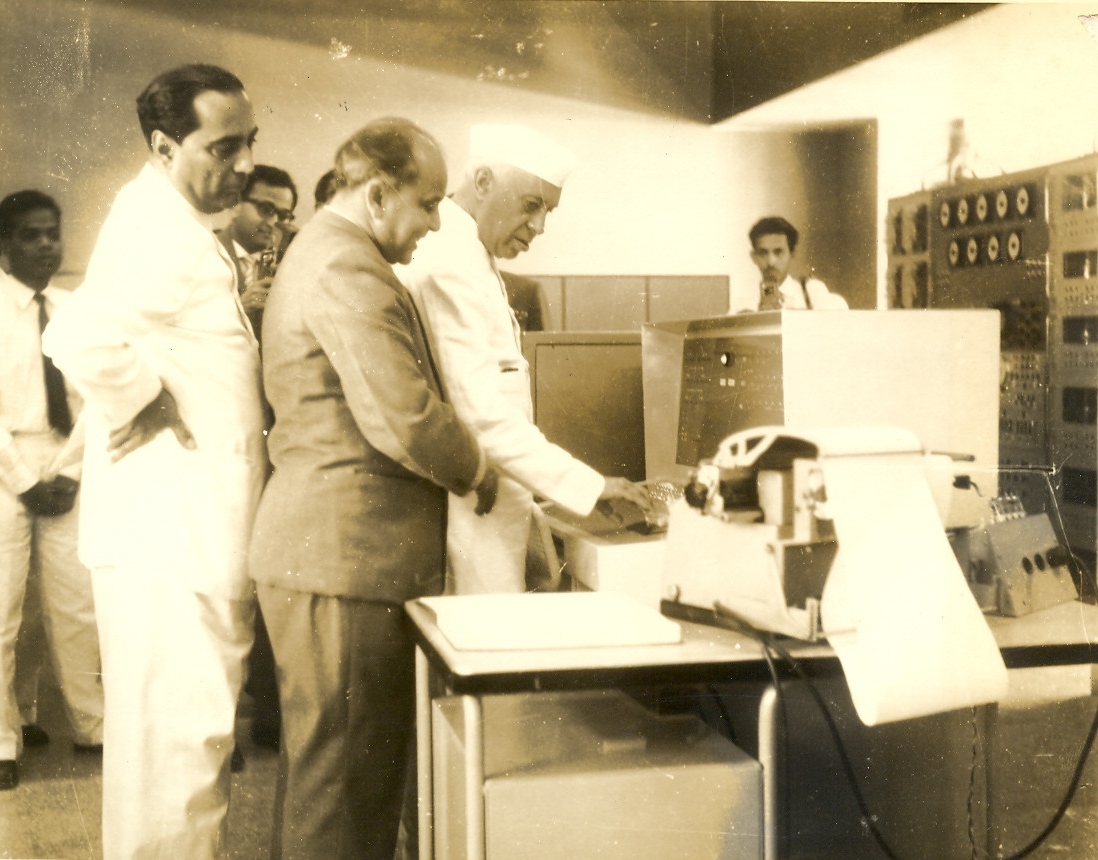
The First Computers, 1956–1978
India’s first computers arrived by ship and by statistics. P. C. Mahalanobis’s Indian Statistical Institute in Calcutta, which was doing the arithmetic for the Five-Year Plans, had built an analog machine for linear equations under Samarendra Kumar Mitra, assembled from war-surplus and scrap parts: 110 potentiometers, solving systems of up to ten unknowns, demonstrated to Prime Minister Nehru in December 1953 and used until 1959. In 1955 the institute bought a HEC-2M from the British Tabulating Machine Company, a descendant of Andrew and Kathleen Booth’s designs with a drum of 1,024 words of 24 bits. It was the first digital computer in the country; Wikipedia has it running in 1956, the Heinz Nixdorf MuseumsForum in August 1955. A Soviet Ural, bought with United Nations support and run with the help of Soviet engineers because every manual was in Russian, followed at ISI in 1958 or 1959, and in the mid-1960s (sources give 1964 and 1966) the institute and Jadavpur University finished ISIJU-1, India’s first transistorised computer, used mainly for teaching. Among the institute’s visitors was Conway Berners-Lee, father of the web’s inventor, who spent two months there in 1958.
The first machine designed in India came from physics. Homi J. Bhabha’s Tata Institute of Fundamental Research in Bombay began a full-scale computer in 1955 on the pattern of the Princeton IAS machine, after a smaller pilot machine for testing circuits (operational in 1956 or 1957, depending on the source), under Rangaswamy Narasimhan: 2,700 valves, 1,700 germanium diodes, 2,048 words of 40 bits in ferrite core, the main frame eighteen feet long. It went into operation in 1960 and Nehru gave it the name TIFRAC (Tata Institute of Fundamental Research Automatic Calculator); the Heinz Nixdorf MuseumsForum dates his formal inauguration to 1962. It served until 1965 and was not followed by a TIFRAC II; the institute bought its next machine abroad, a Control Data 3600 in 1964. Business computing had started in the meantime: Esso’s Bombay office installed an IBM 1401 in 1961, the first computer in an Indian company.
Teaching came through Kanpur. Under the Kanpur Indo-American Programme, a consortium of nine American universities (MIT, Berkeley, Caltech, Princeton, Carnegie Mellon, Michigan, Ohio State, Case Western and Purdue) helped set up IIT Kanpur’s laboratories from 1962, and an IBM 1620 installed in 1963 carried India’s first computer-science courses, with Harry Huskey of Berkeley among the visiting faculty. The programme ended in 1972, partly over political tension between India and Pakistan; by 1971 Kanpur had its own M.Tech and PhD programme in computer science and engineering, the country’s first.
The state then tried to make computers itself. The Department of Atomic Energy set up the Electronics Corporation of India (ECIL) in Hyderabad on 11 April 1967 under A. S. Rao, and its TDC-312 and TDC-316 were the first Indian-built commercial digital computers. Tata Consultancy Services began selling computing services in 1968. The Computer Maintenance Corporation, CMC, was incorporated on 26 December 1975, and in 1978, when IBM left rather than dilute its equity under FERA (see below), CMC took over the maintenance of IBM machines at more than 800 sites, then wrote the railway reservation system IMPRESS that went live on 15 October 1985. The 1978 exit was the hinge: it opened the domestic minicomputer market to HCL, Wipro and DCM, which is where the founders of the export industry learned the trade.
The Foundation: IITs and an Educated Elite
India’s technology story begins not with companies but with institutions. The Indian Institutes of Technology, the first opened at Kharagpur in 1951 under Prime Minister Nehru, created a pipeline of rigorously trained engineers far larger than India’s own industry could absorb. The entrance exam (the JEE) became one of the world’s most competitive; acceptance rates below 1% ensured that IIT graduates were genuinely elite.
The problem was that India had almost no domestic technology industry to absorb them. The Indian government’s regulatory regime (popularly called the “License Raj”) made starting businesses, importing equipment, and scaling companies almost impossible. IBM shut its Indian operations in 1978 rather than comply with FERA requirements that it reduce its ownership stake to 40%. Texas Instruments, which opened a development centre in Bangalore in 1985, needed special government permission for a satellite link that would let its engineers send data to the US instead of shipping magnetic tapes by air.
The result was brain drain at scale. IIT graduates moved to the United States, Britain, and Germany, where technology industries could actually employ them. The Indian diaspora in Silicon Valley, in particular, became technically and financially influential in ways that would matter enormously in the 1990s.
Info
By 2000, Indian-born founders or co-founders led companies including Sun Microsystems (Vinod Khosla), Hotmail (Sabeer Bhatia), and Juniper Networks (Pradeep Sindhu). A 2007 study by Vivek Wadhwa, AnnaLee Saxenian and colleagues found that Indian immigrants had founded or co-founded 15.5% of the Silicon Valley technology and engineering start-ups of 1995 to 2005, more than any other immigrant group.
The Telecom Prelude: C-DOT and the Yellow Booths
Before software exports came dial tones. In 1984, the US-returned telecom engineer Sam Pitroda founded C-DOT (Centre for Development of Telematics) to design digital telephone exchanges for Indian conditions (heat, dust, and unstable power) after a career inventing digital switching technology in Chicago. C-DOT’s rugged rural exchanges made possible the yellow STD/PCO booths that put a public phone within walking distance of most Indians a decade before mobile telephony, and its designs were licensed to dozens of domestic equipment manufacturers.
Texas Instruments and the Satellite Uplink
Texas Instruments’ 1985 software development centre in Bangalore demonstrated the model. Once its dedicated satellite link was approved, its Bangalore engineers could work directly with engineers in Dallas, at a fraction of American salaries.
Other American companies noticed. The model was simple: hire trained Indian engineers in India, pay Indian salaries, a small fraction of US equivalents in the 1990s, and transmit code via telecommunications links. The risk (communication delays, time zone differences, coordination overhead) was real but manageable for certain categories of work.
Nasscom, the National Association of Software and Services Companies, was founded in 1988 to represent the emerging industry. The Indian government, recognizing software exports as a foreign exchange earner that required no physical commodity imports, created Software Technology Parks of India (STPI) in 1991, dedicated zones with reliable power, telecommunications infrastructure, and tax exemptions that Indian businesses otherwise could not access. The liberalization of the Indian economy in 1991, forced by a balance-of-payments crisis, removed many License Raj constraints.
Infosys and the Professional Model
N. R. Narayana Murthy founded Infosys in 1981 with six colleagues and ₹10,000 borrowed from his wife Sudha. The company’s bet was managerial: Indian software companies could offer Western-style professional processes, predictable delivery, and long-term client relationships at much lower cost than Western competitors.
Infosys was deliberately unusual in Indian corporate culture. It listed on NASDAQ in March 1999, the first Indian company to do so, which signalled to American clients that it met Western disclosure and governance standards. It issued stock options broadly, making many of its software engineers wealthy. From its Bangalore headquarters it built sprawling corporate campuses (including its vast Mysore training center) modeled explicitly on American technology company campuses.
Wipro’s path was different. Founded by Azim Premji’s father, M. H. Hasham Premji, as a vegetable oil company in 1945, it pivoted into technology hardware in the 1970s and software services in the 1980s. Tata Consultancy Services (TCS), founded in 1968 as a division of Tata Sons, grew from data processing for the Tata group into an external services business. These three companies (Infosys, Wipro, TCS) became the anchor institutions of what Indians called “IT services” and Americans called “outsourcing.”
Y2K
The Year 2000 computer problem gave India’s IT industry years of growth in a short time. It was well suited to the Indian IT model: it was well-defined, urgent, required enormous amounts of competent but not creative programming work, and carried enormous financial penalties for American companies that failed to fix it in time.
American corporations, facing an army of COBOL mainframe code that needed inspection and remediation line by line, could not hire domestic programmers fast enough. Indian IT companies had the bodies. TCS, Infosys, and Wipro each staffed hundreds of Y2K remediation projects for American financial institutions, insurance companies, and government agencies. The work was tedious (finding and fixing two-digit year fields in millions of lines of code) but it introduced Indian IT firms to the procurement processes, legal structures, and relationship networks of Fortune 500 companies.
When Y2K passed without catastrophe, many of those client relationships continued. The American companies that had outsourced Y2K work realized they could outsource other software development work on similar terms. The offshoring wave of the early 2000s was, in significant part, a Y2K aftereffect.
The H-1B Economy
The H-1B visa program, created by the Immigration Act of 1990, allowed American companies to hire foreign workers in “specialty occupations” (predominantly software engineering) on temporary work visas. The program was designed with Silicon Valley’s talent needs in mind: the technology industry had lobbied for it as a solution to a perceived domestic shortage of engineering talent.
The H-1B program created a triangular economy. Indian engineers on H-1B visas worked for American technology companies. Indian IT services companies (Infosys, Wipro, TCS, and later HCL) used H-1B visas to staff their American operations with employees who could work on-site with clients while remaining on Indian payrolls. The visa program became controversial because it allowed companies to simultaneously claim they could not find American workers and pay foreign workers wages below American market rates.
By the 2000s, Infosys and Wipro were among the largest recipients of H-1B visas annually. The structure created a labor market anomaly: Indian engineers in America on H-1B visas had limited ability to change employers (the visa tied to a sponsoring employer), which gave companies leverage over wages and working conditions that they would not have had with American citizens or green card holders.
Warning
The H-1B program’s design (capping visas at 65,000 annually but allowing companies to apply for far more than available) created a lottery system that was widely gamed. Body-shopping firms (companies that acquired H-1B visas and rented workers to clients) exploited the program’s design. The debate between “importing cheap labor” and “filling genuine talent gaps” was never resolved, because both were simultaneously true depending on the company and the role.
The Offshoring Wave
The 2001 dot-com crash accelerated Indian IT offshoring. American technology companies, facing pressure to cut costs after the bubble burst, adopted offshore development models that had previously been considered risky or experimental. Accenture, McKinsey, and IBM’s services division advised Fortune 500 clients to move application development, testing, and maintenance work to Indian vendors. The savings were large, because an engineer in Bangalore cost a fraction of one in San Jose.
The offshoring wave produced a model called the “Global Delivery Model”, a hybrid structure in which requirements definition and architecture happened in the United States, coding and testing happened in India, and delivery was managed across time zones. Infosys codified this as a systematic methodology; its Mysore training campus could on-board thousands of engineers annually into the model.
The social consequences in the United States were visible and politically charged. American software developers, particularly in industries like financial services, insurance, and healthcare IT, found their roles being eliminated or reclassified as “offshore-eligible.” The term “outsourcing” became a political negative. The 2004 US presidential campaign featured debates about “Benedict Arnold CEOs” who sent American jobs abroad.
In India, software engineering became the most sought-after career, and engineering college enrollment grew rapidly. A generation of Indian parents who had grown up under the License Raj told their children that software was the path to economic security. The boom created a new middle class in Bangalore, Hyderabad, and Pune, which built corporate parks, apartment complexes, and malls around it.
Beyond Services: The Product Question
For two decades, India’s IT industry was defined almost entirely by services, writing code and running systems for other companies’ products. The question of whether India could produce globally competitive technology products became a recurring debate.
The structural barriers were real. Services companies optimized for billing rates and utilization, the percentage of engineer-hours billed to clients. Product development requires extended periods of non-billable work, tolerance for failure, and a different compensation model (equity rather than salary). The cultural and managerial systems built for services were poor preparation for product development.
The 2010s produced partial answers. Flipkart, founded by IIT Delhi alumni Sachin and Binny Bansal in 2007, built India’s dominant e-commerce platform; Walmart paid $16 billion for roughly 77% of it in 2018, valuing the company at $20.8 billion. Ola became the domestic answer to Uber. Paytm, Zomato, and Razorpay built significant fintech and payments businesses. Freshworks became the first India-founded SaaS company to list in the United States, raising $1.03 billion on Nasdaq in September 2021 and closing its first day worth about $13 billion. Zoho, privately held and founded in Chennai, became a global competitor to Salesforce and Google Workspace.
But the category of globally dominant, frontier technology products (search engines, operating systems, cloud platforms, social networks) remained almost exclusively American (with Chinese equivalents for the Chinese market). Indian engineers led product teams at Google, Microsoft, and Adobe, and two of America’s most prominent technology CEOs were Indian-born engineers: Sundar Pichai at Google (an IIT Kharagpur graduate) and Satya Nadella at Microsoft (a graduate of Manipal Institute of Technology). The products those engineers built belonged to American companies.
The AI Wave and a New Inflection
The rise of large language models beginning in 2022 created a new strategic question for Indian IT. If AI could automate significant portions of routine software development and testing (the work that constituted the core of services business) the low-cost labor arbitrage that had driven India’s IT industry for thirty years would erode.
The response was varied. TCS, Infosys, and Wipro announced large investments in AI capability, positioning themselves as partners in “AI transformation” rather than providers of labor. The economics were uncomfortable: an industry built on the gap between Indian and American engineering salaries loses its advantage wherever software can do the entry-level work itself.
📚 Sources
- TIFRAC — Wikipedia
- Heinz Nixdorf MuseumsForum blog, “Computer in Indien” (9 August 2022) (Mitra’s analog computer, the HEC 2M and the Ural at ISI, Conway Berners-Lee’s visit, the CDC 3600, Esso’s IBM 1401)
- Indian Statistical Institute — Wikipedia (HEC-2M 1956, Ural 1959, ISIJU-1 1964)
- IIT Kanpur — Wikipedia (KIAP, IBM 1620 in 1963)
- Electronics Corporation of India Limited — Wikipedia
- CMC Limited — Wikipedia
- The World Is Flat — Thomas Friedman (2005), Farrar, Straus and Giroux
- Outsourcing’s Education Gap — Vivek Wadhwa, IEEE Spectrum
- Keniston, Kenneth & Kumar, Deepak (eds.): IT Experience in India: Bridging the Digital Divide (2004), Sage
- Mathur, Somesh K.: “Indian Information Technology Industry: Past, Present and Future” — conference paper (export figures, the Y2K years, and Nasscom projections)
- Offshoring — Wikipedia
- Flipkart Story — Mihir Dalal, Big Billion Startup (2021)
- Software Technology Parks of India — Wikipedia
- Wadhwa, Vivek; Saxenian, AnnaLee et al.: “America’s New Immigrant Entrepreneurs” (Kauffman Foundation, 2007)
- Infosys — Wikipedia (founding with ₹10,000, the 1999 NASDAQ listing)