The Nordic Tech Industry: Nokia, Linux, Spotify, and the Open Source North
Abstract
The Nordic countries (Finland, Sweden, Norway, Denmark, and the Baltic states) contributed to computing history with a disproportionate intensity for their combined population of roughly 33 million. Finland gave the world Nokia, which dominated mobile phones for a decade, and Linus Torvalds, who released Linux in 1991. Sweden gave the world Ericsson, which built much of the world’s mobile network infrastructure, and Spotify, which reinvented the music industry. Estonia gave the world Skype and a digital government so advanced that citizens vote online and file taxes in three minutes. Sweden produced MySQL, Minecraft, and Candy Crush. Norway produced the Opera browser. Denmark contributed LEGO’s digital transformation. The story starts earlier than the brand names suggest: Sweden’s BESK was briefly the fastest computer in the world in 1954, Denmark’s Regnecentralen wrote one of the first ALGOL compilers, and Norway’s Norsk Data was the country’s second most valuable company before it collapsed. The common threads, a high-trust social fabric, publicly funded research, small domestic markets that forced global ambition, and a culture of engineering pragmatism over entrepreneurial mythology, produced a technology ecosystem unlike any other.
State Computers of the 1950s
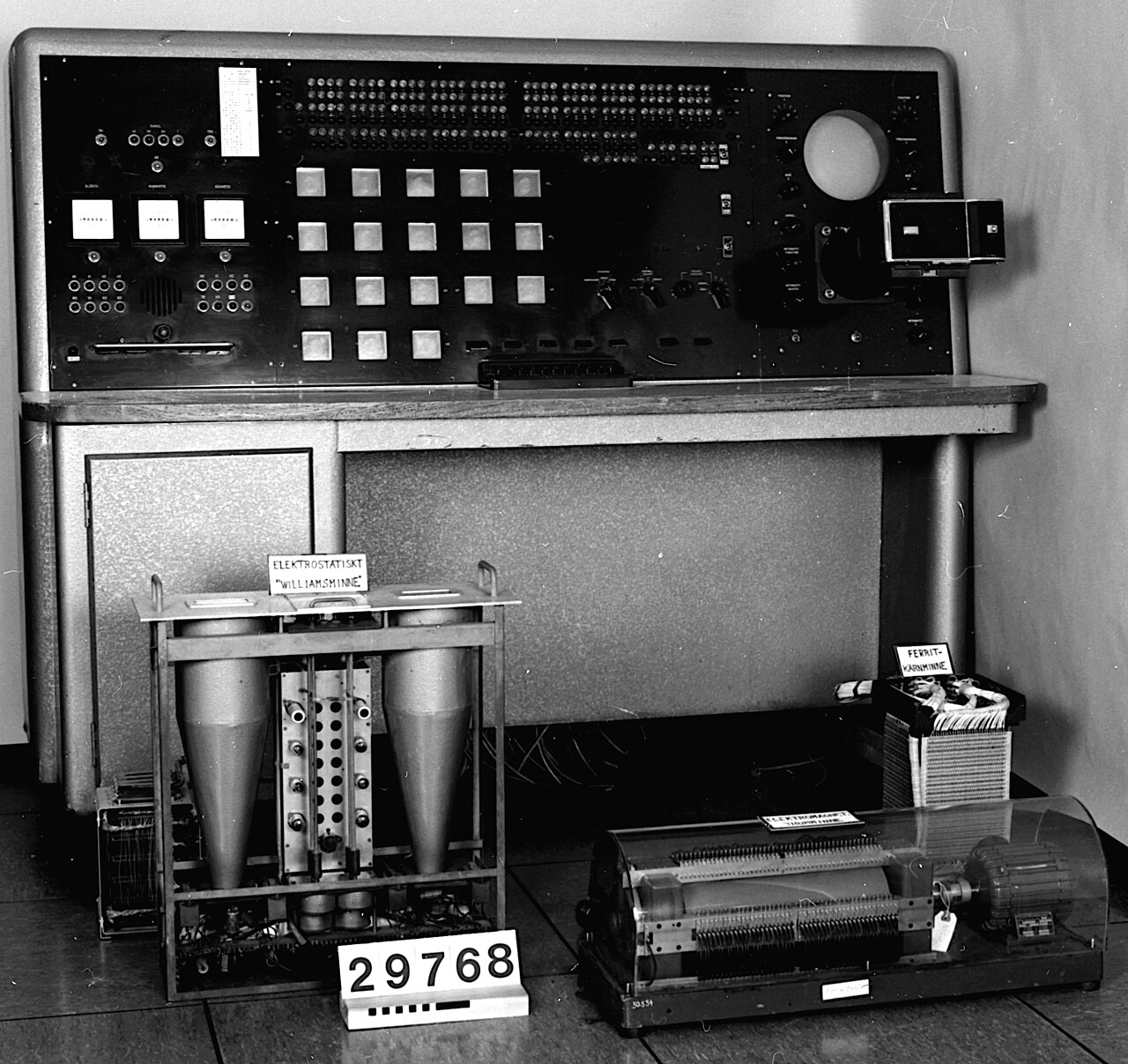
Every Nordic country built or bought its first computer through a state committee, and the four stories run in parallel. Sweden moved first. Matematikmaskinnämnden, the Swedish Board for Computing Machinery, was set up in 1948 and built the relay machine BARK in 1950, then BESK (Binär Elektronisk SekvensKalkylator) in rooms of the old Royal Institute of Technology on Drottninggatan in Stockholm. Erik Stemme led the hardware, Gösta Neovius and Olle Karlqvist designed the instruction set; the board’s first head, Conny Palm, died in December 1951 before the machine ran. BESK was completed in 1953 and inaugurated on 1 April 1954: 40-bit words, 512 words of Williams-tube memory, 2,400 vacuum tubes, an addition in 56 microseconds. For a few weeks it was the fastest computer in the world. In 1957 Hans Riesel used it to find a 969-digit Mersenne prime, then the largest prime known. The design was copied more than any other European machine of its decade: Facit built nine commercial versions, Lund University built SMIL, Saab built SARA, and Denmark built DASK. BESK ran until 1966 and its control panel and memory units are at Tekniska museet.
Denmark’s Regnecentralen was founded on 12 October 1955 as an institute under the Danish Academy of Technical Sciences, funded with Marshall Plan money that had originally been granted to the Danish military for cipher machines. Niels Ivar Bech ran it. The group rented a villa from Carlsberg at Bjerregårdsvej 5 in Valby, reinforced the floor, and built DASK in the dining room: 3.5 tonnes, 2,500 tubes, 1,024 words of core memory. Construction started in April 1956, the machine ran its first programs in 1957 and was inaugurated on 13 February 1958. It was used for the Danish parliamentary election of 15 November 1960. Its transistorised successor GIER was introduced on 14 September 1961, and Regnecentralen’s Peter Naur, who had edited the ALGOL 60 report, delivered a GIER ALGOL compiler with Jørn Jensen in August 1962 (see ALGOL and the ALGOL Family). About fifty GIERs went to Danish and foreign universities. The company’s full story is in Regnecentralen and GIER.
Norway built its first machine as a copy. NUSSE (Norsk Universell Siffermaskin, Sekvensstyrt, Elektronisk) was a version of Andrew Booth’s APEXC, assembled by Thomas Hysing, Ole Amble and Tor Evjen at the Central Institute for Industrial Research (SI) with parts shipped from England and most of the electronics rebuilt in Oslo. It ran from March 1954, starting with a program that played NIM, and stayed in service until 1961: about 1,000 tubes, 512 words of drum memory, roughly 500 additions per second. Odd Hassel used it for crystal chemistry and Ragnar Frisch for national-accounts work, which puts two later Nobel laureates on one drum machine. Its commercial legacy was AUTOKON, a ship-design program begun in 1958 that Kongsberg Våpenfabrikk took over in 1960 and sold to shipyards worldwide.
Finland’s story is the odd one out. The Matematiikkakonekomitea, set up on the initiative of Erkki Laurila at Helsinki University of Technology, decided in 1954 to build ESKO from the plans of Konrad Zuse’s G1a rather than copy the better Swedish BESK. The German plans turned out to be unfinished and contained errors the Finnish team had to fix, so ESKO was only completed in 1960. By then the Post Office Savings Bank had bought an IBM 650 in 1958 and nicknamed it “Ensi” (“First”). Finland’s first working computer was an import, and its home-built one went to a museum having done little work.
The Minicomputer Decades
The 1950s machines produced companies, and for twenty years three of them competed with the American minicomputer makers on their home markets. Datasaab grew out of Saab’s need for aircraft computers: it licensed the BESK design in 1954, finished SARA in 1957, and under Viggo Wentzel built the fully transistorised D2 in 1960 as a navigation computer prototype. The civilian D21 of 1962 sold about thirty units, and a Swedish government evaluation in the 1960s rated Datasaab’s machines above IBM’s for tax calculation. The CK37 flew in the Viggen fighter from 1971. The civilian line ended when the D23 ran late: Datasaab went into a joint venture with Sperry Univac in 1975 and was sold to Ericsson in 1981, where it became Ericsson Information Systems.
Regnecentralen’s RC 4000, designed in 1966 and completed the following year, would be a footnote among integrated-circuit minicomputers if not for its operating system. Per Brinch Hansen’s RC 4000 multiprogramming system separated a small nucleus from the policies built on top of it, the first working example of what was later called a microkernel, the idea Andrew Tanenbaum later argued for against Linux. Regnecentralen itself lasted into the 1980s with the Piccolo and Piccoline school computers; ICL bought half of it in 1988 and the company faded as RC International.
Norsk Data was founded on 8 August 1967 by Lars Monrad-Krohn, Per Bjørge and Rolf Skår, engineers who had built the SAM machines at the Defence Research Establishment at Kjeller. The NORD-1 of 1968 offered memory paging as a standard option; the NORD-5 of 1972 was a 32-bit machine years before DEC’s VAX; the NORD-10 (1973) and ND-500 (1981) ran on the SINTRAN operating system and sold to CERN in quantity from the SPS project onward. At its peak in 1987 Norsk Data employed more than 4,500 people and was, by market value, the second-largest company in Norway after Norsk Hydro. It then underestimated the personal computer and Unix workstations, lost its market in four years, and was bought by Telenor in 1992. In the same city and the same decade, the Norwegian Computing Centre produced Simula 67, presented in Oslo in May 1967 by Ole-Johan Dahl and Kristen Nygaard, the language that introduced classes and objects (see Simula and the Birth of OOP). Sweden’s equivalent software export came from Ericsson’s own laboratory: Erlang, first run in 1986, was built to keep telephone switches running for years without a stop.
Ericsson and the Infrastructure of Mobile Communication
L.M. Ericsson was founded in Stockholm in 1876 by Lars Magnus Ericsson, a telegraph repairman who began manufacturing telephones after inspecting a Bell telephone in 1876 and deciding he could build a better one. He was correct: Ericsson’s telephone handsets won contracts across Europe, and the company expanded into telephone exchanges, the switching equipment that connected telephone lines.
By the mid-twentieth century, Ericsson had become one of the world’s largest telecommunications equipment manufacturers. Its significance to computing history derives primarily from its role in mobile network infrastructure. Ericsson, working alongside Nokia and Motorola in the 1980s, helped develop GSM (Global System for Mobile Communications), the digital mobile standard that replaced analog cellular networks and became the global standard for second-generation mobile telephony. GSM’s adoption beginning in Finland in 1991 launched the modern mobile era.
Ericsson became one of the two dominant global suppliers of mobile network infrastructure (base stations, switching equipment, and the software that runs them) alongside Nokia’s networks division and later Huawei. When 3G, 4G, and 5G standards required entirely new physical infrastructure, network operators worldwide needed Ericsson’s equipment and expertise. By 2023, Ericsson’s equipment handled approximately 40% of global mobile network traffic.
The strategic importance of this position became politically visible when Western governments began restricting Huawei’s access to their networks in 2019–2020. Ericsson and Nokia (as infrastructure vendors, distinct from Nokia’s consumer phone business) were the primary beneficiaries, the only Western suppliers with the technology and scale to replace Chinese equipment. Sweden’s Ericsson found itself, somewhat reluctantly, at the center of a geopolitical technology conflict it had not anticipated.
Nokia: The Rise
Nokia began as a paper mill. Founded in 1865 on the Nokia River in southern Finland, it diversified into rubber products (galoshes, cable insulation) and then cable, eventually acquiring a consumer electronics division in the 1960s. By the 1980s, Nokia was a diversified conglomerate making paper, rubber boots, televisions, and mobile phones, a product it had entered almost accidentally through its cable division’s work on telephone infrastructure.
The transformation into a focused mobile phone company was the work of Jorma Ollila, who became Nokia’s CEO in 1992 and made the decisive choice to divest everything except mobile phones and telecommunications networks. In 1992, this was a bet against the consensus: Nokia’s paper and rubber businesses were profitable and its mobile phone division was a small fraction of revenue.
Nokia’s timing was extraordinary. GSM adoption accelerated across Europe through 1993–1995. Nokia’s phones (which combined technical reliability, intuitive user interface design, and physical durability) captured market share rapidly. The Nokia 1011, released in 1992, was the first mass-produced GSM phone. The Nokia 3310 (2000) became a cultural artifact: a phone of such physical indestructibility that it generated memes twenty years after its release. By 1998, Nokia was the world’s largest mobile phone manufacturer. By 2000, it held roughly 31% of the global market, a share that peaked near 40% in 2007–2008.
Nokia’s dominance at its peak was remarkable for a company headquartered in Finland, a country of five million people. Its market capitalization exceeded $250 billion in 2000, making it briefly the most valuable company in Europe. Finnish national identity became intertwined with Nokia’s success in ways that would make its later decline politically as well as economically painful.
Nokia: The Fall
Nokia’s collapse (from 40% market share in 2007 to near-irrelevance in smartphones by 2013) is one of the most studied failures in technology business history, and the lessons drawn from it remain contested.
The conventional account focuses on the iPhone. Apple’s launch of the iPhone in June 2007 introduced a touch-screen smartphone with a full operating system, a web browser that rendered real pages, and a software ecosystem (the App Store, launched 2008) that allowed third-party developers to extend the device’s functionality indefinitely. Nokia’s phones, optimized over fifteen years for voice calls and basic data, were structurally unsuited to compete.
The deeper account is more complicated. Nokia’s engineers had designed touchscreen smartphones internally, prototypes that resembled the iPhone predated Apple’s product. Nokia understood that smartphones were coming. What it lacked was the organizational culture to prioritize a product that would cannibalize its existing business, the software capability to build a competitive mobile operating system, and the executive decisiveness to make the disruptive bet before Apple made it for them.
Nokia’s internal operating system, Symbian, was designed for the hardware constraints of early mobile phones, limited memory, slow processors, tiny screens. When processors became fast enough and screens large enough to run a full operating system, Symbian’s architectural assumptions became liabilities rather than optimizations. Rewriting it was the obvious solution; executing that rewrite while simultaneously competing in a commodity phone market proved beyond Nokia’s capabilities.
In February 2011, newly appointed CEO Stephen Elop circulated an internal memo that became known as the “burning platform” memo, comparing Nokia’s strategic situation to a man standing on a burning oil platform who must jump into the freezing sea or burn. Elop announced a strategic partnership with Microsoft, committing Nokia’s smartphone line to Windows Phone as its operating system. The partnership was commercially unsuccessful: Windows Phone’s app ecosystem never achieved critical mass, and Nokia’s hardware quality was insufficient to overcome the platform disadvantage. Microsoft acquired Nokia’s handset division in 2013 for $7.2 billion and wrote down most of the investment within two years.
Linux: Linus Torvalds and the Accidental Operating System
On August 25, 1991, a twenty-one-year-old Finnish computer science student named Linus Torvalds posted to the Minix newsgroup:
“I’m doing a (free) operating system (just a hobby, won’t be big and professional like gnu) for 386(486) AT clones.”
The operating system Torvalds was writing in his Helsinki apartment had started as a terminal emulation program to access the university’s Unix machines. He had used Minix (a Unix-like system designed by Andrew Tanenbaum for teaching operating systems) and found it frustrating. He began writing his own kernel.
The decision to release it under a free software license (eventually the GNU General Public License) and to develop it collaboratively with contributors worldwide produced the most widely deployed operating system in history. Linux runs on the majority of the world’s servers, all Android smartphones, the vast majority of supercomputers, and the infrastructure of every major internet company. Google, Facebook, Amazon, and Microsoft run Linux. The internet runs on Linux.
Torvalds developed Linux’s collaborative development model (accepting patches from contributors through email, maintaining the kernel himself as a benevolent dictator) into what became the template for large-scale open source development. His version control tool Git, developed in 2005 after a dispute with the proprietary BitKeeper system that had been managing Linux kernel development, became the dominant version control system in software development globally.
Sweden’s Software Ecosystem
Sweden’s technology industry produced a remarkable cluster of globally significant software companies in the 2000s and 2010s.
MySQL, the open-source relational database, was developed in Sweden by Michael “Monty” Widenius and David Axmark beginning in 1995, released publicly in 1996, and became the dominant database for web applications, powering WordPress, Wikipedia, Facebook (initially), and millions of web services. Sun Microsystems acquired MySQL AB in 2008 for $1 billion; Oracle acquired it with Sun in 2010. Widenius forked MySQL to create MariaDB after Oracle’s acquisition, concerned about the future of the open-source version.
Spotify, founded in Stockholm in 2006 by Daniel Ek and Martin Lorentzon, solved a problem that the music industry had spent a decade failing to address: how to provide convenient access to recorded music without enabling piracy. Napster had demonstrated that consumers wanted on-demand access to any song; the music industry had responded with litigation rather than product. Spotify licensed recorded music from labels, built a streaming service with a freemium model (free with ads, or premium subscription), and launched in Europe in 2008. It reached 600 million monthly active users by 2023, fundamentally restructuring how music was consumed, distributed, and compensated.
Mojang’s Minecraft, created by Markus “Notch” Persson and released in 2011, became one of the best-selling games in history (300 million copies). King’s Candy Crush Saga (2012) became the most downloaded mobile game of its era. Klarna (2005), founded in Stockholm, became Europe’s largest fintech company by user base, introducing “buy now, pay later” financing to e-commerce.
Estonia: The Digital Republic
Estonia’s technology story is unique because its protagonist is not a company but a state.
When Estonia restored independence from the Soviet Union in 1991, it had the advantage of building digital government infrastructure from scratch rather than digitizing existing paper-based systems. The government made early and decisive investments in internet infrastructure, digital identity, and online public services, guided by Toomas Hendrik Ilves (later Estonia’s president) and a generation of technology-minded officials.
e-Estonia (the brand Estonia applies to its digital government infrastructure) includes: a national digital identity card (in use since 2002) that authenticates citizens for banking, voting, tax filing, and government services; X-Road, an open-source data exchange layer that allows government databases to interoperate securely; online voting (available since 2005, used by over 50% of voters in recent elections); and a digital residency program (2014) that allows non-citizens to establish EU-registered businesses with Estonian digital identity.
Estonian citizens file taxes in approximately three minutes. Medical records are centrally accessible to any doctor with the patient’s consent. Company incorporation takes eighteen minutes online. The infrastructure required decades of consistent political will and engineering investment, but its existence proves that digital government at the level of genuine functionality, not just form-filling, is possible.
Estonia also produced Skype. The product’s founders, Janus Friis (Danish) and Niklas Zennström (Swedish), provided the vision and business structure, but the software was written by Estonian engineers Ahti Heinla, Priit Kasesalu, and Jaan Tallinn. Microsoft acquired Skype in 2011 for $8.5 billion.
TransferWise (now Wise), founded in 2011 by Estonian Taavet Hinrikus and Kristo Käärmann, built international money transfer infrastructure that charged a fraction of bank rates, growing to process over £10 billion per month by 2023. Bolt (formerly Taxify), founded in 2013 by Estonian Markus Villig at age nineteen, became one of Europe’s largest ride-hailing platforms operating across 45 countries.
📚 Sources
- BESK — Wikipedia
- BESK — Swedish Wikipedia
- DASK — Danish Wikipedia
- Regnecentralen — Wikipedia
- NUSSE — Store norske leksikon
- NUSSE — Norwegian Wikipedia
- ESKO — Finnish Wikipedia
- Datasaab — Wikipedia
- Norsk Data — Wikipedia
- Steinbock, Dan: The Nokia Revolution (2001), AMACOM
- Cord, David J.: The Decline and Fall of Nokia (2014), Schildts & Söderströms
- Torvalds, Linus & Diamond, David: Just for Fun: The Story of an Accidental Revolutionary (2001), HarperBusiness
- Ericsson: A History of Ericsson — Corporate History
- Spotify: Company Facts and Timeline
- e-Estonia: Digital Society Overview
- Widenius, Michael & Axmark, David: MySQL Reference Manual — Historical Overview
- Mazzucato, Mariana: The Entrepreneurial State (2013), Anthem Press — chapters on public research
- Tidd, Joe: “Innovation Management in Context: Environment, Organization and Performance” — International Journal of Management Reviews, Vol. 3, No. 3 (2001)
- GSMA: “The Mobile Economy: Northern Europe 2023”
- Image: BESK Computer Console and Memories.jpg by Tekniska Museet (CC BY-SA 4.0), via Wikimedia Commons