The History of Displays
Abstract
Every computer needs a way to show its output. The history of computing displays is the history of seven distinct technological eras: cathode ray tube (CRT) oscilloscopes and vector displays, raster-scan CRTs, plasma displays, liquid crystal displays (LCD), organic light-emitting diodes (OLED), electronic ink (E-Ink), and the microLED and spatial computing displays emerging in the 2020s. Each transition was driven by a combination of physics, manufacturing economics, and use cases that the previous generation could not serve. The display technology in any era shapes what software is possible, vector graphics required the physics of an electron beam tracing paths; graphical user interfaces required raster displays with controllable individual pixels; mobile computing required displays that could operate for hours on a battery.
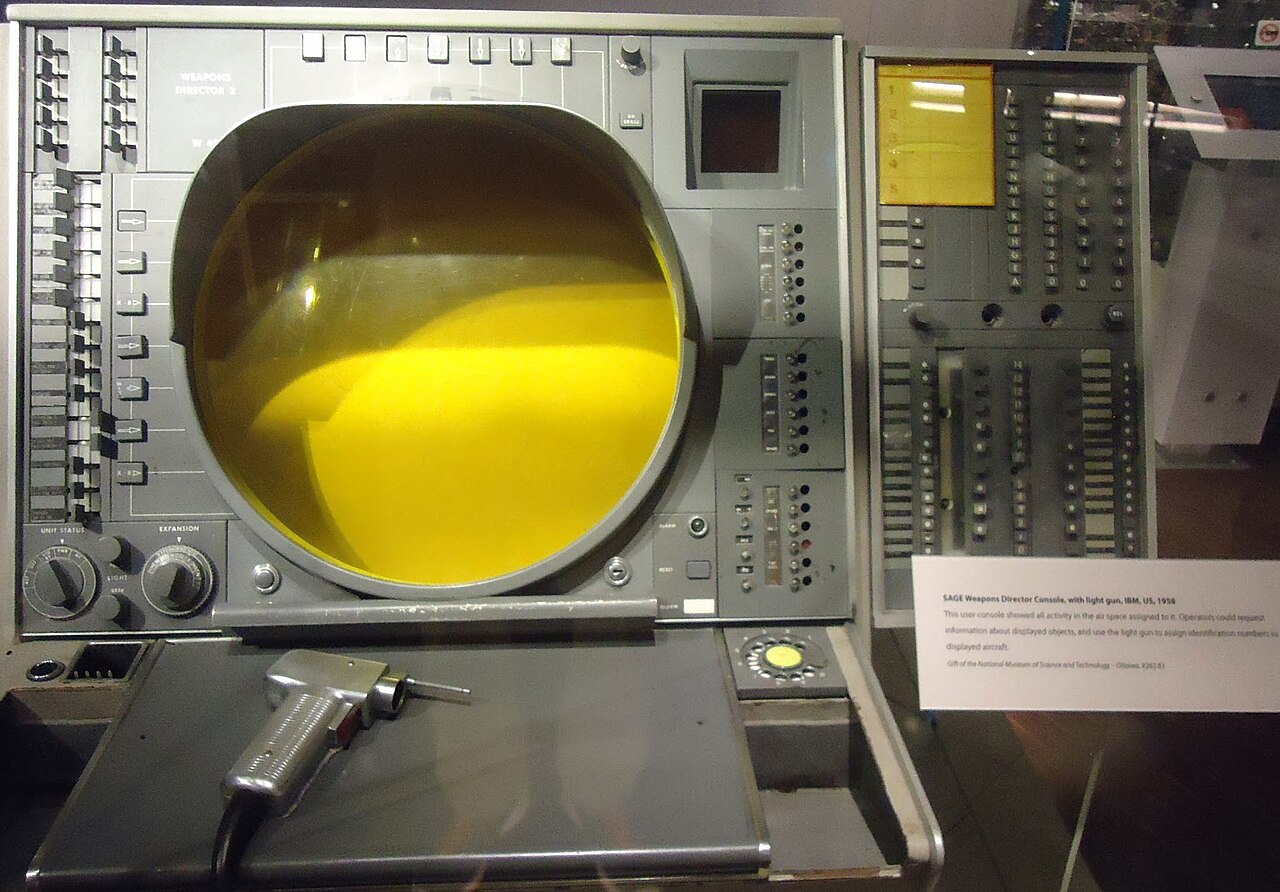
Vector Displays: The Electron Beam as Pen
The earliest electronic displays repurposed the oscilloscope, an instrument that deflected an electron beam to trace waveforms on a phosphor screen. A vector display drove the beam directly between defined coordinates, drawing lines and shapes by moving the beam across the screen. The phosphor glowed where the beam struck it; the image faded as the phosphorescence decayed, requiring the beam to continuously redraw (refresh) the image.
Spacewar! (1962), one of the first interactive computer games, ran on the PDP-1’s vector display. The developer experience on a vector display was fundamental: you drew lines between coordinates, not pixels. Characters and shapes were defined as sequences of line segments.
The CRT vector display was the visual medium of early interactive computing: MIT’s TX-0 and TX-2 computers, the Whirlwind (one of the first computers with a real-time display), the SAGE air defense system (each operator console had a 19-inch vector scope), and Ivan Sutherland’s Sketchpad (1963), the first graphical user interface. Sutherland’s light pen interactions with Sketchpad’s vector display established the visual vocabulary of interactive graphics.
Atari’s Asteroids (1979) and Lunar Lander (1979) were vector arcade games, the smooth rotation and scaling of vector graphics produced a visual quality that raster displays of the same era could not match. The Vectrex (1982) was the only home game console ever built around a vector display; every other console of the era used raster scanning. Vector displays were discontinued by the late 1980s as raster display technology surpassed them in cost and capability.
Raster CRTs: The Grid of Pixels
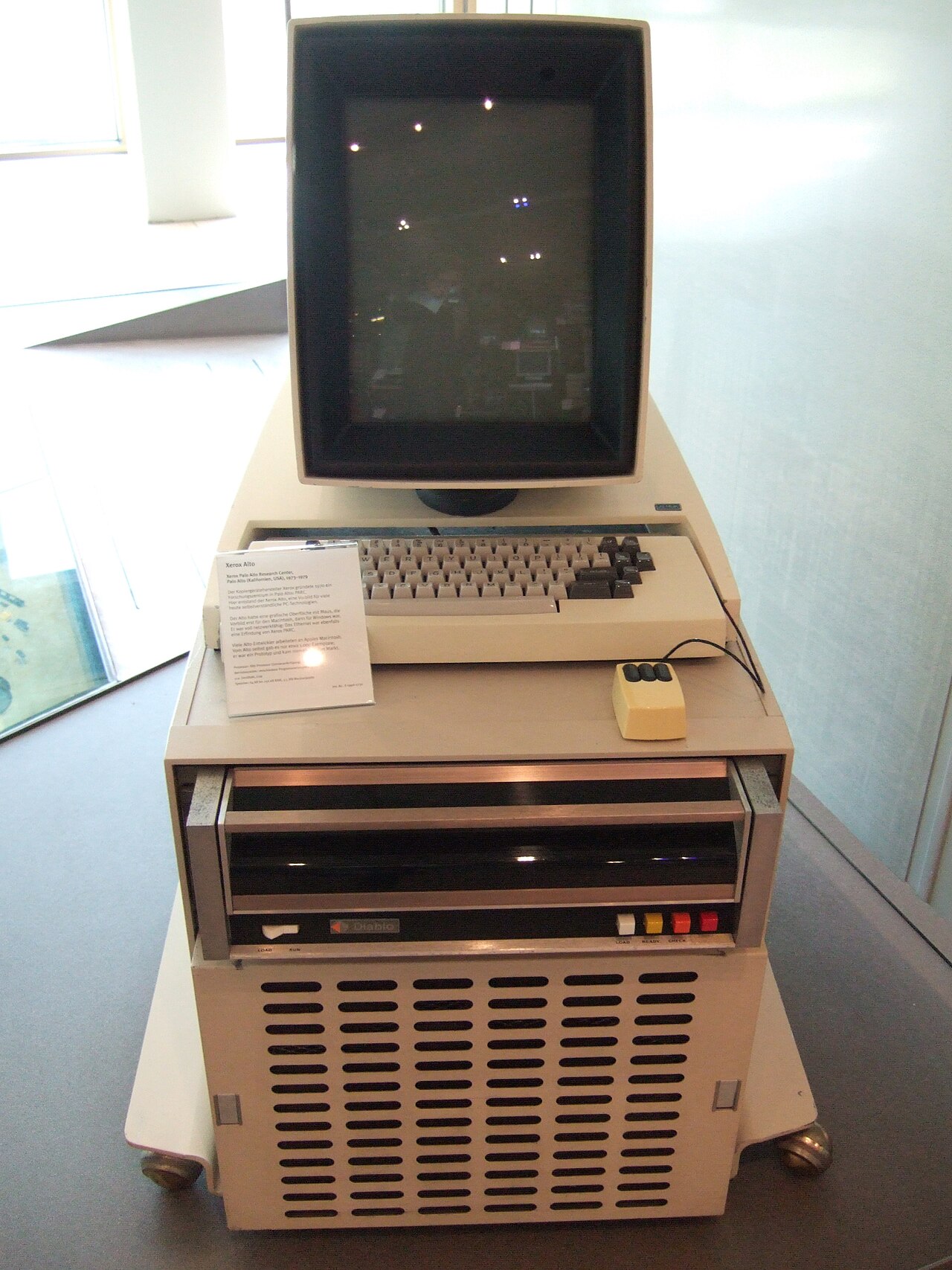
A raster display scans the electron beam horizontally across the screen, line by line, from top to bottom. Each position in the scan is a pixel (picture element); the beam’s intensity at each position determines that pixel’s brightness. Color CRTs used three electron guns (red, green, blue) and a shadow mask to independently control three phosphor dots per pixel.
The shift from vector to raster representation enabled graphical user interfaces. A GUI requires arbitrarily controllable individual pixels (icons, windows, fonts, images) that vector displays could not efficiently produce. The Xerox Alto (1973), the first computer with a graphical user interface, used a raster display. The Apple Macintosh (1984) used a high-resolution 512×342 pixel monochrome raster display at a pixel density sufficient for readable bitmap fonts.
NTSC television CRTs were repurposed as computer monitors through the 1970s and 1980s. The Commodore 64, Apple II, and Atari home computers all used composite video output designed for television receivers. The visual quality of text on a TV CRT was poor (the bandwidth was insufficient for sharp character rendering) which created the market for dedicated RGB monitors with higher bandwidth and better convergence.
Cathode ray tube monitors peaked in the late 1990s: high-end professional CRTs offered resolutions up to 2048×1536, refresh rates up to 120Hz, excellent color accuracy, and effectively zero input latency, properties that still attract a devoted retrocomputing following. Their fatal limitations were weight, depth (a 21-inch CRT weighed 30–50 pounds and was 18 inches deep), power consumption, and electromagnetic emissions.
Plasma Displays: Noble Gas Electroluminescence
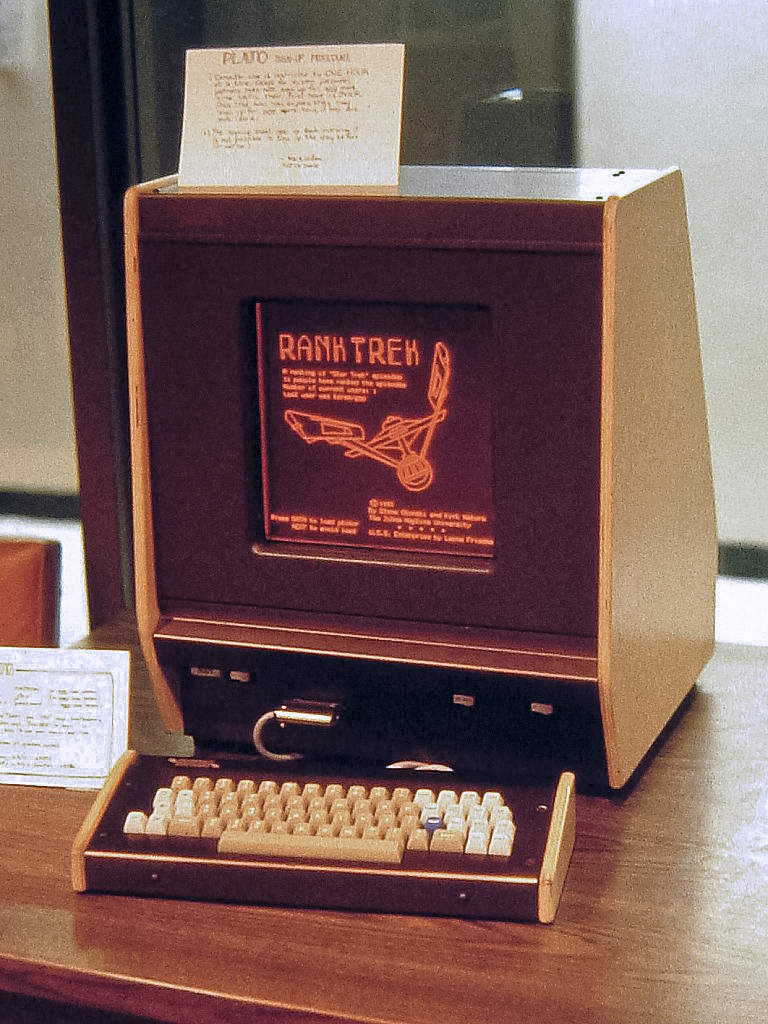
Plasma displays used a grid of small cells filled with noble gas (xenon, neon) that emitted ultraviolet light when electrically excited; the UV excited phosphors on the cell walls to produce visible light. Individual cells were addressable as pixels, enabling flat-panel displays without the depth requirements of CRTs.
The first plasma display panel (PDP) was developed at the University of Illinois by Donald Bitzer and H. Gene Slottow in 1964 for the PLATO educational computer system. PLATO used orange plasma displays extensively, students at terminals throughout the 1970s worked on systems whose displays used the same principle as the later consumer plasma TVs. See PLATO and the Birth of Online Community.
Consumer plasma displays (PDPs) became commercially significant in the early 2000s as large-format flat-panel televisions. Pioneer’s Kuro plasma panels (2008) are still cited by display professionals as the finest black levels and color accuracy achievable in consumer displays. Plasma technology was ultimately defeated by LCD’s lower power consumption, thinner profiles, and manufacturing cost advantages, with the last plasma displays manufactured around 2014.
LCD: Liquid Crystals and Backlights
Liquid crystal displays use materials whose optical properties change under electrical stimulation. Liquid crystals can be aligned by an electric field to either transmit or block polarized light. A twisted nematic (TN) LCD (the foundational technology for modern flat-panel displays) passes backlight through a liquid crystal layer that rotates polarized light by 90 degrees in its natural state (passing it through an output polarizer) and untwists under voltage (blocking the light). Individual pixels are addressed by thin-film transistors (TFTs) in an active matrix arrangement.
LCD technology was first demonstrated in the late 1960s. RCA’s George Heilmeier demonstrated the first working LCD devices in 1968. James Fergason developed the twisted nematic cell in 1971. Sharp commercialized LCD for calculators and digital watches through the 1970s. The first LCD computer monitors appeared in the early 1990s as portable computer displays; desktop LCD monitors became cost-competitive with CRTs in the early 2000s.
IPS (In-Plane Switching) panels, developed by Hitachi in 1996, improved viewing angles and color accuracy at the cost of response time. VA (Vertical Alignment) panels offered better contrast ratios. TN panels offered the fastest pixel response times. The three LCD sub-types have competed for different use cases since the 1990s: TN for gaming (response time), IPS for professional color work and general use, VA for home theater.
The LCD backlight evolved from cold cathode fluorescent lamps (CCFLs) to white LEDs (2009 onwards), then to high-brightness mini-LED arrays that could independently dim different screen zones, local dimming improving contrast ratios by selectively darkening the backlight behind dark image areas.
The Retina Display
Apple’s introduction of the Retina Display in the iPhone 4 (2010) defined the pixel density threshold at which individual pixels became indistinguishable to normal human vision at typical viewing distances, approximately 300 pixels per inch for a phone held at arm’s length. The Retina standard established 300+ PPI as the reference point for high-quality mobile displays and drove rapid improvement in display pixel density across the industry through the early 2010s.
OLED: Light from Organic Molecules
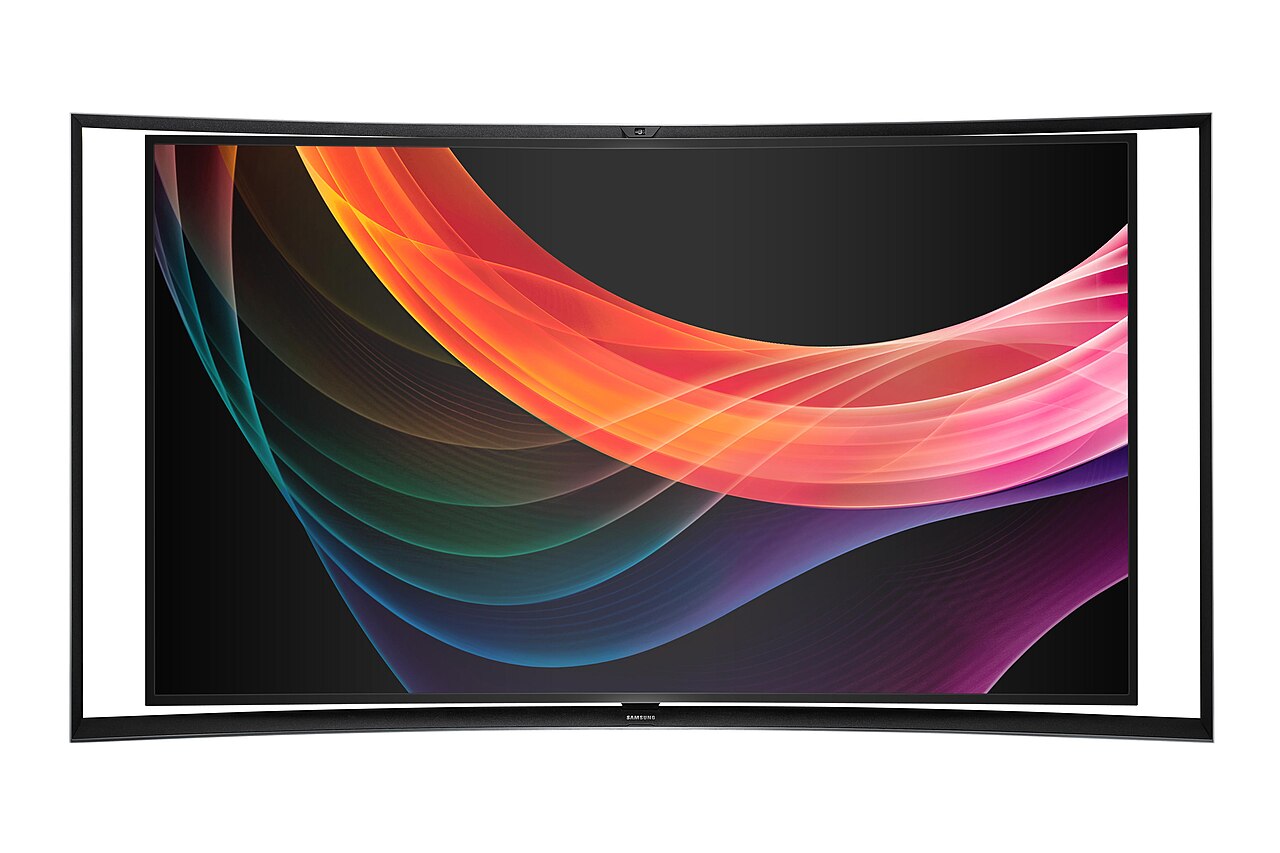
OLED (Organic Light-Emitting Diode) displays produce light directly from organic compound layers energized by electricity, each pixel is a self-illuminating device. Unlike LCDs, OLEDs require no backlight; pixels that are black consume no power; contrast ratios are theoretically infinite (a black pixel emits no light at all). Colors are more vivid because the backlight color filtering used in LCDs wastes most of the light.
Kodak researchers Ching Wan Tang and Steven Van Slyke published the foundational OLED paper in 1987. Pioneer produced the first commercial OLED product (a green monochrome display for a car radio) in 1997. Samsung began mass-producing OLED panels for smartphones (called AMOLED) in the early 2010s; the Samsung Galaxy S series popularized OLED for premium mobile displays.
Apple introduced OLED displays in the iPhone X (2017), and subsequently in all iPhone Pro models. The transition to OLED was driven by the panel’s ability to implement “Face ID” notch designs and always-on display capabilities that LCDs’ power requirements made impractical.
WOLED (white OLED with color filters, developed by LG Display) enabled large-format OLED television panels. LG’s OLED TVs became the reference standard for home theater display quality through the 2010s, offering contrast ratios, viewing angles, and response times that LCD panels could not match. OLED’s limitations, susceptibility to burn-in (permanent image retention from static content), higher cost per panel area than LCD, and lower peak brightness, remained concerns for specific use cases.
E-Ink: Electronic Paper
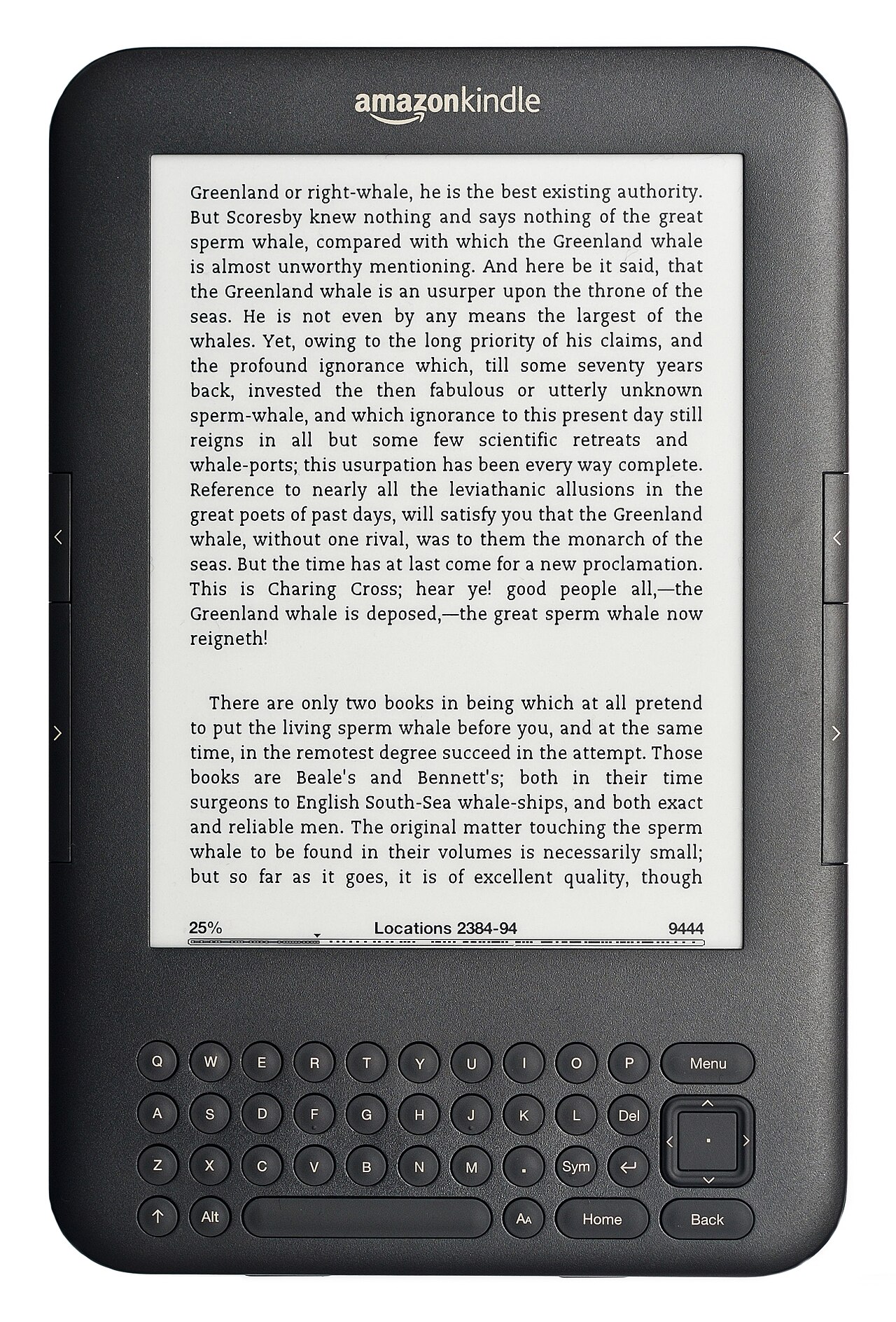
Electronic ink technology uses electrically charged black and white particles in microcapsules. An applied electric field moves particles to the surface of the capsule, black particles for dark, white particles for light. The display requires power only to change state; once set, the display holds its image without any power consumption.
An early precursor, Gyricon, a sheet of bichromal (black-and-white) polyethylene spheres that rotated under an electric field, was invented by Nicholas Sheridon at Xerox PARC in the 1970s. The microcapsule electrophoretic technology used in modern e-paper, in which charged black and white pigment particles move within tiny capsules, was developed in the 1990s by physicist Joseph Jacobson and his students at the MIT Media Lab and commercialized by E Ink Corporation (founded 1997, an MIT Media Lab spin-off). Sony shipped the first E-Ink e-reader, the Librié, in Japan in 2004, but it was Amazon’s Kindle (2007) that took the technology to a mass market and made it the standard display for dedicated e-readers (see Project Gutenberg and the E-Book). The Kindle’s battery life (measured in weeks rather than hours) was the product’s defining advantage.
E-Ink’s limitations, slow refresh rates (images cannot refresh faster than approximately 10 frames per second without visible ghosting), grayscale rather than full color (early generations), and the inability to display video, make it unsuitable for general computing but ideal for reading text with extended battery life.
Color E-Ink (E Ink Kaleido, 2020) added color but at reduced resolution and contrast compared to black-and-white E-Ink. Products including color e-readers and electronic shelf labels have adopted color E-Ink for applications where battery longevity is more important than image quality.
MicroLED and Spatial Computing
MicroLED technology uses microscopic LEDs (measured in microns, versus millimeters for conventional LEDs) as individual display pixels, combining the self-illumination and contrast of OLED with the brightness, longevity, and absence of burn-in risk of inorganic LEDs. Samsung demonstrated large-format microLED panels at CES 2018; Apple has reportedly invested in microLED research for future Apple Watch and display products.
The manufacturing challenge of microLED is “mass transfer”, placing millions of 20-micron LEDs onto a substrate with the precision and yield rate required for consumer products. This remained an active area of manufacturing research as of 2025.
Spatial computing displays: VR headsets (Meta Quest), AR devices (Microsoft HoloLens, Apple Vision Pro), required different display technologies: high pixel density panels for VR (to reduce the “screen door effect” of seeing pixels between rendered elements), and waveguide optics for AR (to overlay digital images on the real world). Apple’s Vision Pro (2024) used micro-OLED displays from Sony, panels with extreme pixel density (a 3660×3200 resolution at roughly 3,386 pixels per inch) enabling immersive images in a form factor that fit within a ski goggle-sized device.
📚 Sources
- Castellano, Joseph A.: Liquid Gold: The Story of Liquid Crystal Displays and the Creation of an Industry (2005), World Scientific
- Mentley, David E.: “State of Flat-Panel Display Technology and Future Trends” — Proceedings of the IEEE 90(4): 453–459 (2002)
- E Ink Corporation: Technology overview and product history (public)
- Chen, J. and W. Cranton (eds.): Handbook of Visual Display Technology (2012), Springer
- Flat-panel display — Wikipedia
- History of display technology — Wikipedia
- Image: Platovterm1981.jpg by Mtnman79 (CC BY 3.0), via Wikimedia Commons
- Image: Amazon Kindle 3.JPG by NotFromUtrecht (CC BY-SA 3.0), via Wikimedia Commons
- Image: Samsung OLED TV.jpg by Samsung Belgium (CC BY 2.0), via Wikimedia Commons