Andy Grove and Intel
Abstract
Andy Grove escaped Hungary as a twenty-year-old refugee, arrived in New York nearly deaf and barely speaking English, and lip-read his way to the top of his class at City College of New York. He went on to build Intel into the most important technology company of the twentieth century. He was not a founder (he was the third employee) but he was the manager who transformed a brilliant semiconductor startup into a disciplined industrial machine. He fired the entire memory business Intel had invented, bet everything on microprocessors, and was right. He coined “strategic inflection point” and wrote one of the most honest books about business leadership ever published. He was also, by his own account, relentlessly difficult to work for, constitutionally paranoid, and very nearly right about everything.
Escape from Budapest
András István Gróf was born in Budapest, Hungary on September 2, 1936, into a middle-class Jewish family. His father ran a small dairy business. At age four, scarlet fever nearly killed him and destroyed much of his hearing; he wore bulky hearing aids for decades, until a series of operations in middle age finally corrected it. When the Nazis occupied Hungary in March 1944, eight-year-old András was hidden by non-Jewish families and survived the war on forged papers that identified him as Catholic. His father survived a labor camp; most of his father’s family did not. The experience of surviving through concealment and adaptation (of understanding that the environment could turn lethal without warning) never entirely left him.
After the war he studied at a Budapest technical school and discovered a talent for writing, contributing theater and film criticism to a Budapest newspaper as a teenager. He enrolled at the Budapest Technical University to study chemical engineering. In the autumn of 1956, Soviet tanks crushed the Hungarian Revolution that had briefly swept through the country. András, twenty years old, left on foot across the Austrian border, carrying almost nothing. He made his way to Vienna, then to New York, where a relative had emigrated earlier.
He enrolled at City College of New York (one of the few American universities with no tuition) and completed a degree in chemical engineering in 1960, graduating at the top of his class despite arriving with rudimentary English and hearing too damaged to follow lectures by ear. He got through by lip-reading and then reconstructing the material afterward. “I had to go over each day’s work again at night with a dictionary at my side,” he told The New York Times in 1960, in an article on that year’s outstanding CCNY graduates. In June 1958 he married Eva Kastan, a fellow refugee he had met the previous summer when both worked at a New Hampshire resort; they stayed married until his death and had two daughters, whose names he kept out of the press. He completed a PhD at UC Berkeley in chemical engineering in 1963, with a dissertation on surface chemistry of semiconductors. The dissertation was excellent enough that Gordon Moore, then at Fairchild Semiconductor, recruited him directly.
Physics of Failure
Grove joined Fairchild Semiconductor in 1963 as a research engineer working on understanding why transistors failed. This was not a glamorous assignment. Failure analysis is meticulous, unglamorous work: you take devices that have stopped functioning, subject them to systematic tests, and try to infer what physical mechanism caused the failure. But it was important work, because reliability was the primary obstacle to wider adoption of integrated circuits. Military customers in particular had stringent reliability requirements, and understanding failure mechanisms was essential to meeting them.
Grove developed a systematic understanding of transistor failure modes (contamination of the silicon surface, oxide defects, electromigration in metal interconnects, hot carrier injection) that informed his later thinking about manufacturing quality. He published research on these mechanisms and became one of the leading experts on MOS transistor reliability. He also, in 1967, published a textbook on MOS physics that remained a standard reference for years.
He joined Intel in 1968 as the third employee, recruited by Robert Noyce and Gordon Moore. His title was director of operations. His actual role was to build a company that could manufacture chips reliably and at scale, to bridge the gap between the brilliant inventions that Noyce and Moore could conceive and the production realities that would determine whether the company survived. This was not a secondary role. The history of semiconductor companies is full of technically brilliant organizations that could not translate laboratory success into manufacturable products. Kilby’s integrated circuit had proved the concept; building a factory that produced integrated circuits profitably at high yield required a completely different set of skills.
Building the Machine
Grove’s contribution to Intel’s early success was systematic operational discipline. He implemented what he called “objective management”, later formalized as OKR (Objectives and Key Results): each quarter, every team and every individual specified measurable objectives and, for each, the key results that would demonstrate the objective had been achieved. Progress was reviewed quarterly; achievements were measured, not approximated.
The method was not new in principle (management by objectives had been advocated by Peter Drucker since the 1950s) but Grove applied it with a rigor unusual even by the standards of a rigorous industry. He wanted to know, precisely, whether a team was on track or behind. He wanted to know the root cause of every significant failure. He wanted to be able to tell, by reading a report, whether a manufacturing problem was getting better or worse. He was not satisfied with narrative explanations that could not be verified against data.
Grove also instituted what he called “fear of failure” as a management principle, not the paralysis of anxiety but the productive discomfort of a person who takes their commitments seriously enough to be genuinely worried when they might not be met. He was demanding of his managers and expected them to be demanding of themselves. He was known to terminate meetings if he determined they were not making progress. He was, by multiple accounts, not easy to work for.
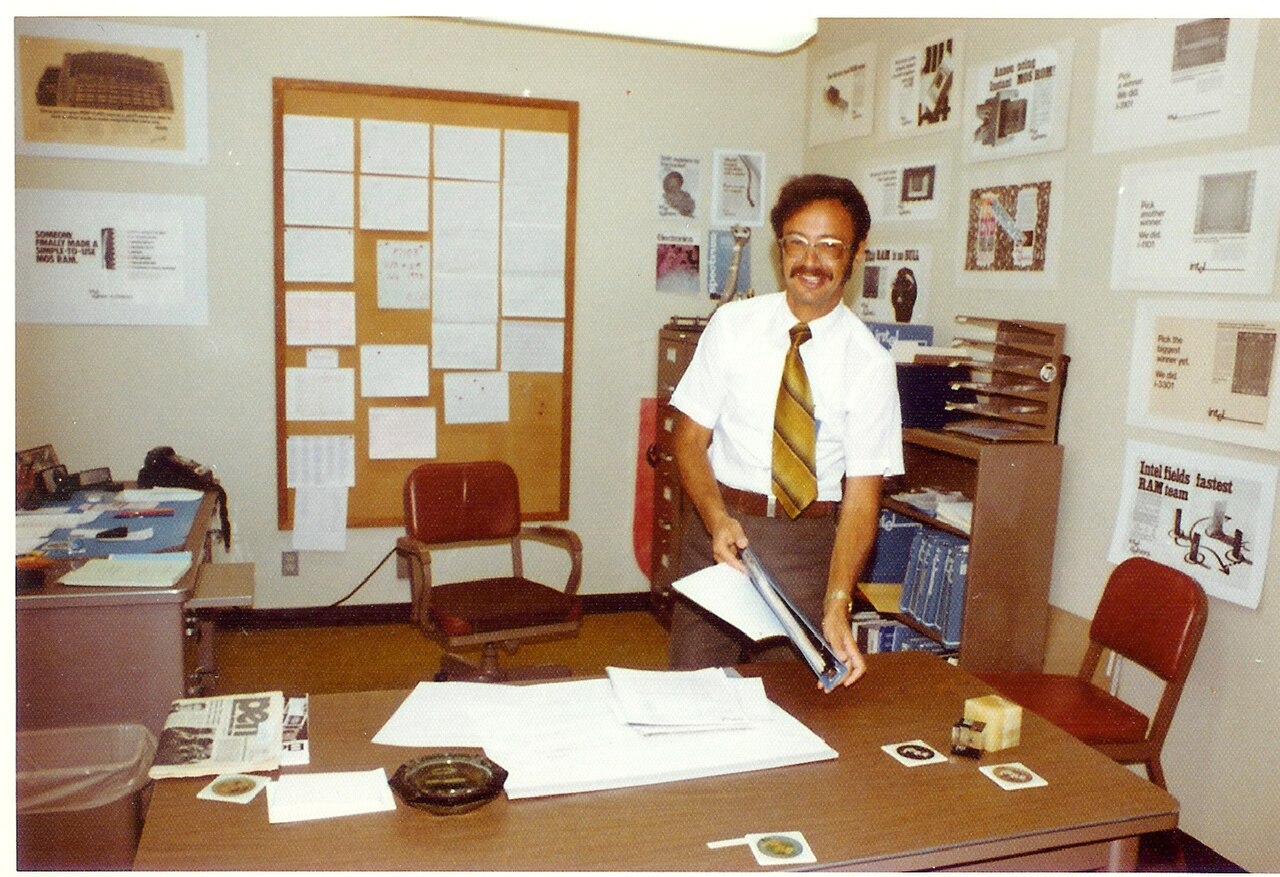
The Intel term for the culture was constructive confrontation: problems were to be attacked loudly, directly, and immediately, without regard for rank. In practice, much of the shouting was Grove’s. When an answer angered him, he would rip off his hearing aid and slam it on the table. Fortune named him one of America’s toughest bosses in 1984, and Craig Barrett, who succeeded him as CEO, described his style as hitting you over the head with a two-by-four. The egalitarianism was equally real: Intel had no executive offices, no reserved parking, no walled suites. Grove worked out of the same low-partitioned cubicle as everyone else, an arrangement that became the default architecture of Silicon Valley.
The OKR system Grove developed at Intel was adopted by Google after John Doerr (who had worked at Intel under Grove) introduced it to Larry Page and Sergey Brin in 1999. From Google, it spread to hundreds of technology companies. Grove’s management method has probably influenced more companies than his semiconductor work, though fewer people know his name in connection with it.
The Strategic Inflection Point
By 1984, Intel was in crisis. The dynamic RAM business that Intel had invented (and that had made the company) was being destroyed by Japanese competition. NEC, Fujitsu, Hitachi, and Toshiba had invested heavily in DRAM manufacturing with government backing and favorable financing terms. Their yields were higher, their quality better, their prices lower. Intel’s DRAM division was losing money on every chip.
Grove’s first response, in 1981, had been to squeeze more out of the people he had: rather than lay off staff, he demanded that employees work an extra two hours a day, unpaid, a program known inside Intel as the 125% Solution. In the same period the company’s grand architectural bet, the object-oriented iAPX 432, shipped years late and benchmarked at a fraction of the speed of its competitors. Grove conceded later that he had been slow to see where the company’s future lay: “I was running an assembly line designed to build memory chips. I saw the microprocessor as a bloody nuisance.”
The choice Intel faced was whether to continue investing to compete in DRAM (which would require massive capital expenditure with uncertain prospects) or to exit a business that had been the company’s identity since its founding. The decision was complicated by psychology: DRAM was what Intel had been founded to make. Exiting would require admitting that the foundation of the company was finished.
Grove described the moment of decision in his book Only the Paranoid Survive (1996):
“I asked Gordon [Moore]: ‘If we got kicked out and the board brought in a new CEO, what do you think he would do?’ Gordon answered without hesitation, ‘He would get us out of memories.’ I stared at him, numb, then said, ‘Why shouldn’t you and I walk out the door, come back, and do it ourselves?’”
They exited DRAM in 1985. Intel wrote down hundreds of millions in inventory and capital equipment. It cut about 7,200 jobs, roughly a third of its workforce, through layoffs and attrition. It committed its future entirely to microprocessors.
The decision required that the IBM PC market keep growing, and keep growing in a way that favored Intel’s x86 architecture. IBM had introduced the PC in 1981 using Intel’s 8088 processor. If the PC grew (and it was growing explosively) Intel would grow. If the PC industry consolidated around a different architecture, Intel would be in serious difficulty.
The bet paid out beyond any reasonable expectation. The IBM PC architecture became the dominant personal computing platform worldwide, and Intel’s control of the x86 microprocessor became the most valuable market position in the technology industry.
Info
Grove used this decision to develop his concept of the strategic inflection point: a moment when the fundamental forces governing a business shift so substantially that continuing on the existing course leads to failure, but the correct new course is not yet clear. His argument was that the right response was to confront the evidence early (before the crisis forced a decision) and make a decisive change while the company still had resources to execute it. The framework became standard vocabulary in business strategy education.
Building the Intel Monopoly
Grove served as Intel’s CEO from 1987 to 1998, the decade in which the company’s market capitalization grew from under $2 billion to over $100 billion. The strategic moves of this period were largely his:
Defending x86: Intel’s 8086 and 8088 had been licensed to AMD and other manufacturers to satisfy IBM’s requirement for a second source. As the PC market grew and x86 became the dominant architecture, Grove recognized that the second-source arrangement was undermining Intel’s business. He progressively tightened Intel’s grip on x86 manufacturing and licensing. The legal battles with AMD over x86 licenses ran through the entire 1990s, but Intel successfully prevented AMD from manufacturing compatible processors without licenses on terms favorable to Intel.
“Intel Inside”: In 1991, Grove approved a marketing initiative that had no precedent in the semiconductor industry: advertising directly to computer buyers, rather than to computer manufacturers. The “Intel Inside” sticker (and the two-note jingle that accompanied it) was placed on computers whose manufacturers agreed to contribute to advertising co-op funds. The campaign cost hundreds of millions of dollars annually and established Intel as a consumer brand. By 1993, “Intel Inside” stickers were on a majority of PCs sold worldwide. Computer buyers who had never cared about processors began asking for “Intel inside.”
The Pentium FDIV Bug: In October 1994, a mathematics professor named Thomas Nicely discovered a flaw in the Pentium processor’s floating-point division unit. The bug (caused by a missing entry in a lookup table used for a specific division algorithm) produced wrong answers in a narrow range of calculations. Intel’s initial response was to dismiss the flaw as minor, pointing out that it affected a very small number of calculations and that most users would never encounter it.
IBM suspended shipments of Pentium-based computers. The story spread through the nascent internet with extraordinary speed. Grove’s initial posture, defending the chip while offering replacements only to users who could demonstrate they had a professional need for correct floating-point arithmetic, became a textbook example of crisis mismanagement. He reversed course, offering unconditional replacements to any customer who asked. Intel set aside $475 million to cover the cost.
Grove later wrote that the Pentium crisis was one of the most instructive episodes of his career. The mistake was not the bug (which was a genuine engineering error of the kind that occasionally appears in complex systems) but the initial response, which prioritized Intel’s cost concerns over customers’ reasonable expectation that a product would work correctly.
Cancer, Parkinson’s, and Advocacy
In 1995, Grove was diagnosed with prostate cancer. He approached his diagnosis as he would have approached a competitive threat: systematically, with data, and with skepticism toward received wisdom. He reviewed the clinical literature on prostate cancer treatment, sought consultations with specialists beyond his own oncologist, and made treatment decisions that differed from the protocols his doctors initially recommended. He wrote about the experience in Fortune magazine in 1996, advocating strongly for early prostate cancer screening and for patients educating themselves about treatment options rather than deferring entirely to physicians.
In 2000, Grove was diagnosed with Parkinson’s disease. He funded Parkinson’s research extensively, endowing a translational-research chair at UCSF through his Kinetics Foundation and, in 2008, pledging up to $40 million of his estate to the Michael J. Fox Foundation (and became a prominent advocate for patient involvement in clinical trials) arguing that patients who had educated themselves about their conditions were capable of being research partners, not merely research subjects. He continued working and writing until advancing Parkinson’s limited his mobility.
He was named Time Person of the Year in 1997, the first time the magazine had given the honor to a figure from the technology industry. The citation recognized Intel’s centrality to the computing revolution of the 1990s.
Grove handed the CEO role to Craig Barrett in 1998 and remained chairman of the board until November 2004. He died on March 21, 2016, in Los Altos, California, at seventy-nine.
Dead End: Intel’s Failure in Mobile
Grove’s era at Intel was defined by the strategic inflection point he correctly identified and navigated. The era that followed was defined by one he missed, or rather, that his successors missed, with consequences he acknowledged.
Warning
In 2005, Steve Jobs approached Intel about manufacturing a custom chip for the device that would become the iPhone. Intel, then under CEO Paul Otellini, declined at the price Apple offered, calculating that the margin was insufficient. Apple used a Samsung-manufactured ARM chip instead. The iPhone launched in 2007. Smartphones became the largest semiconductor market in the world. The ARM architecture (designed for power efficiency rather than raw performance) was fundamentally better suited to mobile devices than Intel’s x86, which had been optimized for performance at any power cost. Intel’s subsequent attempts to compete in mobile (the Atom processor line, various low-power x86 variants) never achieved competitive power efficiency. By 2015, the smartphone market consumed more semiconductors than the PC market, and Intel had essentially no share of it. Grove, in later interviews, identified Intel’s failure to pursue mobile as the missed strategic inflection point of the post-Grove era, the moment when the new CEO should have asked, “If we got kicked out and someone else came in, what would they do?”
The Intel story in the context of the broader semiconductor industry is covered in The Semiconductor Race and Gordon Moore and Moore’s Law.
📚 Sources
- Andrew S. Grove: Only the Paranoid Survive: How to Exploit the Crisis Points That Challenge Every Company (1996), Currency/Doubleday · Open Library
- Andrew S. Grove: High Output Management (1983), Random House · Open Library
- Michael S. Malone: The Intel Trinity: How Robert Noyce, Gordon Moore, and Andy Grove Built the World’s Most Important Company (2014), HarperBusiness · Open Library
- Richard S. Tedlow: Andy Grove: The Life and Times of an American Business Icon (2006), Portfolio · Open Library
- Andrew S. Grove: “Taking on Prostate Cancer” (Fortune, May 13, 1996) Andrew Grove — Wikipedia
- John Doerr: Measure What Matters: How Google, Bono, and the Gates Foundation Rock the World with OKRs (2018), Portfolio · Open Library
- Kandell, Jonathan: “Andrew S. Grove, Longtime Chief of Intel, Dies at 79” — The New York Times (March 21, 2016) · hearing loss and CCNY, constructive confrontation, 125% Solution, “bloody nuisance” quote
- Andrew Grove — Wikipedia · scarlet fever, marriage to Eva Kastan, chairman until November 2004
- Oral history interview with Andrew S. Grove — Science History Institute · two sessions, July 14 and September 1, 2004, interviewed by David C. Brock and Arnold Thackray; transcript (41 pages) and audio
- Image: Andy Grove in His Office.jpg by Intel Free Press (CC BY 2.0), via Wikimedia Commons