ARPANET: Building the Network That Became the Internet
Abstract
ARPANET was the first wide-area packet-switched network, built by the US Department of Defense’s Advanced Research Projects Agency beginning in 1969. What started as an experiment connecting four university computers grew into a 29-node research network by late 1972, acquired email almost by accident in 1971, and gave birth to the TCP/IP protocols that underpin the modern internet. ARPANET was decommissioned on February 28, 1990, but the network it seeded never stopped growing. For the ideas that motivated it, see J.C.R. Licklider and the Intergalactic Network; for the protocols it eventually ran on, see Vint Cerf and Bob Kahn.
The Problem with Three Terminals
In 1966, Bob Taylor was running the Information Processing Techniques Office (IPTO) at ARPA from an office suite in the Pentagon. In a small terminal room next to his office sat three terminals: a modified IBM Selectric connected to a time-sharing computer at MIT, a Teletype linked to a machine at UC Berkeley, and another Teletype wired to the Q-32 at the System Development Corporation in Santa Monica. Each had its own login procedure and its own command set, and Taylor had to remember which belonged to which. He found it irksome.
More fundamentally, Taylor recognized that the researchers ARPA funded at different universities couldn’t share programs, data, or computing resources across institutional lines. Each node in the ARPA research community was an island. If a team at MIT developed a useful piece of software, the team at Stanford couldn’t run it. Most of IPTO’s $19 million budget went to campus research, and much of it was being spent on duplicated computers and software, because the same problems were being solved independently at multiple sites.
Taylor walked down the hall to Charles Herzfeld, ARPA’s director, and pitched the idea of a network connecting the ARPA-funded research computers. Herzfeld moved a million dollars from a ballistic missile defense program into Taylor’s budget. Walking back to his office, Taylor checked his watch: the meeting had taken twenty minutes.
To run the program, Taylor recruited Larry Roberts from MIT’s Lincoln Laboratory. Roberts had already conducted the first experiments in wide-area networking in 1965, connecting a TX-2 computer at Lincoln to a Q-32 at SDC over a low-speed dial-up telephone line. The experiment showed that time-shared computers at a distance could work together, and that the circuit-switched telephone system was a poor fit for the job. Roberts moved to ARPA in late 1966 as program manager for the network project and spent the next two years designing what would become ARPANET.
Packet Switching and the IMP Contract
ARPANET’s central architectural decision was the adoption of packet switching, a technique developed independently by Paul Baran at RAND Corporation and Donald Davies at the National Physical Laboratory in the UK. Rather than establishing a dedicated circuit between sender and receiver (as the telephone network did), packet switching broke messages into small chunks, each labeled with source and destination, and allowed each chunk to travel independently through whatever route was available. Networks built this way were inherently redundant: if a node failed, packets could route around it.
Baran had developed the idea explicitly for military communications that needed to survive nuclear attack. Davies coined the term “packet.” Roberts synthesized both lines of work into the ARPANET design.
In July 1968, ARPA issued a request for proposals to build the Interface Message Processors (IMPs), the specialized computers that would sit at each network node, handling packet routing and transmission so the host computers at each site didn’t have to. Twelve companies bid. The contract went to Bolt Beranek and Newman (BBN) in Cambridge, Massachusetts, whose team was led by Frank Heart; the news reached BBN just before Christmas 1968, and work officially began in the first week of January 1969. The first IMP was due at UCLA by Labor Day, which left BBN about eight months to build it. How new all of this was shows in a congratulatory telegram: Senator Edward Kennedy’s office wired BBN congratulations on winning the million-dollar contract to build the “Interfaith Message Processor” (recounted in Hafner and Lyon’s Where Wizards Stay Up Late).
Heart’s core team was small (about seven engineers, including Will Crowther, Dave Walden, Severo Ornstein and Bob Kahn) and the schedule was brutal. They chose a Honeywell DDP-516 minicomputer as the IMP hardware, hardened it for continuous operation, and wrote the operating software essentially from scratch. The contract specified that the IMPs had to handle messages reliably even when host computers or network links failed. Every design decision was made under the constraint that the system had to be robust against component failure.
Four Nodes, One Crash, One Message
The first IMP arrived at UCLA by air on Saturday, August 30, 1969, and connected to a Sigma 7 computer. Len Kleinrock at UCLA had been running the network measurement center. The second IMP arrived at the Stanford Research Institute (SRI) in early October. UCLA and SRI were Node 1 and Node 2 of ARPANET.
The first network message was sent on October 29, 1969. A UCLA graduate student named Charley Kline sat at the terminal and began typing “LOGIN” to establish a connection to SRI’s host computer. He typed “L”, and SRI confirmed the “L”. He typed “O”, and SRI confirmed the “O”. He typed “G”, and the SRI system crashed.
The first message ever sent on ARPANET was “LO.” The attempt is recorded in the IMP log kept at UCLA, in an entry for 22:30 initialed by Kline (“CSK”) that reads, drily, “Talked to SRI host to host.” About an hour later the full login worked.
Nodes 3 and 4, at UC Santa Barbara (November 1969) and the University of Utah (December 1969), completed the original four-node network, which was fully established by December 5, 1969. By the end of 1969, the backbone of what would become the internet existed.
The Significance of Packet Switching
Circuit-switched networks (like the telephone system) dedicate a path for the duration of a call, reserving bandwidth whether or not it is being used. Packet-switched networks are statistically multiplexed: the same physical link can carry packets from many simultaneous conversations, using its capacity efficiently. This difference in architecture, more than any difference in speed, is why the internet scales so differently from the telephone network. Idle capacity on a packet link is available to any other traffic; an idle stretch on a reserved phone circuit is wasted.
Email: The Killer App Nobody Planned
By September 1971, ARPANET had grown to 18 nodes (23 hosts) and was being used mostly for remote login and file transfer. Then Ray Tomlinson at BBN, working on an unrelated task, sent the first network email.
Tomlinson was working on two separate programs: SNDMSG, which let users on a time-sharing system leave messages for each other in mailbox files, and CPYNET, which transferred files between ARPANET hosts. In the autumn of 1971, he had an insight: if CPYNET could transfer a file between machines, and SNDMSG could append a message to a mailbox file, the two programs could be combined to send a message to a mailbox on a different machine. He modified SNDMSG to do exactly that, and needed a way to specify that the destination mailbox was on a different host rather than the local machine.
He chose the @ symbol, already on the keyboard, not used in usernames, unambiguous as a separator between user and host. The choice was made in minutes. Tomlinson later said he could not remember what the first email said, only that it was something like “QWERTYUIOP”, a test to see if the mechanism worked.
In 1973, an ARPA study commissioned by agency director Stephen Lukasik found that three quarters of ARPANET traffic was email. The network had been designed to share computing resources; what people actually used it for was sending messages to each other.
The Network Grows
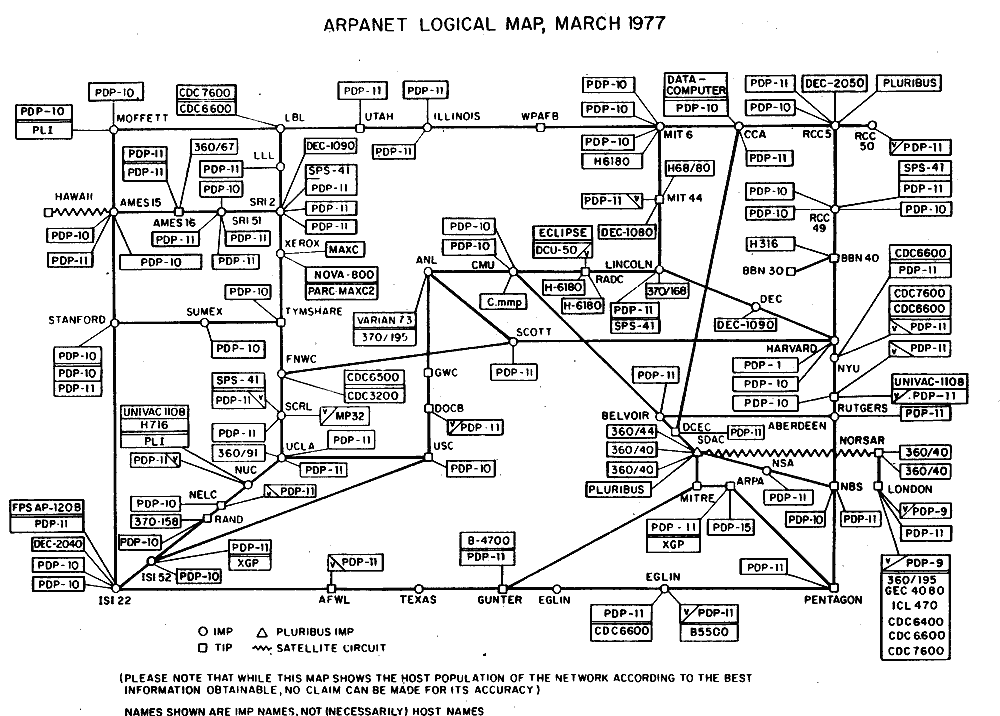
ARPANET expanded rapidly through the early 1970s, and so did what could be done over it: on 16 April 1971 Abhay Bhushan proposed the File Transfer Protocol, FTP. By September 1971, there were 18 nodes. By the time of the public demonstration in October 1972, there were 29.
That demonstration, at the International Conference on Computer Communication (ICCC) in Washington, DC, on 24 to 26 October 1972, was ARPANET’s coming-out party. Larry Roberts set it up and Bob Kahn of BBN organized it: about three dozen terminals at the Washington Hilton, connected through a Terminal IMP (TIP), where conference attendees could sit down and use computers across the network. Some participants had argued for a videotape to guard against crashes; the organizers insisted on a live system. It held up, with one documented crash.
That crash came in the middle of a tour Bob Metcalfe was giving to ten AT&T executives, who, as Metcalfe remembered it, smiled at the evidence that packet switching was flaky. AT&T had already turned the network down once: in 1971 Roberts, aware that ARPA lacked the legal authority to run a permanent network, had asked AT&T about taking it over, and AT&T rebuffed the inquiry.
The network went abroad in 1973. A node at Kjeller near Oslo, opened in June, carried seismological data from the NORSAR array, including readings of Soviet underground nuclear tests; on 25 July 1973 Peter Kirstein’s group at University College London sent its first packets to the University of Southern California, after a long fight with British bureaucracy. Britain’s Royal Signals and Radar Establishment at Malvern was later connected through UCL, and on 26 March 1976 Queen Elizabeth II sent an email there to mark the occasion. That July 1973 also saw the first German-language description of ARPANET, by the Erlangen computer scientist Wolfgang Händler after a tour of American laboratories.
Other packet networks grew alongside. Norman Abramson’s ALOHAnet linked the University of Hawaii’s computers across five islands by radio from June 1971, with a Hewlett-Packard 2100 called Menehune as its hub; it was connected to ARPANET by satellite at the end of 1972 and ran until its funding ended in 1976, and its random-access scheme went on into Ethernet. SRI’s Packet Radio Network, begun in 1973, used a converted delivery van full of radio gear: on 27 August 1976, from a table at the Alpine Inn beer garden near Palo Alto, a report was sent through the van’s packet radio to SRI and on over ARPANET, and on 22 November 1977 a message from the van crossed the radio network, ARPANET and the SATNET satellite network to London and back, the first demonstration of an internet of three networks.
NCP, TCP/IP, and Flag Day
The original ARPANET ran on NCP (Network Control Program), a host-to-host protocol developed by Steve Crocker and others in the Network Working Group from late 1969 and deployed on all nodes in December 1970. In October 1971 the group gathered at MIT for a full shakedown test it called “the bake-off”, verifying that every host on the network (by then 23 hosts at 15 sites) could log on to every other host. NCP worked but had fundamental limitations: it assumed hosts were connected to a single network and could not accommodate the idea of multiple interconnected networks.
As ARPANET expanded and satellite links and radio packet networks were added, the need for a more flexible protocol became clear. In 1974, Vint Cerf and Bob Kahn published “A Protocol for Packet Network Intercommunication,” introducing the Transmission Control Program (TCP), the basis of what became TCP/IP, a design where networks could be interconnected by gateways, and each network didn’t need to know about the others’ internal architecture. The single protocol was later split into separate TCP and IP layers, published as Defense Department standards in January 1980 and in their final form (RFC 791 and RFC 793) in September 1981. The protocol was designed so that unreliable networks could be composed into a reliable internet.
The switch from NCP to TCP/IP was planned by Jon Postel and others, laid out in Postel’s “NCP/TCP Transition Plan” (RFC 801, November 1981). The cutover date (January 1, 1983) was called Flag Day: all hosts had to convert at once, because the two protocols could not talk to each other. Thanks to the years of preparation, it went fairly smoothly.
NSFNET and the Transition to the Modern Internet
Through the late 1970s and early 1980s, ARPANET remained a research network, its access restricted to military and academic institutions with ARPA contracts. The broader research community needed connectivity too. In 1985, the National Science Foundation launched NSFNET; its first backbone went online in 1986, linking six sites (the five NSF supercomputer centers plus the National Center for Atmospheric Research) with 56 kbps links, and regional networks connected universities to it for research use.
NSFNET quickly overwhelmed its original capacity and was upgraded to 1.5 Mbps T1 links in 1988, then to 45 Mbps T3 links in 1991. By this point, ARPANET was increasingly redundant, a smaller, older network operating in parallel with the faster and more accessible NSFNET backbone.
ARPANET was formally decommissioned on February 28, 1990. Most of its sites had already moved to NSFNET and the regional networks, and the original IMPs had long since been replaced.
In April 1995, NSF stopped funding the NSFNET backbone and left backbone service to commercial providers, opening the internet to full commercial use.
The People Who Built It
ARPANET was built by small teams with wide latitude, funded by an agency that left them to make their own technical decisions. The people who built it (Roberts, Heart, Tomlinson, Kleinrock, Cerf, Kahn, Postel) were mostly young and mostly academic, and they were working on a research problem, not a product.
Jon Postel edited the RFC series from 1969 until his death in 1998 and for most of that time also kept the registry of internet numbers and names. After UCLA and a few years at MITRE, he worked from 1977 at USC’s Information Sciences Institute, running the internet’s core administrative functions on research grants. He died on 16 October 1998, aged 55, of complications after surgery to replace a leaking heart valve.
The network was designed to let researchers share computing resources, with no provision for commerce, security or global scale. Its packet-switched architecture and the TCP/IP protocols it adopted in 1983 still carry the internet.
📚 Sources
-
Heinz Nixdorf MuseumsForum blog, “Fünfzig Jahre FTP” (16 April 2021) and “ALOHA auf Hawaii” (28 June 2021) (FTP, ALOHAnet)
-
Heinz Nixdorf MuseumsForum blog, “Mail von der Queen” (24 March 2016) (Kjeller, UCL, Malvern and the Queen’s 1976 email)
-
Heinz Nixdorf MuseumsForum blog, “Der Lieferwagen für das Internet” (5 December 2017) (the SRI van, the 1976 and 1977 experiments; the post gives both 22 and 27 November 1977)
-
Heinz Nixdorf MuseumsForum blog, “Das war das ARPANET” (20 October 2017), “Fünfzig Jahre ARPANET” (25 October 2019) and “ICCC 1972 – das „Coming Out“ des ARPANET” (25 October 2022) (Händler’s 1973 report, the first message, the 1972 conference)
-
Len Kleinrock, “The Day the Infant Internet Uttered Its First Words,” UCLA, 2009
-
James Pelkey, “Commercializing Arpanet 1972–1975,” A History of Computer Communications (Roberts’s 1971 approach to AT&T)
-
Jon Postel, RFC 801, “NCP/TCP Transition Plan,” November 1981
-
RFC 791, “Internet Protocol,” and RFC 793, “Transmission Control Protocol,” September 1981
-
SRI International, “Internetworking” (the 22 November 1977 three-network test)
-
Merit Network, NSFNET: A Partnership for High-Speed Networking, Final Report 1987–1995
-
ARPANET, Wikipedia (node and host counts 1969 to 1973, RFQ bids)
-
Jon Postel, Wikipedia (career and death)