The ARM Architecture: The Chip That Runs the World
Abstract
ARM is the most widely deployed processor architecture in history. Over 230 billion ARM-based chips have been shipped, in every smartphone, most tablets, nearly every embedded controller, and, increasingly, in servers and personal computers. It was designed not by Intel or IBM but by a small team at a British home computer company in Cambridge in 1983, on a budget so tight they could not afford a memory controller. Its defining innovation was not performance but efficiency: doing useful work with as little power as possible. That constraint, irrelevant when computers were mains-powered, became the single most important property of computing hardware when computers moved into pockets. ARM’s business model (licensing the design to anyone who would pay, manufacturing nothing itself) created the structural conditions for the semiconductor industry’s most diverse ecosystem.
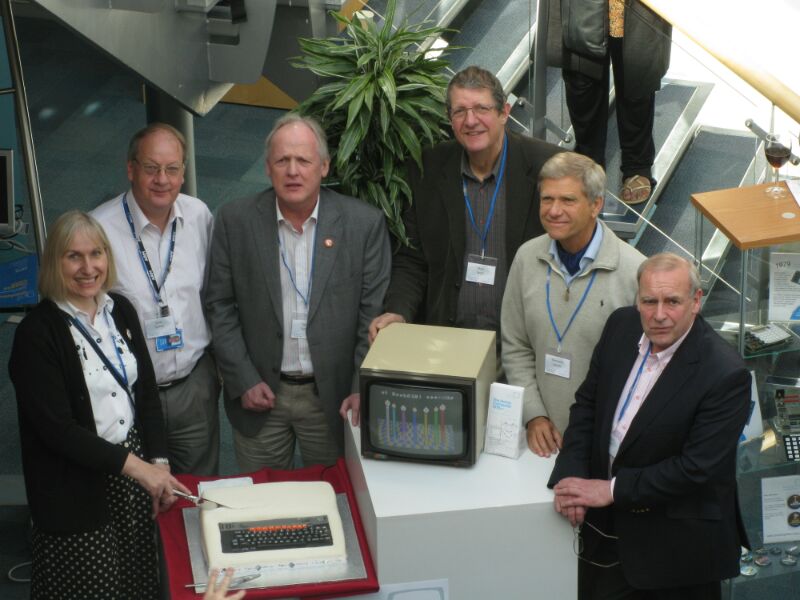
Acorn, BBC, and the Need for Something Better
The ARM story begins with a children’s television program.
In 1981, the BBC launched a national computer literacy initiative (the BBC Computer Literacy Project) and contracted with Acorn Computers of Cambridge to supply the accompanying microcomputer. Acorn had been founded in 1978 by Hermann Hauser and Chris Curry, operating from a Cambridge office above a tailor’s shop. Their BBC Micro was a technical triumph: fast, expandable, and well-suited to the educational market. Between 1981 and 1994, over 1.5 million BBC Micros were sold, and Acorn dominated British educational computing.
By 1983, Acorn was working on its next machine and found that no existing processor met its requirements. The most capable available chips (the Motorola 68000 and the Intel 8086) consumed too much power, generated too much heat, and cost too much to interface with memory. Acorn’s engineers were evaluating processors for a new workstation and found all the available options unsatisfactory.
Two engineers, Sophie Wilson (then Roger Wilson) and Steve Furber, proposed that Acorn design its own processor. The proposal was based on reports coming from the University of California, Berkeley, where David Patterson and his students were developing RISC (Reduced Instruction Set Computing), an architecture philosophy that argued that simpler instruction sets, executed faster, would outperform complex designs that tried to do more per instruction.
The Berkeley RISC project, and the parallel MIPS project at Stanford under John Hennessy, were academic efforts with limited commercial reach. Acorn’s engineers read the papers, obtained access to early Berkeley RISC designs, and drew the conclusion that a small team could build a better chip than the established manufacturers were selling.
Hermann Hauser allocated a team of fewer than a dozen people and a development budget that, by the standards of chip design, was trivially small. The team worked in a temporary building in Cambridge. They had one rule that would prove consequential: they could not afford a hardware simulator, so the chip had to be right first time. The constraint forced a discipline of simplicity that would define ARM’s philosophy for decades.
The First ARM: Simpler Than Anyone Planned
Sophie Wilson designed the instruction set. Steve Furber led the chip design. The ARM1 (Acorn RISC Machine 1) was fabricated by VLSI Technology in 1985.
When the first chips arrived, the team connected them to a BBC Micro for testing. The ARM1 worked correctly on first power-up, an unusual achievement for a first-silicon design. More surprising was a measurement they had not expected: the chip’s power consumption, listed as zero watts on the testing equipment. The test equipment was not broken. The ARM1 was drawing so little current that the measuring instruments could not register it. The chip was operating on the leakage current from the circuitry connected to it.
The ARM1 was fast for its class and consumed essentially no power. This was not primarily a design objective; it was a consequence of simplicity. The whole processor fitted in around 25,000 transistors, addressed memory with 26 bits, and had no cache, no memory management unit, and no floating-point unit. What it had was a clean, orthogonal instruction set that a compiler could target efficiently, a pipeline that executed instructions quickly, and a design small enough to implement in fewer transistors than any competing processor of comparable capability.
RISC Philosophy
RISC architectures are based on an empirical observation: compilers, when generating code for complex instruction sets, use a small subset of available instructions for the vast majority of operations. Complex instructions that took hardware engineers months to implement were used rarely; simple instructions like load, store, add, and branch accounted for 80–90% of executed code. If you designed a chip around the common case (making simple operations fast and cheap) and used software (the compiler) to handle complex operations as sequences of simple ones, the result was faster and smaller than a chip trying to do everything in hardware.
The ARM2 (1986) added the multiply instruction; the ARM3 (1989) added a cache. Each generation maintained strict backward compatibility with the original instruction set. Code compiled for the ARM1 ran on every subsequent ARM processor.
The Spin-Out: Advanced RISC Machines Ltd
In 1990, three companies formed a joint venture that would become one of the most consequential corporate structures in technology history.
Apple was designing the Newton, its pioneering personal digital assistant, and needed a low-power processor. The Apple engineers evaluated ARM and concluded it was the best available option, but wanted a dedicated supply and deeper access to the design. Acorn wanted to commercialize ARM beyond its own products. VLSI Technology wanted to manufacture the chips commercially.
The joint venture (Advanced RISC Machines Ltd) was established in November 1990 in a barn conversion outside Cambridge. It had twelve employees. Its business model was unlike any major chip company’s: ARM would license its processor designs to semiconductor companies, who would manufacture ARM-based chips and pay ARM royalties on each chip sold. ARM would own no fabs, manufacture nothing, and compete with no one. Every company that needed a low-power processor was a potential customer rather than a competitor.
This model had a specific advantage: ARM’s interests were perfectly aligned with its licensees’ success. The more chips a licensee sold, the more royalties ARM received. ARM had every incentive to make its architecture as widely useful as possible and no incentive to restrict access. The contrast with Intel, which manufactured its own chips, competed directly with anyone building x86 processors, and used its manufacturing advantage to maintain pricing power, was complete.
The ARM6 processor appeared in the Apple Newton MessagePad in 1993. The Newton was commercially disappointing (its handwriting recognition was unreliable and was famously satirized in Doonesbury), but the ARM core inside it worked as intended.
The Mobile Revolution: A Coincidence of Constraints
Through the 1990s, ARM’s architecture found its way into embedded systems, the processors controlling printers, hard disk controllers, network equipment, and the early generation of mobile phones. Nokia, Ericsson, and Motorola adopted ARM cores for their handsets because ARM’s power efficiency extended battery life.
The convergence that made ARM dominant was not planned; it was a coincidence between the architecture’s properties and the requirements of a new product category.
When mobile phones evolved from voice devices to pocket computers (with color screens, browsers, cameras, and music players) the power envelope became the binding constraint. A processor that consumed 10 watts and required active cooling was acceptable in a desktop; it was unusable in a device that had to run for a day on a battery the size of a credit card. ARM-based processors consumed milliwatts. Intel’s x86 architecture, optimized over decades for performance in mains-powered machines, consumed watts.
Intel recognized the threat and attempted to address it with XScale (2000), an ARM-licensed product, then with Atom (2008), an x86 design optimized for low power. Neither succeeded in the mobile market. The efficiency gap was not primarily about manufacturing process; it was about instruction set architecture. Complex decoding of x86’s variable-length, backward-compatible instruction set cost power that RISC architectures did not pay.
By 2007, when Apple introduced the original iPhone using a Samsung-manufactured ARM processor, ARM’s dominance in mobile was already established. The ARM architecture was in every phone that mattered. The iPhone did not create ARM’s mobile position; it validated and accelerated it.
Apple’s Custom ARM: A-Series to M-Series
Apple’s first own chip, the A4 (2010, iPhone 4), still used a licensed ARM Cortex-A8 core. With the A6 in the iPhone 5 (September 2012) Apple switched to a CPU core of its own design, Swift, built to ARM’s instruction set specification rather than from ARM’s blueprints. ARM supplied the architecture; Apple’s chip team in Cupertino built the silicon.
The results, released annually through the A-series, demonstrated that architectural licensing enabled competition on implementation quality rather than on architecture itself. Each generation of Apple’s custom ARM chips posted performance-per-watt measurements that exceeded both ARM’s own reference designs and Qualcomm’s competing implementations.
In November 2020, Apple introduced the M1, an ARM-based chip for the Mac, replacing fifteen years of Intel processors. The M1’s performance in sustained workloads exceeded comparably priced Intel laptop processors while consuming substantially less power. The M1 MacBook Air, with no cooling fan, outperformed the Intel MacBook Pro it replaced. The architecture story had completed its arc: a chip designed for efficiency in a Cambridge barn had become the preferred choice for performance in professional computing.
Intel’s Structural Problem
Intel’s response to ARM in mobile was late and insufficient. Its Atom chips were competitive on paper but arrived after the market had standardized on ARM ecosystems. Its failure in mobile cost it the smartphone processor market entirely. The subsequent ARM entry into laptops (Apple M-series) and servers (AWS Graviton, Ampere) has pressed Intel on its remaining strongholds. The x86 instruction set’s backward compatibility (which protected Intel’s position for four decades) is now a liability: the cost of decoding complex instructions that modern software rarely uses is paid in power every clock cycle.
The Ecosystem: 500+ Licensees
ARM’s licensing model produced an ecosystem with no precedent in semiconductor history. Over 500 companies hold ARM architecture licenses. Every major smartphone chip (Apple’s A-series, Qualcomm Snapdragon, Samsung Exynos, MediaTek Dimensity, HiSilicon Kirin) is ARM-based. AWS’s Graviton server processors (2018) brought ARM to cloud computing at scale. Ampere Computing designed ARM-based server chips explicitly for cloud workloads. Nintendo, Sony, and Microsoft use ARM cores in their gaming hardware.
The model created a virtuous cycle: ARM’s ubiquity attracted software optimization (compiler teams optimized for ARM, operating systems tuned their schedulers for ARM’s pipeline characteristics), which made ARM-based products more attractive, which attracted more licensees, which increased ARM’s royalty revenue, which funded better architecture development.
Architecture Licensing vs. Core Licensing
ARM offers two types of licenses. An architecture license allows a company to design its own processor core that implements the ARM instruction set (Apple, Qualcomm, Amazon use this). A core license allows a company to take ARM’s pre-designed processor core and integrate it into a chip without designing the core itself (most smaller chip companies use this). Architecture licensees compete on implementation quality; core licensees compete on integration and pricing. The distinction is why an Apple M-series chip and a MediaTek budget phone chip are both “ARM” but differ dramatically in performance.
SoftBank, Nvidia, and the IPO
In 2016, SoftBank acquired ARM for $32 billion, at the time, the largest acquisition of a European technology company. SoftBank’s founder Masayoshi Son argued that ARM would be central to the Internet of Things: tens of billions of connected devices would all need processors, and nearly all of them would be ARM-based. The strategic logic was sound; the price was aggressive.
In 2020, Nvidia announced its intention to acquire ARM from SoftBank for $40 billion in stock. The deal immediately attracted regulatory scrutiny on both sides of the Atlantic. ARM’s value to the semiconductor industry rested on its neutrality: it licensed to everyone, including Nvidia’s competitors. An Nvidia-owned ARM raised the question of whether Qualcomm, Apple, MediaTek, and Samsung would continue to receive equal access, or whether Nvidia would use ARM’s position as leverage.
Regulators in the UK, EU, US, and China all indicated opposition. In February 2022, Nvidia abandoned the acquisition. The regulatory intervention protected the neutrality that made ARM’s ecosystem function.
ARM went public on the Nasdaq in September 2023, raising $4.87 billion at a valuation of about $54.5 billion (the share price jumped roughly 25% on the first day, briefly lifting the market cap toward $65 billion). SoftBank retained a 90% stake. The IPO was the largest of 2023.
RISC-V: The Open Challenger
The most significant architectural challenge to ARM is not x86 but RISC-V, an open instruction set architecture developed at UC Berkeley starting in 2010, released without licensing fees or restrictions.
RISC-V offers what ARM cannot: a processor architecture that any company can implement without paying royalties or signing license agreements. For applications where cost sensitivity is extreme (billions of microcontrollers embedded in industrial equipment, appliances, and infrastructure) even ARM’s relatively modest licensing fees are significant. For governments and companies concerned about supply chain sovereignty, RISC-V offers architecture independence.
China’s semiconductor industry has adopted RISC-V extensively as a response to U.S. export controls limiting access to ARM’s advanced architecture licenses. The EU and India have funded RISC-V development programs.
RISC-V does not threaten ARM’s position in smartphones or high-performance computing in the near term: ARM’s ecosystem advantages (software optimization, developer tooling, existing IP libraries) are enormous. But it changes the competitive dynamics at the low end and in strategically sensitive markets.
The Architecture That Won
ARM’s dominance was not inevitable. In 1990, when the joint venture was formed in a barn with twelve employees, x86 was established in personal computing, MIPS was strong in workstations and game consoles, SPARC was present in servers, and PowerPC was about to enter the mainstream through Apple and IBM’s AIM alliance. By 2025, x86 retained servers and PCs; everything else (mobile, embedded, IoT, and increasingly laptops and cloud servers) had converged on ARM.
The outcome reflects a specific historical judgment: that power efficiency would become the dominant axis of competition in semiconductor design. This was not obvious in an era of mains-powered workstations. It became obvious the moment computers moved into pockets, and obvious again when data center operators discovered that their electricity bills rivaled their hardware costs.
The twelve engineers in a Cambridge barn, unable to afford a hardware simulator and forced by budget constraints to design something simple enough to be right first time, had accidentally built the architecture for a world that did not yet exist.
For the broader semiconductor story, see The Integrated Circuit Revolution and The Semiconductor Race. For Apple’s use of ARM in its transition from Intel, see Steve Jobs and Apple.
📚 Sources
- Furber, Steve: ARM System-on-Chip Architecture (2nd ed., 2000), Addison-Wesley
- Levy, Markus: “The History of the ARM Architecture: From Inception to IPO” — ARM White Paper (2005)
- The Official History of Arm — Arm Newsroom
- ARM architecture family — Wikipedia
- Patterson, David A. & Hennessy, John L.: Computer Organization and Design: ARM Edition (2016), Morgan Kaufmann
- Nvidia calls off its efforts to acquire Arm — TechCrunch (February 7, 2022)
- ARM Holdings plc: S-1 Registration Statement filed with the U.S. Securities and Exchange Commission (August 21, 2023)
- Image: Sophie Wilson, Chris Turner, Steve Furber, Chris Serle, Hermann Hauser, Chris Curry (7020152153).jpg by Trevor Johnson (CC BY-SA 2.0), via Wikimedia Commons