The IBM PC: The Open Architecture That Standardized Computing
Abstract
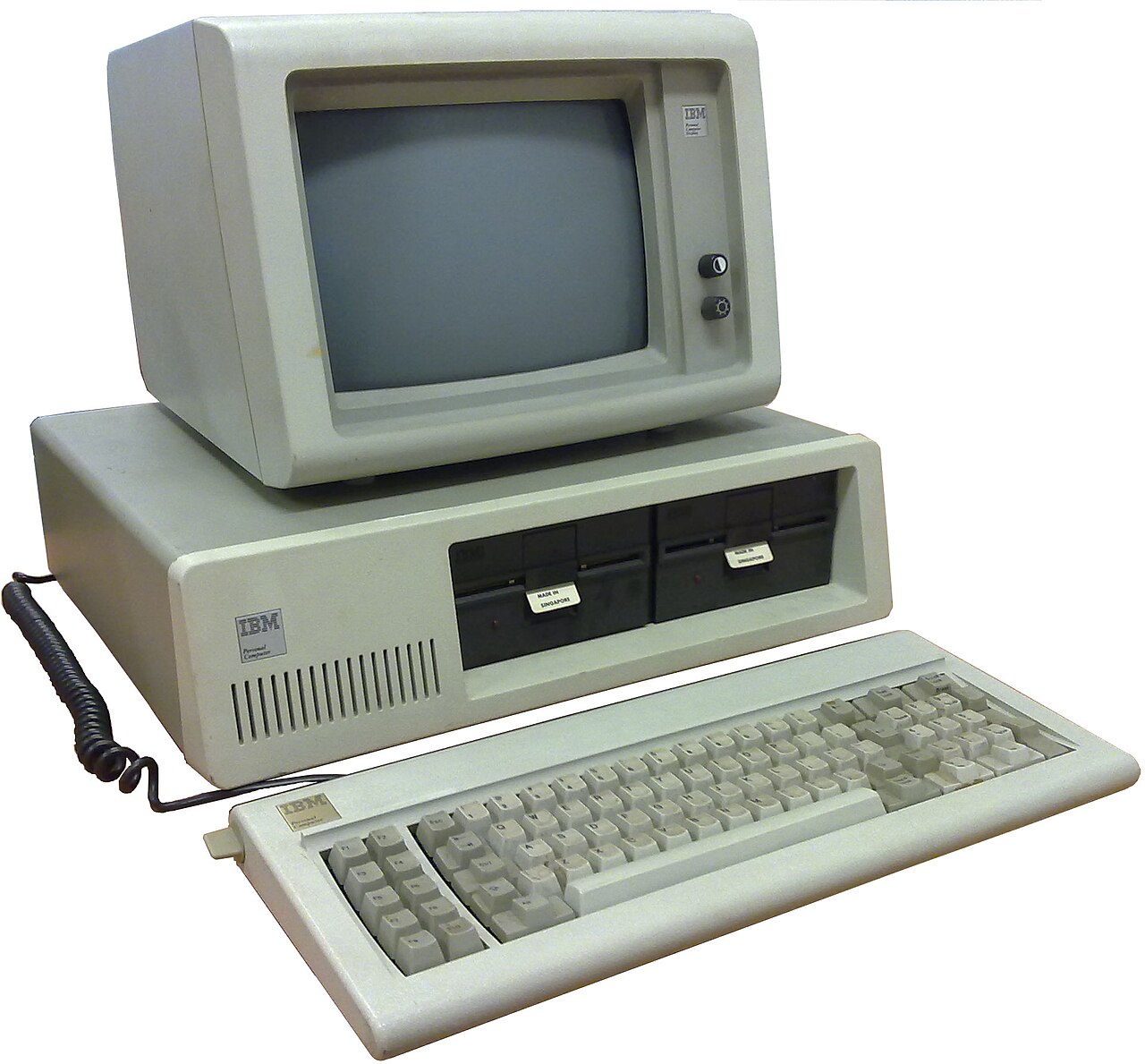
In August 1981, IBM shipped a personal computer built almost entirely from parts it didn’t design, running an operating system it didn’t own, manufactured by a division its own executives had tried to kill. The IBM PC 5150 was an act of corporate panic executed with remarkable speed, assembled by a 12-person skunkworks team in Boca Raton, Florida, in under a year. It succeeded beyond anyone’s expectations, established the x86 architecture as the universal standard for personal computing, and then immediately demonstrated the danger of the decision that made it possible: IBM had chosen an open design that any competitor could copy. Within eighteen months, the clones arrived. Within a decade, IBM had lost control of the industry it had created. The standard endures; the company that set it does not dominate it.
IBM in Crisis
By 1980, International Business Machines was the most powerful company in the computer industry and had completely missed the most important thing happening in it.
The personal computer had arrived. The Apple II had been selling since 1977. The TRS-80 from Tandy/Radio Shack had sold hundreds of thousands of units. The Commodore PET was in classrooms. A market that IBM had dismissed as a hobbyist curiosity was generating real revenue and, more troublingly, generating real legitimacy, businesses were buying Apple IIs to run VisiCalc spreadsheets, and IBM salespeople were watching the machines appear on their customers’ desks without IBM having sold them.
IBM’s internal processes made rapid response nearly impossible. The company’s normal product development cycle ran three to five years. It involved committees, review boards, interdivisional sign-offs, and a culture of deliberate, methodical engineering. These processes had produced excellent mainframes. They were completely incompatible with a market where a product took eighteen months from conception to obsolescence.
William Lowe, an IBM executive in Boca Raton, Florida, made the argument that eventually cut through the bureaucracy: IBM could not build a competitive personal computer through its normal channels, and any attempt to do so would produce a machine that arrived too late. The only option was to operate outside normal IBM procedures, a skunkworks team, off campus, with authority to make decisions quickly and use outside components. In July 1980, IBM’s corporate management committee approved the concept. Lowe’s successor as project leader would be Don Estridge.
Don Estridge and Project Chess
Philip Donald “Don” Estridge was not a senior IBM executive. He was a 43-year-old engineering manager who had spent most of his career working on systems software. He was chosen to lead the project (codenamed Project Chess) because he was available, he was in Boca Raton, and he had a reputation for getting things done without generating political friction.
Estridge assembled a team of twelve engineers and gave them a deadline: the machine had to ship in August 1981, one year away. Meeting that deadline with IBM’s normal manufacturing and component supply chain was impossible. The only viable path was to build the machine from parts that already existed, purchased from outside suppliers, and assembled into a design that any competent engineer could reproduce.
This decision (radical within IBM’s culture of vertical integration) was the hinge on which everything else turned. It meant speed: there was no time to design custom chips. It meant cost: off-the-shelf components were cheaper than bespoke ones. And it meant vulnerability: any competitor could buy the same components and build the same machine.
The processor decision came first. IBM evaluated the Motorola 68000 (technically superior, with a cleaner instruction set) but chose the Intel 8088 instead. The 8088 was a cost-reduced variant of the 8086, with an 8-bit external data bus that allowed it to work with cheaper support chips. It was not the best microprocessor available. It was available, proven, and cheap. Intel had inventory. See The Microprocessor Revolution for the story of how Intel’s chip architecture reached this position.
The Operating System: Gates, Kildall, and the Fifty-Thousand-Dollar Deal
Project Chess needed an operating system. IBM approached the obvious candidate first: Gary Kildall of Digital Research, whose CP/M operating system ran on most 8-bit personal computers and represented the closest thing the industry had to a standard. See Gary Kildall and the OS IBM Didn’t Take for the full account of what happened next.
The negotiations with Digital Research collapsed, accounts differ on why, involving a nondisclosure agreement, a missed meeting, and an intractable licensing dispute. IBM turned to Bill Gates at Microsoft, which primarily sold programming languages. Gates did not have an operating system. He did know where to find one.
Tim Paterson at Seattle Computer Products had written QDOS (Quick and Dirty Operating System) in 1980, as a CP/M-compatible stopgap while Digital Research delayed releasing CP/M-86 for the 8086 processor. QDOS was not an original design; Paterson later acknowledged that he had written it to be compatible with CP/M’s system calls, using the CP/M programmer’s manual as a functional specification.
Microsoft purchased the rights to QDOS from Seattle Computer Products for approximately $50,000. Paterson reportedly had no idea his system would be licensed to IBM. Microsoft retained the license; it sold IBM the right to use the renamed system (PC DOS) without selling IBM exclusive ownership. It was the most consequential software contract in business history. While IBM sold PC DOS as part of its computer, Microsoft could license the same software to any other manufacturer as MS-DOS.
Bill Gates recognized the strategic significance of what he held. See Bill Gates and Microsoft for the story of how Microsoft built an empire on this foundation.
August 12, 1981: Launch
The IBM Personal Computer, model 5150, was announced on August 12, 1981. It was sold through Sears and ComputerLand retail stores, another break with IBM tradition, which normally sold through its own salesforce.
The base configuration, with 16KB of RAM and no disk drive, cost $1,565. A fully configured system with 64KB RAM, a color graphics card, and a floppy drive cost over $3,000. These were not low prices (an Apple II with comparable memory cost somewhat less) but the IBM name carried enormous weight. Corporate purchasing departments that had hesitated to buy a “toy computer” from a company named Apple were willing to buy from IBM. The machine came with a legitimacy that no previous personal computer had possessed.
Sales exceeded all internal projections. IBM sold 800,000 units in the first two years. By 1983, IBM’s personal computer division was generating more than $4 billion in annual revenue. Time magazine named the personal computer its “Machine of the Year” for 1982, the first time the honor had not gone to a person.
The Clone Problem
IBM’s open architecture had a legal vulnerability that the Boca Raton team had acknowledged and accepted. The PC’s design used standard components connected through a published standard called the ISA bus. The only element that couldn’t be legally copied was the IBM BIOS, the Basic Input/Output System, a small piece of firmware that provided the fundamental interface between hardware and software.
Columbia Data Products produced the first IBM-compatible clone in June 1982, less than a year after the original launch. Columbia had reverse-engineered the BIOS through clean room techniques: one team of engineers read and documented everything the BIOS did without looking at IBM’s code; a second team, who had never seen the original, wrote new code that did the same things. The result was functionally identical but legally original. Courts later confirmed the legality of the approach.
Compaq Computer Corporation took the technique further (see Compaq and the BIOS Clean-Room). Rod Canion and two co-founders, engineers who had left Texas Instruments, designed a portable IBM-compatible computer that could run the same software as the IBM PC. The Compaq Portable launched in November 1982, sixteen months after the original IBM PC. It weighed 28 pounds and was shaped like a small suitcase, but it ran PC software and it could be carried. Compaq sold $111 million worth in its first year: the most successful first year of any company in American business history to that point.
Once Compaq demonstrated that the clone market was real and legally defensible, the flood began. Hundreds of manufacturers (most of them Taiwanese) began producing IBM-compatible machines at prices IBM could not match with its manufacturing costs. By the mid-1980s, the “IBM PC compatible” had become a standard independent of IBM. The standard was the hardware architecture, the Intel processor, and MS-DOS. IBM’s name was on none of those components.
The Attempt to Reclaim Control: PS/2 and MCA
IBM’s leadership understood what had happened. In 1987, IBM responded with the PS/2 product line and the Micro Channel Architecture (MCA) bus, a new hardware standard, proprietary to IBM, that clone manufacturers would need to license from IBM and pay royalties on.
The PS/2 and MCA were technically superior in several respects. They didn’t matter. The clone manufacturers (led by a consortium called the Gang of Nine that included Compaq, HP, and several others) responded by jointly developing the EISA bus as an alternative open standard. Software developers declined to write specifically for MCA features. Customers declined to pay a premium for IBM’s proprietary standard when compatible alternatives were cheaper and ran the same software.
IBM’s PS/2 strategy failed completely. By 1990, the clone manufacturers dominated the market IBM had created. IBM’s PC division (the most successful new business in IBM’s history) was about to become unprofitable.
The Legacy: Forty-Four Years of x86
The IBM PC’s immediate commercial story ends in failure for IBM: it exited the personal computer business entirely in 2005, selling its ThinkPad line to Lenovo. But the decisions made in Boca Raton in 1980 and 1981 locked in standards that remain universal.
The x86 architecture, Intel’s instruction set, introduced in the 8086 and present in descending form in the 8088 that powered the original IBM PC, is still the dominant architecture for personal computers, servers, and data centers in 2025. Every Windows PC, every Linux server, every Mac running Intel processors (and even Apple’s M-series chips through emulation) traces its software ancestry to the ISA that Intel designed for a chip family that debuted in 1978. Forty-four years of backward compatibility have built a software ecosystem so vast that no alternative architecture has been able to displace it.
The open architecture principle that IBM adopted out of necessity became the philosophical foundation of the PC industry. The idea that a standard hardware platform, built from commodity components, could support a competitive software ecosystem (that the value should live in software rather than hardware) is so obvious today that it requires effort to remember that IBM arrived at it by accident, under time pressure, in a skunkworks project that the company’s own culture would never have sanctioned under normal circumstances.
Don Estridge, who had led Project Chess and built IBM’s PC division into a multi-billion-dollar business, died on August 2, 1985, when Delta Air Lines Flight 191 crashed on approach to Dallas/Fort Worth International Airport. He was 48. IBM had recently recalled him to corporate headquarters, where he was to take a senior executive position. The personal computer division he had built was already beginning to lose the competitive ground it would never fully recover.
📚 Sources
- Chposky, James & Leonsis, Ted — Blue Magic: The People, Power and Politics Behind the IBM Personal Computer (1988)
- Carroll, Paul — Big Blues: The Unmaking of IBM (1993)
- IBM Personal Computer — IBM History
- Computer History Museum — The IBM PC
- History of personal computers — Wikipedia
- Stross, Randall — The Microsoft Way (1996)
- Compaq — Wikipedia
- Pournelle, Jerry — IBM PC Launch Coverage, BYTE Magazine, October 1981
- Wallace, James & Erickson, Jim — Hard Drive: Bill Gates and the Making of the Microsoft Empire (1992)
- Image: Ibm pc 5150.jpg by Ruben de Rijcke (CC BY-SA 3.0), via Wikimedia Commons