France's Tech Industry: Minitel, State Ambition, and the Grande École Pipeline
Abstract
France approached computing as a matter of national sovereignty. When IBM threatened to dominate European computing in the 1960s, Charles de Gaulle launched the “Plan Calcul”, a state-directed program to build a French computer industry independent of American control. The effort produced Bull, Thomson, and a generation of state-funded technology institutions, none of which achieved global dominance. From 1982 France handed out free Minitel terminals to telephone subscribers and built the most successful national videotex network in the world, a decade before the World Wide Web. Minitel reached about nine million users at its peak and supported a working market of paid online services; it also, arguably, delayed France’s adoption of the internet. The pattern recurs: a country that produces excellent engineers and funds research generously has repeatedly struggled to turn them into global technology companies, though Dassault Systèmes, Capgemini and, since 2023, Mistral AI are exceptions.
De Gaulle, the Computer, and the Plan Calcul
France’s computer industry had a Norwegian root. Fredrik Rosing Bull, an engineer at the Oslo insurer Storebrand, patented a punched-card tabulator in 1919 that read cards on a rotating drum; fourteen systems were built from 1922 to 1925, the year he died. His successors moved production to Paris, where H. W. Egli Bull was founded on 9 March 1931 and became the Compagnie des Machines Bull two years later. By 1948 France had 385 Bull installations, more than IBM’s. The electronic Gamma 3 of 1951 sold some 1,200 units, and Heinz Nixdorf’s young Paderborn firm supplied electronic adders and multipliers for Bull equipment under an exclusive contract from January 1959. The large Gamma 60 of 1960 found only twenty buyers, the small Gamma 10 of 1962 more than a thousand, but heavy losses in 1963 forced Bull into partnership with General Electric in July 1964.
The political origin of France’s technology ambitions was a rebuff. In the mid-1960s the United States refused export licences for IBM and CDC machines, among them the CDC 6600, to the Commissariat à l’énergie atomique, to slow work on the French hydrogen bomb; the refusal became public in 1966. In 1964 General Electric had taken a majority stake in Compagnie des Machines Bull, the largest French computer manufacturer, and cancelled two of its machines. Together the two episodes confirmed de Gaulle’s conviction that dependence on American technology was a strategic vulnerability.
The Plan Calcul, approved by de Gaulle in July 1966, was the response. On 6 December 1966 the government forced two existing firms, CAE and SEA, together into CII (Compagnie Internationale pour l’Informatique), provided substantial state funding, and directed state procurement toward French machines. The goal was a French computer industry competitive with IBM.
The result was mixed. CII produced machines (the IRIS 50 of about 1970 and the IRIS 80 of 1971) that were technically credible but commercially inadequate at the global scale. The French state could guarantee domestic procurement but could not manufacture global demand. CII was pulled out of the Unidata consortium with Siemens and Philips (see Dead End: Buying a Computer Industry) and absorbed into Honeywell Bull in 1976 to form CII Honeywell Bull, and the French computer champion became increasingly dependent on American partnership, ultimately becoming simply Bull, a company that survived through state support and gradual repositioning into IT services.
The Plan Calcul’s more durable result was institutional. It created IRIA (Institut de Recherche en Informatique et en Automatique) on 3 January 1967 at Rocquencourt, renamed INRIA in 1979, which became one of Europe’s largest computer science research institutes, with strong work in programming languages, distributed systems, and formal verification. INRIA’s first network project was CYCLADES (1971–1978), whose datagram design shaped TCP/IP and whose cancellation in favour of the PTT’s Transpac is the sharpest example of the pattern this article describes: see Louis Pouzin and the Datagram. It reinforced the grandes écoles pipeline, the system of elite engineering schools (École Polytechnique, École Normale Supérieure, Mines ParisTech) that trained the engineers who would staff both state institutions and private companies. It also confirmed technology as a matter of state policy in France.
The most enduring French first came from a small company outside the Plan. In June 1972 Alain Perrier of the agricultural research institute INRA, who needed a cheap computer to evaluate evaporation measurements, ordered one from R2E (Réalisations et Études Électroniques) in Orsay. François Gernelle and three colleagues built it around Intel’s 8008 processor with two kilobytes of memory; Perrier received it in January 1973, and the next month R2E put it on sale as the Micral N for 8,500 francs, the first commercially sold computer built around a microprocessor. A floppy drive followed in December 1973 and a keyboard and screen in 1974. CII Honeywell-Bull bought R2E in 1978 and sold “Bull Micral” machines until 1989.
Minitel: The Internet Before the Internet
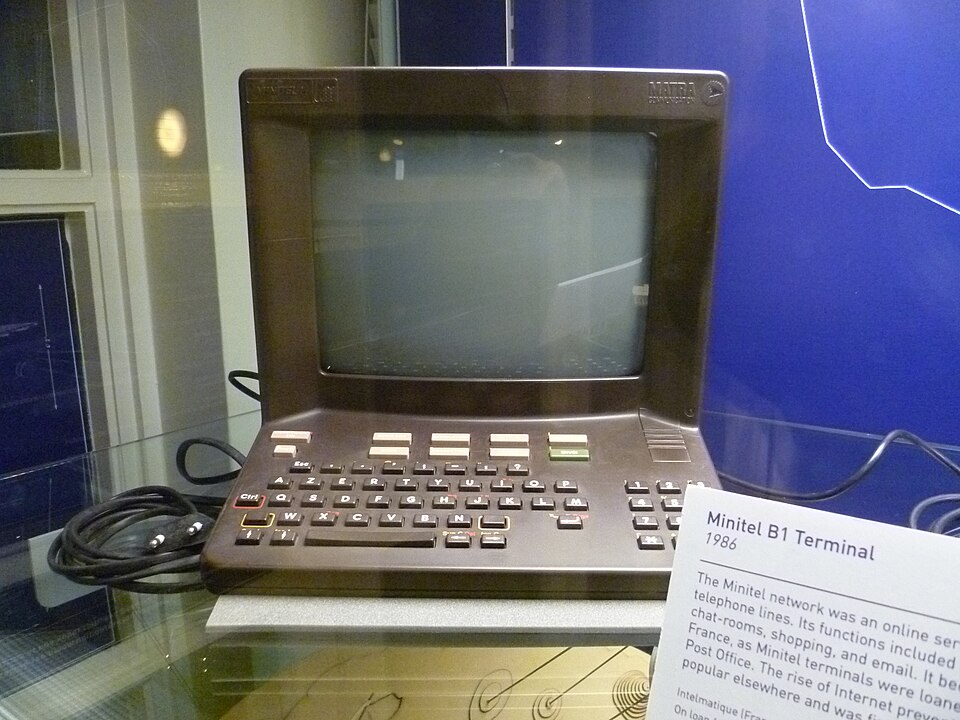
Trials began in Saint-Malo in the summer of 1980 with 55 households; a second pilot followed in July 1981 with 2,500 households in the western suburbs of Paris. Post Minister Louis Mexandeau formally inaugurated the Télétel service in Rennes on 4 February 1983. The Direction générale des Télécommunications, the PTT’s telecoms arm and the predecessor of France Télécom, had begun in 1982 to distribute Minitel terminals (small beige devices with a screen, keyboard, and built-in modem) to French telephone subscribers, for free. The terminal connected to the Télétel network through the telephone line, providing access to an electronic directory service that replaced the printed white pages.
The directory service was only the beginning. In February 1984 the network was opened to third-party content providers through a system called Kiosque: users dialled a short number such as 3615, typed the name of the service, and paid by connection time; the operator collected the fees and passed a share to the providers. The billing required no credit cards, no accounts and no registration: charges appeared on the telephone bill.
There were 120,000 terminals at the end of 1983, 1.9 million in 1985, 4.2 million in 1988 and 6 million in 1991; at the peak, around 2002, about nine million people used the network through terminals or PCs. The services available included train and flight reservations (SNCF’s reservation system was among the most popular), weather, news, banking, shopping, and (in a development that made Minitel internationally famous) adult chat services, called messageries roses, which generated enormous traffic and revenue and shocked French observers who had assumed the network would be used for practical information retrieval.
Minitel’s Technical Architecture
Minitel used a videotex protocol called Télétel, which transmitted formatted text and simple graphics. In videotex mode terminals displayed 25 rows of 40 columns, in eight shades of grey, with semigraphic characters for drawing. The terminal stored nothing: each screen was fetched from a service provider’s server, reached through the Transpac packet-switching network. The design suited the information-retrieval services Minitel was built for.
Entrepreneurs could launch Minitel services with little capital, because the telephone network and the billing system were provided by the PTT and later France Télécom. The Kiosque billing model allowed micro-transactions at scale. French internet historians have argued that Minitel created in France, by the mid-1980s, a functioning e-commerce ecosystem (with online shopping, online banking, and online information services) that the United States would not achieve until the late 1990s.
Dead End: The Minitel Trap
When the World Wide Web emerged in 1991–1993, France had a functioning alternative. Minitel worked. Millions of French people used it every day for tasks that the early web performed poorly: train reservations, banking, business directories. The web’s early interface was worse than Minitel’s for practical tasks; its content was thinner; its connection was slower.
France Télécom resisted Minitel’s retirement. The terminals were deployed, the network was profitable, and the political constituency for preserving the system was strong. Instead of retiring the system, France Télécom bridged it: gateways in the mid-1990s let Minitel services be reached from a personal computer, and by the end of 1999 some three million people were using Minitel emulator software on a PC rather than a terminal. These were half-measures that preserved the ecosystem rather than accelerating the transition.
The result was a measurable delay in France’s internet adoption. By 1999, internet penetration in France was significantly lower than in Germany, the UK, or Scandinavia, countries that had no functioning alternative to displace. French companies that might have built early internet services continued serving Minitel’s user base. The entrepreneurs who might have built French equivalents of Amazon or Yahoo! were building Minitel services instead.
The Innovator’s Dilemma, National Edition
Minitel succeeded, and its success became an obstacle. France had online information services in millions of homes years before anyone else, and the cost of that was reluctance to abandon them. The pattern of disruptive innovation (inferior new technology displacing superior established technology through gradual improvement) played out at the scale of a nation’s digital infrastructure. Minitel was shut down on June 30, 2012, thirty years after its launch.
INRIA, Dassault, and French Technical Depth
At INRIA, the Caml family, an ML dialect first implemented at INRIA in 1987 and continued as Caml Light and then OCaml from 1996, runs Jane Street’s trading systems and was the implementation language of Facebook’s Hack and Flow type checkers. The Coq proof assistant, first released at INRIA in 1989 and renamed Rocq in 2025, is one of the main tools for machine-checked proofs of software and mathematics. Xavier Leroy’s verified C compiler CompCert, produced at INRIA, demonstrated that a production compiler could be mathematically proven correct.
Dassault Systèmes, founded in 1981 as a spinoff from the aerospace company Dassault Aviation, built CATIA (Computer-Aided Three-dimensional Interactive Application), the 3D CAD software that became the standard design tool for aerospace (Boeing, Airbus), automotive (BMW, Toyota), and shipbuilding industries globally. In 2023 Dassault Systèmes had revenues of about €6 billion, making it one of Europe’s largest software companies.
Capgemini, founded as Sogeti by Serge Kampf in a two-room Grenoble apartment on 1 October 1967, became one of the world’s largest IT services and consulting firms, a French company that built a global business advising other companies on technology, without itself developing technology products.
Station F and the Startup Wave
President Emmanuel Macron, who served as Economy Minister before his 2017 election, made startup promotion a signature policy. The phrase “La French Tech,” coined in 2013 as a government branding initiative, was accompanied by visa reforms (the French Tech Visa allowed startup founders and employees to obtain residence permits rapidly), tax incentives, and the development of Station F, a startup campus opened in Paris on 1 July 2017 in the converted Halle Freyssinet railway freight building, with 34,000 square metres of space for up to 1,000 startups and around 30 incubator programmes. By floor space it is the world’s largest startup campus. Xavier Niel put roughly €250 million of his own money into buying and rebuilding it.
Companies of this wave include Criteo (programmatic advertising, listed on NASDAQ in October 2013), BlaBlaCar (long-distance ride-sharing, 2006), Doctolib (healthcare appointment booking, 2013), Ledger (hardware crypto wallets, 2014), OVHcloud (Europe’s largest hosting provider), and Contentsquare (digital experience analytics) In April 2023 three former Google DeepMind and Meta researchers founded Mistral AI in Paris, which became Europe’s best-funded developer of large language models.
France’s AI research was internationally prominent. Yann LeCun, born at Soisy-sous-Montmorency outside Paris in 1960 and trained at ESIEE Paris and the Université Pierre et Marie Curie, founded Facebook AI Research in 2013 and was Chief AI Scientist there and at Meta until he announced his departure in November 2025, and shared the 2018 Turing Award for deep learning with Yoshua Bengio and Geoffrey Hinton.
📚 Sources
- Heinz Nixdorf MuseumsForum blog, “Bull – Datentechnik aus Frankreich” (11 October 2019)
- Heinz Nixdorf MuseumsForum blog, “Klein und französisch” (6 April 2018)
- Heinz Nixdorf MuseumsForum blog, “Die drei Jahrzehnte des Minitel” (13 January 2017) (the 1980 and 1981 pilots, the 1983 inauguration, terminal counts by year, the 2002 peak)
- Mailland, Julien & Driscoll, Kevin: Minitel: Welcome to the Internet (2017), MIT Press
- Curien, Nicolas & Muet, Pierre-Alain: La Société de l’Information (2004), La Documentation française
- Mounier-Kuhn, Pierre E.: L’Informatique en France de la Seconde Guerre Mondiale au Plan Calcul (2010), PUPS
- Nora, Simon & Minc, Alain: The Computerization of Society (1978/trans. 1980), MIT Press
- Inria — Wikipedia
- Dassault Systèmes — Wikipedia
- Capgemini — Wikipedia
- Leroy, Xavier: “Formal Verification of a Realistic Compiler” — Communications of the ACM 52(7): 107–115 (2009)
- La mission French Tech: the government initiative launched in 2013, its visa scheme and programmes.
- Plan Calcul — Wikipedia: the refused US export licences to the CEA, the 1964 GE takeover of Bull, de Gaulle’s approval in July 1966, the creation of CII in December 1966, IRIA in 1967, and the 1976 absorption of CII into Honeywell Bull.
- Minitel — Wikipedia: the Saint-Malo trial of July 1980, the 1982 PTT rollout, terminal counts from 120,000 in 1983 to nearly nine million at the peak, and the shutdown on 30 June 2012.
- Minitel — Wikipédia (French): the 25 × 40 videotex screen format and the Kiosque billing model of February 1984 with its 3615 tariff.
- Compagnie internationale pour l’informatique — Wikipédia: CII formed from CAE and SEA on 6 December 1966, and the IRIS 50 and IRIS 80.
- OCaml — Wikipedia: first Caml implementation at INRIA in 1987, Caml Light, Objective Caml in 1996, and the OCaml users Jane Street, Facebook (Hack, Flow) and Docker.
- Rocq — Wikipedia: Coq first released at INRIA in 1989 by Coquand, Huet and others, renamed Rocq in March 2025.
- Station F — Wikipedia: opened 1 July 2017 in the Halle Freyssinet, 34,000 m², up to 1,000 startups, Xavier Niel’s roughly €250 million investment.
- Yann LeCun — Wikipedia: born 8 July 1960 at Soisy-sous-Montmorency, ESIEE 1983, UPMC doctorate 1987, 2018 Turing Award with Bengio and Hinton, departure from Meta announced in November 2025.
- Brousseau, Éric: “E-Commerce in France: Did Early Adoption Prevent Its Development?”, The Information Society 19(1), 2003: the argument that Minitel and EDI delayed France’s move to the internet.
- Capgemini — 50th Anniversary Press Kit: Sogeti founded by Serge Kampf in Grenoble on 1 October 1967.
- Image: Minitel B1 terminal 1986 02.JPG by Philafrenzy (CC BY-SA 4.0), via Wikimedia Commons