Gary Kildall and the OS IBM Didn't Take
Abstract
Gary Kildall wrote the first widely licensed operating system for microcomputers. His CP/M (Control Program for Microcomputers) was the dominant OS for 8-bit microcomputers throughout the late 1970s, the software infrastructure on which thousands of applications ran, the product that proved that one operating system could work across dozens of different hardware configurations. When IBM came to Kildall in 1980 to license an OS for its new personal computer, the negotiations collapsed. IBM turned to Bill Gates, who licensed someone else’s CP/M-like system, sold it on to IBM, and later bought it outright for $50,000. The rest is the history of Microsoft. Kildall spent the decade that followed watching a technically inferior copy of his work become the standard for personal computing, fighting Microsoft with better products that never caught up, and never fully recovering from the moment everything changed. He died in 1994, at 52, from a head injury, with his memoir unpublished. He is remembered, when remembered at all, as the man who wasn’t there when IBM called.
The First Computer Scientist in the Room
Gary Arlen Kildall was born on May 19, 1942, in Seattle, Washington. His father ran a navigation school that taught sailors to use sextants and charts. Kildall grew up around instruments, precision, and practical problem-solving, a childhood inflected by the technical culture of maritime Seattle.
He took his mathematics degree at the University of Washington in 1967, a master’s in computer science there in 1968, and, after his Navy years began, a PhD in 1972, in a discipline so new that Washington’s program was among the first in the country. Kildall was part of the inaugural cohort of people who could legitimately call themselves computer scientists rather than mathematicians or engineers who had drifted into computing.
His dissertation, “Global expression optimization during compilation,” worked on the data flow analysis that lets a compiler reason about how values move through a program in order to optimize its output. It was rigorous theoretical work, the kind that belongs in research laboratories. Kildall was not drawn to theory for its own sake. He wanted to build things.
To meet his draft obligation he taught computer science to officers at the Naval Postgraduate School in Monterey, California, and stayed on there as a faculty member. On the side he consulted for Intel, which needed software for its new microprocessors: Intel lent him 8008 and 8080 systems, and he wrote instruction-set simulators for them (INTERP/8 and INTERP/80). He was, for a brief period, one of the few people in the world who knew how to program them.
PL/M: The First Language for Microprocessors
The Intel 8008, released in 1972, was the first commercially available 8-bit microprocessor: a central processing unit on a single chip. Programming it required writing assembly code: direct manipulation of registers and memory addresses in the chip’s native instruction set. Writing an assembler was straightforward. Writing anything of real complexity was not.
Kildall’s response was PL/M (Programming Language for Microprocessors), a high-level programming language designed specifically for microprocessor development. Released in 1973, PL/M borrowed heavily from PL/I, the IBM systems language, but stripped it to what was practical on a chip with 8-bit registers and minimal memory. It allowed programmers to write systems software (device drivers, I/O routines, embedded control programs) without descending to assembly for every operation.
PL/M was not glamorous. It had no academic prestige, no Turing Award waiting for it. It was engineering: get the job done. But it established Kildall’s method. He approached software pragmatically, as infrastructure, tools that existed to make other work possible, not as ends in themselves. The approach was exactly right for the moment the industry was entering.
Intel used PL/M internally. It became the implementation language for much of Intel’s development software in the mid-1970s. Intel sold the PL/M compiler; Kildall was paid as a consultant, largely in development equipment, not royalties. He was still thinking of himself as an academic with interesting side projects.
CP/M: The Architecture of the Operating System
In 1973 and 1974, Kildall wanted to connect his Intel 8080 development system to a floppy disk drive, useful for storing and loading programs without manually toggling switches. The problem was that every interaction with the disk required hardware-specific code: different disk controllers had different interfaces, different timing, different sector sizes. Any program that read or wrote files would have to be rewritten for each hardware configuration.
Kildall’s solution was architectural. He divided the problem into two layers:
The Basic Input/Output System (BIOS): a thin, hardware-specific module that the user (or hardware manufacturer) provided for their particular disk controller and I/O hardware. The BIOS handled the physical details (reading a sector, writing a byte) in terms specific to that machine.
Above it, CP/M itself (Control Program for Microcomputers): a hardware-independent operating system that managed files through a consistent interface, maintained a directory structure on disk, and provided a command interpreter. Programs wrote to CP/M’s standard calls; the BIOS translated those calls into hardware operations. A program written to CP/M ran on any machine that had a CP/M BIOS written for it.
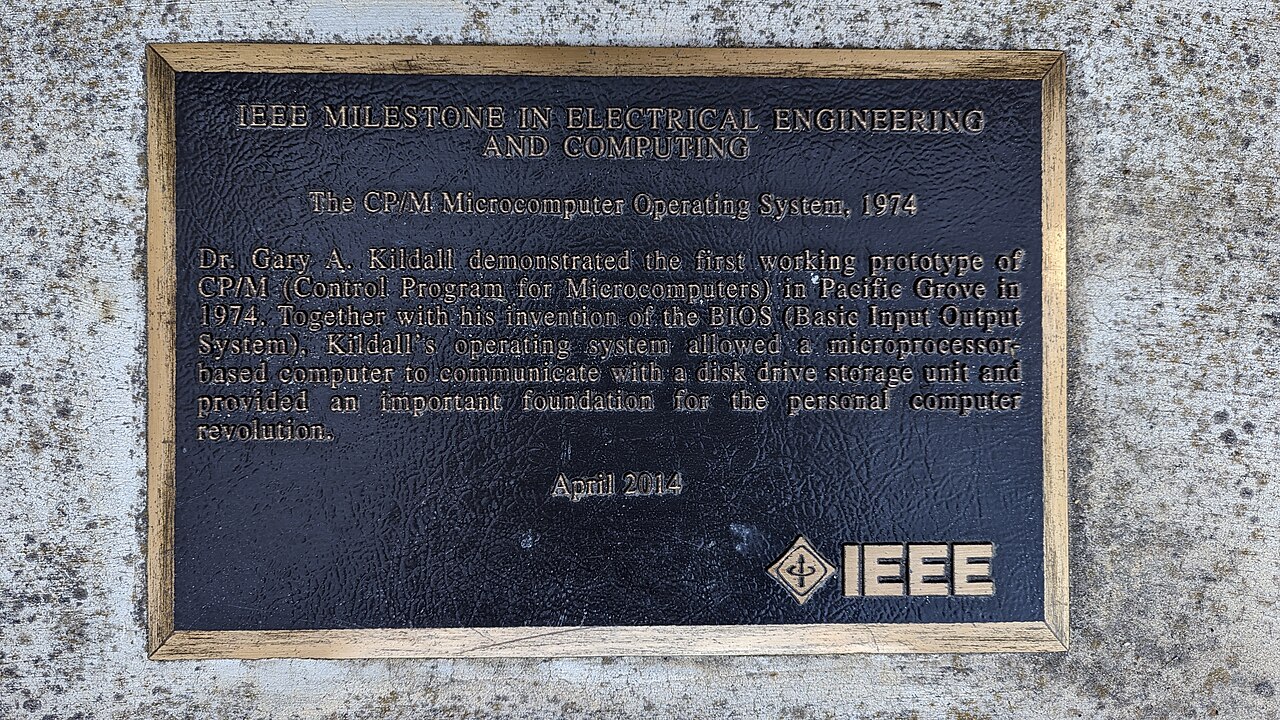
This was the BIOS abstraction, the separation of hardware-specific code from the operating system proper. It took shape as CP/M was moved to different machines in 1975 and 1976, and the name BIOS comes from CP/M. The IBM PC of 1981 kept the name and the idea for its firmware, and the IEEE Milestone plaque in Pacific Grove (2014) honours CP/M and the BIOS together.
CP/M 1.4 was the version that established the standard in the late 1970s, followed by CP/M 2.2 in 1979. It ran on machines using the S-100 bus (the expansion bus introduced by the Altair 8800) and shortly thereafter on dozens of other hardware configurations. The key was the BIOS: hardware manufacturers who wanted their machines to run CP/M’s growing software library needed only write a BIOS for their specific hardware. Kildall supplied the OS; they supplied the hardware layer. This OEM model (licensing an operating system to hardware manufacturers who adapted it for their machines) was the commercial structure that CP/M pioneered and that MS-DOS would later replicate.
CP/M’s Technical Innovations
CP/M introduced several concepts that became standard across the industry:
- File Control Blocks (FCBs): data structures for managing open files, providing programs a consistent interface to disk I/O regardless of underlying hardware.
- Transient Program Area (TPA): the memory region above the resident OS where user programs ran, establishing the model of OS-resident code at fixed addresses with programs loaded above.
- The command line interpreter (CCP): a built-in command processor handling file operations (DIR, ERA, REN, SAVE, TYPE) that became the template for MS-DOS’s COMMAND.COM.
- BIOS as hardware abstraction layer: the concept that would appear in every subsequent PC architecture.
QDOS, written at Seattle Computer Products and later sold to Microsoft as the basis of MS-DOS, was designed so that CP/M programs could be translated to it with minimal change. Its author, Tim Paterson, was explicit about this: he wanted 8080 software written for CP/M to come across to the 8086 easily.
Digital Research and the CP/M Empire
Kildall and his wife Dorothy McEwen set up the company that became Digital Research, Inc. (DRI) to commercialize CP/M, registering it first under the name Intergalactic Digital Research. The company started in Monterey and soon moved to Pacific Grove, a small coastal town next to it. The address was less Silicon Valley than afterthought, but it did not matter. The first licensee was Omron, for its terminals, in 1975; IMSAI shipped CP/M with its 8080 machines from 1976, and Osborne, Kaypro, Commodore and later Amstrad followed. CP/M spread by reputation, through hobbyist networks, Byte magazine articles, and the testimony of users who had discovered that one operating system could run on dozens of machines.
By September 1981 Digital Research had sold more than 250,000 CP/M licences, and sublicences put the real number higher; by the early 1980s an estimated 2,000 applications ran on it, among them WordStar (the dominant word processor), dBASE II (the dominant database manager), SuperCalc (a VisiCalc competitor) and, from 1983, Turbo Pascal. The CP/M software ecosystem was the richest in the personal computer market.
Digital Research had 20 employees and $3.5 million in revenue in 1980 and took in $20 million in 1982. Kildall was wealthy and respected.
What was coming was IBM.
The Meeting That Changed Everything (1980)
In the summer of 1980, IBM was developing its first personal computer under a project so secret it was codenamed Project Chess. IBM’s traditional approach to new products (years of internal development, proprietary components, controlled distribution) had been abandoned under competitive pressure: the Apple II and its imitators were taking corporate customers IBM regarded as its own. The solution was to build a PC quickly, using off-the-shelf components and outside software, and ship it within a year.
IBM’s software team, led by Jack Sams, arrived at Digital Research’s Pacific Grove offices in August 1980. Their goal was to license CP/M for the IBM PC. CP/M was the obvious choice: it was the dominant operating system, it had the largest software library, and it had demonstrated it could be ported to new hardware.
What happened at that meeting has been disputed for four decades. The account that became legend (told in Hard Drive, in Paul Allen’s memoir and in most retellings of Gates’s rise) is that Kildall was out flying his private plane when IBM arrived and could not be bothered with the visitors.
The flight is real; the rest is disputed. On the morning of 22 August 1980 Kildall and his colleague Tom Rolander flew his plane to the Bay Area to deliver software to the hardware maker Bill Godbout, a prior appointment. Dorothy McEwen, Digital Research’s president and a full business partner, received Jack Sams’s team. IBM asked her to sign its nondisclosure agreement, which was drafted to protect IBM and left the other side little protection; she refused to sign without her husband’s and the company lawyer’s approval. Kildall returned in the afternoon. Accounts differ on whether he then met the IBM team and whether the NDA was eventually signed; according to Kildall, a handshake agreement was later reached on a flight to Florida, which Sams denied.
Where the talks foundered was money and control. Digital Research licensed CP/M for a royalty per copy; IBM wanted a one-time payment. Neither side moved, and CP/M-86, the 8086 version IBM needed, was not finished.
IBM turned to Microsoft.
Misconception: Kildall lost the IBM deal because he went flying instead of meeting IBM
He was flying that morning, to a business appointment made before IBM called, and he was back the same day. The first meeting stalled over IBM’s one-sided nondisclosure agreement, which Dorothy McEwen would not sign without him; the deal failed over royalty-versus-flat-fee terms and an unfinished CP/M-86, not over an absent founder. The story of the hobbyist pilot who could not be bothered is a later simplification. See Myths and Misconceptions.
MS-DOS and the Replicated System
IBM, having failed to acquire CP/M, turned to Bill Gates. Gates, who had a relationship with IBM through Microsoft’s BASIC interpreter, initially referred IBM back to Digital Research. When that went nowhere, Gates introduced IBM to an operating system Microsoft did not yet own.
Seattle Computer Products had developed QDOS (Quick and Dirty Operating System) for its own 8086-based hardware. QDOS was explicitly modeled on CP/M (its creator, Tim Paterson, had CP/M documentation in hand while writing it) adapted for the Intel 8086’s 16-bit architecture. Microsoft first licensed QDOS from Seattle Computer Products at the end of 1980 for $25,000, then in July 1981 bought all rights outright for $50,000, renamed it MS-DOS (Microsoft Disk Operating System), and licensed it to IBM as PC-DOS.
IBM shipped the IBM PC in August 1981. PC-DOS was available for $40. CP/M-86 (the 8086 port of Kildall’s OS) arrived for the IBM PC only in spring 1982, at $240. The price differential alone made the outcome predictable. IBM’s marketing machine, the largest in the computer industry, was behind MS-DOS. CP/M-86 was an afterthought.
The IBM PC clone market (which IBM had accidentally enabled by using off-the-shelf components and a relatively open architecture) standardized on MS-DOS. Within two years of the PC’s launch, the new business software was being written for MS-DOS first.
The Long Rearguard (1982–1991)
Kildall did not give up. The decade that followed the IBM deal was a sustained technical effort to compete with a company that had the IBM imprimatur, distribution advantages, and Microsoft’s considerable commercial aggression.
Digital Research’s responses were frequently technically superior to their Microsoft equivalents and commercially ineffective:
CP/M-86 and Concurrent DOS addressed the 8086 market but could not overcome MS-DOS’s installed base and pricing. Concurrent DOS offered multitasking that MS-DOS could not provide; users preferred compatibility.
GEM (Graphical Environment Manager), introduced on 28 February 1985, was a graphical user interface for DOS that predated Windows 1.0. GEM’s desktop and icons closely resembled the Apple Macintosh interface. Apple threatened legal action in the summer of 1985, and Digital Research gave in rather than risk an injunction: it agreed to replace the PC version, dropping features such as the trash-can and disk icons on the desktop and overlapping windows, and to pay Apple an undisclosed sum. GEM survived as the interface for the Atari ST (a popular computer in Europe) and as the interface for Ventura Publisher, a desktop publishing application. As a general-purpose GUI for DOS, it was finished.
DR-DOS, released in 1988, was Digital Research’s most direct challenge to Microsoft. It was compatible with MS-DOS (it ran the same applications) and added features MS-DOS lacked: DR DOS 5.0 (1990) loaded the system into high and upper memory, and DR DOS 6.0 (1991) bundled disk compression and task switching. Microsoft answered with MS-DOS 5.0 and 6.0, which added the same features.
Microsoft’s other response was not technical. Beta versions of Windows 3.1 contained code (the “AARD code”) that displayed a spurious error message on systems running DR-DOS, and internal Microsoft emails, disclosed in later litigation, discussed making Windows look incompatible with it. This FUD (Fear, Uncertainty, and Doubt) campaign discouraged users from adopting a competitor through manufactured compatibility concerns. Microsoft’s licensing practices drew a separate antitrust response: the US Department of Justice, acting alongside the European Commission on identical terms, settled with Microsoft in July 1994 over per-processor licensing deals that made OEMs pay for MS-DOS on machines that shipped without it.
Novell acquired Digital Research in 1991. In 1996 it sold DR-DOS to Caldera, which sued Microsoft over the compatibility sabotage; that case settled in January 2000 on terms not then disclosed.
The Novell sale made Kildall rich and ended his part in the operating-system business. From 1983 to 1990 he had co-hosted The Computer Chronicles, the public-television technology program, with Stewart Cheifet. In 1985 his company KnowledgeSet had released The Electronic Encyclopedia, Grolier’s encyclopedia on CD-ROM, one of the first CD-ROM reference works; his last venture, Prometheus Light and Sound in Austin, Texas, developed a home telephone system linking landline and mobile phones. And he was writing his memoir.
The memoir had a specific trigger. In 1992, the University of Washington’s computer science program celebrated its 25th anniversary. Kildall, one of the first PhDs the program had produced, attended as an ordinary member of the audience. The keynote was given by Bill Gates, a Harvard dropout whose connection to the university was as a donor. Kildall took the slight hard and began writing Computer Connections: People, Places, and Events in the Evolution of the Personal Computer Industry, completing a rough draft of 232 pages by late 1993 and giving about fifty bound copies to colleagues, friends and family. The Computer History Museum put an authorised excerpt online on 3 August 2016, under half the text and ending in 1978, so it leaves out the 1980 IBM meeting. The manuscript is not a neutral document. “Don’t think for a minute that Gates made it ‘big time’ because of his technical savvy,” it says, describing Gates as “more of an opportunist than a technical type.” Harold Evans later used the unpublished draft as a primary source for the Kildall chapter of They Made America (2004), which concluded that Microsoft’s fortune rested on Kildall’s inventions; IBM and Microsoft both disputed that account as one-sided.
Dead End: When Being Right Isn’t Enough
The story of CP/M is the encyclopedia’s most direct case study in platform economics overriding technical merit.
CP/M was not a dead end because it was bad. It was the best personal computer operating system available when IBM was making its platform decision. The BIOS abstraction it pioneered became universal. The file system concepts it introduced became standard. The command-line interface it shipped was the template for everything that followed, including DOS. Its successor DR-DOS was technically superior to MS-DOS.
What CP/M could not survive was platform lock-in at the moment of industry formation. The IBM PC was not just a computer; it was the decision point at which the entire industry would standardize. Once IBM chose MS-DOS and the clone market formed around it, the question shifted from “which OS is better?” to “which OS runs more software?” Every application ported to MS-DOS increased DOS’s advantage; every ISV choosing to develop for DOS first (or only) increased the penalty for running CP/M. Network effects are not neutralized by technical excellence.
The second factor was IBM’s price structure. Digital Research, negotiating in 1980, had no way to know that IBM’s PC would catalyze a clone industry, that the clone industry would be the real market, and that software sold through IBM retail channels at $40 would establish a price ceiling that made CP/M-86 at $240 uncompetitive before it launched. IBM’s distribution and retail pricing were not part of the negotiation; they were the negotiation’s aftermath.
The third factor was Microsoft’s aggressive response to competition. Kildall built better products. Microsoft used its Windows relationship to suppress the adoption of those products through technical manipulation and FUD. The DR-DOS antitrust settlement, the internal emails about engineering compatibility failures into Windows; these document a competitive strategy that was not about technical merit.
The Counterfactual
What if Digital Research had accepted IBM’s terms in 1980? The counterfactual is irresistible and unanswerable. CP/M-86 would have become the IBM PC standard. The clone market, if it formed (and IBM’s architecture made clones possible regardless of the OS), would have standardized on CP/M. Microsoft would have remained a programming languages company (BASIC, Fortran, COBOL) without the DOS royalties that funded Windows development. Kildall’s BIOS abstraction would be the heritage of a successful company rather than a footnote in Microsoft’s origin story.
The counterfactual matters less than what it reveals: the outcome of 1980–1981 was not determined by technical quality, market fit, or entrepreneurial merit. It was determined by the terms of a single licensing negotiation, IBM’s impatience with those terms, and Bill Gates’s willingness to move fast with someone else’s software.
The End
Gary Kildall died on July 11, 1994, in Monterey, California, at 52. He had suffered a head injury three days earlier, on 8 July, at a biker bar in Monterey; accounts differ on whether he fell from a chair, fell down steps or was struck, and police investigated a possible homicide. He was discharged from hospital twice before he died, and the autopsy was inconclusive, though it noted evidence of chronic alcoholism. His memoir, “Computer Connections,” existed only as a rough draft and was not published in his lifetime.
On 25 April 2014 the IEEE dedicated a Milestone plaque to CP/M outside 801 Lighthouse Avenue in Pacific Grove, Digital Research’s former headquarters.
For the IBM PC decision that bypassed CP/M, see The IBM PC. For the Microsoft that benefited, see Bill Gates and Microsoft.
📚 Sources
- Heinz Nixdorf MuseumsForum blog, “Das war Gary Kildall” (9 September 2016) (Omron and IMSAI as first licensees, Digital Research revenue 1980 and 1982, the Computer Chronicles years, the memoir’s 232 pages and 50 copies, the 2016 CHM excerpt)
- Kildall, Gary: “Computer Connections” — unpublished memoir, written c. 1993–1994. Excerpts published by the Computer History Museum
- Evans, Harold: They Made America: From the Steam Engine to the Search Engine (2004), Little, Brown — Chapter on Gary Kildall
- Gary Kildall — Wikipedia · education, Intel simulators, the 22 August 1980 flight with Rolander to Godbout, the NDA, the Florida handshake claim, KnowledgeSet, Prometheus, the 1992 University of Washington anniversary, memoir quotes, the circumstances of his death
- CP/M — Wikipedia · 250,000 licences by September 1981 (citing InfoWorld), about 2,000 applications, CCP commands
- Allen, Paul: Idea Man: A Memoir by the Cofounder of Microsoft (2011), Portfolio — Chapter 7
- Freiberger, Paul & Swaine, Michael: Fire in the Valley: The Making of the Personal Computer (2000, 2nd ed.), McGraw-Hill
- Manes, Stephen & Andrews, Paul: Gates: How Microsoft’s Mogul Reinvented an Industry — and Made Himself the Richest Man in America (1993), Doubleday
- Paterson, Tim: “Is DOS a Rip-Off of CP/M?” — DosMan Drivel, August 2007
- Computer History Museum: Oral history of Tom Rolander (VP, Digital Research) — interview conducted 2016
- Wallace, James & Erickson, Jim: Hard Drive: Bill Gates and the Making of the Microsoft Empire (1992), Wiley
- US Department of Justice: settlement with Microsoft over per-processor licensing, press release, 15 July 1994 — coordinated with a parallel European Commission undertaking on the same terms