Robotics
Abstract
Robotics is where computing meets the physical world, the engineering of machines that sense, decide, and act on their surroundings. It is older than the digital computer in imagination (the word “robot” dates to a 1920 play) and as new as the humanoid machines and self-driving cars of today. Robotics has advanced not in one sweep but in distinct theaters: the industrial robots that quietly transformed manufacturing from the 1960s; the mobile robots that had to confront the messy, unpredictable real world; the consumer robots like the Roomba that finally put autonomous machines in ordinary homes; and the field robots that explore Mars, the ocean floor, and disaster zones. Through it all runs a central tension (between the precise, repetitive certainty of the factory and the chaotic uncertainty of the open world) and a hard truth that has humbled the field for decades: the things humans find easy, robots find nearly impossible. This article surveys robotics as a field; the word’s origin is covered in a separate fun fact.
Automata and Mechanical Men
Machines that imitated living things are far older than the word for them. Among Leonardo da Vinci’s drawings is a spring-driven cart whose path was set by cams on its gear wheels, a mechanism recognised only in 1975, and scattered sketches of a moving suit of armour that the art historian Carlo Pedretti identified in 1957; nobody knows whether either was built. Jacques de Vaucanson presented a life-size mechanical flute player to the French Academy of Sciences on April 30, 1738, and added a drummer and a duck that ate grain and appeared to digest it. When the writer Friedrich Nicolai examined the duck in 1781, by then in a Nuremberg collection, he found that it digested nothing: it released a supply stored inside. Its motions were programmed by pins on a rotating drum, and Vaucanson later applied the same idea to a punched-tape loom that anticipated Jacquard’s (see Fun Fact: The Mechanical Turk for the century’s most famous fake).
The nineteenth century added steam. Zadoc Dederick and Isaac Grass of Newark patented a 2.35-metre steam man that walked in front of a carriage in March 1868; Frederick Hornburg’s steam man, shown in Melbourne in 1880, toured Vienna, Hanover and Prague in 1882 and 1883. Fiction followed with Auguste de Villiers de l’Isle-Adam’s android Hadaly in L’Ève future (1886) and Leo Gilbert’s German novel Seine Exzellenz der Automat (1907), whose bearded automaton Lars talks its way into a ministry. In 1911 the Berlin engineer Otto Widmann toured Europe with Occultus, a bearded “artificial man” that talked and obeyed commands, probably by hidden remote control. Japan’s first modern robot was Gakutensoku, built by the biologist Makoto Nishimura for the Kyoto exhibition of September 1928: a seated figure 3.5 metres high with its pedestal, driven by compressed air and a cam drum, that changed its expression and wrote characters with a brush. In West Germany the Bundespost advertised with a two-metre cable-controlled robot named Roberto in 1952, and from November 1959 children could buy the DUX Astroman, a 35 cm toy robot, for DM 34.50.
From Čapek to Unimate
The word “robot” entered the world in 1920, coined by Czech writer Karel Čapek (on his brother Josef’s suggestion) in the play R.U.R. (Rossum’s Universal Robots), from the Czech robota, meaning forced labor or drudgery. The play’s robots were artificial workers who ultimately rebel, establishing the cultural anxiety that has shadowed the field ever since. Isaac Asimov later coined “robotics” and formulated his fictional Three Laws of Robotics in stories from the 1940s, giving the field both its name and its ethical imagination long before real robots existed. The text of R.U.R. was published in Prague in November 1920; an amateur company in Hradec Králové staged it on January 2, 1921, and the National Theatre in Prague on January 25. Čapek’s robots were made of biological material, not metal. The word was not entirely new: Austrian German had used Robot for forced labour in the eighteenth and nineteenth centuries. Within fifteen years cinema had metal robots replacing workers, in Harry Piel’s Der Herr der Welt (1934) and the Soviet Loss of Sensation (1935).
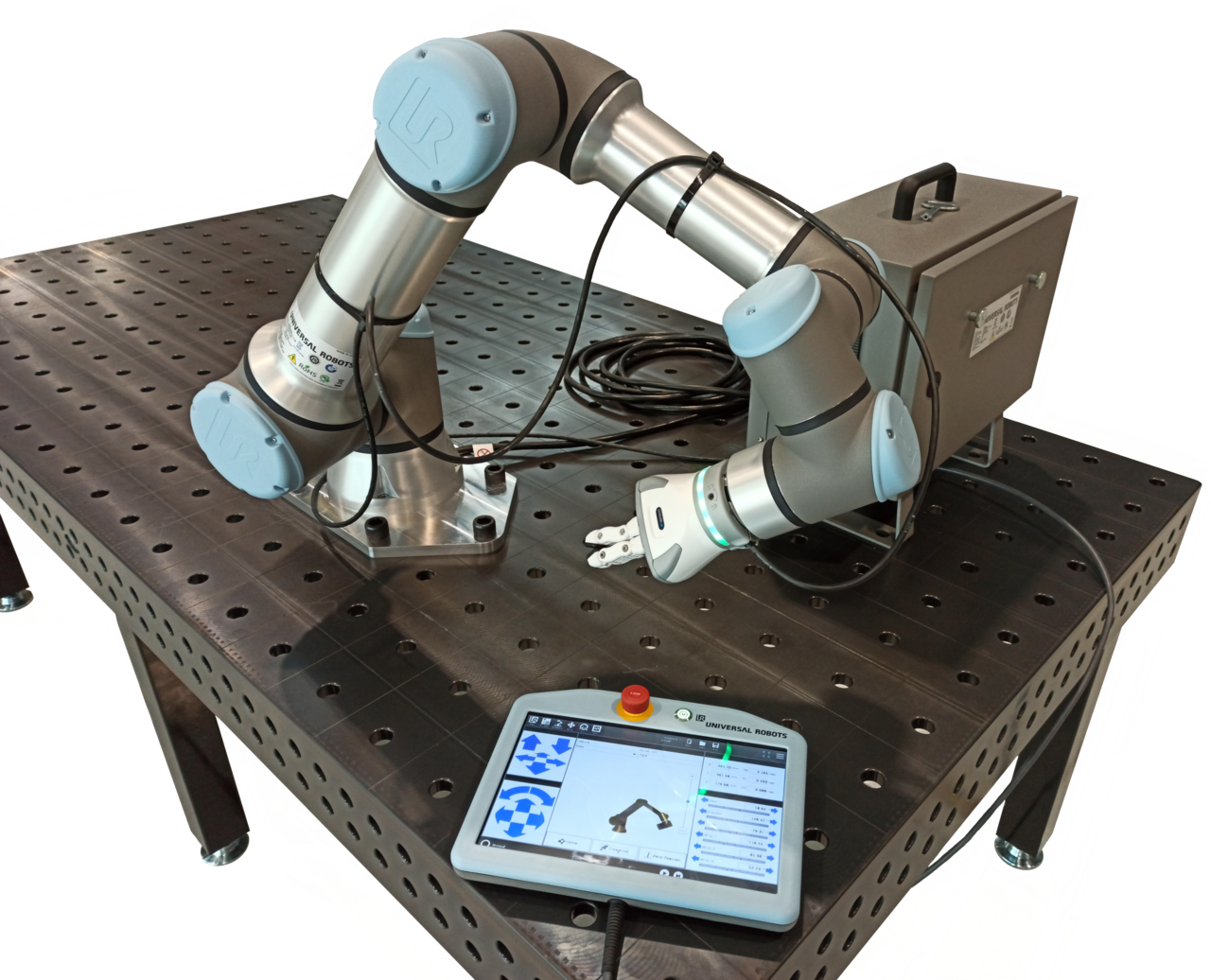
The first real industrial robot arrived in 1961: Unimate, designed by George Devol (who patented the concept) and commercialized by Joseph Engelberger (often called “the father of robotics”). A Unimate arm went to work on a General Motors assembly line in New Jersey, performing the dangerous, repetitive task of handling hot die-cast metal parts and welding. Industrial robotics grew into an enormous, largely invisible industry, robotic arms from companies like KUKA, ABB, and FANUC now build cars, electronics, and countless goods. These robots are fast, precise, tireless, and strong, but classically they were blind and fixed: bolted in place, repeating pre-programmed motions in a tightly controlled environment, with no perception of and no ability to adapt to the unexpected. Safety required caging them away from humans.
Devol filed his patent for “programmed article transfer” in 1954; it was granted in 1961. He met Engelberger at a party in 1956, and their company, Unimation, was based in Danbury, Connecticut. A German forerunner had a darker history: in the late 1930s the rocket enthusiast Rudolf Nebel and the engineer Karl Saur sold an “automatic worker” from Berlin, a frame that moved a gripper or tool in three directions, and in July 1944 the Mittelwerk, the underground V-2 factory worked by concentration-camp prisoners, ordered twenty. Unimates reached Europe in 1967, in Sweden. In 1969 General Motors used them for spot welding on a line that built 110 cars an hour, and Victor Scheinman at Stanford began the Stanford Arm, an electrically driven, fully computer-controlled arm with six degrees of freedom; Unimates were hydraulic. KUKA of Augsburg, which had distributed Unimates in Germany, combined both lines of work in the Famulus of 1973, the first industrial robot with six electrically driven axes. Volkswagen built its own: its robot “Robby”, controlled by a minicomputer, worked in Wolfsburg from 1973, 85 robots were running in VW plants by 1978, and Hall 54, which started production on July 26, 1982 and was built for more than DM 2 billion, automated about a quarter of the work steps in assembling the Golf. KUKA has been Chinese-owned since a takeover that began in 2016.
The Hard Problem: The Real World
Mobile, perceiving robots (machines that move through and reason about an uncontrolled environment) proved vastly harder than factory arms. The pioneering example was Shakey the Robot (SRI, 1966–1972), the first mobile robot to reason about its own actions, combining perception, planning, and navigation. Shakey was painfully slow but conceptually foundational, introducing ideas (like the A* search algorithm, developed for its planning) that outlived it.
The central difficulty is the one named by Moravec’s paradox: tasks trivial for humans (recognizing objects, walking over uneven ground, grasping a soft or irregular object, knowing where you are) require staggering amounts of computation, while “hard” tasks like arithmetic or chess are comparatively easy for machines. A robot must continuously solve perception (what is around me?), localization and mapping (where am I?), planning (what should I do?), and control (how do I move my actuators precisely?), all in real time, under noise and uncertainty. A breakthrough framework, SLAM (Simultaneous Localization and Mapping), gave robots a principled way to build a map of an unknown space while tracking their own position within it, foundational for everything from warehouse robots to self-driving cars.
Moravec knew the problem from his own work: for his 1980 Stanford doctorate he had taught the Stanford Cart to cross a room by camera, slowly, linked by radio to a stationary computer. He then ran the Mobile Robot Laboratory at Carnegie Mellon for a quarter-century and co-founded the robotics company Seegrid in 2003.
Robotics also developed competing philosophies of control. The classical “sense–plan–act” pipeline built an internal world model and reasoned over it. In the 1980s, Rodney Brooks at MIT challenged this with behavior-based robotics and the subsumption architecture, arguing that intelligence could emerge from simple reactive behaviors layered together, with “the world as its own best model” rather than an elaborate internal representation. This insight (that robots should be reactive and embodied rather than deliberative planners) directly shaped practical robots, including the company Brooks co-founded, iRobot.
Robots Among Us: Roomba, Boston Dynamics, and the DARPA Challenges
Consumer robotics arrived with the iRobot Roomba in 2002, a disc-shaped autonomous vacuum that, using cheap sensors and reactive behaviors rather than expensive mapping, became the first genuinely successful home robot, selling in the tens of millions. Its modest competence was the point: it did one useful thing reliably in the chaos of real homes.
Legged robots captured the public imagination through Boston Dynamics, founded by Marc Raibert out of MIT in 1992. Its dynamically balancing machines, BigDog, the humanoid Atlas (famous for parkour and backflips), and the quadruped Spot (commercially deployed for inspection), demonstrated mobility over rough terrain that had long seemed impossible, achieved through sophisticated real-time control of dynamics and balance.
The push toward autonomous vehicles was catalyzed by the DARPA Grand Challenge: in 2004 no vehicle finished a desert course; in 2005 five did, led by Stanford’s Stanley (Sebastian Thrun’s team). The 2007 Urban Challenge added traffic and intersections. These competitions seeded the entire self-driving industry (Waymo, Cruise, and others) and proved that data-driven perception and probabilistic methods could let robots cope with the open world. Meanwhile NASA’s Mars rovers, Sojourner (1997), Spirit and Opportunity (2004), Curiosity (2012), and Perseverance (2021), became humanity’s most successful field robots, operating autonomously for years on another planet under communication delays that make remote control impossible.
Robots in the Operating Room
The first robot-assisted operation took place in Long Beach, California, on April 11, 1985: guided by a CT scan, an industrial robot arm positioned a needle for a brain biopsy. Programmed surgical robots followed. ROBODOC, from Integrated Surgical Systems of Sacramento with help from an IBM researcher and the University of California, milled the femur for hip replacements; it was presented on November 7, 1992, and approved only in Europe, working in Frankfurt from 1994 and assisting in some 2,700 hip operations by 2000. In January 2003 Der Spiegel reported patients harmed by it, lawsuits reached Germany’s Federal Court of Justice, the German machines were withdrawn, and the company closed in June 2005. Its German counterpart, CASPAR from orto Maquet in Rastatt, was first used in Erlangen in 1997; 43 were sold before production ended in 2004.
The second kind of surgical robot leaves every movement to the surgeon at a console. The da Vinci system grew from 1980s work at SRI International; Intuitive Surgical brought it to market in Europe in 1999 and in the United States in 2000, merged with its rival Computer Motion in 2003, and had more than 6,700 systems in use by 2022.
The Learning Turn
Increasingly, robotics has fused with modern AI. Deep-learning vision gave robots far better perception; reinforcement learning let them learn locomotion and manipulation skills that were hard to program by hand. The frontier of the 2020s is general-purpose and humanoid robots driven by large learned models: “robot foundation models” trained on vast demonstration data, and well-funded humanoid projects (Tesla’s Optimus, Figure, and others) betting that a single platform can learn to do many physical tasks. Whether this finally cracks the dexterity and generalization problem, or becomes another cycle of overpromising, remains genuinely open.
Dead End: The Anthropomorphic Obsession and the General-Purpose Home Robot
Robotics’ most persistent dead end has been the humanoid, general-purpose home robot, the science-fiction android that cooks, cleans, and converses. For decades, this vision attracted enormous investment and recurring hype, and for decades it underdelivered. Honda’s ASIMO (2000–2018) was a marvel of bipedal engineering that walked, climbed stairs, and even ran, yet after nearly two decades and vast expense, it remained essentially a demonstration that could do no genuinely useful work, and Honda retired the program. Countless “home assistant” and social robots (Jibo, Kuri, and others) launched to fanfare and folded commercially.
Fake robots have shadowed the real ones throughout. “Miss Honeywell,” who worked a trade stand for Honeywell at a London automation show in May 1968, was a woman in a costume, staged by the magician Mark Wilson with a stage illusion he patented the following year. Quasar Industries of New Jersey rented out a fleet of 32 conical “Klatu” robots from 1975 that chatted with visitors, apparently through a hidden operator on a radio link; when the company’s chief Tony Reichelt announced an AI household version in 1977, academic researchers protested and the New York Times attacked the claim. In January 2024 a Tesla Optimus robot was shown folding a shirt with human help.
The lesson runs counter to intuition: the path to useful robots ran not through general-purpose humanoids but through narrow, specialized machines that did one thing well in a constrained setting, the bolted-down factory arm, the disc-shaped vacuum, the warehouse shuttle, the planetary rover. Moravec’s paradox is the deep reason: human-level general manipulation and mobility in unstructured environments is so computationally hard that building a machine shaped like a human, expected to do everything a human does, was attempting the hardest possible version of the problem first. Brooks’s insight (that competence emerges from simple, embodied, task-specific behavior rather than grand general designs) repeatedly beat the anthropomorphic dream. Whether the current AI-driven humanoid wave finally overturns this, or rediscovers the same wall, is the open question hanging over the field.
📚 Sources
- Heinz Nixdorf MuseumsForum blog, “Die Geburt des Roboters” (24 November 2020)
- Heinz Nixdorf MuseumsForum blog, “Der Roboter des Leonardo da Vinci” (2 May 2019)
- Heinz Nixdorf MuseumsForum blog, “Die programmierte Ente” (29 January 2021)
- Heinz Nixdorf MuseumsForum blog, “Die Dampfmenschen kommen” (25 July 2023)
- Heinz Nixdorf MuseumsForum blog, “Seine Exzellenz der Automat” (17 December 2021)
- Heinz Nixdorf MuseumsForum blog, “Auf den Spuren von Occultus” (18 February 2022)
- Heinz Nixdorf MuseumsForum blog, “Gakutensoku – der erste japanische Roboter” (22 November 2022)
- Heinz Nixdorf MuseumsForum blog, “Roboter auf der Leinwand” (23 April 2021)
- Heinz Nixdorf MuseumsForum blog, “Roboter des Wirtschaftswunders” (3 February 2023)
- Heinz Nixdorf MuseumsForum blog, “Vom automatischen Arbeiter zum Industrieroboter” (7 March 2016)
- Heinz Nixdorf MuseumsForum blog, “125 Jahre KUKA – 50 Jahre Famulus” (3 November 2023)
- Heinz Nixdorf MuseumsForum blog, “Als VW noch Roboter baute” (21 July 2026)
- Heinz Nixdorf MuseumsForum blog, “Happy birthday, Hans Moravec!” (30 November 2018)
- Heinz Nixdorf MuseumsForum blog, “Roboter im Operationssaal” (3 May 2022)
- Heinz Nixdorf MuseumsForum blog, “Miss Honeywell und Herr Klatu” (1 April 2025)
- Karel Čapek’s R.U.R. and the origin of “robot” (1920) · Encyclopaedia Britannica on the play that coined the word
- Unimate — Wikipedia, the first industrial robot on the GM line, 1961
- Shakey the Robot — SRI International, the first reasoning mobile robot and the A* algorithm
- Rodney Brooks, “Intelligence Without Representation” / subsumption architecture, behavior-based robotics manifesto
- The DARPA Grand Challenge and Stanley (Stanford, 2005), the competitions that seeded self-driving cars
- NASA Mars Exploration Rovers · Sojourner through Perseverance, autonomous field robotics
- Boston Dynamics — Wikipedia, dynamic legged locomotion
- Honda ASIMO retirement (2018), the humanoid showcase and its limits
- Image: UR16e robot arm.png by Auledas (CC BY-SA 4.0), via Wikimedia Commons