Yugoslavia's Computing Industry: CER, Iskra Delta, and the Computer Broadcast on the Radio
Abstract
Yugoslavia stood outside the Warsaw Pact and was only an associate member of Comecon, so it could buy Western machines as well as build its own, and its computing shows both. Belgrade’s Vinča institute built the country’s first digital computer, the CER-10, between 1956 and 1960, and the Mihajlo Pupin Institute, which took over its computer group, sold small series of bookkeeping and banking machines into the 1980s. Slovenia’s Iskra Delta, which began in 1974 as DEC’s Ljubljana agent and was assembling PDP-11s by 1978, grew to 2,000 employees as one of the largest computer makers in the country and collapsed in 1988. And when import rules kept foreign home computers out in 1983, the engineer Voja Antonić published the plans for the Galaksija in a magazine, 8,000 readers built one from a kit, and a Radio Belgrade show broadcast home-computer software as sound for three years. The article is short because the industry was; its dead end is the state that dissolved under it.
CER
The first Yugoslav digital computer was built for the nuclear institute. A team of about seventy at the Vinča institute outside Belgrade, led by Rajko Tomović and Dušan Mitrović and with Tihomir Aleksić among its leading designers, developed the CER-10 between 1956 and 1960, a hybrid of valves, transistors and electronic relays with magnetic-core memory, paper-tape input and a teleprinter; it stayed in use until 1966. Aleksić and Nedeljko Parezanović followed it with the CER-20 and CER-30 programmable calculators of 1963 to 1966, used at the institute, at the Elektronska Industrija works in Niš and at RIZ in Zagreb, and the group became the computing arm of the Mihajlo Pupin Institute in Belgrade. Its products were small machines for the domestic market: the CER-200 series of 1966, eighteen “electronic bookkeeping computers” (twenty with the later CER-202 and CER-203 variants) on transistors and medium-scale integrated circuits for banks and enterprises, some in service until 1989, and the CER-22 of 1967, designed by Dušan Hristović, a series of three banking and data-processing machines with punched cards, tape and a line printer, retired in 1975. Nothing in the line was built in hundreds.
Digitron
Yugoslavia also had an early pocket calculator. Digitron was founded on 1 February 1971 in Buje, a small town in Istria, in a building that now houses the local fire brigade, and began by copying Japanese desktop calculators. Its db 800 combined Texas Instruments’ TMS1802NC calculator chip, announced on 17 September 1971, with a TI four-function keyboard: eight digits, 13 by 8 by 4 centimetres, and reportedly as expensive as a small car. A contemporary source puts the start of sales on 15 January 1972, and Boris Halasz, who curated a 2023 exhibition on Croatian computing for the Zagreb technical museum, counted no units built in 1971 and 3,209 in 1972. The often-repeated production start of May 1971 does not hold up, but January 1972 may still make the db 800 the first pocket calculator made in Europe. The db 801 of 1973 won a design award, and in the languages of the region digitron became the ordinary word for a pocket calculator (see The Pocket Calculator).
Iskra Delta
Yugoslavia’s industrial computer maker came from the DEC dealership. Iskra Delta began in 1974 as Elektrotehna, the Ljubljana representative of Digital Equipment Corporation, and in 1978 started assembling PDP-11 minicomputers in Ljubljana, a route open to Yugoslavia because it stood outside the Warsaw Pact and was only an associate member of Comecon (compare Comecon Computing, where the same machines had to be cloned). It merged with the computer divisions of the Iskra electronics combine and the Gorenje appliance maker, reached 2,000 employees, ran a joint venture with Energoinvest in Sarajevo and a terminal plant at Paka near Slovenj Gradec, and sold the PDP-11-compatible Delta 800 and the Partner business computer across the federation. It was one of the largest computer producers in the country.
It lasted fourteen years. Iskra Delta was late to microcomputers, and when import rules loosened in the late 1980s its customers bought the originals; the company collapsed in 1988, bankruptcy proceedings opened in Yugoslavia on 5 February 1990 and were completed in Slovenia in February 2021, thirty-one years later.
Galaksija
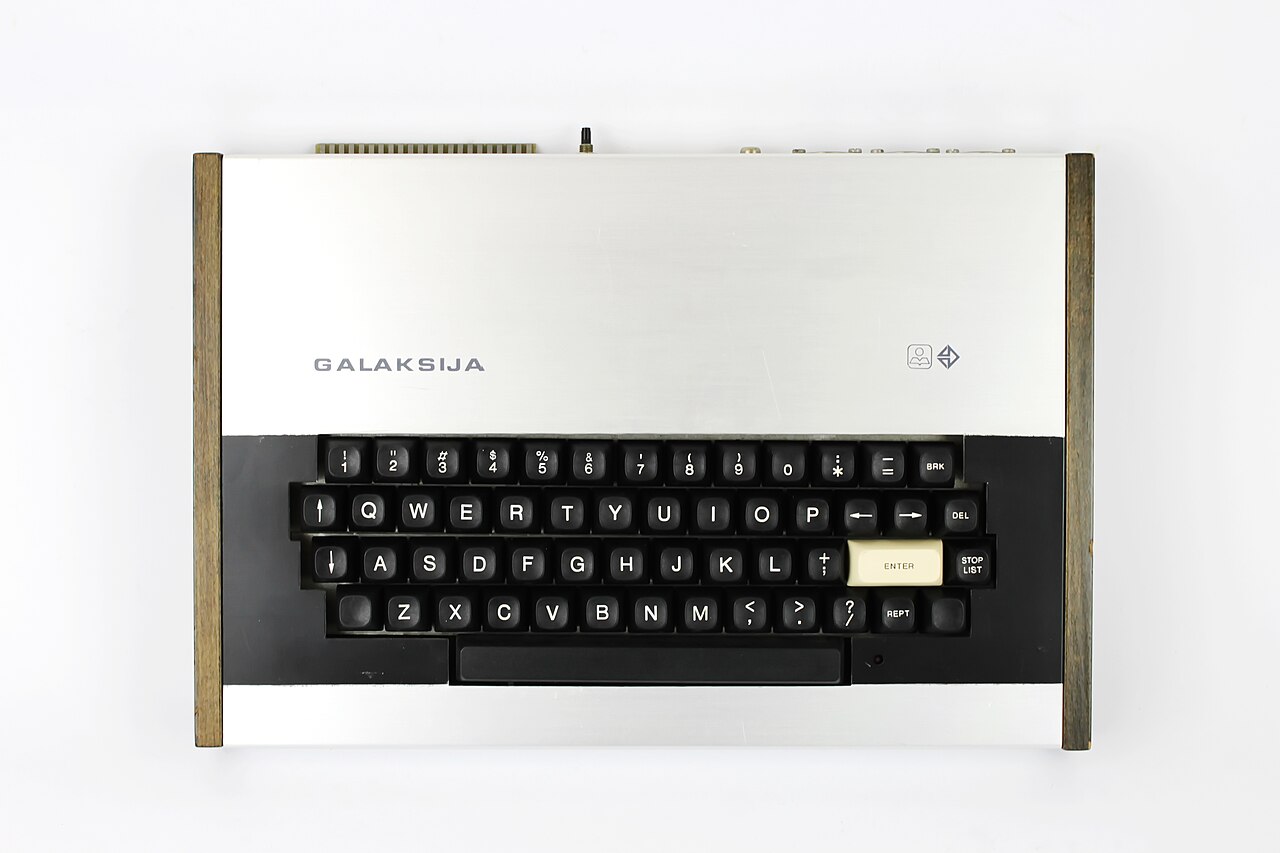
The best-known Yugoslav computer was never sold as a product. In the early 1980s import restrictions kept Western home computers out of the country, and Voja Antonić, a Belgrade engineer and journalist, designed a machine that could be built at home. The idea came to him on holiday in Montenegro in summer 1983, reading the manual of an RCA microprocessor; the result was the Galaksija, a Z80A at 3.072 MHz with 4 to 8 KB of system ROM plus a character ROM, and 2 to 6 KB of RAM, expandable to 54 KB, a keyboard built into the board and a BASIC whose error messages were “WHAT?”, “HOW?” and “SORRY”. He gave the design away. With the journalist Dejan Ristanović he published the full plans in a special issue of the magazine Računari u vašoj kući in late December 1983, in a print run of about 30,000, an offshoot of Jova Regasek’s science and science-fiction monthly Galaksija, after which the computer was named. The issue sold out and was reprinted until about 120,000 copies had been sold; the editors expected perhaps a thousand readers to build one, and about 8,000 ordered the kits from Antonić. From autumn 1983 the Radio Belgrade show Ventilator 202, presented by Zoran Modli, broadcast programs as audio for listeners to record on cassette, about 150 pieces of software over three years for the Galaksija, the ZX Spectrum and the Commodore 64. An improved Galaksija Plus followed in 1985, the special issue grew into the regular computer magazine Računari, and the public interest the machine created helped loosen the import controls that had prompted it: by late 1984 new customs rules explicitly allowed private imports of microcomputers.
Dead End: An Industry Without a Country
The Yugoslav case is the only one in this section where the state, not the industry, failed first. The Pupin institute’s machines were competent and few; Iskra Delta had the rare advantage of a DEC partnership and lost it to its own slowness and the opening of imports; the Galaksija was a triumph of improvisation against a trade rule. None of them had reached the scale at which a computer industry sustains itself when the federation began to break up in 1991, and the wars that followed removed the domestic market, the Sarajevo joint venture and the institutions that had funded the work.
📚 Sources
- Heinz Nixdorf MuseumsForum blog, “Galaksija – der Selbstbau-Computer aus Belgrad” (27 November 2020) (the Montenegro holiday, Regasek and the magazine, 120,000 copies sold, memory and error messages, Galaksija Plus)
- Heinz Nixdorf MuseumsForum blog, “Taschenrechner aus Istrien” (14 July 2026) (Digitron’s founding, the db 800 and its TI chip, the January 1972 sales start and Halasz’s production counts)
- CER Computers — Wikipedia (CER table by Dušan Hristović: dates, unit counts, users)
- Oblakoder, “Spaces where computing and IT industry of Yugoslavia developed” (the CER-10 team under Tomović and Mitrović, Vinča staff moving to the Pupin Institute, Iskra Delta’s collapse)
- Institute Mihajlo Pupin, Timeline (CER-10 in 1960, CER-22 in 1967)
- Comecon — Wikipedia (Yugoslavia’s associate status from 1964)
- Vlado Vince, “Building a Galaksija, Part II: The Origin Story” (the DM 50 customs limit, the expected few hundred builders, over 8,000 kit and EPROM orders, the late-1984 customs reform)
- Iskra Delta — Wikipedia
- Galaksija (computer) — Wikipedia
- Image: Desktop computer GALAKSIJA, 1983.jpg by Museum of Science and Technology Belgrade (CC BY-SA 3.0), via Wikimedia Commons