Gustav Tauschek: The Forgotten Inventor
Abstract
Gustav Tauschek (1899–1945) was a Viennese inventor without an engineering degree who left school during the First World War, started as a messenger at the Austrian National Bank and became one of the most productive inventors in punched-card technology. For the German firm Rheinmetall he built a complete punched-card accounting system between 1925 and 1930 that never went into production; when IBM bought the Rheinmetall subsidiary in 1928 it paid about $250,000 for his patents and signed him as an outside inventor. Among roughly 169 patents he sold to IBM were a magnetic drum memory (1932), the storage technology of many first-generation computers, and an early photoelectric reading machine. He died in Zurich in February 1945, a year before ENIAC was shown to the public, and his name was largely forgotten.
Fünfhaus, the Front and the National Bank
Gustav Tauschek was born on 29 April 1899 in Fünfhaus, a working-class district of Vienna, where his parents ran a small laundry and linen business. He attended a Realgymnasium and left in 1917 with a wartime school-leaving certificate to serve in the Austro-Hungarian army, fighting in Serbia and the Tyrol. He was taken prisoner by the Italians, attended technical lectures in captivity, and returned to Vienna in August 1919.
He found work as a messenger at the Austrian National Bank. There he designed an improved guilloche machine, the device that engraves the fine interlaced patterns used on banknotes to make them hard to forge. He filed the patent on 21 September 1922; it was granted in 1923 and the bank bought it. In April 1924 he filed Austrian patents for a card punch and a card sorter, and in May for a machine that evaluated cards for payroll, all for the dominant data-processing technology of the day, the punched card (see Herman Hollerith and the Punched Card). By 1929 he held more than thirty patents.
The Tauschek System
On 18 May 1925 Tauschek signed a contract with the German armaments and machinery company Rheinmetall, which had turned to office machines after the war at its factory in Sömmerda, Thuringia. Rheinmetall set up a department for him, and over the next five years he developed a complete punched-card accounting system of his own design, the “System Tauschek”: card punches, sorters, a tabulator with a printer, and an accounting machine programmed with plug cables, intended to automate a company’s bookkeeping from entry to printed result. Several prototypes were built.
The system never reached the market. In 1928 Rheinmetall founded a punched-card subsidiary in Berlin, Rheinmetall Lochkarten GmbH, and IBM bought it the same year, removing a potential German competitor to its tabulating machines. IBM paid about $250,000 for Tauschek’s patents and gave him a five-year contract as an outside developer. Rheinmetall closed his department on 30 June 1930, in the Depression. Tauschek returned to Vienna and later gave his prototypes to the Technisches Museum Wien, which still holds them.
Inventor for IBM
Under the IBM contract, which ran until the end of 1935, Tauschek worked from a private workshop near Vienna and sent IBM a steady stream of inventions. The arrangement suited IBM’s strategy under Thomas J. Watson Sr. of buying the patents of independent inventors as well as developing its own, building a wall of intellectual property around its tabulating-machine business (see IBM: The Company). In total Tauschek sold about 169 patents to IBM. He is named as inventor on a 50-page US patent for an electric calculating machine filed by IBM on 24 June 1936.
His designs went well beyond tabulators. According to the Heinz Nixdorf MuseumsForum, they included a machine that paid out banknotes and coins, a precursor of the cash machine; an accounting machine that stored 10,000 bank account records on magnetized steel plates; a printing device that sprayed ink; a machine to imitate handwriting; and illuminated advertising signs. Few of them were built.
The Drum
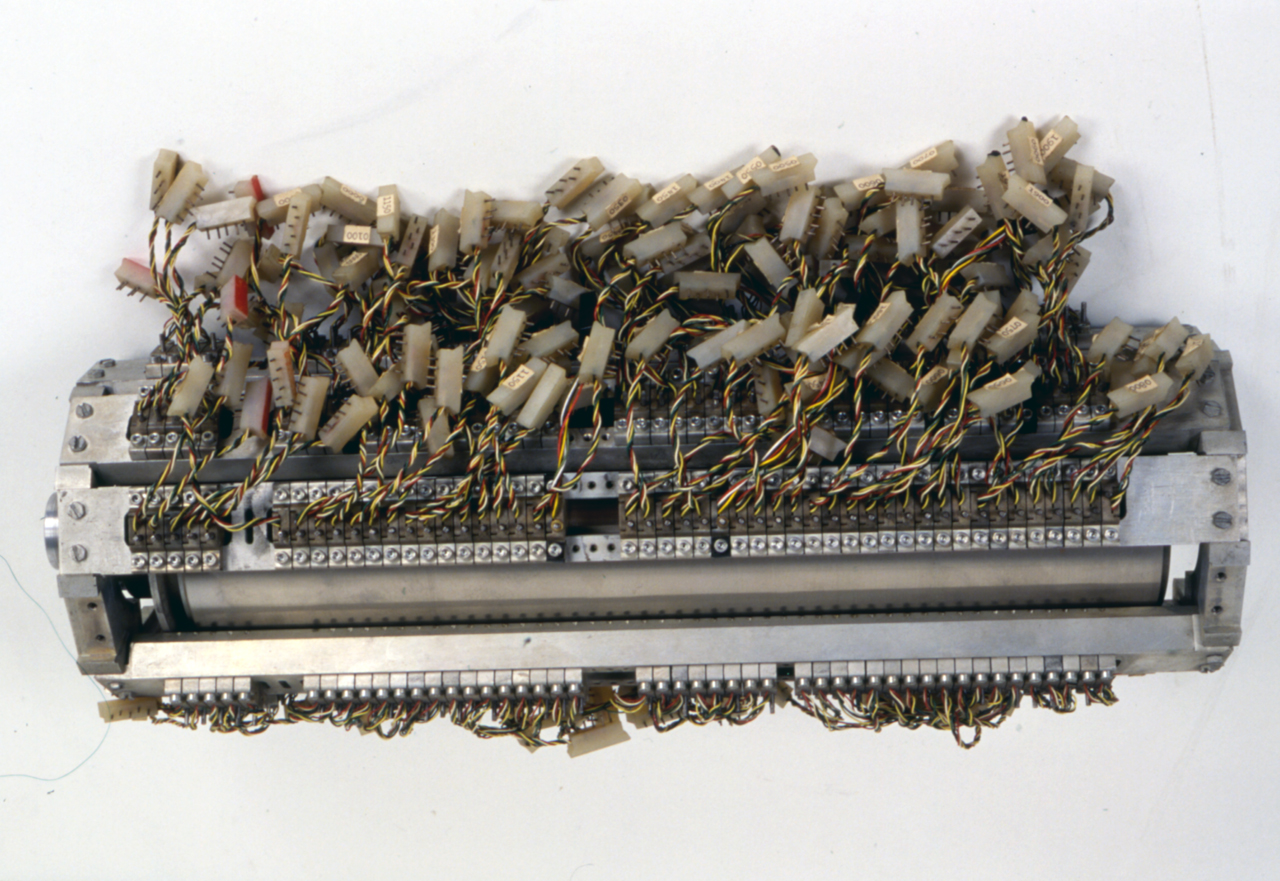
Tauschek’s best-known invention came in 1932: a magnetic drum memory, a rotating cylinder coated with magnetic material on which data was written and read by fixed heads as the surface passed under them. His original design is described as storing about 500,000 bits. There were no electronic computers to use it; he conceived it as storage for electromechanical accounting machinery.
The idea outlived its context. When electronic computers arrived after the war, they needed large, reliable memory, and the drum was the cheapest answer. Engineering Research Associates in St. Paul built drums for code-breaking machines and the ERA 1101; the IBM 650 of 1954, the most widely sold computer of the 1950s with about 2,000 installations, was built around a drum, as were many other machines in Britain, the United States and the Soviet Union (see The Storage Revolution). Programmers placed instructions around the drum so that the next one arrived under the read head just as it was needed, a craft remembered in The Story of Mel. For about a decade, until magnetic core memory replaced it as main memory, much of the world’s computing ran on a rotating cylinder of the kind Tauschek had patented.
The Reading Machine
In 1928 and 1929 Tauschek also designed a photoelectric reading machine. A photocell scanned a printed character, and the machine compared the light pattern mechanically against a set of templates until it found a match. The German Wikipedia records that he intended it partly to make printed text accessible to blind people. It is counted among the earliest optical character recognition machines, patented decades before OCR became a commercial product in banking and postal sorting.
Zurich
By October 1943 Tauschek’s patent applications gave an address in Zurich, in neutral Switzerland. He died there of a pulmonary embolism on 14 February 1945, aged 45, a few months before the end of the war in Europe and a year before ENIAC was shown to the public. Vienna named a street in its Floridsdorf district Tauschekgasse in the 1960s, and Erfurt named a Gustav-Tauschek-Straße in its research and industrial park in 2012. According to the Heinz Nixdorf MuseumsForum, no full biography of him has been written.
Dead End
Tauschek’s career followed a pattern common in early information technology: the individual inventor whose work disappears into a corporation. Three things kept his name out of the histories. He was an inventor, not a founder: his patents improved IBM’s products and strengthened its position, but no product carried his name, and his own complete system was bought in order not to be made. He worked in Austria and Germany between the wars, outside the Anglo-American institutions that later wrote the history of computing. And he died before the field existed that might have claimed him: his drum became a computer memory only after his death, through engineers who may never have read his patents. Much of what survives of his work is in a museum archive in Vienna.
📚 Sources
- Heinz Nixdorf MuseumsForum blog, “Gustav Tauschek: ein Erfinderschicksal”: birth in Fünfhaus, parents’ laundry, war service, National Bank, 1922 guilloche patent, April and May 1924 patents, Rheinmetall contract of 18 May 1925, department closed 30 June 1930, IBM contract to end of 1935, 1936 US patent, Zurich address by 1943, unrealized inventions, street names, no biography
- Franz Pichler: “Tauschek, Gustav”, Neue Deutsche Biographie 25 (2013): Kriegsmatura 1917, Italian captivity, more than 30 patents by 1929, IBM’s purchase for $250,000
- Österreichisches Biographisches Lexikon: Tauschek, Gustav
- Wikipedia (German): Gustav Tauschek: 169 patents to IBM, reading machine for the blind, embolism, streets in Vienna and Erfurt; cites Martin Helfert et al., Gustav Tauschek und seine Maschinen (2007)
- Wikipedia: Gustav Tauschek and Wikipedia: Drum memory: 1932 drum, about 500,000 bits, IBM 650
- Google Patents: US 2,224,774, “Tabulating Machine” (filed 24 June 1936)
- Wikipedia: Optical character recognition
- Wikipedia: IBM 650: about 2,000 units
- Image: Memoria a tamburo magnetico per sistema IBM 650 - Museo scienza tecnologia Milano D1171.jpg by Museo Nazionale Scienza e Tecnologia Leonardo da Vinci (CC BY-SA 4.0), via Wikimedia Commons