Computing in East Germany: Robotron and the Kombinate
Abstract
East Germany built one of the largest computer industries of the Eastern Bloc: the Kombinat Robotron, the biggest industrial combine in the GDR, employed 68,000 people, the country produced its own mainframes, minicomputers, personal computers, and microchips, and between 1977 and 1988 it invested about 14 billion marks in microelectronics alone. Almost all of it was cloned from Western designs that the CoCom embargo forbade the East to buy, re-engineered at enormous cost, years behind the originals. In September 1988 party leader Erich Honecker received a self-developed 1-megabit memory chip; in August 1989, three months before the Wall fell, a 32-bit microprocessor. When the embargo and the state disappeared in 1990, the industry disappeared with them, in months. What remained was engineering talent in Dresden, and on that foundation grew the largest microelectronics cluster in Europe.
Pioneers Without a Market
East German computing began where West German computing did: with capable scientists and no industry to absorb them. At Carl Zeiss Jena, Wilhelm Kämmerer and Herbert Kortum built the relay calculator OPREMA for the optics works’ lens computations. It ran from May 1955, held 16,626 relays in two independent halves, was programmed by plugboard, and took up 240 square meters. They then developed the ZRA 1, the first serially produced programmable digital computer in the GDR. It was shown at the Leipzig spring fair in 1960, and 31 machines were built at the Zeiss branch plant in Saalfeld before production ended in late 1963 in favor of the transistorized Robotron 100. Fifteen went to academy and research institutes, ten to universities, the rest into industry.
At the TU Dresden, the mathematician Nikolaus Joachim Lehmann had sketched a drum-memory computer as early as 1949. He built the D-series machines (D1 and D2 with tubes and relays, D3 and D4 with semiconductors) at his Institut für Maschinelle Rechentechnik; two D1s with 760 tubes and 100 relays each were finished in 1956, the faster D2 in 1959. His D4a, patented in 1960 and presented in 1965, was a transistor computer small enough to be, in his words, a “work device for the desk”, one of the earliest desk-sized universal computers anywhere. Industry officials doubted both its feasibility and its market against established mechanical office equipment, yet its production version, the Cellatron C 8205, came out of VEB Rechenelektronik Zella-Mehlis from 1969 in about 3,000 units.
The field got its first forum on August 19, 1957, when 32 experts from universities, industry, and government met at the electrical engineering college in Ilmenau to discuss calculating machines; the meeting led to a working group on electronic calculating and accounting machines, the first body in the GDR devoted to computer development. Lehmann also pushed the GDR into IFIP and formal computer science education; TU Dresden’s supercomputing center today carries his name.
The West watched from the start. The CIA’s declassified files, fed by informants in East German plants, record a report as early as late 1946 that Hollerith and Powers punched-card machines were being dismantled at the Rheinmetall-Borsig works in Sömmerda and shipped to the Soviet Union; an “electronic computer” in Dresden in October 1953; a long report on Lehmann’s D1 in December 1954; Zeiss’s relay machine (the OPREMA) in the same month; and an overview of “Computer Development in East Germany” in May 1955. A search for Zeiss and Jena in the archive returns 759 documents, and the Stasi’s arrest of fifteen Zeiss managers for espionage on 21 March 1953 is recorded there too. A 1985 CIA study rated East German computing well but counted “over 500 active agents” of its industrial espionage.
From Office Machines to Robotron
The industry that eventually took over came from office equipment, not from the laboratories. In 1958 the state grouped its office-machine factories into the VVB Büromaschinen, renamed VVB Datenverarbeitungs- und Büromaschinen in 1964. Its developer, VEB Elektronische Rechenmaschinen (Elrema) in Karl-Marx-Stadt (today Chemnitz), had used the brand name Robotron since 1959, first for the tube-based R 12, which did the multiplying and dividing for an accounting machine, then for the transistorized Robotron 100 of 1964. Its first large data-processing system was the Robotron 300, developed in the mid-1960s and built at the Rafena television works in Radeberg. The Council of Ministers formally endorsed the project on July 3, 1964, in a resolution on introducing machine data processing. It was modeled on the IBM 1401: diode-transistor logic with 18,500 transistors and 43,000 diodes, a 100 kHz clock, 3,000 to 5,000 instructions per second, and core memory for 10,000 to 40,000 characters. An installation filled 35 square meters, weighed six tonnes, and cost three million marks. The “300” was the target speed of its card reader, 300 punched cards per minute. Software included the assembler MOPS and an ALGOL 60 compiler, and the console was styled by the industrial designer Karl Clauss Dietel.
A prototype was the GDR’s attraction at the Interorgtechnika fair in Moscow from September 1 to 15, 1966, where Siemens showed its older transistor machine 2002. Walter Ulbricht visited the East German stand and misspelled his entry in the guest book; Leonid Brezhnev had left before reaching it. About 350 machines were built between 1967 and 1972, and they ran the payrolls, inventories, and research calculations of universities and state enterprises well into the 1970s, and a few into the mid-1980s. The successor, the R 21, led into the ESER generation.
On April 1, 1969, as part of Walter Ulbricht’s economic reform program, the VVB was split into two combines: VEB Kombinat Robotron for computers and the Kombinat Zentronik for office machines. The name was a blend of “robot” and “electron”. The founding happened without announcement: the Kombinat first appeared in the East Berlin Berliner Zeitung on April 22, and in the party paper Neues Deutschland on April 28, in a job advertisement seeking engineers and scientists for a future Robotron research center in Dresden. The first headquarters sat in the Rafena works at Radeberg; in 1970 the management and most of the computer production moved to a new complex on Dresden’s Leningrader Straße, opposite the city hall. On January 1, 1978, Zentronik was dissolved into Robotron, which brought in the old Astra accounting-machine works in Karl-Marx-Stadt, the former Rheinmetall plant in Sömmerda, and the Seidel & Naumann works in Dresden that made the Erika typewriter.
By 1989 Robotron was the largest industrial Kombinat in the GDR: roughly 68,000 employees in 21 plants, with further sub-plants in 64 towns and sales and service offices in 28 countries, and an annual revenue of 12.8 billion East German marks. Three general directors ran it in twenty-one years: Siegfried Zugehör (1969 to 1973), Wolfgang Sieber (1973 to 1982), and Friedrich Wokurka (1982 to 1990). In 1987 the GDR had about 2,000 mainframes and process computers, 4,400 mid-range systems, and 42,000 microcomputers installed, and around a thousand ESER mainframes had been exported.
A Kombinat bundled research institutes, component suppliers, and final assembly under one general director and one plan target. It could concentrate resources on a state priority; what it could not do was kill a failing product line, price anything at market value, or buy the best available part from abroad.
Cloning Under Embargo
The CoCom embargo barred the export of advanced Western computers and chipmaking equipment to the Eastern Bloc. The GDR’s answer was systematic re-engineering. The standard microprocessor of East German computing, the U880 from Mikroelektronik Erfurt, was an unlicensed copy of the Zilog Z80. The process computers R 4000 and R 4200 followed the Honeywell Series 16. The K 1600 minicomputer line copied DEC’s PDP-11.
The mainframes copied IBM. Under the Soviet-led ESER program (see Comecon Computing for the 1968 decision that committed the entire Eastern Bloc to copying IBM), Robotron built the EC 1040, compatible with the IBM System/360. Its central processor, developed by Elrema in Karl-Marx-Stadt, managed 320,000 operations per second with up to one megabyte of ferrite core memory, and it ran DOS/EC and OS/EC, re-implementations of IBM’s DOS/360 and OS/360. The EC 1055, EC 1056, and finally the EC 1057 (from 1987, the fastest computer built in the GDR) followed the System/370.
The high end followed the same pattern. From August 1985, Robotron-Elektronik Dresden developed the K 1840, a 32-bit re-implementation of DEC’s VAX-11/780, precisely because CoCom forbade selling superminis to Comecon countries. It reached series production in 1988, ran at 1.1 MIPS with up to 16 MB of memory, won the National Prize First Class, and 217 systems were delivered by 1990 at 1.9 million marks apiece. Its successor, the K 1820, was a copy of the MicroVAX II built around an East German VAX processor; about ten functional samples existed by March 1990 (robotrontechnik.de counts five), and series production never began.
Every clone required the original first, obtained through intermediaries, smuggling networks run by Alexander Schalck-Golodkowski’s foreign-currency apparatus, the Bereich Kommerzielle Koordinierung, and the Stasi’s scientific-technical intelligence arm, which systematically collected Western documentation and hardware. Western firms knew it. A Stasi report of February 22, 1989 recorded that Siemens was pressuring West German equipment makers to stop supplying the Jena and Erfurt chip combines, threatening “business-damaging consequences”; the GDR had contracted about 34 million valuta marks of such equipment imports for that year alone. The copies arrived years after the originals and cost multiples of the world market price, paid in a currency nobody wanted.
Before the embargo tightened, the GDR had also bought Western machines openly. In 1966 a Siemens 3003 began processing data for 23 Centrum department stores, and the Zuse KG sold a Z25 to the chemical works in Wolfen; machines from the Soviet Union, Poland, Britain, France, and the United States followed, including two IBM System/360 models.
The Stasi’s Computers
The Ministry for State Security used computers from the 1960s, mostly for databases. In 1963 it rented time at an East Berlin computing center; in 1965 it bought a Bull Gamma 10, and in 1968 a GE-100 from Bull-General Electric. The systems stored transit-pass journeys into the GDR, visits to the Leipzig fair, and addresses harvested from mail inspection. From June 1969 the work belonged to the new Arbeitsgruppe XIII (Abteilung XIII from 1972), which built its own computing center in Berlin-Wuhlheide.
The center’s main machines came from Munich. On June 30, 1969, a seven-member East German delegation arrived at Siemens for two weeks of training on the System 4004-45, the company’s newest mainframe (based on the RCA Spectra 70), and on its database software GOLEM. The paper customer was the Central Institute for Information and Documentation; the delegation’s leader, the mathematician Gerhard Bäßler, had in fact been a Stasi officer since 1968 and was deputy head of technology and programming in Arbeitsgruppe XIII. The 4004-45 was on the CoCom list, and the Siemens board negotiated an exemption in Washington. Three systems, priced at 23,151,060 Deutschmarks with software, were installed in a new building in Wuhlheide between August and December 1970. The buyer of record was the foreign-trade firm Interver, whose director Horst Schuster was an informant under the code name “Sohle”. When Schuster fled west in 1983, he told the BND about the Wuhlheide center; whether Siemens ever learned who its customer was is not documented. The story surfaced through the civil-rights activist Ingrid Köppe in the Bundestag committee that investigated the GDR’s Western trade from 1991 to 1994.
GOLEM held the Stasi’s central card index of persons, about four million cards in the early 1970s. From 1974 the computers also ran SIRA, the information-retrieval system of the foreign intelligence service HVA, which recorded incoming reports but withheld agents’ real names. In the 1980s the Siemens machines gave way to ESER mainframes. Parts of SIRA survived the file destruction the HVA carried out before its dissolution. So did the Rosenholz files, HVA index cards that reached the CIA after the GDR’s end; they fill 381 CD-ROMs and name 280,000 people, of whom about 6,000 West Germans and 20,000 East Germans were informants.
The Microelectronics Program
The decision that shaped the GDR’s last decade came at the sixth plenum of the SED Central Committee in June 1977, which made microelectronics a party priority. A “world standard comparison” commissioned by the Central Committee had measured the gap: four to eight years behind the international lead in analog circuits, six to seven years in memory chips and microprocessors, up to nine years in specialized production equipment. East German machines delivered a tenth of Western productivity, in good cases a third, at five to ten times the cost.
On January 1, 1978, the state founded the Kombinat Mikroelektronik Erfurt, which by 1989 had 60,000 employees. Its product list is a calendar of Western originals arriving late: the U808, the GDR’s first microprocessor, a copy of the Intel 8008 in production from 1978; the U880 Z80 copy, produced from 1980; the 16-bit U8000 from 1984; and the U80601, a copy of the Intel 80286, which entered production in 1989, seven years after the original. New chip factories went up in Erfurt-Südost, the first built from 1981 to 1984, the second finished in 1988.
The bill was large. Between 1977 and 1988 the GDR invested about 14 billion marks in microelectronics, roughly equal to the country’s entire research and development budget for 1988. Gerhard Schürer, the head of the State Planning Commission, later said his doubts began when it became clear that the industry produced “with far too small series, far too expensively”; on the megabit chip, he said, the planning commission had effectively “dropped out” because the costs could no longer be controlled. It did not stop the program.
The Megabit Chip
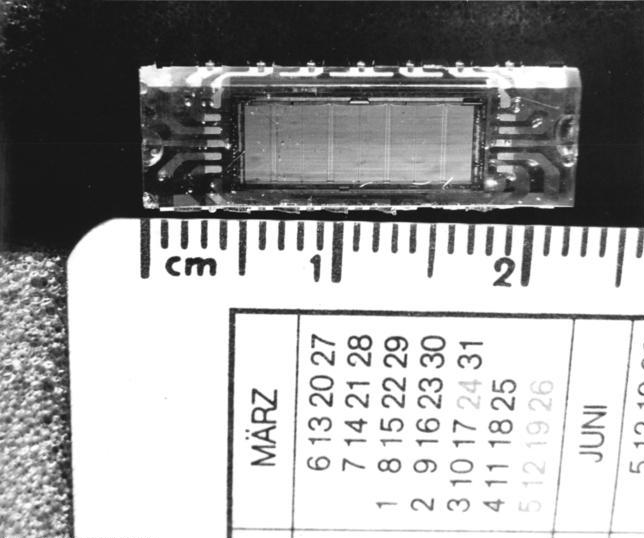
The showpiece of the GDR’s last years was the 1-megabit DRAM. The West was not far ahead. On April 18, 1986, IBM announced that its plants in Böblingen and Burlington were making 1-megabit chips for its own 3090 mainframes; several Japanese firms were already producing them, and Siemens started production in Regensburg in early 1987 with know-how licensed from Toshiba. The GDR leadership resolved in February 1986 to reach world standard in microelectronics within three years. In July 1986, Günter Mittag, the Politburo member in charge of the economy, decided with the two combine directors to pursue it on two tracks at once: the Kombinat Carl Zeiss Jena was to develop the chip from its own research together with the Soviet Union, while the Kombinat Mikroelektronik Erfurt was to put it into series production using technology from the Japanese firm Toshiba, acquired around the embargo. Toshiba later pulled out, which left Erfurt dependent on the Dresden technology. The double approach was expensive, but it kept the GDR’s commitments to Moscow and brought in Western know-how at the same time.
The Zeiss track, at the Zentrum Mikroelektronik Dresden (ZMD), produced the U61000. The first fault-free samples were verified on August 10, 1988, and on September 12, 1988, a chip was ceremonially presented to Erich Honecker, celebrated as proof that socialism could hold pace at the technological frontier. The pilot line produced about 5,000 sample chips in 1988 and some 30,000 in 1989, at yields of at most 20 percent. A 4-megabit successor was planned for autumn 1990. Volume production was planned for a newly built plant at Mikroelektronik Erfurt; it never started. When the embargo fell in 1990, anyone could buy equivalent chips on the world market, in quantity, for a fraction of the cost. Development was halted in spring 1990.
Info
CoCom denied the GDR Western machines and chips, which forced it to build an indigenous capability that a small country could not afford; the same embargo shielded that capability from competition and hid its true cost until 1990. The chip worked, but nobody could have made money selling it.
Ox and Donkey
On August 14, 1989, at its works in Erfurt, the Kombinat Mikroelektronik handed Honecker the first working samples of the GDR’s 32-bit microprocessor, the U80701, a copy of DEC’s MicroVAX 78032 developed by reverse engineering, with about 130,000 transistors in NMOS technology. Honecker answered with an old line from the labor movement: “Den Sozialismus in seinem Lauf halten weder Ochs noch Esel auf”, socialism in its course is stopped by neither ox nor donkey.
Twelve weeks later the Wall fell. The development team received the National Prize in October 1989. The U80701 never went into series production; at the Leipzig spring fair of 1990, it was displayed in a showcase.
Pocket Calculators
The East German pocket calculator began with a souvenir. In early 1972 Otfried Steger, minister for electrical engineering and electronics, brought a Busicom LE-120A back from a trip to Japan and asked VEB Funkwerk Erfurt whether it could build one. A development team started in April; a laboratory model ran on June 20, 1972, using Texas Instruments TMS0105NC chips that reached Erfurt by an undocumented route. The result, the four-function minirex 73, made by VEB Röhrenwerk Mühlhausen, was shown at the Leipzig spring fair of March 11 to 18, 1973, one year after the first West German pocket calculators and ten months before the first Soviet ones. From 1975 the minirex used the U820D, an East German copy of the chip. The Mühlhausen plant, by then VEB Mikroelektronik “Wilhelm Pieck”, brought out the MR 609 in 1982, the country’s first scientific calculator, and a cheaper copy of it, the SR1 school calculator, sold for 123 marks; about a million were made.
Personal Computers
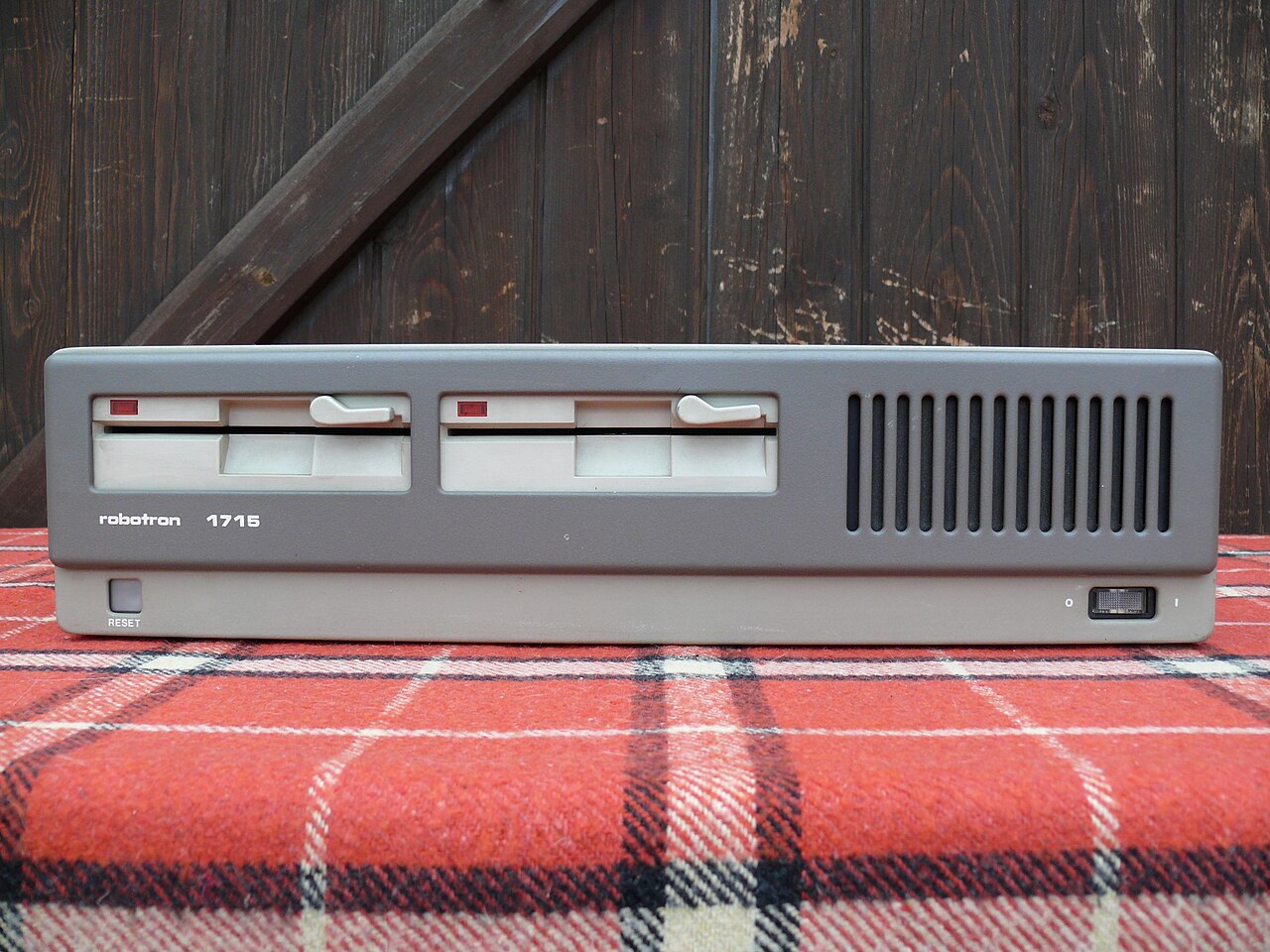
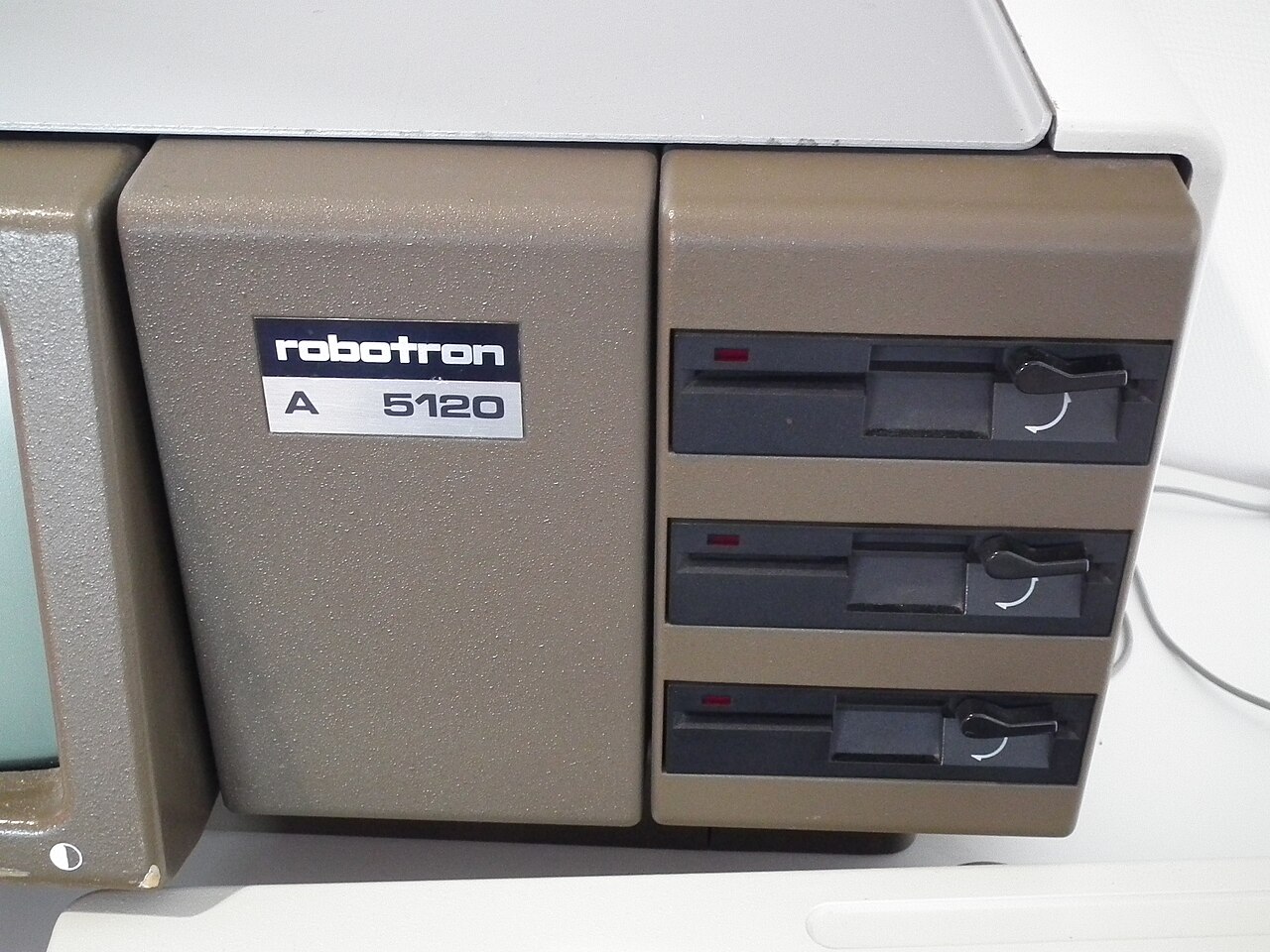
The office side of Robotron did better than the chip side, because it could build on what Erfurt actually delivered. The A 5120 office computer came first. In 1985 the Sömmerda works introduced the PC 1715, which became the standard computer of the GDR in the 1980s: a U880 processor at 2.4576 MHz, a second U880 as keyboard controller, and SCP, an adaptation of CP/M. It initially cost 19,000 marks. By 1990, 93,096 had been built, and about 50,000 of them went to the Soviet Union under the designation CM 1904, from 1987 at a rate of 10,000 a year.
The 16-bit generation followed the IBM PC. The A 7100 was not PC-compatible; its successor, the A 7150 of January 1988, was, within limits. It ran on the K1810WM86, a Soviet copy of the Intel 8086, though many units carried genuine Intel 8086 and 8087 chips, and offered a choice of operating systems that mirrored the Western ones: DCP, a PC-compatible DOS; SCP1700, after CP/M-86; and MUTOS, a Unix clone. The EC 1834 from Sömmerda (1986) was an IBM XT equivalent with a Soviet 8086 copy; 34,000 were built in Sömmerda and Karl-Marx-Stadt. Its AT-class successor, the EC 1835, never reached series production: Sömmerda assembled twenty in 1990 and showed one at the Leipzig spring fair. By the end of the GDR perhaps 100,000 domestically built small computers were installed; according to the same estimate, about twice as many had come in privately from the West.
Robotron also sold to the West, mostly at the low end, for hard currency. Its printers reached West German home-computer owners under importers’ brand names such as “Präsident”, and in the United States as “Samelco”. For Commodore’s West German branch, Robotron built the mechanics of the CBM 8028 and CBM 8229 daisy-wheel printers, with electronics from a West German firm and firmware from Commodore. Most of the Erika typewriters were sold in the West as well, largely through mail-order catalogs.
Home Computers That Weren’t at Home
The spring fair in Leipzig in March 1984 brought the GDR’s first wave of small computers. The simplest was the LC80, a learning computer from VEB Mikroelektronik Erfurt (chief developer Werner Kämpf): a bare A4-sized board with a U880, 1 KB of RAM, 2 KB of ROM, a 25-key hexadecimal keypad, and a six-digit display, programmed in machine code. It went on sale that summer for 720 marks, the first East German computer a private citizen could buy in a shop.
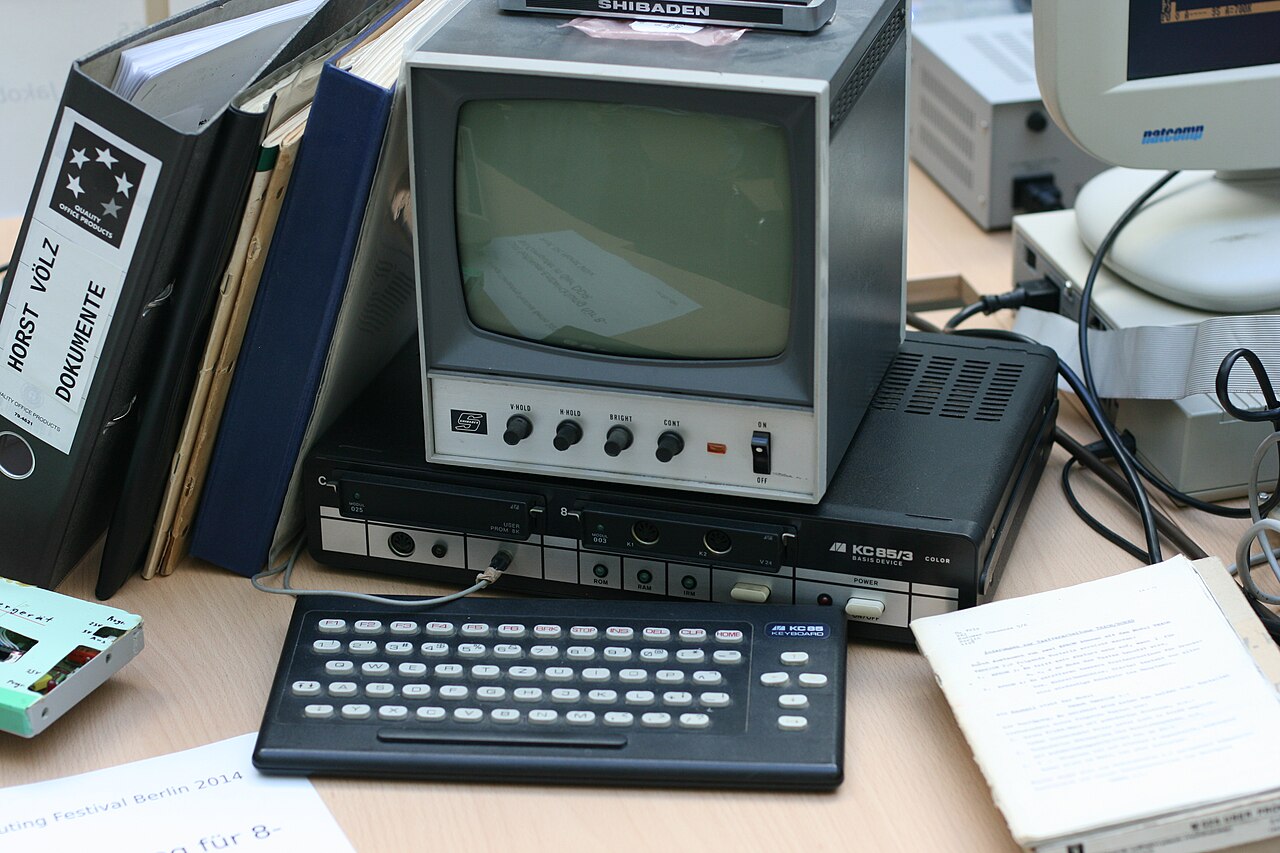
The same fair showed two rival home computers, both with a U880 and 16 KB of RAM expandable to 64 KB, both storing programs on cassette. The Z 9001, developed by a youth research collective at VEB Robotron-Meßtechnik in Dresden, was the official one; the first hundred were made between September and December 1984 and sold for 1,550 marks. The HC 900 from VEB Mikroelektronik “Wilhelm Pieck” Mühlhausen, developed by Werner Domschke and Werner Dennstedt, had not been planned by anyone and was the better machine: it had a separate keyboard and addressed each screen pixel, where the Z 9001 could only draw in 8-by-8 blocks. The planners resolved the embarrassment by renaming. From 1985 home computers became “small computers”: the Z 9001 became the KC 85/1, followed in 1987 by the KC 87 with BASIC in ROM, and about 30,000 machines of that family were built before production ended in spring 1989. The HC 900 became the KC 85/2, followed by the KC 85/3 (1986) and the KC 85/4 (1988), all running the U880 at about 1.75 MHz. About 45,000 of the Mühlhausen machines were built in six years, and although they were nominally home computers, private customers rarely got one: most went to schools, organizations, and enterprises. A KC 85/3 cost 1,700 marks; the KC 85/4 was listed at 4,600 marks in April 1989 and cut to 2,150 that July.
The machine that did reach private desks was the Z 1013, a single-board kit computer with a membrane keyboard from Robotron in Riesa, sold from 1985 for 650 marks (an improved version cost 965); about 25,000 were sold by 1990. Owners had to type in the BASIC interpreter themselves. Manufacturing tolerances were so loose that its clock had to be cut from the planned 2.5 MHz to 1 MHz for reliable operation. In 1988 the Bildungscomputer A 5105 was presented for the school system at 11,000 marks; by the end of August 1989 only about 1,000 had been built, and some 5,000 were made by April 1990, when it became obsolete with the state that ordered it. The country’s sole arcade machine, the Poly-Play, appeared in 1985 in FDGB holiday homes and youth clubs.
The last eight-bit computer of the GDR was the KC compact from Mühlhausen, an Amstrad CPC re-engineered around the U880, in the case of the A 5105 (Mühlhausen paid Robotron a million marks for the tooling) and with a QWERTY keyboard in a QWERTZ country. A June 1989 price-office paper planned 20,000 a year at 2,300 marks, aimed for once directly at private buyers. It went on sale after the Leipzig fair of March 1990, the price fell to 999 marks within weeks, and production stopped in July 1990, the month the currency union let East Germans buy the Western original.
Software was scarcer than hardware. A word-processing module, TEXOR, cost 758 marks. One programmer received 8,000 marks for a game license, more than a year’s salary. Two authors distributed their word processor WordPro as a printed listing in a book, to be typed in by hand.
Scarcity shaped the culture. Western home computers came in through relatives and the intershop economy; a Commodore 64 was a status object, and East German computer clubs debugged and extended the KC machines with a thoroughness born of having nothing else. When the border opened, the first purchases of many East German engineers were the machines they had spent a decade re-implementing.
The state watched the scene without much alarm. An April 1988 report of the Stasi’s secrecy-protection unit counted privately owned computers in the “tens of thousands”, most of them Western. In East Berlin, enthusiasts met every Wednesday evening in the computer club of the Haus der jungen Talente on Klosterstraße, organized by the engineer Stefan Seeboldt, and copied games until the drives ran hot; Stasi informants filed reports on the meetings and found nothing of operational interest. What did worry the ministry was data leaving the country. Applications to operate a modem or acoustic coupler were refused, and Seeboldt told the taz after the Wall fell that he knew of cases where visitors were at the door ten minutes after a connection attempt, usually ending in confiscation.
East German science fiction had imagined the network the ministry feared. Alfred Leman, a biologist who worked in research at Carl Zeiss Jena from 1968 to 1985, wrote the short novel Zilli 2062, almost certainly before 1990 though published in 1991: a fourteen-year-old girl in a future Berlin moves through a planet-wide web of glass and metal cables without which, the narrator says, nothing in society runs any more. The book even mentions the 414s, the American teenagers who broke into computers in 1982 and 1983.
Courses on Television and Radio
Broadcasting taught computing early. On January 16, 1969, six days after West German WDR started its series Wir machen ein Programm, East German television (Deutscher Fernsehfunk) began a course on “Elektronische Datenverarbeitung”: 26 lessons on fundamentals and 19 on applications, each part with eight accompanying booklets, and viewers who completed the first 26 lessons could sit an examination in 1970.
With few shops and no floppy distribution, East German radio later became a software publisher. On October 16, 1986, the science magazine of the school radio on Radio DDR II ended a test broadcast with three BASIC programs for computing prime numbers, sent as audio signal; listeners recorded the screeching tones on cassette and loaded them into their computers. The station received about 50,000 letters. On January 7, 1987, the course “BASIC 1x1 des Programmierens” began, twenty episodes, followed by ten more for advanced programmers, with each program broadcast in full for the KC 85, the Z 1013, the AC1 kit computer, and even Atari machines. The youth station DT64 repeated the material in its Computerclub, and in January 1989 it launched “REM”, a half-hour computer magazine. Course materials for BASICODE, a Dutch-born scheme for exchanging BASIC programs between incompatible machines by radio, were mailed out about 10,000 times by October 1989.
Dead End: The Reckoning of 1990
Currency union and open markets ended the Kombinate within months. The Kombinat Robotron was dissolved on July 1, 1990; the Kombinat Mikroelektronik Erfurt had already been converted into a stock corporation on June 28. The former combine plants became companies owned by the Treuhandanstalt, the agency charged with privatizing East German industry. Their productivity was far below Western competitors; their products, priced honestly for the first time, had no buyers, and most were liquidated in the following years. K 1840 production stopped in mid-1990.
Fewer than five percent of Robotron’s 68,000 employees found places in successor companies. Robotron Datenbank-Software GmbH in Dresden kept the name. The software house in Karl-Marx-Stadt became part of IBM, and a Dresden systems house ended up with SAP. In Sömmerda the works, renamed Robotron Büromaschinenwerk Sömmerda AG, put an Intel 80286 into the EC 1834 case and sold it as the Soemtron PC 286, alongside 386 and 486 models; 9,400 Soemtron PCs left the plant, the last one, a black PC 286, on December 5, 1991, before the works was liquidated. The German-Taiwanese ASI and later Fujitsu Siemens Computers assembled PCs there afterwards. Even the GDR’s country domain vanished without ever having existed: .dd had never been delegated to the internet’s root zone (see The Domain Name System). Fifty years after the founding, on April 1, 2019, Robotron Datenbank-Software opened a Robotron museum in Dresden.
The epilogue is in Dresden. The chip expertise assembled for the megabit program did not evaporate: ZMD survived in privatized form, and in the mid-1990s Siemens and then AMD chose Dresden for new semiconductor fabs, drawing on the region’s engineers. Around those plants grew “Silicon Saxony”, today the largest microelectronics cluster in Europe, with Infineon, GlobalFoundries, Bosch, and TSMC, whose first European fab broke ground there in 2024. In Erfurt, the foundry X-FAB grew out of the old chip works.
📚 Sources
- Heinz Nixdorf MuseumsForum blog, “Computer-Spione am Werk” (23 July 2021)
- Kombinat Robotron — Wikipedia (de) · founding April 1, 1969, VVB predecessors, Zentronik merger 1978, general directors, 68,000 employees, 21 plants, 64 towns, 28 countries, 12.8 billion marks, products and their Western models, Commodore printer cooperation, Präsident/Samelco, successor companies, under 5 percent, museum 2019
- Robotron 300 — Wikipedia (de) · Elrema, Moscow prototype 1966, production 1967 to 1972, 350 units, IBM 1401 model, technical data, name from card reader, last machines dismantled 1984 to 1986
- EC 1040 — Wikipedia (de) · System/360 compatibility, 320,000 operations per second, core memory, DOS/EC and OS/EC
- K 1840 — Wikipedia (de)
- U80701 — Wikipedia (de) · MicroVAX 78032 copy, about 130,000 transistors, presented August 14, 1989, ten K 1820 samples, National Prize October 1989, Leipzig fair 1990
- Intel 8008 — Wikipedia (de) · U808 as East German copy, production from 1978
- Kombinat Mikroelektronik Erfurt — Wikipedia (de) · founding January 1, 1978, 60,000 employees, Erfurt-Südost fabs, U808, U880, U8000, U80601, dissolution June 28, 1990, X-FAB
- Gerhard Barkleit: Mikroelektronik in der DDR. SED, Staatsapparat und Staatssicherheit im Wettstreit der Systeme, Hannah-Arendt-Institut, Dresden 2000 (PDF) · June 1977 plenum, world standard comparison, 14 billion marks 1977 to 1988, Schürer’s doubts, July 1986 two-track strategy with Toshiba technology, handovers of September 12, 1988 and August 14, 1989
- Stasi-Unterlagen-Archiv: Embargobestimmungen und Mikroelektronik in der DDR, Information Nr. 81/89 of February 22, 1989 · Siemens pressure on suppliers, 34 million valuta marks of equipment imports
- Tagesspiegel: Als Honecker Ochs und Esel bemühte · the quote and the 32-bit processor handover
- Landtag von Sachsen-Anhalt: 14. August 1989
- U61000 — Wikipedia (de) · first fault-free samples August 10, 1988, 5,000 and 30,000 chips, yield up to 20 percent
- ComputerBase: 30 Jahre U61000 (2018) · development ended spring 1990, ESO III volume production never started
- K 1820 — Wikipedia (de) · about ten functional samples by March 1990, U80701 CPU
- robotrontechnik.de: Computer K1820 · probably only five units built
- PC 1715 — Wikipedia (de) · 1985, Sömmerda, U880 at 2.4576 MHz, SCP, 19,000 marks, 93,096 units, about 50,000 to the USSR
- A 7150 — Wikipedia (de) · January 1988, K1810WM86, DCP, SCP1700, MUTOS
- Disk Control Program — Wikipedia (de)
- René Meyer: Computer in der DDR, c’t, October 23, 2019 · EC 1057, Z 1013 price, sales and clock reduction, A 5105 price and numbers, TEXOR, WordPro, game license fee
- Computersendungen im Rundfunk der DDR, Humboldt-Universität zu Berlin · first broadcast October 16, 1986, 50,000 letters, BASIC 1x1, DT64 Computerclub, REM, BASICODE mailings
- ZRA 1 — Wikipedia (de) · Leipzig fair 1960, 31 units at Saalfeld, end of production late 1963 for the Robotron 100, distribution
- Nikolaus Joachim Lehmann — Wikipedia (de)
- KC 85 — Wikipedia (en)
- robotrontechnik.de — technical archive of East German computing
- Silicon Saxony — Wikipedia (en)
- Silicon Saxony e.V.: The right decisions at the right time – How Saxony became Europe’s microelectronics hotspot · ZMD’s 3,300 specialists after 1990, Siemens 1993/94, AMD 1996, Bosch 2021, ZMD’s survival
- AMD Saxony — Wikipedia (de) · AMD Fab 30 in Dresden from 1996
- Silicon Saxony e.V.: TSMC/ESMC breaks ground on Dresden fab · groundbreaking August 20, 2024
- Poly-Play — Wikipedia (en) · only East German arcade machine, 1985, FDGB holiday homes and youth clubs
- Heinz Nixdorf MuseumsForum blog, “60 Jahre Robotron 300” (2026-09-01) · Council of Ministers resolution July 3, 1964, Interorgtechnika September 1 to 15, 1966, Ulbricht and Brezhnev, MOPS and ALGOL 60, Dietel design, R 21, still in use in 1980
- Heinz Nixdorf MuseumsForum blog, “Robotron – der sozialistische Computerkonzern” (2019-04-01) · Robotron brand from 1959, R 12, Robotron 100, first press mentions April 22 and 28, 1969, Cellatron 8205, 1987 installed base, ESER exports, PC 1715 exports from 1987
- Heinz Nixdorf MuseumsForum blog, “Computerszene DDR” (2017-08-18) · OPREMA May 1955, 16,626 relays, 240 m², Lehmann 1949 concept, D1 1956, D2 1959, D4a 1965 and Cellatron C 8205, Ilmenau conference August 19, 1957
- Heinz Nixdorf MuseumsForum blog, “Siemens und die Staatssicherheit” (2020-06-09) · Siemens 3003 1966, Zuse Z25 Wolfen, IBM 360s, Siemens 4004-45 delegation June 30, 1969, Bäßler, CoCom exemption, price, Wuhlheide installation 1970, Interver and Schuster, Köppe
- Heinz Nixdorf MuseumsForum blog, “SIRA ruft Rosenholz” (2017-02-17) · Stasi computers from 1963, Bull Gamma 10, GE-100, Arbeitsgruppe XIII, GOLEM index of four million cards, SIRA, switch to ESER, Rosenholz 381 CD-ROMs and 280,000 persons
- Heinz Nixdorf MuseumsForum blog, “Mythos Megabit” (2016-04-18) · IBM announcement April 18, 1986, Siemens/Toshiba Regensburg 1987, GDR decision February 1986, about 35,000 pilot chips, 4-megabit plan
- Heinz Nixdorf MuseumsForum blog, “Es begann mit minirex – Taschenrechner aus der DDR” (2023-03-14) · Steger and the Busicom LE-120A, laboratory model June 20, 1972, TMS0105NC, Leipzig fair March 1973, Soviet calculators 1974, U820D, MR 609, SR1
- Heinz Nixdorf MuseumsForum blog, “Der letzte Robotron-Computer” (2016-12-05) · EC 1834 1986 and 34,000 units, EC 1835, 100,000 domestic small computers estimate, Soemtron PC 286, 9,400 units, last PC December 5, 1991, ASI
- Heinz Nixdorf MuseumsForum blog, “LC80 – der erste Heimcomputer der DDR” (2024-10-04) · LC80 1984, 720 marks, Werner Kämpf, specification, A 5105 production of 5,000
- Heinz Nixdorf MuseumsForum blog, “Kampf der Kleincomputer: Z 9001 gegen HC 900” (2025-03-07) · Z 9001 and HC 900 at the 1984 fair, developers, graphics, renaming to KC, KC 87, 30,000 Z 9001 family, KC 85/4 price, Z 1013 kit
- Heinz Nixdorf MuseumsForum blog, “KC compact: der letzte Acht-Bit-Computer der DDR” (2025-08-08) · Amstrad CPC base, A 5105 case for one million marks, QWERTY, 1989 price plan, 999 marks, end of production July 1990
- Heinz Nixdorf MuseumsForum blog, “Die Stasi und die Spielcomputer” (2022-05-20) · ZAGG report April 1988, Haus der jungen Talente, Seeboldt, modem refusals and taz quote
- Heinz Nixdorf MuseumsForum blog, “Sozialistische Automaten” (2018-03-19) · Alfred Leman, Zilli 2062, the 414s
- Heinz Nixdorf MuseumsForum blog, “Wir machen ein Programm” (2019-01-10) · WDR series January 10, 1969, DFF course from January 16, 1969, 26 and 19 lessons, examination 1970
- Robotron Z 1013 — Wikipedia (de) · 650 marks for the base model, 965 for the later version
- Prices of GDR home computers, Centrum Warenhaus Dresden April 1989 and Funkamateur July 1989 (archived) · KC 85/4 at 4,600 and 2,150 marks
- Image: Bundesarchiv Bild 183-1988-0912-037, VEB Carl Zeiss Jena, 1-Megabit-Chip.jpg by Bernd Settnik (CC BY-SA 3.0 de), via Wikimedia Commons
- Image: RobotronPC1715.jpg by Karsten Reichert (Xaar) (CC BY-SA 3.0), via Wikimedia Commons