Dead End: Silicon Graphics
Abstract
Silicon Graphics (SGI) built the machines that made real-time 3D graphics a business: the workstations on which Industrial Light & Magic made the dinosaurs of Jurassic Park, the graphics chip inside the Nintendo 64, and the OpenGL programming interface that outlived every computer the company shipped. Founded in November 1981 on Jim Clark’s Geometry Engine chip, it grew to $3.7 billion in annual revenue and a market value above $7 billion in 1995. Within ten years PC graphics cards, several of them designed by engineers who had left SGI, delivered most of what its workstations did at a small fraction of the price. SGI bought Cray and sold it, abandoned its own processors for Intel’s Itanium, went bankrupt twice, and sold its remaining assets for $42.5 million in 2009. Google’s headquarters stands on its former campus.
Jim Clark

Jim Clark was born in 1944 in Plainview, Texas. He dropped out of high school at sixteen and spent four years in the U.S. Navy, where he first worked with electronics. He then took bachelor’s and master’s degrees in physics at the University of New Orleans and a PhD in computer science at the University of Utah in 1974, under Ivan Sutherland, with a dissertation on the 3D design of B-spline surfaces. Utah was then the center of computer graphics research. Clark worked at the New York Institute of Technology’s Computer Graphics Lab, which fired him for insubordination, taught at UC Santa Cruz from 1974 to 1978, and became an associate professor of electrical engineering at Stanford in 1979.
At Stanford, Clark and his students designed the Geometry Engine. Drawing a 3D scene means multiplying every point of every object by transformation matrices, clipping what falls outside the view, and projecting the rest onto the screen, millions of floating-point operations per frame. In 1979 that work ran in software on general-purpose computers and was slow. The Geometry Engine was a VLSI chip that did it in hardware, and a pipeline of these chips could transform geometry fast enough for interactive graphics. Clark described it in a 1982 SIGGRAPH paper, “The Geometry Engine: A VLSI Geometry System for Graphics.”
The Founding
Clark founded Silicon Graphics in Mountain View on 9 November 1981 to sell systems built around the chip. His co-founders were mostly Stanford graduate students: Kurt Akeley, David J. Brown, Tom Davis, Rocky Rhodes, Marc Hannah, Herb Kuta, and Mark Grossman. Ed McCracken, who came from Hewlett-Packard, became chief executive in 1984 and ran the company for thirteen years.
The first products, the IRIS 1000 series of 1984, were graphics terminals with an 8 MHz Motorola 68000 that attached to a host computer. The IRIS 2000 series of August 1985 and the IRIS 3000 series that followed were full workstations running UNIX. SGI shipped about 3,500 of the 2000 and 3000 series before discontinuing the 68000-based line in November 1989.
MIPS and the 4D
In 1987 SGI switched processors. The IRIS 4D/60 “Professional IRIS” used a MIPS RISC chip, the architecture that John Hennessy’s group had developed at Stanford (see Hennessy and Patterson). The Personal IRIS of 1988 put the same design into a smaller box; at an entry price of £10,300 it was SGI’s cheapest workstation. The operating system, IRIX, was SGI’s version of UNIX.
The MIPS dependency grew. In 1992 SGI bought MIPS Computer Systems for $333 million to secure its processor supply, and for the rest of the 1990s every SGI workstation and server ran on MIPS chips. MIPS licensed the architecture to other chipmakers, and MIPS processors went into game consoles and embedded equipment far outside SGI’s own products.
Onyx and Indy
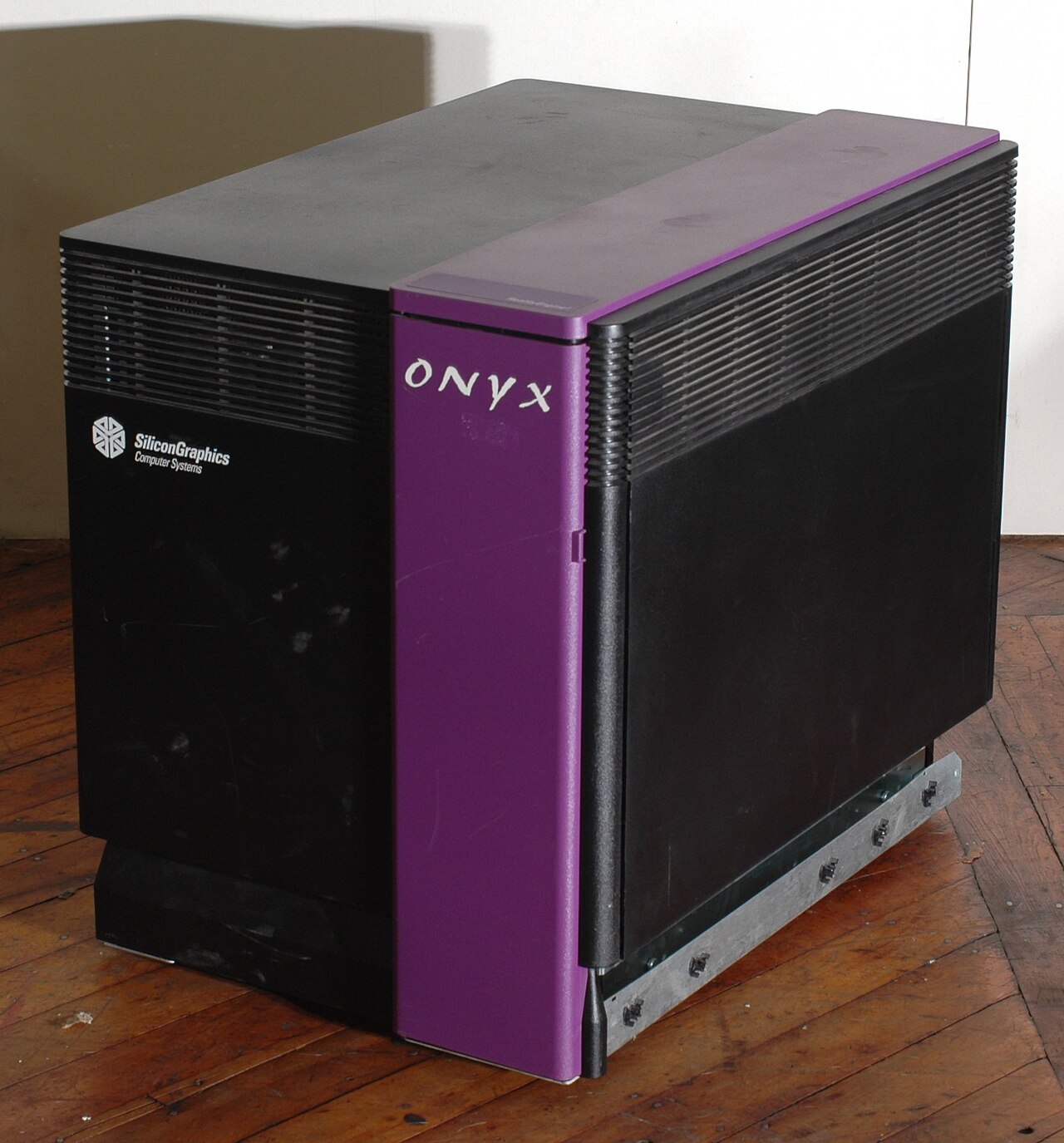
By 1993 SGI sold machines at both ends of the market. The Onyx, introduced in January 1993, was a deskside or rack-mounted graphics supercomputer. With RealityEngine2 graphics it cost from $159,900 to $634,900. CBS News used one to render live 3D graphics of the 1994 U.S. election results, and Nintendo’s early development kits for the Nintendo 64 were Onyx systems costing $100,000 to $250,000 each. InfiniteReality graphics followed in 1995 and the Onyx2 in 1996.
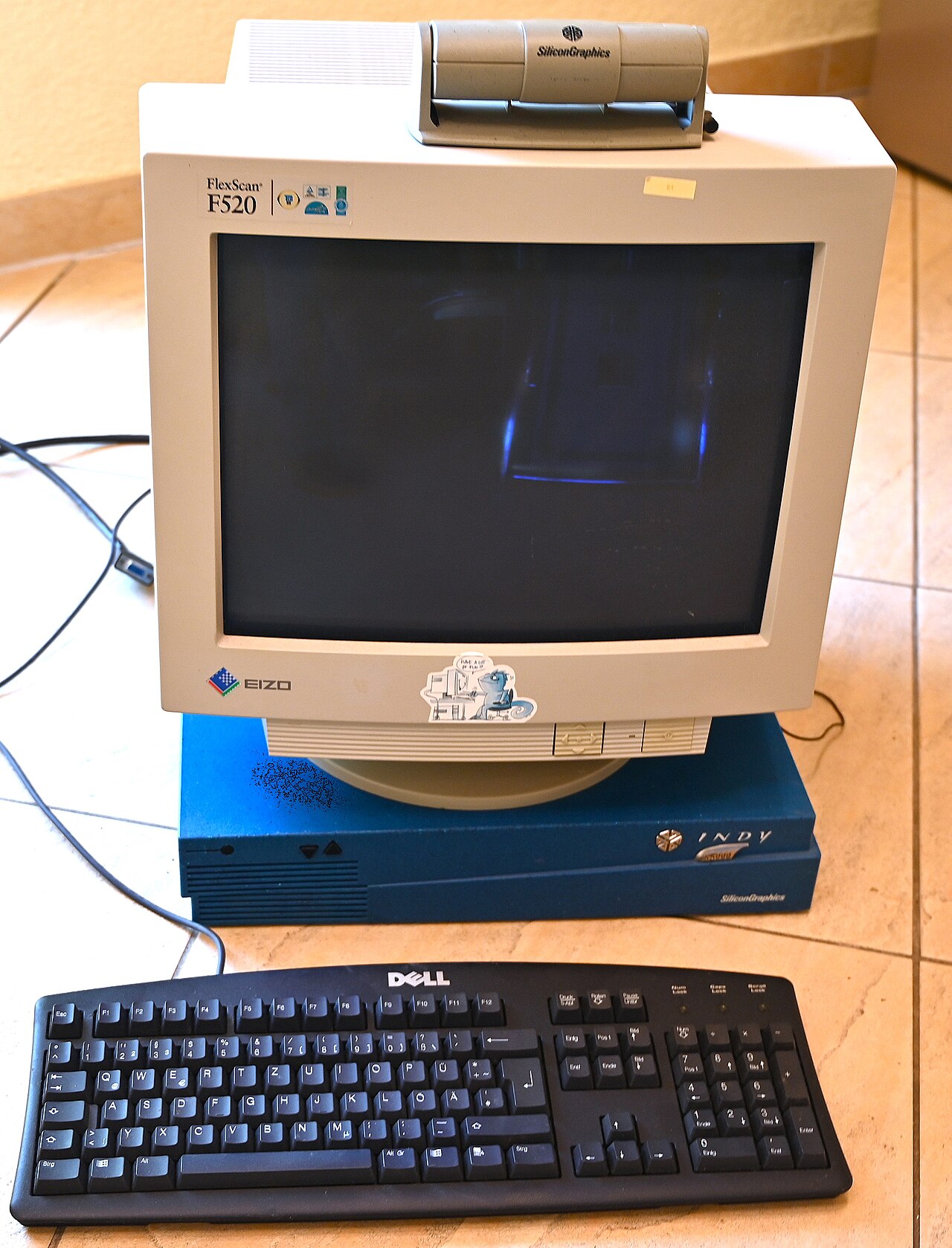
At the other end, the Indy of 12 July 1993 started at $5,000 and was aimed at designers and multimedia producers who would otherwise have bought a Macintosh or a PC. It was the first computer to come with a video camera as standard, the IndyCam, meant for video conferencing and video mail.
Hollywood
Industrial Light & Magic had bought SGI workstations running Alias modeling software for The Abyss (1989). On SGI machines it made the liquid-metal T-1000 of Terminator 2 (1991) and the dinosaurs of Jurassic Park (1993). By the mid-1990s its artists in San Rafael worked on hundreds of SGI workstations, and from 1995 to 2002 every film nominated for the Academy Award for Visual Effects was made on SGI systems.
Jurassic Park also put an SGI on screen. When the park’s systems fail, the character Lex sits down at an SGI Crimson running fsn, SGI’s experimental three-dimensional file system navigator, flies through the directories as a landscape of blocks, and says: “It’s a UNIX system! I know this!” The 3D file browser that looks like set dressing was a real SGI program.
In 1995 SGI bought the two leading 3D software companies, Alias Research of Toronto and Wavefront Technologies of Santa Barbara, for nearly $500 million in total, and merged them into Alias|Wavefront. Its animation package Maya, released in 1998, became a standard tool in film and games production.
OpenGL
SGI’s programmers wrote graphics code against IRIS GL, a proprietary interface that ran only on SGI hardware. In 1992 the company cleaned it up, removed the parts that depended on its own window system, and published it as OpenGL, licensed to other vendors and governed by an industry Architecture Review Board. The motive was commercial: a standard interface would make 3D software portable, and SGI expected most of that software to run best on SGI machines. OpenGL became the cross-platform standard for 3D graphics for the next two decades (see Graphics APIs).
The standard did not protect the company. Microsoft promoted its own Direct3D on Windows. In December 1997 SGI and Microsoft announced Fahrenheit, a joint project meant to unify the two, whose low-level interface would “become the primary graphics API for both consumer and professional applications on Windows.” Microsoft put its effort into Direct3D instead, and in November 1999 SGI announced it would “reduce our involvement in all aspects of the Fahrenheit project.” Only a scene-graph component ever shipped.
Nintendo 64
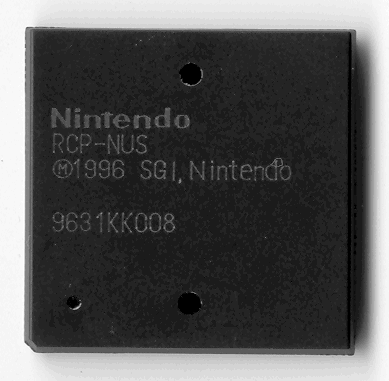
Early in 1993 Clark met Nintendo’s president, Hiroshi Yamauchi, and on 23 August 1993 the two companies announced Project Reality, a home console built on SGI technology that Clark said would bring “the combined computer power of hundreds of PCs” to the living room for under $250. The project was led at SGI by Wei Yen, whose hiring rule, as the team member Steve Shepard later recalled, was “Only hire superstars.” The team designed the Reality Coprocessor, a single chip that handled 3D graphics and sound, next to a MIPS R4300i processor. The first version of the chip taped out on 24 February 1995, a second on 23 July 1995, and the console was first shown in public at Nintendo’s Shoshinkai trade show in Tokyo in November 1995.
The Nintendo 64 launched in 1996 at $199 and sold almost 33 million units, putting SGI-designed 3D hardware in more homes than SGI’s own workstations ever reached. In 1997 Wei Yen and about twenty engineers from the project left SGI to found ArtX, which designed the graphics chip of Nintendo’s GameCube and was bought by ATI in 2000.
Clark Leaves
Clark did not see the Nintendo 64 ship as an SGI executive. After disagreements with the company’s management over its direction, he left SGI in late January 1994 and within weeks founded Netscape with Marc Andreessen, investing $4 million of his own money; when AOL bought Netscape in 1999 his stake was worth about $1.2 billion (see Marc Andreessen and Netscape).
The Engineers Who Left
The departures that damaged SGI most were those of engineers who took their knowledge of 3D pipelines to the PC. Ross Smith, Scott Sellers, and Gary Tarolli, all former SGI employees, founded 3dfx in August 1994. Its Voodoo Graphics chip went to manufacturing in November 1995, and on a card costing a few hundred dollars it gave PC games texture-mapped 3D that had required an SGI workstation a few years earlier (see The GPU Revolution).
Nvidia’s founders came from Sun and LSI Logic, not SGI, but SGI regarded Nvidia’s chips as built on its patents. In April 1998 it sued Nvidia for infringing a texture-mapping patent. In July 1999, after a week of testimony and just before the case went to the jury, the companies settled: they cross-licensed their patents, SGI named Nvidia its preferred graphics supplier, and in August 1999 SGI transferred a team of its own graphics engineers to Nvidia as part of a restructuring that cut 1,000 to 1,500 jobs (see Jensen Huang and Nvidia).
The Wrong Turns
SGI’s business rested on the premise that real-time 3D needed expensive special-purpose hardware. By the late 1990s a PC with a 3D accelerator card delivered a growing share of a workstation’s graphics performance for a small fraction of its price, and each generation of PC chips closed more of the gap. Workstation customers began buying Windows NT PCs with graphics cards. The company answered with a series of moves, several of which it later reversed.
- Cray. In February 1996 SGI bought Cray Research for $740 million. Three months later it sold Cray’s business-systems division to Sun Microsystems for “significantly less than $100 million.” On 31 March 2000 SGI sold the rest of Cray to Tera Computer for $35 million plus one million shares (see Seymour Cray and Supercomputing).
- Management. McCracken resigned in October 1997 after several quarters of losses. Rick Belluzzo, hired from Hewlett-Packard, became chief executive in January 1998 and left in August 1999 to run Microsoft’s MSN division. Bob Bishop led the company from 1999 to 2005.
- Processors. In 1998 SGI announced that it would move from MIPS to Intel’s Itanium, spun MIPS Technologies off in a public offering that year, and distributed its remaining stake to shareholders in June 2000. The first Itanium workstation, the SGI 750, shipped in 2001; Itanium itself became one of the industry’s costliest failures (see Dead End: Intel Itanium).
- Windows. In January 1999 SGI announced the Visual Workstation 320 and 540, Intel machines running Windows NT with SGI’s own graphics chipset. Their proprietary parts made upgrades expensive next to ordinary PCs, later models were standard PCs, and SGI dropped the line in January 2002.
- Software. Alias|Wavefront, bought for nearly $500 million in 1995, was sold in June 2004 to the private equity firm Accel-KKR for $57.5 million. Autodesk bought it in 2006.
Columbia
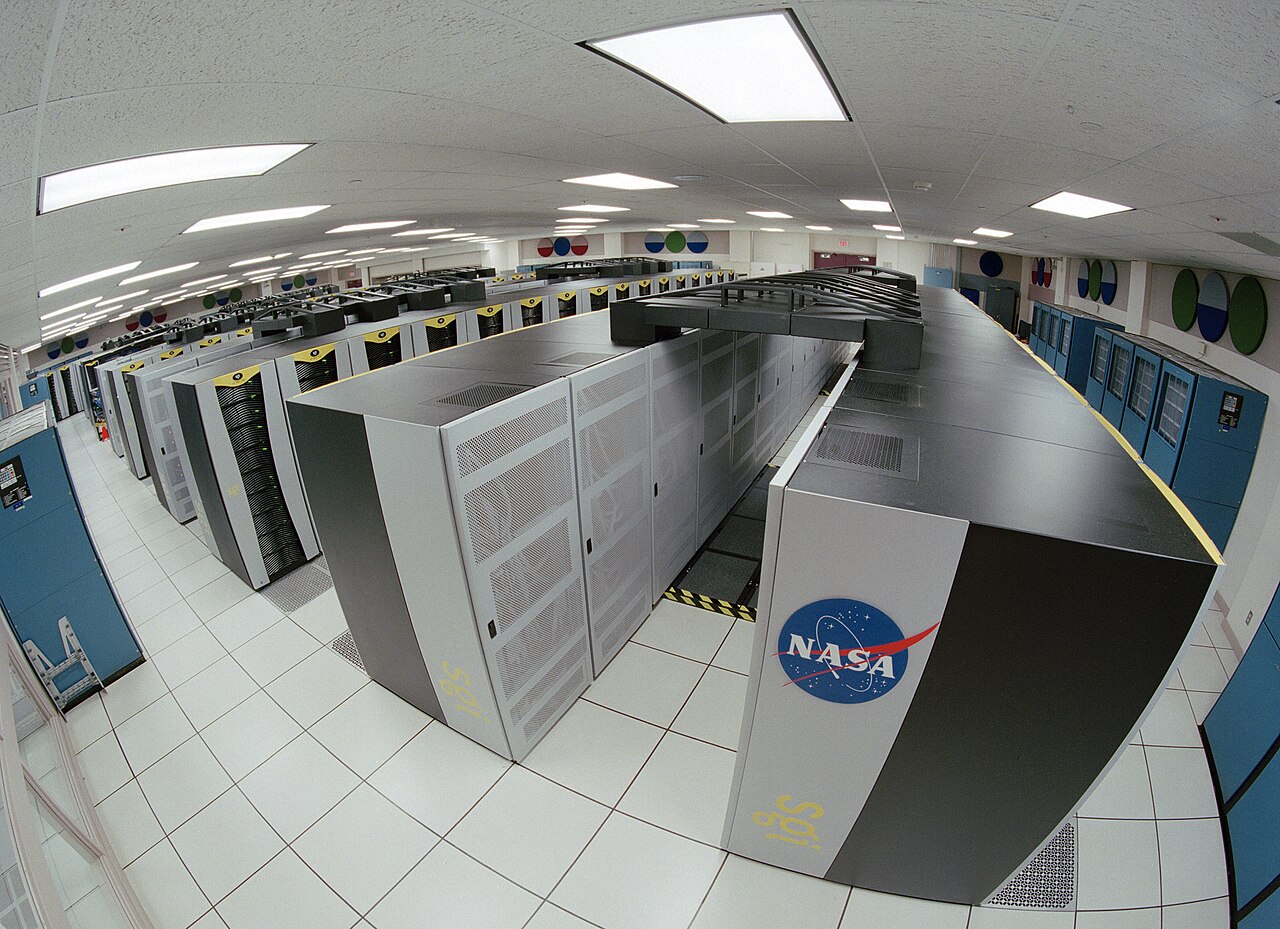
SGI’s last large success came in supercomputing, on Linux. The Altix line, announced in January 2003, ran Linux on Itanium 2 processors and used SGI’s shared-memory interconnect, which let hundreds of processors address one memory. In 2004 SGI built Columbia for NASA’s Ames Research Center: twenty 512-processor Altix systems, 10,240 Itanium 2 processors in all, named for the crew of the Space Shuttle Columbia, lost in 2003. It ranked second on the TOP500 list in November 2004 and ran until 2013 (see The Supercomputer Era). The market for such machines was small, and IRIX and MIPS, the platform most SGI customers still ran, were on their way out.
⚠️ Dead End
SGI’s market capitalization had exceeded $7 billion in 1995. In November 2005 the New York Stock Exchange delisted the stock because it had fallen below the minimum price; the company was then worth about $120 million. In February 2006 SGI warned that it could run out of cash by the end of the year. It filed for Chapter 11 on 8 May 2006, announced in September 2006 the end of MIPS and IRIX development, and emerged from bankruptcy on 17 October 2006. It filed again on 1 April 2009. Rackable Systems bought substantially all its assets in a deal announced at $25 million and closed on 11 May 2009 at $42.5 million, about one percent of SGI’s revenue in its best year. Rackable took the name and traded as Silicon Graphics International; the old company became Graphics Properties Holdings, a patent-holding shell. Hewlett Packard Enterprise bought Silicon Graphics International on 1 November 2016 for $275 million, mainly for its supercomputing business.
The reasons are visible in the timeline. SGI’s hardware advantage lasted only as long as 3D graphics needed custom silicon that nobody else built in volume. Once graphics chips were made for games in quantities of millions, prices fell faster than SGI could lower its costs, and much of the expertise in those chips came from people SGI had trained. The company’s attempts to follow its customers to the PC (Windows NT workstations, Itanium, the Nvidia settlement) gave up its own platform without winning the new one.
The buildings passed to the next generation of companies. SGI’s Amphitheatre Parkway campus, completed in 1997, was leased by Google from 2003; in June 2006, a month after SGI’s first bankruptcy filing, Google bought it together with other SGI properties for $319 million, and it became the Googleplex. SGI’s earlier headquarters on North Shoreline Boulevard now houses the Computer History Museum.
📚 Sources
- Wikipedia: Silicon Graphics (founders, product lines, acquisitions and disposals, CEOs, bankruptcies, Rackable deal, Academy Award nominees, Columbia, real estate)
- Wikipedia: James H. Clark
- James H. Clark, “The Geometry Engine: A VLSI Geometry System for Graphics,” ACM SIGGRAPH Computer Graphics 16(3), July 1982, doi:10.1145/965145.801272
- Wikipedia: SGI IRIS · SGI Indy · SGI Onyx
- Wikipedia: File System Navigator
- FTC: Silicon Graphics, Inc. (June 1995, Alias and Wavefront acquisitions) · Wikipedia: Alias Systems Corporation
- Microsoft: Silicon Graphics and Microsoft Form Strategic Alliance To Define the Future of Graphics (17 December 1997) · The Register: MS quietly dumps Windows OpenGL support (1999) · Wikipedia: Fahrenheit (graphics API)
- Steve Shepard: Project Reality: Making the Nintendo 64 · Wikipedia: Nintendo 64 · Wikipedia: ArtX
- Wikipedia: 3dfx · Computer History Museum: 3dfx Oral History Panel (2013)
- EE Times: Silicon Graphics settles patent suit with Nvidia (1999) · EDN: SGI, Nvidia Settle Patent Case (1999; Nvidia named preferred graphics supplier) · EE Times: SGI graphics team moves to Nvidia (10 August 1999) · HPCwire: SGI Files Patent Infringement Suit Against NVIDIA (1998)
- Wikipedia: Richard Belluzzo · Wikipedia: Edward R. McCracken
- HPCwire: SGI Intros New Line of Intel-Based Workstations (January 1999) · Wikipedia: SGI Visual Workstation
- Wikipedia: Columbia (supercomputer)
- New York Times: SGI files for Chapter 11, sells to Rackable (1 April 2009)
- DCD: Hewlett Packard Enterprise picks up SGI for $275 million (2016) · Scientific Computing World: HPE completes acquisition of SGI
- Wikipedia: Googleplex
- Image: SGI-onyx.jpg by Retro-Computing Society of Rhode Island (CC BY-SA 4.0), via Wikimedia Commons
- Image: James H. Clark.jpg by Knnkanda (CC BY-SA 3.0), via Wikimedia Commons
- Image: SGI Indy mit Originalkamera.jpg by Dirk Liesch (CC BY 4.0), via Wikimedia Commons