Barcodes and the UPC
Abstract
The barcode ties almost every manufactured product on Earth to a database, and few people ever think about it. In 1948 two graduate students at Drexel, Bernard Silver and Norman Joseph Woodland, set out to automate the grocery checkout. On a Miami Beach shore Woodland drew Morse code in the sand and stretched the dots and dashes into thin and thick lines. Their patent, filed on 20 October 1949, described a circular “bullseye” symbol that no electronics of the day could read, and they sold it in 1962 for $15,000. Railroads tried coloured barcodes on freight cars and gave up. In 1973 the U.S. grocery industry chose a rectangular code designed by George Laurer at IBM, the Universal Product Code (UPC), and on 26 June 1974 a pack of Juicy Fruit gum in Troy, Ohio, became the first product scanned at a checkout. The scanner was slow to catch on, met protests from shoppers, crossed the Atlantic as the 13-digit EAN (first German scanner checkout: Augsburg, October 1977), and spread to warehouses, hospitals, the military and airline boarding passes. RFID was supposed to replace it in the 2000s and did not. Its successor is the two-dimensional QR code, invented in Japan in 1994, which the grocery industry plans to read at every checkout by the end of 2027.
Two Students and an Overheard Conversation
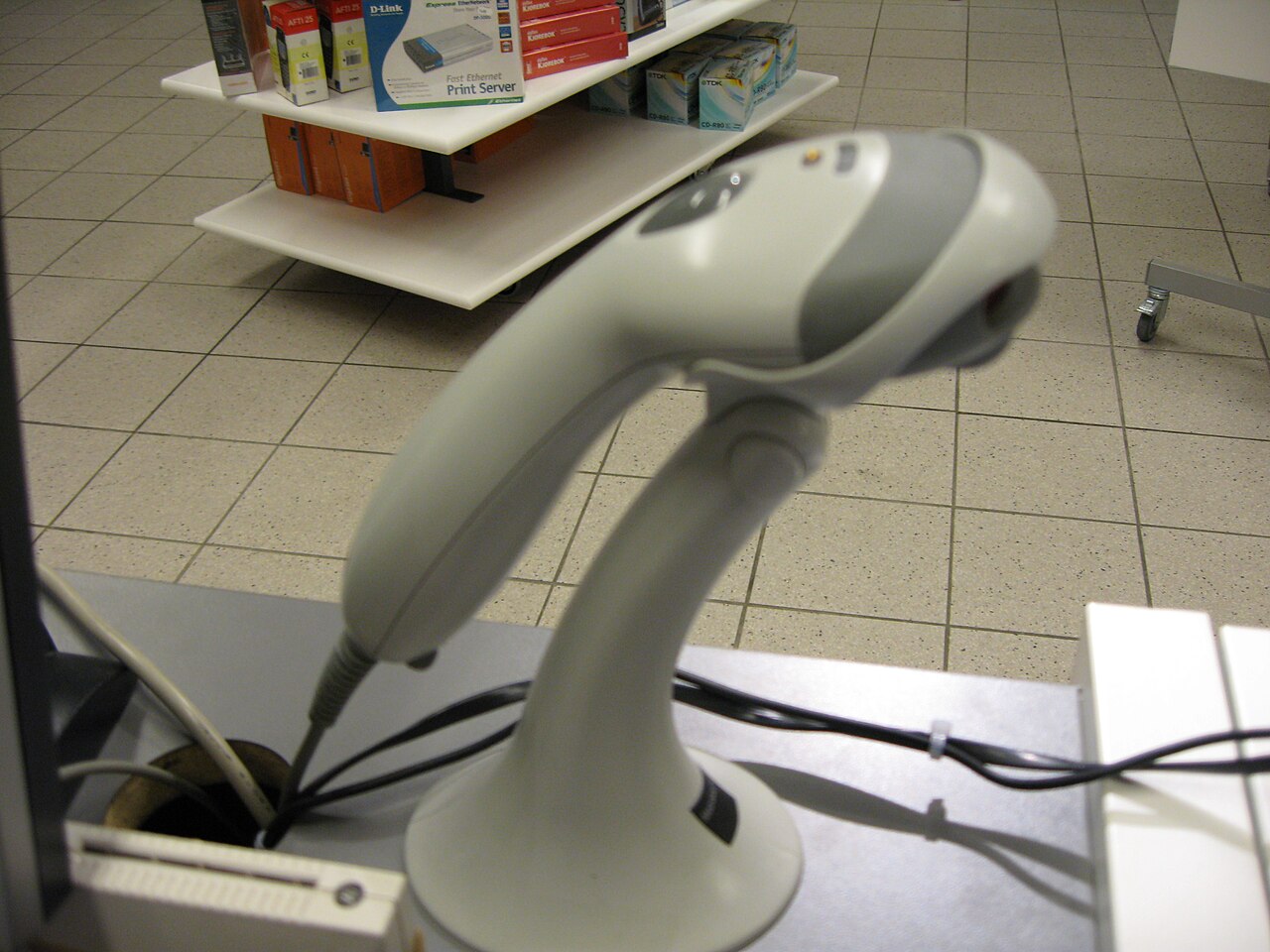
In 1948 Bernard Silver, a graduate student and physics instructor at the Drexel Institute of Technology in Philadelphia, overheard the president of a local food chain (Food Fair, by most accounts) asking one of the deans to develop a system that would capture product information automatically at the checkout. The dean declined. Silver mentioned it to his friend Norman Joseph Woodland, and the two decided to try.
Silver, born on 21 September 1924, took his B.Sc. in electrical engineering at Drexel in 1947. Woodland was born in Atlantic City, New Jersey, on 6 September 1921, served in the Second World War as a technical assistant on the Manhattan Project at Oak Ridge, Tennessee, took a mechanical engineering degree at Drexel in 1947, and lectured there in 1948 and 1949. Their first model used ink that glowed under ultraviolet light. It worked, but the ink faded and the system was too expensive to be practical.
Morse Code in the Sand
Woodland was confident enough in the problem to quit his teaching post and move into his grandfather’s apartment in Miami Beach to think. He had learned Morse code as a Boy Scout. “I remember I was thinking about dots and dashes when I poked my four fingers into the sand,” he later recalled. Pulling his hand toward him left four parallel lines, which “could be wide lines and narrow lines, instead of dots and dashes.” He then imagined bending them into concentric circles, so that a scanner could read the pattern from any direction. That was the bullseye barcode.
Silver and Woodland filed a patent for “Classifying Apparatus and Method” on 20 October 1949. It was granted on 7 October 1952 as U.S. Patent 2,612,994. It described both a linear and a circular symbol, to be read by a moving spot of light. A reading device Woodland built shone a 500-watt incandescent bulb onto the paper and caught the reflection with a large vacuum-tube photomultiplier, far too bulky and expensive for a grocery checkout. A bright, focused light source and cheap electronics to decode the signal were still missing; the first working laser was built only in 1960.
A Patent Sold Too Soon
Woodland joined IBM in 1951, but IBM showed no interest in the patent. In 1962 Silver and Woodland sold it for $15,000 to the electronics company Philco, which later sold it on to RCA. That sum was the only money either man made from the invention. (Some accounts, among them Wikipedia’s article on Woodland, date the sale to 1952; most give 1962.)
Bernard Silver died on 28 August 1963, of acute myelogenous leukemia, at 38. The first barcode was scanned in a store eleven years later. The patent expired in 1969, just as the laser and the integrated circuit made product scanning feasible.
Bar Codes on Freight Cars
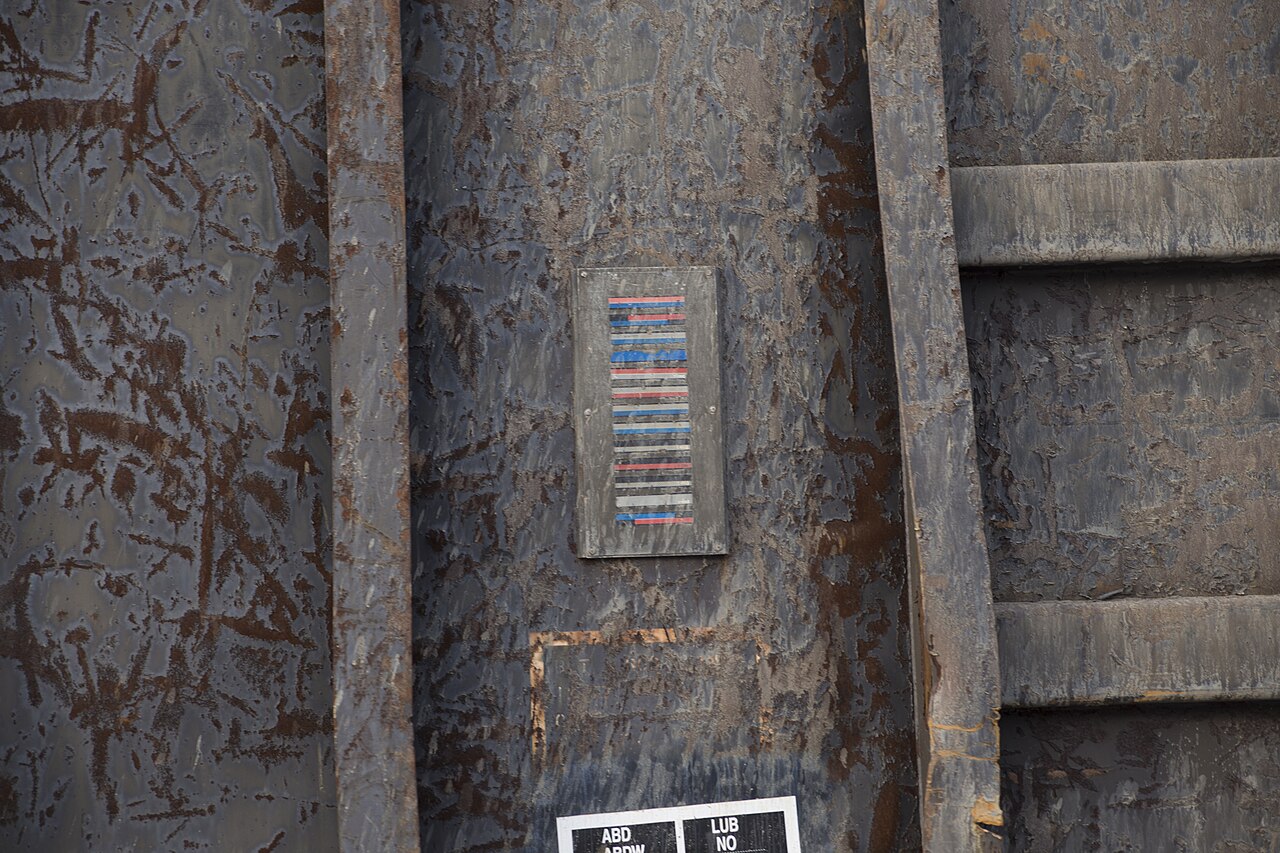
The first large-scale barcode system did not run in a supermarket but on American railroads. David Jarrett Collins, an MIT graduate who joined GTE Sylvania in 1959, proposed identifying freight cars automatically as they rolled past a trackside scanner. Sylvania’s system, KarTrak, put a plate on each car with thirteen horizontal labels made of coloured stripes (blue, red, white and black). The labels encoded the owner’s code, the car number, start and stop markers and a check digit, and a scanner read them from about 2.7 to 3.7 metres (9 to 12 feet) away as the train passed.
The Boston and Maine Railroad tested KarTrak on gravel cars from 1961. In 1967 the Association of American Railroads (AAR) made it the industry standard, and installation began on 10 October 1967. By 1970 about 86 percent of roughly two million North American freight cars carried a plate. Collins left Sylvania in 1968 to found Computer Identics, which installed one of its first scanning systems at a General Motors Buick plant in Flint, Michigan, in spring 1969.
The labels did not survive railroad life. After seven years about 10 percent of them had failed, and the maintenance programme to inspect and replace them never gained sufficient compliance. By 1975 scanners read only about 80 percent of passing cars correctly. A 1977 AAR white paper cited inaccurate data, labels at the end of their life and incomplete adoption, and in a ballot in late 1977 and early 1978 the railroads dropped the labelling requirement by a margin of five to one. The industry had spent about $150 million on KarTrak. The railroads did not look seriously for a successor until the mid-1980s, and in 1991 the AAR made radio-frequency tags (automatic equipment identification, AEI) mandatory.
The Grocery Industry Organizes
American supermarkets in the 1960s ran on thin margins and expensive labour. Every can carried a price sticker applied by hand, every price was keyed into the register by hand, and every keying error cost money. The National Association of Food Chains held a meeting on automated checkout in 1966. RCA, now holder of the Woodland and Silver patent, interested the association in the idea in 1969, and in 1970 manufacturers and retailers formed the U.S. Supermarket Ad Hoc Committee on a Uniform Grocery Product Code. McKinsey consultants worked out the numbering scheme: one number per product, identical in every store. The code identifies the product only; the price is kept in the store’s computer.
The symbol itself was left to competition. RCA built on Woodland’s bullseye and from July 1972 ran an 18-month test in a Kroger store in Cincinnati. In Britain, Sainsbury’s started using barcodes developed by Plessey in 1972, mounted on shelves rather than on products.
George Laurer’s Rectangle
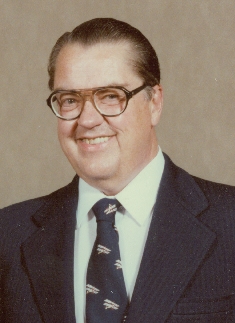
George J. Laurer was born in New York City on 23 September 1925. He survived polio as a teenager, was drafted into the U.S. Army during the Second World War while still in eleventh grade, and afterwards enrolled in a technical school for radio and television repair. His instructor told him he belonged in college. He graduated in engineering from the University of Maryland in 1951 and joined IBM the same year as a junior engineer.
In late 1969, at IBM’s site in Research Triangle Park, North Carolina, Laurer was assigned to design a supermarket scanner and label. He judged the bullseye unworkable for a practical reason. Printing presses run in one direction, and ink smears along the direction of travel. A smeared ring is distorted on two sides of the circle and becomes unreadable, while a bar smeared along its length only gets longer, and length carries no information. Laurer proposed vertical bars. Heard Baumeister supplied equations for the achievable density, William Crouse developed a hand-held wand reader, and the mathematician David Savir worked with Laurer on the check digit. IBM moved Woodland to Research Triangle Park in 1971, and he helped refine the proposal.
IBM presented the design to the industry committee in Rochester, Minnesota, on 1 December 1972. The committee’s symbol selection subcommittee chose it over six competing designs, among them RCA’s bullseye, and on 3 April 1973 it was adopted as the Universal Product Code. IBM gave Woodland its Outstanding Contribution Award in 1973. Laurer stayed at IBM until June 1987, held more than two dozen patents, and died in Wendell, North Carolina, on 5 December 2019, aged 94.
The First Beep
On 26 June 1974, at 8:01 in the morning, at the Marsh Supermarket in Troy, Ohio, cashier Sharon Buchanan passed a 10-pack of Wrigley’s Juicy Fruit chewing gum, picked by Marsh’s head of research and development, Clyde Dawson, across a scanner. The NCR register rang up 67 cents. A 1974 Juicy Fruit package donated by Dawson is catalogued in the collection of the Smithsonian’s National Museum of American History.
The Scanner That Failed
The beep in Troy did not start a stampede. A scanner only paid off once most products in a store carried a code, and a grocer saw no savings until at least 70 percent of its goods carried a code printed by the manufacturer. Manufacturers waited for scanners, and grocers waited for codes. In 1976 Business Week ran a story headlined “The Supermarket Scanner That Failed.”
Shoppers had their own objections. The industry’s business case rested on eliminating price stickers: if the price lived in the computer, nobody had to label each can. Consumer groups feared they would no longer be able to check what they paid, and campaigned for laws requiring a price on every item. In 1983 seven states and several cities, Chicago among them, prohibited stores from removing individual price labels, and another 21 states were considering similar rules. Some stores added “talking” registers that read each price aloud; Stop & Shop tried one in its Lexington store and removed it in August 1982.
Adoption came anyway. Giant Food, near Washington, D.C., became the first chain with scanners in all its stores in 1979, combined with a large customer-education campaign. In 1980, 2,842 stores in the United States and Canada had scanners. By early 1983 the figure was 6,466 supermarkets, about one in five in the United States, with roughly 100 more added every month.
Europe Adds a Digit
Europe built its own system on the American one. In 1976 retailers and manufacturers from European countries agreed on a 13-digit code, the European Article Number (EAN), which used the same bars as the UPC and added one leading digit. The leading digits identify the national numbering organisation, so the scheme could grow beyond one country. In 1977 representatives from twelve countries founded the European Article Numbering Association in Brussels to administer it. Because the extra digit is a zero for UPC codes, every UPC is also a valid EAN-13, and a European scanner can read American products.
In Germany, the spice maker Wichartz of Wuppertal printed the first barcode on one of its seasoning mixes on 1 July 1977. The first scanner checkout went into service in October 1977 in a Südmarkt supermarket in Augsburg. By 1984, according to GS1 Germany, nearly all packaged food sold to consumers in Germany carried a code.
The prefix system produced a few oddities. Books are numbered from the fictional country “Bookland”: an ISBN printed as a barcode begins with 978 or 979, and the prefix 977 marks magazines and other serials with an ISSN. A national prefix tells you which organisation issued the number, not where the product was made. The European and American administrators merged in 2005 into GS1, with 101 national member organisations at the time; in 2009 the EAN was renamed the Global Trade Item Number (GTIN), though most people still say EAN.
How a Barcode Works
A linear barcode writes numbers in the widths of bars and spaces. A UPC digit occupies seven narrow units, called modules, divided into two bars and two spaces of varying width, much like Woodland’s thick and thin Morse lines. The scanner sweeps a beam across the pattern and measures how long the reflected light stays dark or light. Only the ratios of the widths matter, which is why a code that is stretched, tilted or smeared along the bars still reads.
Several conventions make this reliable:
- Quiet zones: blank margins on either side tell the scanner where the code begins and ends.
- Guard bars: fixed patterns at the start, middle and end set the scanner’s timing. They carry no product data.
- Number structure: a UPC-A code has twelve digits: a number-system digit, a five-digit manufacturer code, a five-digit product code, and a check digit. Number system 2 marks variable-weight goods such as meat priced at the counter, 3 marks pharmaceuticals, and 5 marks coupons.
- Check digit: add the digits in the odd positions and multiply by three, add the digits in the even positions, and take whatever brings the total up to the next multiple of ten. For 0 3600 02914 5 that is (0+6+0+2+1+5)×3 + (3+0+0+9+4) = 58, so the check digit is 2. The scanner recomputes it on every read and rejects any read where it does not match. The rule catches every single wrong digit and most swaps of two neighbouring digits, which is why a bad scan usually fails instead of charging for the wrong item.
Small packages get UPC-E, a six-digit compressed form that drops zeros the scanner can restore. The rule that maps characters to bar patterns is called a symbology; UPC and EAN are two of several hundred. Readers moved from incandescent bulbs to helium-neon lasers, then to laser diodes and camera-based imagers that can read a code from any angle.
The barcode belongs to an older line of machine-readable media that goes back to Herman Hollerith’s punched card, the technology that built IBM, the company that won the UPC competition.
Beyond the Supermarket
Other industries wanted to encode letters as well as digits. In 1974 David Allais and Ray Stevens at Intermec designed Code 39, named for its original 39 characters plus a start/stop symbol, and in 1981 the U.S. Department of Defense adopted it for marking everything sold to the military under its LOGMARS programme. GS1 standards moved onto wholesale multipacks, cases and cartons in 1983 and into healthcare in 1995, where barcodes on medicines and patient wristbands help check that the right patient gets the right drug.
The barcode also let shoppers do the cashier’s work. David R. Humble of CheckRobot Inc. in Deerfield Beach, Florida, developed an automated checkout, and in July 1986 the first machine went into a Kroger store near Atlanta. The machines were expensive and spread slowly.
Linear codes hold a dozen or so digits. To store whole records, engineers stacked them. In 1991 Ynjiun Wang at Symbol Technologies introduced PDF417 (“Portable Data File”, each character built from four bars and four spaces over 17 modules), which carries names, addresses and dates on U.S. driver’s licences. Airlines used it to replace magnetic-stripe boarding passes: IATA’s Resolution 792 set the standard, and in December 2010 IATA announced that all boarding passes issued by its member airlines carried a 2D barcode, which it estimated would save the industry up to $1.5 billion a year.
The Myth of the Beast
Myth: Every barcode secretly contains the number 666, the “Mark of the Beast.”
The guard bars at the start, middle, and end of a UPC do resemble the bar pattern that encodes the digit 6, which is how the rumour started. But the guard bars are not digits at all: they are fixed timing references that encode no value, not even a 6. Look closely and the genuine digit 6 has a wide white space beside its bars that the guard patterns lack. George Laurer answered the rumour himself: “There is nothing sinister about this,” he wrote, calling it “simply a coincidence like the fact that my first, middle, and last name all have 6 letters.” See Myths and Misconceptions.
The Database Behind the Beep
The savings at the register were the smaller part of the change. Every scan updates a database, so a retailer knows what sold, in which store and at what hour, without counting the shelves. That data made automatic restocking and just-in-time logistics possible: warehouses reorder on demand, and suppliers see sales figures within days instead of waiting for orders. The same infrastructure carries e-commerce fulfilment, loyalty programmes and parcel tracking, and the volume of transaction data it produced fed the storage revolution and the demand for data compression. GS1 counted more than one billion products carrying its barcodes in 2023; GS1 UK and the German press agency dpa put the number of scans at about ten billion a day.
QR Codes
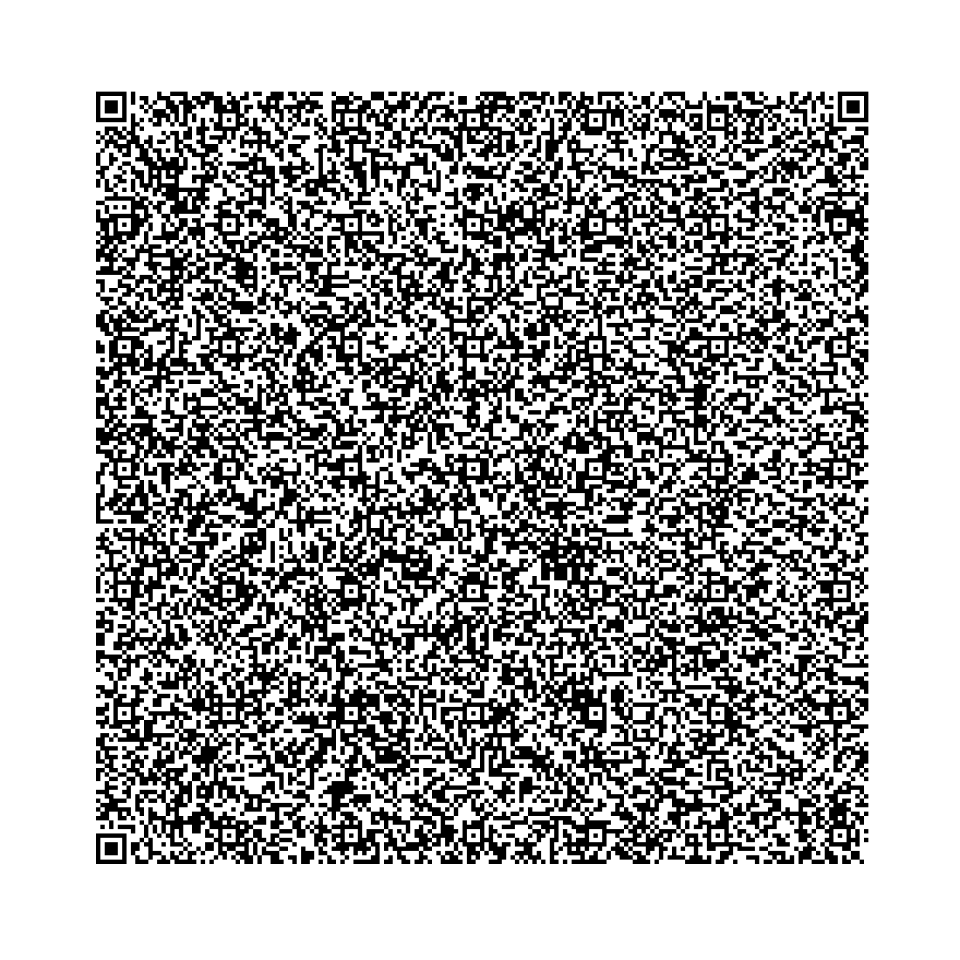
In 1994 engineer Masahiro Hara at Denso Wave, a subsidiary of the Japanese automotive-parts maker Denso, invented the QR code (“Quick Response”) to track car parts. Each box of parts carried several barcode labels that had to be scanned one by one, and Hara wanted a single code that held all of it and could be read fast.
The early design of black and white squares was inspired in part by the stones on a Go board. The three square markers in the corners use a 1:1:3:1:1 ratio of dark and light, chosen because it was the pattern least likely to appear in printed matter, so a camera can find and orient the code at any angle. A large QR code holds up to 7,089 digits or 2,953 bytes, and at its highest error-correction level it can still be read with about 30 percent of it damaged or covered. ISO standardised it in 2000.
Denso Wave holds patents on the QR code but chose not to enforce them on the standardised codes, and the code spread through Japan’s mobile culture on posters and business cards years before the West noticed it. Alipay designed QR payments in 2011, and in China paying by scanning a code became routine. The COVID-19 pandemic brought QR menus, contact-tracing check-ins and vaccination certificates to the rest of the world. The same ease of use made QR codes a phishing tool: stickers with fraudulent codes have been found on parking meters, sending drivers to fake payment pages.
Toward 2027
The barcode is now changing shape for the first time since 1973. In 2021 GS1 backed an industry goal that retail checkouts worldwide should be able to read two-dimensional codes by the end of 2027, an initiative known as Sunrise 2027. In 2024 it introduced “QR Codes powered by GS1”, which carry the product number along with a web address, batch number or expiry date. The linear EAN/UPC is not being banned; for a transition period products can carry both, and the scanner at the checkout reads whichever it finds.
⚠️ Dead End: RFID, the Barcode Killer
In the early 2000s, radio-frequency identification (RFID) was expected to make the barcode obsolete. A chip with an antenna can be read without line of sight, through a box, many at once, and each item can carry its own serial number. In June 2003 Walmart announced that from January 2005 its top 100 suppliers would have to put RFID tags on every pallet and case shipped to its distribution centres. When January 2005 came, 57 suppliers were shipping tagged goods, and the requirement had been narrowed to three distribution centres in the Dallas–Fort Worth area. A later target of tagging by all suppliers by the end of 2006 was not met.
In Germany the plan met public resistance. In April 2003 the Metro Group opened its Future Store, an Extra supermarket in Rheinberg near Duisburg, as a test site for RFID in retail, with chips under the price labels of some products. In early 2004 privacy activists found that the store’s Payback loyalty cards also contained RFID chips, which customers had not been told about. The Bielefeld group FoeBuD had already given Metro a Big Brother Award in 2003 and organised Germany’s first anti-RFID demonstration outside the store at the end of February 2004. On 2 March 2004 Metro announced that it would replace the cards of its roughly 10,000 users with cards carrying a barcode.
RFID did not disappear. It is used on pallets and shipping containers, in clothing retail, libraries, toll systems and passports. But a tag costs money and a printed barcode costs almost nothing, and on the individual can of soup the barcode stayed.
⚠️ Dead End: The Bullseye That Lost
Woodland’s 1949 bullseye was chosen because a circle can be read from any direction. It failed twice. In the 1950s no affordable technology could read it. In 1973, when the electronics existed, it lost the industry standard to Laurer’s rectangle because ink smeared on fast printing presses. The idea that was conceptually superior lost to the one that was manufacturable. The two men who conceived it earned $15,000 between them. Silver had been dead for a decade when the first code was scanned. Woodland, who died in Edgewater, New Jersey, on 9 December 2012, spent his career as an IBM engineer. President George H. W. Bush awarded him the National Medal of Technology in 1992, and in 2011 he and Silver were inducted into the National Inventors Hall of Fame.
Fun Fact
Clyde Dawson, the shopper behind the first scan, gave a 1974 pack of Wrigley’s Juicy Fruit to the Smithsonian’s National Museum of American History, which catalogues it as a food package: a 67-cent purchase kept in a museum because of the beep it made.
📚 Sources
- Heinz Nixdorf MuseumsForum blog, “Mathematik für den Supermarkt” (18 October 2019) (Oak Ridge, the UV-ink model, Woodland at IBM from 1951, the 1962 sale, McKinsey, the 3 April 1973 standard, Dawson and Buchanan, seven modules per digit)
- Barcode, Wikipedia (Food Fair, KarTrak dates, 1962 Philco sale, the 1966 NAFC meeting, Sainsbury’s and Plessey 1972, the RCA Kroger test, IBM’s 70 percent estimate, Business Week 1976, LOGMARS 1981)
- Universal Product Code, Wikipedia (Laurer’s assignment in 1969, Baumeister, Crouse, the 1 December 1972 presentation, NCR register, digit structure, check-digit example, UPC-E)
- Norman Joseph Woodland, Wikipedia (birth, Oak Ridge, Drexel 1947, transfer to North Carolina 1971, 1973 IBM award, 1992 National Medal of Technology, death 9 December 2012; RCA and the food chains 1969)
- Bernard Silver, Wikipedia (birth 21 September 1924, Drexel 1947, death 28 August 1963, leukemia)
- George Laurer, Wikipedia (biography, polio, army service, Maryland 1951, IBM 1951 to 1987, Savir, the 666 quote, death 5 December 2019)
- KarTrak, Wikipedia (Collins, label design, AAR standard 1967, 86 percent by 1970, 80 percent read rate, 1977 white paper, five-to-one ballot, $150 million)
- Automatic equipment identification, Wikipedia (mid-1980s search for a successor, AEI made mandatory 1991)
- MIT Technology Review, “Behind Bars” (1 April 2003) (500-watt bulb, photomultiplier, patent expiry, the 1970 committee)
- Smithsonian National Museum of American History, Archives Center: N. Joseph Woodland Papers (NMAH.AC.1433)
- Smithsonian Magazine, “The History of the Bar Code” (Miami Beach, the four-fingers quote, Symbol Selection Committee)
- Smithsonian NMAH collection: Wrigley’s Juicy Fruit Chewing Gum (1994.3123.19) (package from 1974, gift of Clyde L. Dawson)
- WYSU, “50 years ago, the first retail barcode was scanned at an Ohio grocery store” (25 June 2024)
- Christian Science Monitor, “Electronic price scanners speed up supermarket cashier lines” (5 December 1980) (2,842 stores, consumer resistance, Giant and Publix)
- Christian Science Monitor, “Supermarket cash registers that talk” (18 January 1983) (6,466 supermarkets, item-pricing laws in seven states and Chicago, Giant 1979, talking registers)
- GS1, Wikipedia (EAN founded in Brussels by members from 12 countries)
- GS1 Historical Timeline (UCC 1974, EAN Brussels 1977, healthcare 1995, the 2005 merger, the 2027 goal, more than 1 billion products, QR Codes powered by GS1)
- GS1 Germany, “Zahlen, Daten, Fakten zum Barcode” (PDF) and CIO / dpa, “Der Barcode wird 50” (24 June 2024) (EAN 1976, Wichartz 1 July 1977, Augsburg October 1977, coverage by 1984, GTIN 2009)
- GS1 UK, “The iconic barcode turns 50 today” (3 April 2023) (10 billion scans a day)
- International Article Number, Wikipedia (Bookland 978/979, ISSN 977, prefixes do not mark origin)
- Code 39, Wikipedia (Allais, Stevens, Intermec 1974, origin of the name)
- Self-checkout, Wikipedia (Humble, CheckRobot, Kroger near Atlanta, July 1986)
- PDF417, Wikipedia (Wang, Symbol Technologies 1991, name, driver’s licences)
- IATA press release, “100% Bar Coded Boarding Passes” (15 December 2010) (full implementation, up to $1.5 billion annual savings)
- QR code, Wikipedia (Hara, Denso Wave 1994, Go board, 1:1:3:1:1 ratio, capacity, error correction, ISO 2000, Alipay 2011, COVID, parking-meter scams)
- Technology Review, “Wal-Mart Details RFID Requirement” (7 November 2003) and Supermarket News, “Wal-Mart: 57 Suppliers Meet January RFID Mandate”
- RetailWire, “Perspectives on Wal-Mart’s RFID Timeline” (narrowing to three Texas distribution centres, missed 2006 target)
- Big Brother Awards 2003: Metro AG (Consumer Protection) (Future Store, Rheinberg, opened April 2003)
- FoeBuD, RFID press release (February 2004) (chips under price labels and in Payback cards)
- Computerwoche, “Metro entfernt RFID-Chips aus Kundenkarten” (2 March 2004) (10,000 cards, first German anti-RFID demonstration)
- 666 Barcode, Snopes
- Image: GeorgeLaurer1987.jpg by PhilFree at French Wikipedia (CC BY 1.0), via Wikimedia Commons