Jony Ive and Apple Design
Abstract
Jonathan “Jony” Ive joined Apple in 1992 from a small London design consultancy and led its industrial design for more than two decades, most of them as the closest creative partner of Steve Jobs, who called him his “spiritual partner at Apple.” His team’s iMac G3 (1998), iPod (2001), iPhone (2007), MacBook Air (2008), iPad (2010) and Apple Watch (2015) made industrial design a central part of how computers and phones are sold and copied. After Jobs’s death he also took over Apple’s software design and pushed the 2013 redesign of iOS. His preference for thinness produced Apple’s most criticized hardware of the 2010s, the butterfly keyboard and the cylindrical Mac Pro. He left Apple in 2019 to found the design firm LoveFrom, and in 2025 OpenAI bought his hardware start-up io for about $6.5 billion to design devices for the AI era; its first product was reported in February 2026 to have slipped to 2027.

From Chingford to Cupertino
Jonathan Paul Ive was born on 27 February 1967 in Chingford, east London, the son of a silversmith who taught design and technology. He studied industrial design at Newcastle Polytechnic (now Northumbria University), graduating with first-class honors in 1989, and in 1990 joined Tangerine, a small London design consultancy.
Tangerine designed whatever clients asked for: power tools, hair combs, televisions, bathroom ceramics. Ive designed a washbasin and toilet for Ideal Standard; the client rejected it as too modern and too expensive to make, in a review meeting led, by Ive’s later account, by a manager wearing a red clown’s nose for the charity Red Nose Day. One of Tangerine’s clients was Apple, and the work impressed its designers enough that Apple recruited Ive as a full-time employee in September 1992.
The Apple He Joined
The Apple of the early 1990s was losing money and direction, with a series of chief executives and a product line of beige boxes in too many variations (see Steve Jobs and Apple). Ive’s projects included the Twentieth Anniversary Macintosh of 1997, a flat, upright machine with a liquid-crystal display and Bose speakers sold for $7,499, which was too expensive to sell in numbers. He became head of the industrial design group in 1996 and, by his own account, was close to leaving when Jobs returned in 1997.
Jobs at first looked for a well-known designer from outside. Instead he found what he wanted in Ive’s studio and made him senior vice president of industrial design. The two became unusually close, and Jobs spent much of his time in the design studio. In Walter Isaacson’s biography Jobs called Ive “my spiritual partner at Apple” and said that Ive had more operational power at Apple than anyone except Jobs himself: “There’s no one who can tell him what to do, or to butt out.”
The iMac and the Studio
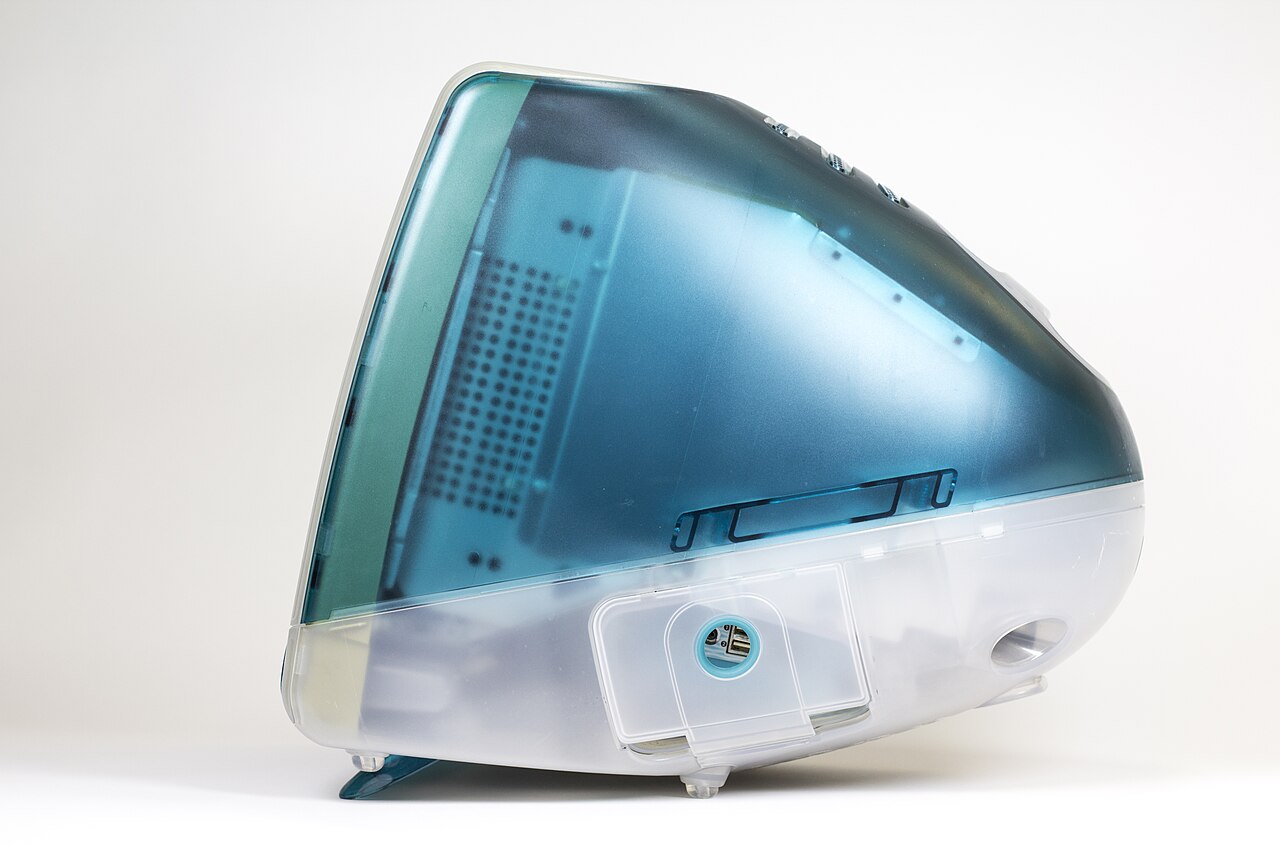
The first product of the partnership was the iMac G3, announced in May 1998 and shipped that August: an all-in-one computer in a translucent, blue-green “Bondi Blue” plastic shell with a handle on top, no floppy drive and USB ports in place of Apple’s old connectors. It became one of the fastest-selling computers Apple had made, helped return the company to profit and was copied in translucent plastic across household goods from staplers to irons. Later colors followed in 1999.
Ive’s industrial design group was small, a dozen or two designers who stayed together for many years, and worked with unusual authority inside Apple. Its studio in Cupertino was where products began, with forms worked out in models and prototypes before engineering decided what was inside, and the group also took responsibility for materials and manufacturing processes.
The Products
Not every design sold. The Power Mac G4 Cube, unveiled at Macworld New York on 19 July 2000, put a G4 processor in an 18-centimetre cube inside a clear acrylic shell, cooled without a fan by air rising through it; it cost more than the ordinary Power Mac G4, had almost no room for expansion, sold about 150,000 units and was discontinued in July 2001, though the Museum of Modern Art took one. The second iMac, presented on 7 January 2002, put a 15-inch flat screen on a movable arm above a 27-centimetre white hemisphere holding the electronics; it sold from $1,299 to $1,799, had 150,000 advance orders when shipping began on 29 January, and was replaced by the flat iMac G5 on 31 August 2004.
- iPod (October 2001): a white polycarbonate front, a polished steel back and, from 2004, the click wheel. The white earphones became part of the advertising. Tony Fadell led the engineering (see Tony Fadell).
- iPhone (announced January 2007): a single slab of glass and metal with one button. Within a few years almost every smartphone maker had moved to a similar form (see The Mobile Computing Revolution). In the patent case Apple brought against Samsung in 2011, tried in 2012, Apple’s designers, including Christopher Stringer of Ive’s team, testified about how the iPhone’s appearance had been developed.
- MacBook Air (January 2008) and the unibody MacBook Pro (October 2008): laptop cases milled from a single block of aluminum, a process that turned manufacturing into part of the design.
- iPad (2010) and Apple Watch (announced 2014, shipped 2015), the first new product category developed after Jobs’s death.
Ive’s approach drew openly on the work of Dieter Rams at Braun and his principle of “less, but better”. He talked about the “care” visible in an object, and his team’s work was largely a matter of removal: fewer screws, seams, buttons and ports, until what remained appeared inevitable.
He was knighted (KBE) in the 2012 New Year Honours for services to design and enterprise.
Software and the Watch
After Jobs died in October 2011 and Scott Forstall, the head of iOS software, was dismissed in October 2012, Ive took over human interface design for Apple’s software as well. iOS 7 (2013) removed the skeuomorphic textures of earlier versions, the leather of the calendar and the felt of Game Center, in favor of flat color, thin type and translucent layers. Much of the industry followed.
The Apple Watch was Ive’s project more than any other. Apple sold it as a fashion object as well as a gadget and offered an Apple Watch Edition in 18-carat gold at prices from $10,000 to $17,000. The gold models did not find a market and were discontinued in September 2016, after one generation; later Edition models were made of ceramic and titanium. Ive became chief design officer in May 2015, handing day-to-day management of the design teams to others, and spent much of his last Apple years on Apple Park, the ring-shaped headquarters in Cupertino designed with the architects Foster + Partners, which opened in 2017.
Leaving Apple
On 27 June 2019 Apple announced that Ive would leave to start an independent design company with Apple as a client. The Wall Street Journal reported days later that he had become dispirited after the Apple Watch, came to the campus less often and sometimes did not appear at design meetings, and that he had grown distant from Tim Cook, whom some colleagues saw as more interested in operations than design. Cook called the report “absurd.”
Ive founded LoveFrom with the designer Marc Newson. Its clients included Ferrari, Airbnb and the British monarchy, for which it designed the emblem of King Charles III’s coronation in 2023. The consulting arrangement with Apple ended in 2022.
io and OpenAI
In 2024 Ive founded a hardware company, io, with former Apple designers Evans Hankey, Scott Cannon and Tang Tan, and began working with Sam Altman of OpenAI on devices built around AI. On 21 May 2025 OpenAI announced that it would acquire io for about $6.5 billion in stock, its largest acquisition, with Ive and LoveFrom taking responsibility for design across OpenAI; the deal closed on 9 July 2025 (see The Generative AI Revolution).
The name did not survive. In June 2025 IYO, a start-up making AI earpieces, sued OpenAI, io, Altman and Ive for trademark infringement; OpenAI removed the announcement material, decided not to use the name “io” for its hardware and later settled. In January 2026 OpenAI said it was on track to show its first device in the second half of the year; in February 2026 MacRumors reported that the device had been delayed to 2027.
Dead End
When thinness became the goal
Ive’s drive for thinness and seamlessness produced Apple’s most criticized hardware of the 2010s. The “butterfly” keyboard (2015–2019) saved fractions of a millimeter in laptop thickness, but its keys failed when a speck of dust got under them; Apple ran repair programs and faced class-action suits, and returned to the older scissor mechanism in 2019–2020. The cylindrical 2013 Mac Pro was so tightly built around its cooling design that it could not take newer, hotter graphics cards; in April 2017 Apple executives publicly said they had designed themselves “into a bit of a thermal corner” and promised a new design. Ports disappeared from MacBooks faster than users’ accessories did, starting the “dongle era.” After Ive left, Apple made its laptops slightly thicker again and brought back ports, function keys and the MagSafe charger.
The pattern was the same each time: a design goal that had served Apple well, removing everything unnecessary, was applied past the point where it served the person using the product.
📚 Sources
-
Heinz Nixdorf MuseumsForum blog, “Apple Power Mac G4 Cube – das Design-Wunder” (17 July 2020) and “Apple iMac G4 – die Lampe auf dem Schreibtisch” (7 January 2022)
-
Kahney, Leander: Jony Ive: The Genius Behind Apple’s Greatest Products (2013), Portfolio
-
Isaacson, Walter: Steve Jobs (2011), Simon & Schuster and AppleInsider, “Steve Jobs left designer Jony Ive more power than anyone at Apple” (21 October 2011)
-
Wikipedia: Jony Ive: birth, education, Tangerine, Ideal Standard, Apple 1992, roles, knighthood, LoveFrom
-
Dezeen, “Jony Ive designs coronation emblem with "gentle modesty" for King Charles III” (13 February 2023) (designed by Jony Ive and LoveFrom)
-
Wikipedia: Twentieth Anniversary Macintosh and Daring Fireball, “Jony Ive Describes the 20th Anniversary Macintosh in 1997”
-
Wikipedia: iMac G3 and Wikipedia: Apple Industrial Design Group
-
TechCrunch, “Apple discontinues gold watch, adds ceramic” (7 September 2016)
-
Apple Newsroom, “Jony Ive to form independent design company with Apple as client” (27 June 2019)
-
MacRumors, “WSJ: Jony Ive Became ‘Dispirited’ After Apple Watch and Sometimes Failed to Show Up to Meetings” (1 July 2019) and NBC News, “Tim Cook disputes ‘absurd’ reports about Jony Ive’s departure”
-
OpenAI, “Sam and Jony introduce io” (21 May 2025) and CNBC, “Steve Jobs once called designer Jony Ive his ‘spiritual partner’ at Apple” (24 May 2025)
-
Fortune, “OpenAI, IYO, io: the trademark lawsuit” (27 June 2025) and The Fashion Law, “OpenAI Quietly Pulls ‘io’ Branding Amid Trademark Clash”
-
Bloomberg Law, “OpenAI, Io Settle IYO Trademark Lawsuit Following Injunction”
-
Wikipedia: iPod Classic: scroll wheel (2001), touch wheel (2002), click wheel (2004)
-
Axios, “OpenAI aims to debut first device in 2026” (19 January 2026) and MacRumors, “OpenAI’s Jony Ive-Designed Device Delayed to 2027” (10 February 2026)
-
The Verge, Apple’s butterfly keyboard saga and repair programs
-
heise online, “50 Jahre Apple: Menschen, die den Mac- und iPhone-Hersteller präg(t)en” (archived)
-
Image: Jonathan Ive 2009.jpg by Gary Cohen (CC BY-SA 2.0), via Wikimedia Commons
-
Image: Imac G3 Bondi Blue side.jpg by Stephen Hackett (CC BY-SA 4.0), via Wikimedia Commons