Cryptography: The Secret Science
Abstract
For most of human history, cryptography was the exclusive property of states and militaries: a tool for protecting diplomatic cables and battlefield orders. The 1970s changed everything. A pair of Stanford mathematicians published a paper describing a cryptographic system that did not require sender and receiver to share a secret in advance, and within months, three MIT researchers turned this idea into RSA, the algorithm that secured the web’s first encrypted connections. The subsequent fifty years of cryptographic history are the story of mathematics becoming infrastructure, of civil liberties battles fought with publication and encryption software, and of governments learning that mathematics is an export they cannot control.
Ancient Cryptography to the Enigma
Simple substitution ciphers (replacing each letter with another) were used by Julius Caesar (the Caesar cipher, a rotation of the alphabet by a fixed number) and remained adequate for centuries because the typical adversary lacked systematic methods to break them. The Arab mathematician al-Kindi developed frequency analysis in the 9th century: because certain letters appear more often in any given language, counting letter frequencies in ciphertext reveals the substitution key. Most classical ciphers fell to this technique.
The oldest surviving treatment of the subject is a chapter in the Greek writer Aeneas Tacticus’s book on defending besieged cities, written around 360 BC. It describes hiding messages (pricking tiny dots under letters of an innocent text, a slave with a message tattooed on his shaved scalp) and a simple cipher: a thread pulled in sequence through 24 holes, one per letter, in a bone or a wooden disc. Even Caesar’s cipher is commonly reported backwards. Suetonius wrote that a reader had to substitute the fourth letter, D, for A, so Caesar enciphered by shifting three letters back, and his successor Augustus used a shift of one.
In the fifteenth century Leon Battista Alberti invented the cipher disc, two concentric alphabets that could be turned against each other, and Giambattista della Porta printed a paper version in 1563. Cryptanalysis was by then a state service. Sir Francis Walsingham, Elizabeth I’s secretary of state, ran a network that intercepted letters, and his decipherer Thomas Phelippes read the correspondence of the Babington plot, including Mary Queen of Scots’ letter of July 17, 1586 approving it; she was executed in February 1587. Some texts have resisted every effort. The Voynich manuscript, an illustrated cipher book on vellum radiocarbon-dated to the first half of the fifteenth century, bought by the antiquarian Wilfrid Voynich in 1912 and held at Yale since 1969, has never been read.
The Vigenère cipher (1553) defeated simple frequency analysis by using multiple shifted alphabets, keyed by a keyword.1 For three centuries it was considered unbreakable. Charles Babbage broke a variant of it by 1854 (though he never published); Friedrich Kasiski independently published the method in 1863. The pattern recurs throughout cryptographic history: “unbreakable” systems fall to unexpected mathematical insight.
In the United States, the craft of codebreaking was professionalized in the early twentieth century largely by two people who met while hunting imaginary ciphers in Shakespeare: William Friedman (who coined the term cryptanalysis) and Elizebeth Smith Friedman, who broke the radio codes of Prohibition-era smuggling syndicates and, in the Second World War, of the Nazi spy network in South America. Their statistical and structural methods, developed at the private Riverbank Laboratories from 1916, became the foundation of American signals intelligence.
Machines came in the late nineteenth century. In Germany, the Paris firm G. Schacher & Co. received a patent in 1879 for a crank-operated device printing a Vigenère cipher, and the Berlin student Ernst George filed a patent on January 15, 1880 for a printing cipher machine whose two pin wheels gave a key that repeated only after 56 letters. Around 1900 the “Discret,” a cheap type-wheel typewriter with a movable inner alphabet ring, sold for 75 marks. Electric rotor machines came with and after the First World War: the Dutch naval officers Theo van Hengel and Rudolf Spengler built a rotor machine in 1915, Arvid Damm in Sweden, Edward Hebern in the United States, Hugo Koch in the Netherlands and Arthur Scherbius in Germany filed rotor patents, and two Danes, Peter Beyer and Alfred Carlsen, patented an electric cipher typewriter with a sliding wiring block in 1919–21. Scherbius’s design became the Enigma, first sold commercially in 1923.
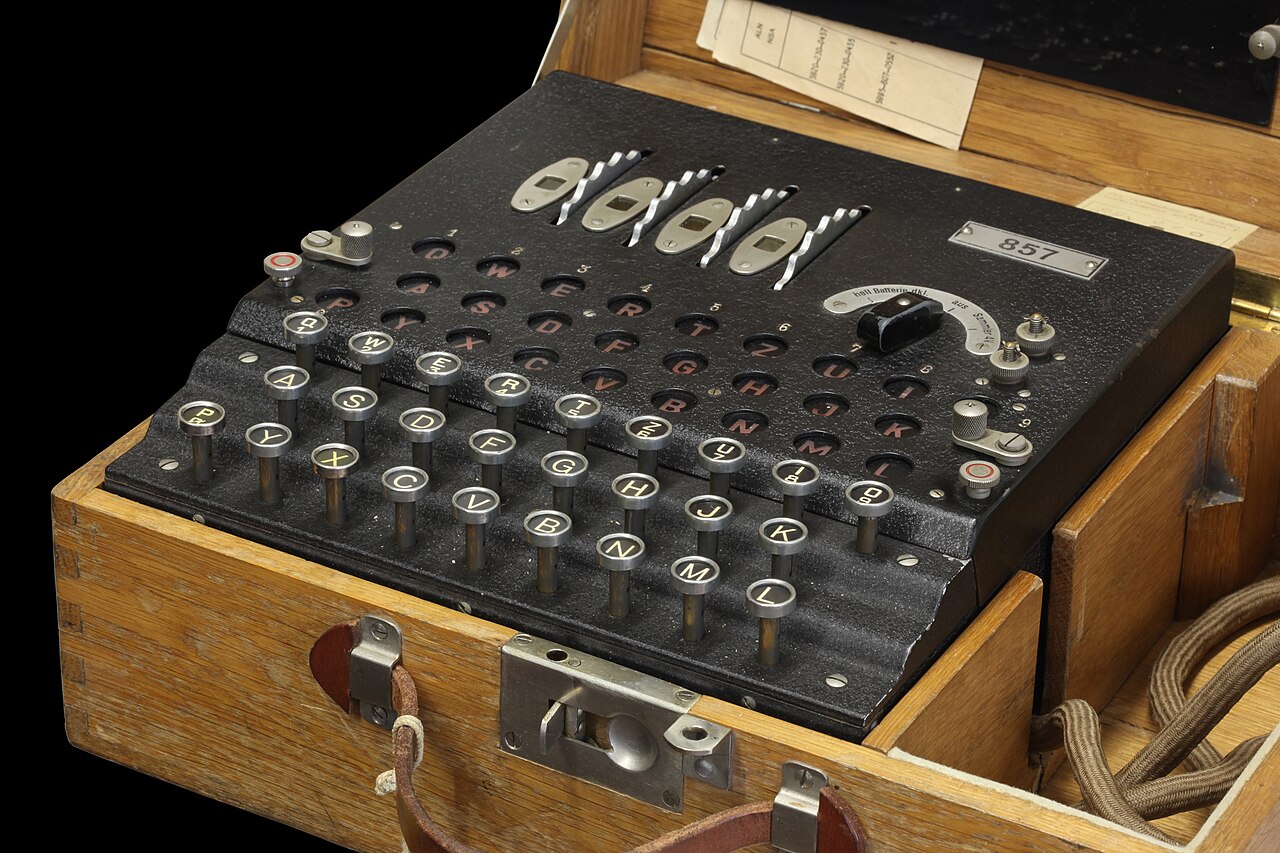
The Enigma machine, adopted by the German military from the late 1920s and used throughout Nazi Germany’s war effort, first broken by Polish mathematicians in 1932 and then, on a far larger scale, by British codebreakers at Bletchley Park during World War II (see Alan Turing and the Enigma), was the last major pre-digital cipher. Its defeat established that mechanical complexity was insufficient: you needed mathematical proof of security, not just engineering difficulty. The Germans had warnings. In August 1943 the Abwehr passed on a report from an agent in the US Navy Department that U-boat orders were being read, and little changed.
Rotor Machines After Enigma
Germany’s last cipher machine was never broken because it barely saw service. Fritz Menzer’s Wanderer SG 41, built on the pin-and-lug principle of Boris Hagelin’s Swedish machines (sold as the C-35, C-36 and, in America, the M-209, which German codebreakers did read), was delivered from October 1944: about 1,000 to the Abwehr and some 500 of a numeric version to the Luftwaffe weather service. Switzerland, whose plugboard-less commercial Enigmas were being read by France, Britain, the United States and Germany, began its own design in 1941; the Nema (“new machine”), built by Zellweger, reached the army and diplomatic service in 640 copies in 1947, served until 1979, and was sold off to collectors for 50 francs apiece on May 4, 1994. The American KL-7, developed from 1945 and built by Burroughs, entered service early in 1953, became NATO’s standard from 1956 and was in use in some 25,000 copies in 1966; it was betrayed to the Soviets by the army officer Joseph Helmich and the navy spy John Walker. Electronic systems replaced the rotor machines in the 1970s.
The Codebreaking Agencies
Britain’s Government Code and Cypher School was formed on November 1, 1919 by merging the army and navy codebreaking bureaus, ran Bletchley Park in the war, became GCHQ in 1946 and moved to Cheltenham in 1952–54. Its existence was first reported in 1976 and became common knowledge through the 1982 trial of Geoffrey Prime, a GCHQ linguist who had sold secrets to the KGB and was sentenced to 38 years. Earlier, John Cairncross had passed Bletchley material to Moscow in 1943. Gordon Welchman, who had designed the Bombe’s diagonal board, had his security access withdrawn and was visited by the NSA after he published The Hut Six Story in 1982. In 2003 the GCHQ translator Katharine Gun leaked an NSA request to spy on UN Security Council delegates before the Iraq war; the prosecution dropped the case in February 2004.
The United States professionalised codebreaking in the Second World War with some 11,000 women among its staff: Genevieve Grotjan had the key insight against the Japanese Purple machine in 1940, and Ann Caracristi later became deputy director of the NSA; a postage stamp honoured these “code girls” in October 2022 (see Women in Computing). The National Security Agency was established on November 4, 1952 from the Armed Forces Security Agency of 1949, under General Ralph Canine. Its existence was so little acknowledged that its initials were read as “No Such Agency” until two of its mathematicians, William Martin and Bernon Mitchell, defected and held a press conference in Moscow on September 6, 1960. The NSA was also one of the largest computer buyers of its era, from copies of the ATLAS and ABNER machines in 1953 to the IBM HARVEST of 1962; its programmer Dorothy Blum, who used FORTRAN before its public release, was inducted into the agency’s Hall of Honor in 2004. Even harmless material stayed locked away: a video of Grace Hopper’s unclassified lecture to NSA staff on August 19, 1982 was released only in August 2024, after a journalist’s request.
West Germany’s Federal Intelligence Service (BND) set up its cipher bureau, the Zentralstelle für das Chiffrierwesen, in 1956 at Mehlem near Bonn under Erich Hüttenhain, formerly the leading cryptanalyst of the Wehrmacht high command’s cipher department. It took on computer security in 1986 and on January 1, 1991 left the intelligence service to become the Federal Office for Information Security (BSI), with Otto Leiberich as its first president.
Shannon’s Mathematical Cryptography
Claude Shannon (see Claude Shannon and Information Theory) provided that foundation in his 1949 paper “Communication Theory of Secrecy Systems.” Shannon proved that the one-time pad (a cipher where the key is a truly random string as long as the message, used only once) is perfectly secret: an adversary with unlimited computing power gains zero information about the plaintext from the ciphertext. He also defined when any cipher is computationally secure: when breaking it requires more work than any feasible adversary can perform.
This gave cryptographers a framework for rigorous argument. Before Shannon, ciphers were “broken” or “unbroken” as a matter of empirical fact. After Shannon, security could be argued mathematically, which also meant it could be disproved mathematically, which was an improvement.
The Key Distribution Problem
All cryptographic systems before 1976 shared a fundamental limitation: sender and receiver must agree on a secret key before communicating. This is easy when two spies meet in a park; it is impossible when a customer wants to buy something from a website they have never contacted before.
In 1976, Whitfield Diffie and Martin Hellman at Stanford published “New Directions in Cryptography,” one of the most consequential papers in the history of applied mathematics. They described public-key cryptography: a system in which each party has two mathematically related keys, one public, one private. A message encrypted with the public key can only be decrypted with the private key. Two parties can establish a shared secret over a public channel without prior communication, because each party’s private key is never transmitted.
The paper also drew on ideas of Ralph Merkle, then a student, and won Diffie and Hellman the 2015 Turing Award. It appeared just as IBM’s block cipher, designed chiefly by the Berlin-born Horst Feistel, became the US Data Encryption Standard (DES) in 1977. In July 1977 an NSA employee, Joseph Meyer, wrote to warn that publishing such work might violate arms-export law; the protest that followed left Hellman unprosecuted.
Diffie and Hellman described the concept; they did not provide a practical implementation. The specific Diffie-Hellman key exchange protocol they published remains in use, but the paper was explicit that finding a suitable mathematical function for the general public-key scheme was an open problem.
Prior Art: GCHQ’s Secret Discovery
In 1997, the British signals intelligence agency GCHQ declassified documents revealing that its researchers (James Ellis, Clifford Cocks, and Malcolm Williamson) had independently discovered public-key cryptography between 1969 and 1974, including an algorithm mathematically equivalent to RSA (Cocks, 1973) and the Diffie-Hellman key exchange (Williamson, 1974). The work was classified and unused for two decades. Ellis died in 1997, weeks before the declassification, without public recognition of his discovery.
RSA: The Algorithm That Runs the Internet
In 1977, three MIT researchers (Ron Rivest, Adi Shamir, and Leonard Adleman) found the mathematical trapdoor function Diffie and Hellman had sought: the RSA algorithm, based on the difficulty of factoring large integers. Multiplying two large prime numbers together takes milliseconds; factoring the result back into its prime factors is computationally infeasible for numbers of sufficient size.
RSA was the first practical public-key cryptosystem. It could be used for both encryption and digital signatures (signing with a private key, verifying with the corresponding public key). It became the foundation of SSL (Secure Sockets Layer, 1995) and its successor TLS (Transport Layer Security), the protocol that puts the “S” in HTTPS.
Rivest, Shamir, and Adleman submitted RSA to Martin Gardner, who published it in his Scientific American “Mathematical Games” column in August 1977. Thousands of readers wrote in for the technical memo; amid the export-law worries raised by the Meyer letter, the mailing was held back until December 1977, but no government action followed. The authors offered a $100 reward for factoring the published “RSA-129” challenge number; it was factored in April 1994 (by a team coordinating roughly 1,600 computers over the Internet) demonstrating that key sizes needed to grow with computing power.
PGP: Cryptography Goes Public
Philip Zimmermann was a political activist and software engineer who believed that strong cryptography should be available to ordinary citizens, not just governments and corporations. In 1991, facing a Senate bill that would have let the government read electronic communications, he released on June 5, 1991 PGP (Pretty Good Privacy) (an implementation of RSA and other ciphers for encrypting email) as free software.
The U.S. government responded by opening a criminal investigation of Zimmermann for “munitions export without a license.” Cryptographic software was classified as a munition under the International Traffic in Arms Regulations (ITAR); exporting it was theoretically equivalent to exporting a weapons system. The investigation lasted three years before being dropped in 1996 without charges.
PGP itself highlighted a different problem: while the cryptography was sound, key management was difficult enough that most people used it incorrectly or not at all. The key verification model (web of trust) required users to physically verify each other’s public keys or rely on chains of trusted signatures, a process too cumbersome for most use cases. PGP email encryption remains a minority practice among journalists, security researchers, and activists; it never achieved mass adoption.
The Strange Lineage of E4M and TrueCrypt
The same “encryption for everyone” impulse produced E4M (Encryption for the Masses), an open-source disk-encryption program released on December 18, 1998, software that scrambled an entire drive rather than individual emails. E4M’s code is widely believed to underlie TrueCrypt (2004), for years the most trusted free disk-encryption tool and a staple of privacy activists and criminals alike. The unsettling twist is the identity of E4M’s author: Paul Le Roux, a gifted programmer who in the following decade built one of the world’s largest criminal organizations (an online-pharmacy empire that mutated into drug and arms trafficking and contract killings) before his 2012 arrest by the U.S. DEA, to whom he then turned informant. Le Roux denied any role in TrueCrypt, and the connection is disputed, but the episode is a reminder that cryptographic tools, once released to the masses, serve whoever picks them up, including their own creators.
The Clipper Chip Controversy
In 1993, the Clinton administration proposed the Clipper chip, a hardware encryption device that would provide strong encryption for telephone voice communications, with one condition: the key would be split into two parts, each deposited with a different government agency, allowing law enforcement to decrypt communications with a court order. This key escrow mechanism was presented as a balance between privacy and law enforcement access.
The proposal was met with near-universal opposition from cryptographers, civil liberties organizations, and the technology industry. AT&T researcher Matthew Blaze published a paper in 1994 demonstrating a flaw in the Clipper chip’s key escrow protocol that would allow a user to subvert the escrow mechanism while maintaining encryption. The Clipper chip initiative was abandoned by 1996.
The arguments made against Clipper: that backdoors are always exploitable by adversaries as well as law enforcement, that secure cryptography is mathematically indivisible from cryptography available to criminals, that key escrow creates a target of enormous value, have been repeated in every subsequent “crypto war.” The FBI’s 2016 demand that Apple create a version of iOS capable of unlocking the San Bernardino shooter’s iPhone was the Clipper debate resurfaced for the smartphone era.
Modern Cryptography: AES, Elliptic Curves, and the Quantum Threat
The Advanced Encryption Standard (AES), selected by NIST in October 2000 through an open international competition and approved as a federal standard in November 2001, replaced DES (Data Encryption Standard, 1977) as the global standard for symmetric encryption. The Rijndael algorithm, designed by Belgian cryptographers Joan Daemen and Vincent Rijmen, has resisted all practical attacks at standard key sizes.
Elliptic curve cryptography (ECC), developed independently by Neal Koblitz and Victor Miller in 1985, provides equivalent security to RSA with much smaller key sizes, making it suitable for constrained devices. Most TLS connections now use elliptic curve Diffie-Hellman (ECDH) for key exchange.
The quantum computing threat to public-key cryptography is real: Shor’s algorithm (1994) would efficiently factor large integers and compute discrete logarithms on a sufficiently powerful quantum computer, breaking RSA and ECC. NIST began a post-quantum cryptography standardization process in 2016 and published initial standards in 2024. The migration to quantum-resistant algorithms will take a decade and must happen before quantum computers capable of running Shor’s algorithm at relevant key sizes exist.
Dead End: Key Escrow as Government Policy
The Clipper chip was the most prominent attempt to mandate government access to encrypted communications, but not the last. The UK’s Investigatory Powers Act (2016) included provisions for requiring communication service providers to maintain “technical capability notices”, essentially ongoing backdoor requirements. The EU has repeatedly debated client-side scanning mandates. Australia’s Assistance and Access Act (2018) created requirements for technology companies to provide assistance to law enforcement that cryptographers argued were technically impossible to fulfill without weakening encryption for everyone.
None of these proposals resolved the fundamental mathematical reality: there is no such thing as encryption that is secure against some adversaries and insecure for others on demand. Either the encryption is secure or it is not. The governments arguing for “lawful access” have not found a third option; the cryptographers arguing that none exists have not persuaded governments to stop looking.
📚 Sources
- Heinz Nixdorf MuseumsForum blog, “Aeneas Tacticus – der erste Kryptologe” (12 September 2023)
- Heinz Nixdorf MuseumsForum blog, “Ave Caesar – ein kryptologisches Rätsel” (7 July 2015)
- Heinz Nixdorf MuseumsForum blog, “Das Fundament der Kryptologie” (5 September 2017)
- Heinz Nixdorf MuseumsForum blog, “Das mysteriöse Voynich-Manuskript” (22 May 2026)
- Heinz Nixdorf MuseumsForum blog, “1880 – ein Patent für eine Chiffriermaschine” (14 January 2025)
- Heinz Nixdorf MuseumsForum blog, “Diskret – Schreibmaschine zum Chiffrieren” (12 March 2024)
- Heinz Nixdorf MuseumsForum blog, “Wie zwei Dänen beinahe die Enigma erfanden” (1 February 2022)
- Heinz Nixdorf MuseumsForum blog, “Der Verräter von Bletchley Park” (21 June 2019)
- Heinz Nixdorf MuseumsForum blog, “Die Enigma nach der Enigma” (17 October 2017)
- Heinz Nixdorf MuseumsForum blog, “Nema – die Schweizer Enigma” (21 May 2021)
- Heinz Nixdorf MuseumsForum blog, “KL-7 – die Enigma der NSA” (12 August 2025)
- Heinz Nixdorf MuseumsForum blog, “Nicht länger geheim” (1 November 2019)
- Heinz Nixdorf MuseumsForum blog, “Der vergessene Codebrecher” (9 July 2019)
- Heinz Nixdorf MuseumsForum blog, “Briefmarke für die Code Girls” (28 February 2023)
- Heinz Nixdorf MuseumsForum blog, “„No Such Agency“: 70 Jahre NSA” (4 November 2022)
- Heinz Nixdorf MuseumsForum blog, “Martin und Mitchell – die Überläufer von der NSA” (5 September 2025)
- Heinz Nixdorf MuseumsForum blog, “Die Lady von der NSA” (22 January 2016)
- Heinz Nixdorf MuseumsForum blog, “Grace Hopper besucht die NSA” (11 February 2025)
- Heinz Nixdorf MuseumsForum blog, “Das Amt am Rhein” (14 March 2017)
- Heinz Nixdorf MuseumsForum blog, “Das offene Geheimnis” (5 April 2016)
- Heinz Nixdorf MuseumsForum blog, “Der Mann, der die Mails versteckte” (12 February 2019)
- Diffie, Whitfield & Hellman, Martin: “New Directions in Cryptography” — IEEE Transactions on Information Theory, Vol. 22, No. 6 (1976)
- Rivest, Ronald L., Shamir, Adi & Adleman, Leonard: “A Method for Obtaining Digital Signatures and Public-Key Cryptosystems” — Communications of the ACM, Vol. 21, No. 2 (1978)
- Singh, Simon: The Code Book: The Science of Secrecy from Ancient Egypt to Quantum Cryptography (1999), Doubleday
- Levy, Steven: Crypto: How the Code Rebels Beat the Government — Saving Privacy in the Digital Age (2001), Viking
- Blaze, Matt: “Protocol Failure in the Escrowed Encryption Standard” — Proceedings of the 2nd ACM CCS (1994)
- NIST: Post-Quantum Cryptography Standardization (ongoing)
- Image: Enigma-IMG 0487-black.jpg by Rama (CC BY-SA 2.0 fr), via Wikimedia Commons
-
The cipher is named after the French diplomat Blaise de Vigenère, but the 1553 version described here was actually devised by the Italian cryptographer Giovan Battista Bellaso. Vigenère published a stronger (autokey) variant in 1586; the misattribution stuck in the 19th century and never came off. ↩︎