Sophie Wilson and ARM
Abstract
Sophie Wilson designed the ARM instruction set architecture (the set of instructions that defines what ARM processors can do and how software talks to them) in 1985, working for the small Cambridge computer company Acorn with a team of three people and a budget that could not afford to buy tape drives. The processor she designed now runs in over 95% of the world’s smartphones, the majority of tablets, most embedded systems from dishwashers to cardiac monitors, and Apple’s entire Mac line since 2020. It is the most widely deployed processor architecture in history. Wilson has described the design process as surprisingly simple; the remarkable thing is not that she designed it but that a design of such simplicity proved so universally applicable.
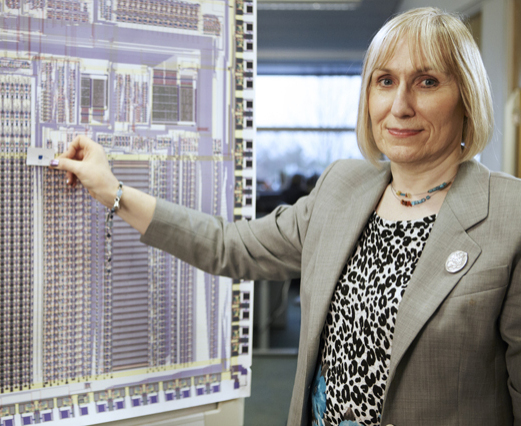
Acorn and the BBC Micro
Sophie Wilson was born Roger Wilson in June 1957, in Leeds. She studied mathematics at Cambridge and, in the summer of 1977 while still a student, designed a small MOS 6502-based system to electronically control feed for cows, demonstrating the practical engineering ability that would define her career.
She joined Acorn Computers in Cambridge in 1978 as one of its earliest employees. Acorn was a small British microcomputer company, one of dozens that appeared in the wake of the Altair and the Apple II. In 1981, Acorn won the contract to produce the BBC Micro, a personal computer for the BBC’s Computer Literacy Project, a nationwide program to teach computing to the British public. Wilson designed much of the MOS 6502-based machine’s hardware and wrote its operating system and its dialect of BASIC, BBC BASIC, the language a generation of British schoolchildren learned to program in. The BBC Micro sold 1.5 million units in Britain and became the standard school computer of the early 1980s, introducing a generation to computing.
The BBC Micro’s success gave Acorn the revenue and credibility to attempt more ambitious projects. By 1983, it was clear to Acorn’s leadership (particularly Hermann Hauser and Chris Curry) that the 6502 microprocessor was approaching its limits for the next generation of machines. They needed something more powerful. The obvious choice was to license one of the American 32-bit processors under development: Intel’s 80286, Motorola’s 68000, or the National Semiconductor 32032.
Why Design a New Processor
The decision not to license but to design was driven by several factors. The available processors were expensive, complex, slow for the performance they delivered, and power-hungry. Examining their architecture, Acorn’s engineers concluded that the complexity was self-imposed: complex instruction sets required complex decoders that slowed the critical path through the processor. The RISC (Reduced Instruction Set Computing) research coming out of Berkeley (David Patterson) and Stanford (John Hennessy) in 1980–1982 suggested that simpler instructions, executed quickly, outperformed complex instructions with long execution times.
Acorn could not afford to buy tape drives for simulation, so the team verified the design by writing a software simulator first. Steve Furber led the hardware implementation; Wilson designed the instruction set.
The design constraints were severe: a university-scale budget, a team of three, eighteen months. These constraints turned out to be generative rather than limiting.
Designing the Instruction Set
Wilson’s ARM instruction set had a core philosophy: every instruction must be useful in real programs. There would be no instructions included because they were theoretically elegant or because they might someday be useful. Every instruction had to earn its place by appearing frequently in actual compiled code.
The resulting set had 64 instruction encodings in 32-bit words (later extended). Key features:
Conditional execution: Every ARM instruction carries a 4-bit condition code field. Any instruction can be conditionally executed, executed only if the previous operation set the condition flags in the appropriate state. This eliminated the need for short conditional branches and increased code density dramatically. No other major architecture had this feature; it became ARM’s most distinctive characteristic.
A large register file: 16 general-purpose registers, versus 8 in x86. More registers meant fewer memory accesses, which were expensive relative to register operations.
Load/store architecture: Unlike x86, ARM instructions could not directly operate on memory; they could only load values from memory into registers and store values from registers to memory. This simplified the instruction set and made pipeline design easier.
The barrel shifter: Shift operations were free, incorporated into other instructions rather than requiring separate shift instructions. Multiplication of a value by a power of two cost nothing extra.
The PC as a register: The program counter was one of the 16 general registers, allowing unusual programming tricks, functions could be called by loading the PC, not by a dedicated call instruction.
The Acorn RISC Machine (ARM) ran its first silicon on April 26, 1985. The chip worked correctly on the first try, extremely unusual for a new processor design. Its power consumption was so low that it could run without power while connected only to the logic analyzer; the test equipment was leaking enough current to operate it. This accidental low-power characteristic would become ARM’s defining advantage in battery-powered devices twenty years later.
From Acorn to the World
Acorn released the ARM-based Acorn Archimedes personal computer in 1987, technically superior to anything available at the time, but arriving too late to challenge the IBM PC clone market that was consolidating around x86. The Archimedes sold in Britain and was adopted by UK schools, but did not achieve the international breakthrough Acorn had hoped for.
The ARM processor itself was more successful than the computer it powered. In 1990, Acorn, Apple, and VLSI Technology formed Advanced RISC Machines Ltd (ARM Holdings) as a joint venture. Apple had chosen ARM for the Apple Newton PDA; VLSI would fabricate the chips; ARM would develop the architecture. The joint venture’s business model was unusual: ARM would not manufacture processors but license the instruction set architecture to other companies, which would design their own ARM-compatible chips.
This IP licensing model (licensing intellectual property rather than selling products) became the template for a new type of technology company. ARM’s revenue came from license fees and royalties; its customers (Qualcomm, Samsung, Apple, Texas Instruments, dozens of others) designed their own silicon implementations that were compatible with ARM software.
The model worked because software portability gave ARM network effects: software written for one ARM chip would run on all ARM chips, so any manufacturer who chose ARM got access to all ARM software. The ecosystem’s value grew with each new ARM licensee, and the ecosystem value attracted more licensees.
Apple Silicon and the Smartphone Era
The ARM architecture’s defining moment in consumer electronics was the iPhone (2007). Apple chose the ARM architecture for the iPhone’s processor for the same reason Acorn had designed it: power consumption. A smartphone’s battery life depends on processor efficiency, and ARM’s load/store architecture, conditional execution, and generally simpler instruction set made it more efficient per operation than x86.
The iPhone established ARM as the dominant smartphone processor architecture. Android phones followed on ARM. By 2015, ARM licensees shipped approximately 15 billion chips annually, more than the entire personal computer industry had shipped in its history to that point.
The final transition came in 2020 when Apple Silicon (Apple’s own ARM-based processors, beginning with the M1) replaced Intel x86 in the Mac lineup. The M1 achieved performance per watt dramatically superior to Intel’s offerings, demonstrating that the architectural advantages Sophie Wilson had designed into ARM in 1985 remained relevant and decisive forty years later.
Wilson has continued at Broadcom (which acquired the Acorn spinout element14), designing future processors. She transitioned in the 1990s. Her design, unchanged in its fundamental architecture, is now computing’s dominant hardware platform.
📚 Sources
- Wikipedia: Sophie Wilson
- Wikipedia: ARM architecture
- The ARM Architecture — Sophie Wilson, 1985 (ARM Holdings)
- Stephen Furber: ARM System-on-Chip Architecture (2000) — Addison-Wesley
- The ARM Architecture (this encyclopedia)
- Apple Silicon: M1 Chip — apple.com (2020)
- Image: Sophie Wilson.jpg by Chris Monk (CC BY 2.0), via Wikimedia Commons