From Vacuum Tubes to Transistors: The Dawn of the Semiconductor Age
Abstract
The first electronic computers switched with vacuum tubes: 17,000 of them in ENIAC, 49,000 in each of the SAGE air-defense computers. Tubes were fast but hot, power-hungry and short-lived, and keeping a machine running meant hunting failed tubes. The transistor, invented at Bell Labs in December 1947, took about a decade to replace them. The early point-contact transistors were unreliable, and the first transistor computers of 1953 to 1955, at Manchester, Bell Labs and Harwell, were experiments that ran slower than tube machines. Junction transistors and Philco’s surface-barrier transistor made fast transistor logic possible; MIT’s TX-0 of 1956 showed it, and from 1958 to 1960 the manufacturers switched: the RCA 501, Philco’s TRANSAC, Olivetti’s Elea, IBM’s 7090 and the IBM 1401, of which over 12,000 were produced. By the early 1960s new computers used no tubes. Japan for a time took a third path, the ferrite-core parametron, which was cheap and reliable but too slow.
Computing in Glass
John Ambrose Fleming invented the two-electrode valve, the diode, in 1904; the American radio entrepreneur Lee de Forest added a control grid and patented his “Audion” in 1907, granted in February 1908. He thought of it as a radio detector and sold the patents to AT&T in 1913, whose engineers and General Electric’s found that a hard-vacuum triode made an excellent amplifier. A vacuum tube used for switching is a triode or one of its descendants: a heated cathode emits electrons, a positively charged anode (plate) collects them, and a wire-mesh grid between the two controls the flow. A small voltage on the grid can turn a large current on or off, so a tube can act as an amplifier or as a switch. Two tubes cross-connected form a flip-flop that holds one bit. Tubes switched in microseconds, thousands of times faster than the relays of the electromechanical computers of Konrad Zuse, Howard Aiken and Bell Labs.
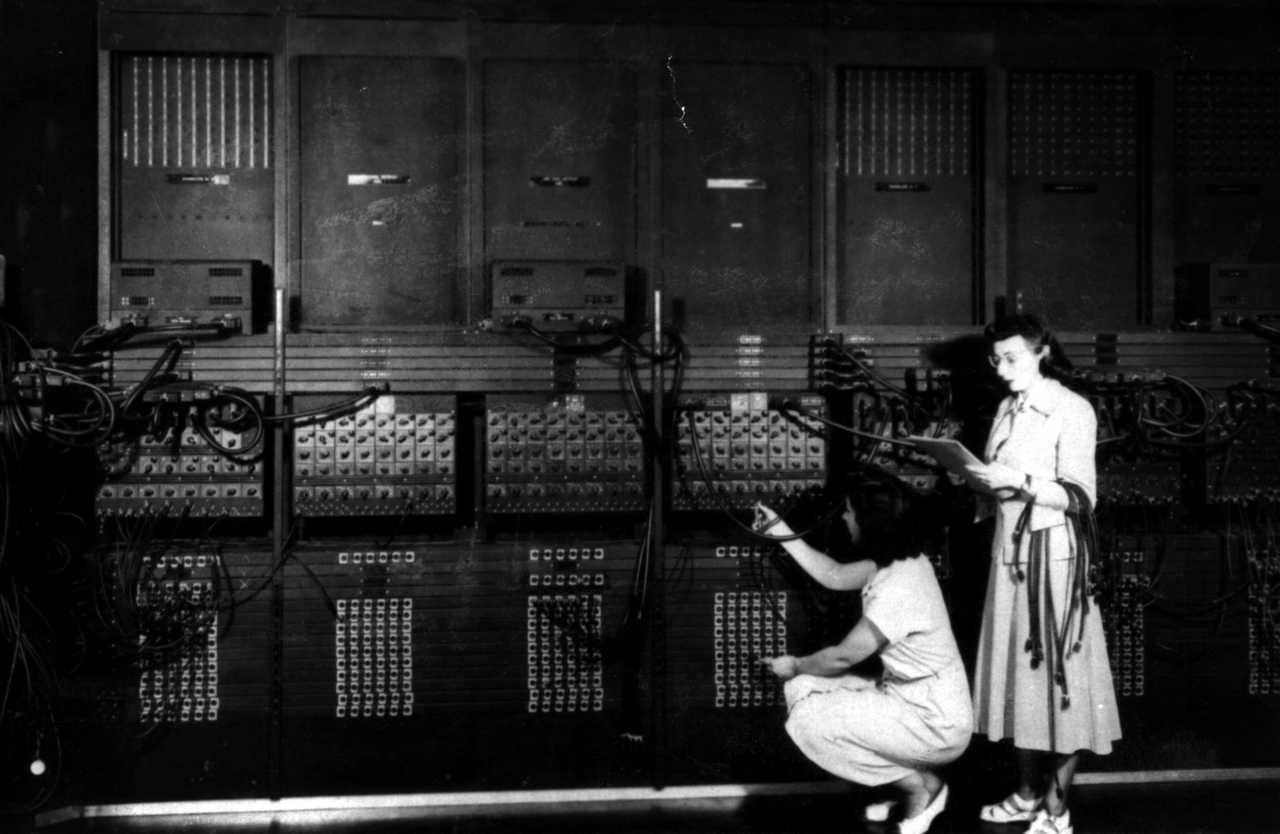
The first large tube machines were built for war. The Colossus code-breaking machines at Bletchley Park had 1,600 tubes in the Mark I and 2,400 in the Mark II, and ten Mark IIs were running by the end of the war. Tommy Flowers, who designed them, had learned from the Post Office telephone network that tubes lasted much longer if they were never switched off. ENIAC, completed at the University of Pennsylvania in 1945, had more than 17,000 tubes, weighed about 27 tonnes and drew 150 kilowatts.
Most tube failures came during warm-up and cool-down, when thermal stress was highest. In ENIAC’s early years tubes burned out almost every day and the machine was unusable for long periods. Its engineers reduced the rate to about one tube every two days, and locating the failed tube took around 15 minutes. By 1954 ENIAC ran 116 hours without a failure.
Not every tube computer filled a hall. By the mid-1950s drum-memory machines such as the Librascope LGP-30, with 113 tubes, and the Bendix G-15, with 450, fitted into an office and sold by the hundred (see Small Computers of the 1950s).
Making Tubes Reliable
Radio tubes had been designed for radios, which switched them on, ran them in their linear range and switched them off again. Computers held many tubes cut off, with no current flowing, for hours at a time while their heaters stayed on. At MIT, the engineers of Whirlwind, a real-time computer with about 5,000 tubes (the HNF counts about 7,850 in the finished machine), found that this produced cathode poisoning: silicon in the tungsten alloy of the heater filament formed a layer of barium orthosilicate on the cathode, which stopped it emitting electrons. Sylvania developed a special tube for Whirlwind, the 7AK7, with a high-purity filament. The Whirlwind team also invented marginal checking: running the circuits at deliberately degraded voltages so that weakening tubes failed during maintenance instead of during a computation. Of 1,412 7AK7 tubes in service by 1950, only 18 had failed (see Whirlwind, SAGE and Core Memory).
Other measures became standard: heater voltage ramped up over a minute or more, motor-generator sets to isolate the machine from fluctuations in the mains, “computer-grade” tubes made and tested to tighter standards, and plug-in modules so that a failed circuit could be swapped in seconds. Electronic calculation reached business before stored-program computers did. At IBM, Ralph Palmer and Byron Phelps built a valve multiplier in 1942, and the IBM 603 electronic multiplier, announced on 27 September 1946 with 300 tubes, performed about a hundred multiplications a minute for a rent of just under $400 a month; it was the first electronic calculating device built in quantity, about a hundred in all. In Germany Walter Sprick built a comparable machine in Kiel in 1951, and Heinz Nixdorf’s ES 24 electronic adder of 1955 was the first series-produced German electronic calculator. IBM’s 604 electronic calculating punch of 1948 used 1,250 miniature tubes in removable modules; with its successor, the 605, more than 5,000 were sold or leased.
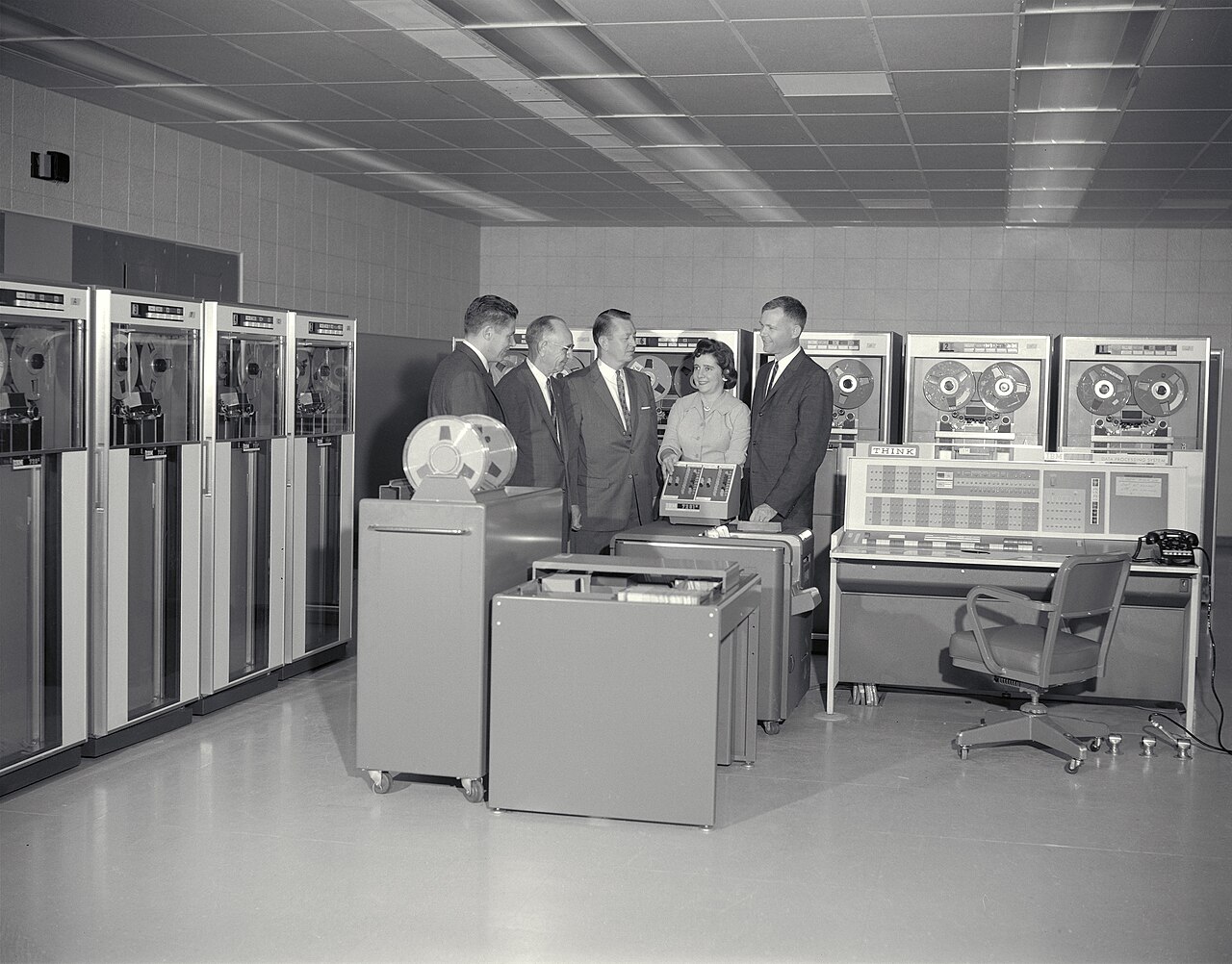
The scale reached its peak in the AN/FSQ-7 computers of the SAGE air-defense network: 60,000 tubes per installation, 49,000 of them in the computers, up to 3 megawatts of power and some 250 tons per machine. Each site had two computers, one active and one on standby, so that tube failures did not interrupt the air defense of North America. Twenty-four were installed, and the last were switched off in 1983 and 1984. They were the largest computers ever built, and they showed that with enough engineering and redundancy tubes could be made dependable. They could not be made small, cool or cheap.
The Transistor
On 16 December 1947 John Bardeen and Walter Brattain at Bell Labs made a germanium crystal amplify a signal through two closely spaced gold contacts pressed onto its surface: the point-contact transistor. Their group leader William Shockley worked out the theory of a different device in January 1948, the junction transistor, built from layers of differently doped semiconductor (see The Transistor). The three shared the Nobel Prize in Physics in 1956.
A transistor does what a triode does, switching a large current with a small one, with no heater, no vacuum and no glass. It needed milliwatts instead of watts, gave off little heat and in principle did not wear out. The early devices were far from that ideal. Point-contact transistors were handmade, varied widely from one to the next, were sensitive to temperature and failed often. Junction transistors, first produced in 1951, were more uniform and robust but slow at first. Through the early 1950s tubes were faster, cheaper and better understood, and for computer designers the transistor was a promise.
The First Transistor Computers
Several groups built transistor computers between 1953 and 1957, and the claims of being first depend on what counts.
- Manchester, November 1953. Tom Kilburn’s group at the University of Manchester (the graduate students Richard Grimsdale and Douglas Webb did the building, and it ran on 16 November 1953), the builders of the Manchester Baby, ran a prototype with 92 point-contact transistors and 550 diodes. The full-size version, commissioned in April 1955, had 200 point-contact transistors and 1,300 diodes and consumed 150 watts. It still used a few tubes for its clock, and in 1955 its average error-free run lasted only 1.5 hours, mostly because of the transistors. Metropolitan-Vickers rebuilt the design with junction transistors as the Metrovick 950, of which six or seven were made from 1956.
- TRADIC, January 1954. Bell Labs built TRADIC for the U.S. Air Force, which wanted to know whether a transistor computer could fly in a bomber. Led by Jean Howard Felker, it used 684 transistors and 10,358 germanium diodes and ran on less than 100 watts, small and light enough for a B-52. Its 1 MHz clock, however, needed a vacuum-tube amplifier, because no transistor of the time could supply the power at that frequency.
- Harwell CADET, February 1955. At the Atomic Energy Research Establishment in Britain, E. H. Cooke-Yarborough’s team avoided tubes completely by running the clock at only 58 kHz. CADET used 324 point-contact transistors and 76 junction transistors, offered a regular computing service from August 1956, ran for 80 hours or more without interruption, and is probably the first fully transistorized computer. Its name was “Transistor Electronic Digital Automatic Computer” spelled backward.
- IBM 604 transistor version, October 1954. IBM engineers replaced the 604’s 1,250 tubes with about 2,200 transistors in an experimental machine.
- ETL Mark III, July 1956. The Electrotechnical Laboratory in Tokyo built Japan’s first transistor computer, with 130 point-contact transistors and about 1,800 germanium diodes.
- Informatik-System Quelle, late 1957. Karl Steinbuch’s order-processing machine for the Quelle mail-order house in Fürth, the first transistor computer on the European continent, though built for that single task.
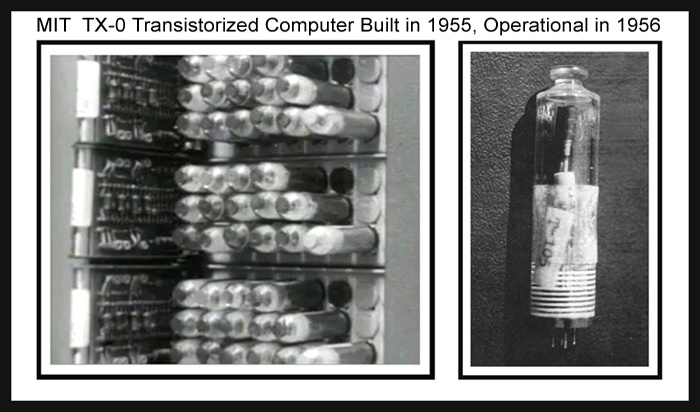
These machines proved that transistors could compute, but they were slower than the tube computers of their time. Speed came from a new device. In 1953 Philco introduced the surface-barrier transistor, made by electrochemically etching and plating a germanium wafer to precise thinness, the first transistor fast enough for high-speed computing. At MIT’s Lincoln Laboratory, Wesley Clark designed and Ken Olsen engineered the TX-0, built in 1955 and 1956 with about 3,600 surface-barrier transistors, as a test bed for a large magnetic-core memory. It worked well and reliably enough that Lincoln lent it to MIT in 1958, where students used it interactively at its console, one of the first computers to allow that, and the place where the hacker culture of the Tech Model Railroad Club began. Olsen left to found Digital Equipment Corporation, whose PDP-1 of 1959 drew directly on the TX-0 (see DEC and the Minicomputer Era).
The Switch
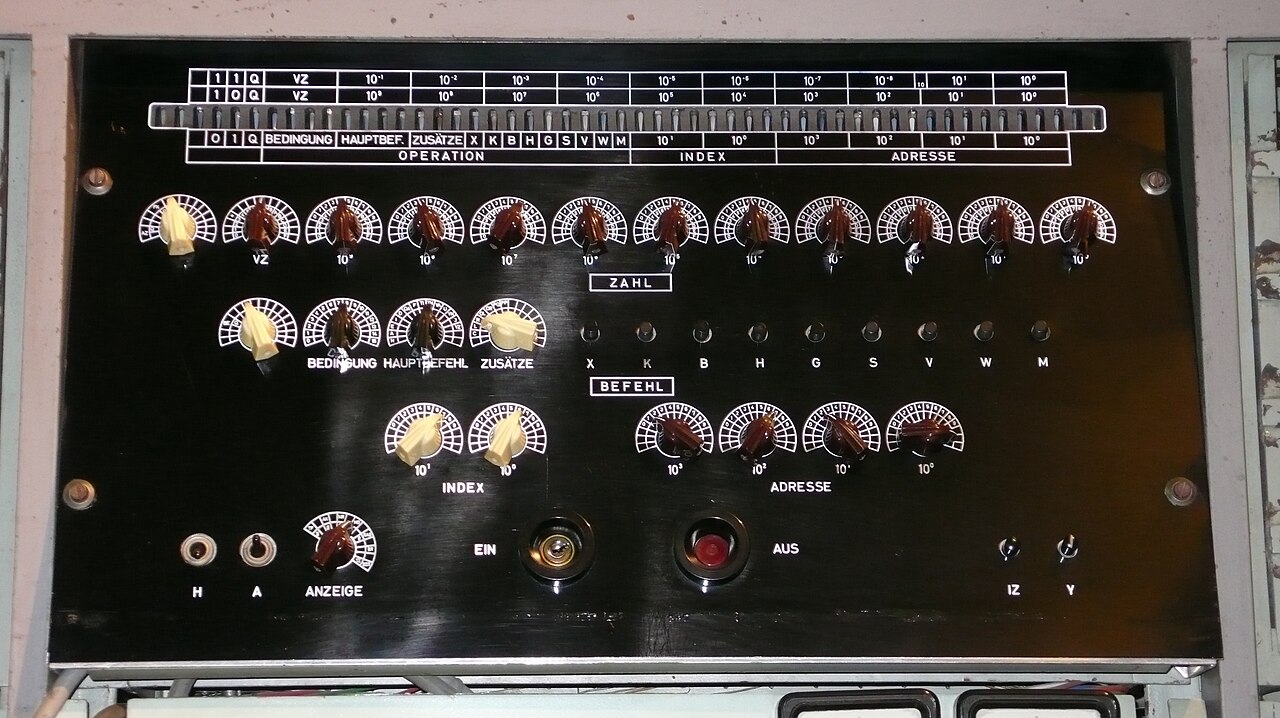
Commercial transistor computers followed within two years of the TX-0. IBM announced the IBM 608 calculator in April 1955 and shipped it in December 1957, the first all-solid-state computing machine on the market; IBM had demonstrated an experimental all-transistor version of the 604 in October 1954. Burroughs delivered a transistorized guidance computer for the Atlas and Thor missiles to Cape Canaveral in June 1957. RCA shipped the all-transistor RCA 501 in 1958, and Philco shipped its TRANSAC S-1000 and S-2000, built with its own surface-barrier transistors, from the autumn of 1958.
In Europe, Heinz Zemanek at the Vienna University of Technology built the Mailüfterl from 1956 to 1958 with 3,000 transistors and 5,000 diodes. He had obtained the transistors from Philips, which had promised 1,000 hearing-aid transistors and eventually sent 4,000. He named the machine a “Viennese May breeze”, a joke at the expense of MIT’s Whirlwind and Typhoon (see Heinz Zemanek and the Mailüfterl). Olivetti’s Elea 9003, sold from 1959, was the first commercial fully transistorized computer from Italy (see Camillo and Adriano Olivetti).
In the Netherlands the Electrologica X1, a germanium-transistor machine from Amsterdam’s Mathematisch Centrum with software by Edsger Dijkstra, was delivered from 1958; 35 were built by 1965, eighteen of them ordered from West Germany (see The Netherlands’ Tech Industry).
IBM’s switch decided the market. The IBM 7090, delivered from November 1959, was a transistorized version of the tube-based IBM 709 with more than 50,000 germanium junction transistors. It was six times faster than the 709 and rented for half the price, about $63,500 a month in 1960. For business IBM presented the IBM 1401 on 5 October 1959 in a closed-circuit television broadcast to 102 locations in North America; it received 5,200 orders in five weeks, more than it had expected for the machine’s whole life, and delivered the first in September 1960. Rents started at $2,500 a month, and by 1971 IBM had built about 12,000 of the 1401 family, which in the mid-1960s made up half of all computers in the world. Transistors also reached the desk in 1964: the Italian IME 84, shown at the Milan fair in April with 424 germanium transistors, the Friden EC-130 in May, Sharp’s Compet CS-10A in July and Canon’s Canola 130 in October (see The Pocket Calculator). 7090s and 7094s computed orbits for the Mercury and Gemini flights and ran an early version of the SABRE airline reservation system. The 1401 was built from standardized transistor circuit cards (see The IBM Mainframe Era). By then the vacuum-tube computer was obsolete for new designs, although tube machines such as the SAGE computers stayed in service for decades.
What Changed
The transistor did not change what a computer could compute. It changed how many computers there could be and where they could go. A transistorized machine of 1960 used a fraction of the power and floor space of an equivalent tube machine, did not need a room-sized air-conditioning plant, and failed far less often. The 1401 brought computers to medium-sized businesses that had used punched-card tabulators, and the TX-0 and PDP-1 put them within reach of laboratories and universities. Interactive use, real-time control and computers in aircraft and missiles all depended on the change.
The transistors themselves kept improving. Gordon Teal at Texas Instruments produced the first silicon transistors in 1954, which tolerated higher temperatures than germanium. Jean Hoerni’s planar process at Fairchild in 1959 made transistors flat on a silicon wafer, protected by a layer of oxide, and the same process allowed many transistors and their connections to be made together on one chip (see Robert Noyce and Fairchild Semiconductor and The Integrated Circuit Revolution). IBM’s System/360 of 1964 used hybrid Solid Logic Technology modules instead of separate transistors on cards, and the computers of the late 1960s moved to integrated circuits. The discrete-transistor computer lasted about a decade.
Dead End
The transistor was not the only candidate to replace the tube. In 1954 Eiichi Goto, a graduate student at the University of Tokyo, invented the parametron, a logic element made from a pair of small ferrite cores and a resonant circuit. Driven by an alternating current, the circuit oscillates at half the driving frequency in one of two phases 180 degrees apart, which represent 0 and 1. Parametrons were simple and reliable, and they were cheap: a ferrite core cost about 5 yen, against 1,000 yen for a vacuum tube and 8,000 yen for a transistor. NTT’s Musasino-1 ran in March 1957, and the University of Tokyo’s PC-1, with 4,200 parametrons, became operational on 26 March 1958 as the fastest computer in Japan. Fujitsu, NEC, Hitachi and others built commercial parametron computers, some of which sold hundreds of units.
The parametron’s weakness was speed. It worked at about 10 to 30 kHz, while transistor computers were reaching clock rates around 1 MHz, and the gap could only grow as transistors improved and the parametron could not. As transistor reliability rose and prices fell, the Japanese manufacturers switched, and parametrons were obsolete by the mid-1960s (see Japan’s Computing Industry). Magnetic logic of related kinds, built from cores and magnetic amplifiers, had a similar career in the West: reliable, cheap and too slow.
📚 Sources
- Heinz Nixdorf MuseumsForum blog, “Lee de Forest – Vater der Elektronenröhre” (25 August 2023)
- Heinz Nixdorf MuseumsForum blog, “1946: IBM 603 rechnet mit Elektronen” (22 September 2026)
- Heinz Nixdorf MuseumsForum blog, “70 Jahre Transistorrechner” (14 November 2023)
- Heinz Nixdorf MuseumsForum blog, “Ein Computer mit Transistoren” (5 February 2019)
- Heinz Nixdorf MuseumsForum blog, “IBM entdeckt den Transistor” (4 October 2019)
- Heinz Nixdorf MuseumsForum blog, “1964 – Transistorrechner auf dem Tisch” (15 March 2024)
- Wikipedia: Vacuum-tube computer: Colossus tube counts, ENIAC failures and repair time, IBM 604, cathode poisoning, ramped heater voltage, motor-generator sets
- Penn Engineering: ENIAC
- Wikipedia: Whirlwind I: about 5,000 tubes, silicon cathode poisoning, Sylvania 7AK7, marginal testing, 18 failures among 1,412 tubes
- Wikipedia: AN/FSQ-7 Combat Direction Central
- Bardeen, J., and Brattain, W. H.: “The Transistor, A Semi-Conductor Triode”, Physical Review 74(2): 230–231 (1948) and Wikipedia: Transistor
- Wikipedia: Transistor computer: Manchester 1953 and 1955, Metrovick 950, TRADIC, CADET, ETL Mark III, Burroughs, Philco surface-barrier transistor and TRANSAC, IBM 604 and 608, RCA 501, Elea 9003, System/360 SLT
- Heinz Nixdorf MuseumsForum blog, “Der erste Kleincomputer” (28 July 2017)
- Wikipedia: TRADIC and Wikipedia: Harwell CADET
- Wikipedia: TX-0
- Wikipedia: Mailüfterl
- Wikipedia: IBM 7090 and Wikipedia: IBM 1401
- Computer History Museum: The Silicon Engine, timeline of semiconductors in computers
- Computer History Museum: “1953: Transistorized Computers Emerge” (ETL Mark III: 130 transistors, about 1,800 diodes)
- ETHW: Milestones: Parametron, 1954 and Wikipedia: Parametron
- Image: MIT TX-0 computer Philco surface-barrier transistors.JPG by Historianbuff (CC BY-SA 3.0), via Wikimedia Commons