Dead End: Symbian
Abstract
Symbian was the smartphone operating system before the world agreed on what a smartphone was. Born in 1998 from Psion’s EPOC and jointly owned by Nokia, Ericsson, Motorola, and Psion, it powered the machines that defined the category for a decade: by 2006 it held 73% of the smartphone market, and cumulative shipments passed 385 million devices by 2010. Four years after the iPhone it was effectively dead. Symbian is the cleanest case study of a platform that won every battle of its own era and lost the war to a redefinition of the product.
The Psion Inheritance
Symbian descended from EPOC32, the operating system the British handheld maker Psion built for its Series 5 organizer (1997). EPOC was engineered for exactly the constraints a year-2000 phone had: kilobytes of RAM, no hard disk, days of battery life, and no tolerance for crashes in a device that had to take calls. Its microkernel-flavored design, obsessive memory discipline, and native C++ made it the only serious alternative to squeezing a desktop OS into a phone.
In June 1998 Psion and the phone giants Nokia, Ericsson, and Motorola founded Symbian Ltd. as a joint venture in London, the industry’s shared defense against the feared alternative: Microsoft owning phone software the way it owned the PC (see Dead End: Microsoft’s Mobile Failures for how that threat actually fared). The Ericsson R380 (2000) was the first phone sold as a “smartphone” running the OS; the Nokia 9210 Communicator (2001) was the first open one users could install software on, and the Nokia 7650 (2002) brought the mass-market S60 interface.
UIQ and the P800
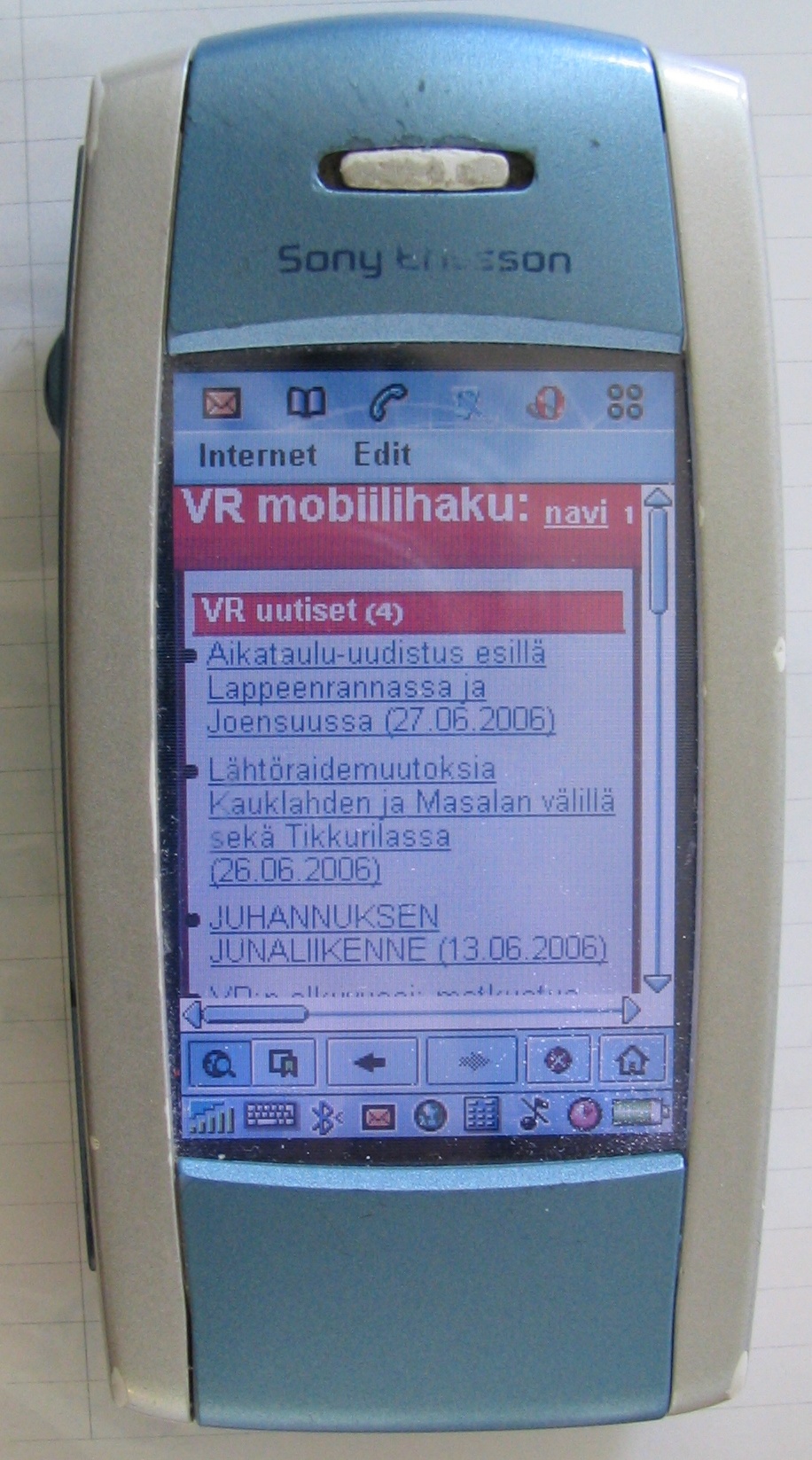
Nokia’s S60 assumed a phone with a keypad. Ericsson wanted a pen. In 1998 Ericsson Mobile Communications set up a Mobile Applications Lab in Ronneby, in southern Sweden, and in April 1999 the team became Symbian AB, a subsidiary of Symbian Ltd. It built a pen-based interface code-named Quartz, publicly announced in February 2000 and renamed UIQ in 2002.
The first UIQ phone was the Sony Ericsson P800, announced in March 2002 and shipped in the second half of that year. It ran UIQ 2.0 on Symbian OS v7.0: a 208 × 320 touchscreen in 4,096 colours, a stylus, a VGA camera, a Memory Stick Duo slot and a 156 MHz Philips processor. Its trick was a hinged number pad that covered the lower part of the screen: its mechanical keys simply pressed on the resistive touchscreen underneath, and folding it back turned the phone into a PDA with a 2.9-inch display. The Register’s hands-on in April 2002 called it “probably the most desirable little piece of technology we’ve seen for a while”. The P900 (2003) and P910 followed, and Motorola (A920, A1000), BenQ and Arima licensed UIQ as well; Nokia even sold one UIQ phone, the 6708, a rebadged BenQ for Asia-Pacific.
UIQ’s owners changed as the Symbian consortium did. Sony Ericsson bought UIQ Technology in a deal announced on 7 November 2006, and Motorola took half of it in October 2007. When Nokia bought out Symbian Ltd. in 2008 and the new Symbian Foundation chose S60 as its interface, UIQ had no role left. UIQ Technology’s board decided on 29 December 2008 to file for bankruptcy, made public on 5 January 2009, when about 200 employees were left; Sony Ericsson moved to Windows Mobile and Motorola to Android.
The Peak
Through the mid-2000s Symbian was the smartphone market. It shipped on Nokia’s entire smart lineup, on Sony Ericsson and Motorola phones running the pen-based UIQ interface, and on NTT DoCoMo phones in Japan under the MOAP(S) platform. It crossed 100 million cumulative devices in November 2006, the year its market share peaked at 73%, and 250 million by 2009. Nothing else was close: BlackBerry was an email appliance, Windows Mobile a distant niche, and Palm fading.
The success concealed two structural problems. First, the “one OS, many owners” construction meant the user interface was deliberately left to the licensees, so S60, UIQ, and MOAP applications were mutually incompatible: one kernel, three platforms, no single ecosystem. Second, the engineering culture that made EPOC fit in a 1997 organizer had hardened into developer hostility. Symbian C++ was a dialect of its own, with non-standard string types (descriptors), manual cleanup stacks instead of exceptions, and, after 2005, a mandatory code-signing regime (Symbian Signed) that made hobbyist development a bureaucratic ordeal. Developers wrote for Symbian because the users were there, not because they wanted to.
The Redefinition
The iPhone (2007) did not beat Symbian on any axis Symbian measured. It had no 3G, no MMS, no apps at launch, worse battery life, and one carrier. It redefined the axes: a capacitive touchscreen, a real web browser, and, from 2008, an application store with a checkout flow that worked. Android then delivered the same model to every other manufacturer free of charge.
Symbian’s response was a retrofit. S60 5th Edition (2008) grafted touch onto an interface designed for keypads, and reviewers of the flagship Nokia N97 (2009) documented the seams. Nokia bought out the other Symbian Ltd. shareholders in June 2008 and moved the code to the Symbian Foundation, which made the platform open source under the Eclipse Public License in February 2010, at the time one of the largest code contributions ever made to open source. It changed nothing visible to users, and Nokia took the code proprietary again in 2011 as the foundation collapsed.
Dead End
In early February 2011 Nokia CEO Stephen Elop circulated his “burning platform” memo, comparing Nokia to a man on a burning North Sea oil rig, and on February 11 announced the switch to Windows Phone, dropping Nokia’s Linux-based alternative along with it (see Dead End: Maemo and MeeGo). Symbian went from strategy to liability in one press release: share collapsed from 22% in mid-2011 toward zero as buyers and developers abandoned a platform its own vendor had condemned. The Nokia 808 PureView (2012), carrying a 41-megapixel camera years ahead of the industry, was the last Symbian phone; Nokia closed the application channel in January 2014.
The autopsy is unusually clear. Symbian’s kernel engineering was never the problem, and its market position was the strongest any mobile platform has held. It died because its governance (a committee of competing hardware vendors, none responsible for the whole product) could not produce the thing the iPhone proved mattered: one coherent experience and one ecosystem a developer could target with ordinary tools. The best distribution in the world could not sell an operating system optimized for constraints that had stopped existing. The full corporate side of the collapse is told in Nokia.
📚 Sources
- Symbian — Wikipedia
- Symbian Ltd. — Wikipedia
- Nokia CEO Stephen Elop’s “burning platform” memo, full text — Engadget (2011)
- Nokia confirms the 808 PureView was the last Symbian phone — BBC News (2013)
- UIQ — Wikipedia
- UIQ Technology — Wikipedia
- Sony Ericsson P800 — Wikipedia
- Sony Ericsson P800 — Mobile Phone Museum
- Hands on with the PDA-killer Sony P800 — The Register (26 April 2002)
- UIQ “files for bankruptcy” in Sweden — The Register (5 January 2009)
- More than 200 jobless following UIQ’s bankruptcy — The Local (8 January 2009)
- Symbian OS market data — Canalys / Gartner via Wikipedia mobile OS market share
- Image: Sony Ericsson P800 with web browser.jpg by Zache (CC BY-SA 3.0), via Wikimedia Commons