Robert Noyce and Fairchild Semiconductor
Abstract
Robert Noyce co-invented the integrated circuit, co-founded Intel, and served as the informal mayor of Silicon Valley, the man who embodied what it looked like to be both a scientist and an entrepreneur. He ran companies without executive perks, gave engineers stock options, and was at the center of every major transition in the semiconductor industry from 1957 to 1990. He died at sixty-two, ten years before Jack Kilby received the Nobel Prize for the integrated circuit. His technical contributions were matched only by his organizational ones: the management culture he created at Fairchild and Intel became the DNA of an entire industry.
The Traitorous Eight
Robert Norton Noyce was born in Burlington, Iowa on December 12, 1927, the third of four sons of a Congregationalist minister. He studied physics at Grinnell College in Iowa, where his trajectory changed because of a single faculty member. Grant Gale, Grinnell’s physics professor, had been a classmate of John Bardeen (one of the inventors of the transistor) at the University of Wisconsin, and in 1948 he obtained two of the first transistors produced at Bell Labs for teaching purposes. Noyce thus had hands-on experience with the transistor in 1948, years before most engineers outside Bell Labs had seen one. He was captivated. He completed a PhD at MIT in 1953, studying physics.
Noyce joined Shockley Semiconductor Laboratory in Mountain View, California in 1956, recruited by William Shockley, co-inventor of the transistor and winner of the 1956 Nobel Prize in Physics. Shockley had assembled, by most measures, the most talented group of semiconductor engineers in the world. And then he managed them into mutiny.
Shockley was brilliant and erratic in almost equal measure. He micromanaged technical decisions his engineers understood better than he did. He demanded lie-detector tests after a minor office incident. He pursued technical directions (particularly a four-layer diode that he was convinced would make his fortune) that his staff believed were commercial dead ends. By 1957, eight of his engineers had concluded they could not do productive work under his management.
The eight (Robert Noyce, Gordon Moore, Jean Hoerni, Julius Blank, Victor Grinich, Eugene Kleiner, Jay Last, and Sheldon Roberts) approached Arthur Rock, a New York investment banker, and through him Sherman Fairchild, heir to the Fairchild photography empire. At a meeting with the financiers in a San Francisco hotel, the eight and two investors signed ten dollar bills as a token of their agreement. Fairchild provided $1.38 million in start-up capital. Their last day at Shockley was 18 September 1957; the next day they signed the contracts for Fairchild Semiconductor, formally a division of Fairchild Camera and Instrument. After a few weeks in a garage the company moved in November into a building in Palo Alto, with a manager from the parent company in charge and Noyce as technical director until he took over.
Shockley, furious, called them the “Traitorous Eight.” The name stuck, and became, over time, a badge of honor.
The Planar Process: Manufacturing That Could Scale
At Fairchild, the technical work moved quickly. Its first product, in 1958, was the 2N697 silicon transistor. But the critical innovation came in 1959 from Jean Hoerni, the most mathematically gifted member of the group: the planar process.
Previous transistors were manufactured as “mesa” structures, the semiconductor was etched into a raised mesa shape, with the delicate junction regions exposed on the surface. The exposed junctions were vulnerable to contamination and difficult to protect in production. Yields were poor; reliability was marginal.
Hoerni’s solution was to protect the transistor’s junction with a layer of silicon dioxide grown directly on the silicon surface. Photolithography (a process borrowed from printing) could etch windows through the oxide where electrical contacts were needed. The transistor was sealed beneath an oxide layer rather than exposed to the environment. The result was a flat, protected device: the planar transistor, sold from 1960 as the 2N1613.
Noyce immediately saw further implications. If transistors were flat, multiple transistors could be made on the same flat surface simultaneously, in one manufacturing batch. And if the metal layer deposited over the oxide for contacts could be patterned by photolithography, the connections between transistors could be printed rather than wired. The fundamental barrier to mass production (hand wiring) could be eliminated.
Info
The planar process is the direct ancestor of every integrated circuit ever manufactured. Every chip produced in the 2020s (from microcontrollers to trillion-transistor AI accelerators) uses a planar process descended from Hoerni’s 1959 invention. The specific materials and lithographic wavelengths have changed; the fundamental concept of building everything on a flat surface by successive deposition and etching steps has not.
Noyce filed his integrated circuit patent on July 30, 1959, five months after Jack Kilby’s February 1959 filing. His circuit differed from Kilby’s in one crucial dimension: it used the planar process, making it manufacturable at scale. Kilby’s germanium circuit with its hand-attached gold wire bonds was a proof of concept. Noyce’s silicon planar circuit was an industrial process.
The patent dispute between Texas Instruments (Kilby) and Fairchild (Noyce) ran through the 1960s. In 1966 the two companies agreed to cross-license their patents, and in 1969 the Court of Customs and Patent Appeals upheld Noyce’s claims on the interconnections. The industry came to treat both men as independent co-inventors, which matched the facts: they had arrived at the integrated circuit independently, through different paths, within months of each other. See also: Jack Kilby and the Integrated Circuit.
Fairchild’s Dominance and Its Contradictions
In 1961 Fairchild produced its first integrated circuit, four transistors and two resistors on one chip. Through the early 1960s, Fairchild Semiconductor was the dominant company in the semiconductor industry, and by 1966 it was the second-largest US electronics component maker after Texas Instruments. The founding group had already halved: four of the eight left in 1961 to join another company, Moore and Noyce left to found Intel in 1968, and Grinich and Blank were gone by 1969. The planar process gave it manufacturing yields far superior to competitors. The military contracts that funded much of early semiconductor development flowed toward Fairchild, whose product reliability met the demanding specifications of missile guidance and avionics programs. By early 1959 Fairchild’s main revenue came from silicon transistors supplied to Autonetics for the Minuteman missile’s guidance computer.
Noyce’s management style during these years was notable for what it lacked. There were no executive parking spaces. There were no private dining rooms. The organizational chart was flat by the standards of American corporate culture in 1960. Engineers were treated as capable adults who could be trusted with information about the company’s strategic direction. This was not common practice.
What Noyce could not give his engineers at Fairchild was stock options. Sherman Fairchild and the parent company refused to hand out equity in the division, and the lack of options was one of the grievances that drove its people away. When Noyce and Moore founded Intel, they told investors from the start that the company would fund a stock option plan and a stock purchase plan for employees. Broad employee options spread from Intel and the other Fairchild spinoffs and became the standard compensation model of the technology industry.
But Fairchild Semiconductor existed as a division of Fairchild Camera and Instrument, an East Coast industrial company that viewed its semiconductor subsidiary as a business unit rather than a technology revolution. The parent company extracted profits from Fairchild Semiconductor while refusing to invest at the scale the market opportunity required. It denied Fairchild Semiconductor engineers meaningful equity in the subsidiary’s success. The result was predictable: the talent began to leave.
The founding of Intel by Noyce and Gordon Moore in 1968 was the most visible departure, but it was far from the only one. Over the decade from 1958 to 1968, Fairchild Semiconductor alumni founded dozens of companies in the Santa Clara Valley. The pattern (bright engineers leave a successful company, raise venture capital, start a new company) repeated so many times that it became the template for an industry. A map drawn in later years of the companies descended from Fairchild Semiconductor, tracing the lineage of spinoffs and their subsequent spinoffs, looks like an explosion.
Intel: A New Kind of Company
In 1968, Noyce and Gordon Moore left Fairchild. Arthur Rock, the investment banker who had funded Fairchild’s founding, raised $2.5 million in convertible debentures on the strength of a business plan of about two pages. They named the company Intel, short for Integrated Electronics, though its founders also quietly enjoyed that “intel” was slang for intelligence.
The Intel they built was different from Fairchild in one critical respect: it owned itself. There was no parent company to drain profits or override technical decisions. Noyce and Moore held equity directly. They designed the company to retain talent by giving engineers meaningful ownership stakes. They applied, deliberately, every lesson about what had gone wrong at Fairchild.
Intel’s early technical history is told in the articles on Gordon Moore and Moore’s Law, Andy Grove and Intel, and Federico Faggin and the Microprocessor. Noyce’s role in Intel’s founding years was primarily as external face and cultural anchor: he was the person who walked into a room and made investors want to fund whatever was being proposed, who testified before Congress and sounded reasonable, who embodied the idea that a semiconductor company could be simultaneously a research institution and a profitable business.
He served as Intel’s CEO until 1975, then as Chairman, ceding operational control to Gordon Moore and then Andy Grove while remaining the company’s symbolic leader.
The Mayor of Silicon Valley
From the late 1960s onward, Noyce became the central figure of what was only beginning to be called Silicon Valley, the cluster of semiconductor and computer companies in the Santa Clara Valley south of San Francisco. He was, as colleagues and journalists both described him, the “mayor” of the place: not a formal authority but the person whose opinion on any important matter carried the most weight, who mediated disputes between companies, who represented the industry to the outside world.
He was also, privately, a complex man. He flew small planes and was reckless enough to worry the people who cared about him. He had two marriages. He worked with the intensity of someone who genuinely could not stop, and he drank more than was good for him in later years. The charisma that made him so effective in public (the ability to make everyone he spoke to feel uniquely attended to) sometimes masked the ordinary human costs of that kind of sustained performance.
In 1977, Noyce co-founded the Semiconductor Industry Association to advocate for the American semiconductor industry in Washington. Trade disputes with Japan, import duties on semiconductors, export controls on technology; these were becoming matters of significant commercial consequence, and the industry needed a political voice. Noyce provided it.
In 1988, facing what had become a genuine crisis (Japanese manufacturers had achieved near-total dominance in DRAM production, the commodity product that had once been America’s semiconductor heartland), Noyce agreed to lead Sematech, a government-industry research consortium funded jointly by DARPA and fourteen semiconductor companies. The program’s goal was to restore American competitiveness in semiconductor manufacturing processes.
It worked. By the mid-1990s, American manufacturers had recovered significant market share in the advanced process technology that determined who could build the smallest, fastest chips. Sematech was one of the most successful industrial policy programs in American history, and Noyce drove it with the energy of a man who genuinely believed the fate of American technology was at stake, because he believed it was.
Death Before the Prize
Noyce died on June 3, 1990, in Austin, Texas. He suffered a heart attack at home after his morning swim and died at Seton Medical Center. He was sixty-two. The semiconductor industry mourned as if it had lost a head of state.
Ten years later, the Nobel Committee awarded half of the 2000 Prize in Physics to Jack Kilby “for his part in the invention of the integrated circuit.” The Nobel Prize is never awarded posthumously. Kilby wrote in his Nobel autobiography that if Noyce were still alive, “I have no doubt we would have shared this prize.”
The irony was not lost on observers: Noyce’s planar silicon process was the version that the entire semiconductor industry actually used. Every chip ever manufactured since 1960 descends more directly from Noyce’s patent than from Kilby’s. Yet it was Kilby who stood in Stockholm and delivered the Nobel lecture.
Dead End: Fairchild as a Corporation
Despite producing the most consequential semiconductor research of the 1960s (the planar transistor, the planar integrated circuit, the Micrologic logic family), Fairchild Semiconductor was a corporate failure.
Warning
Fairchild’s parent company, Fairchild Camera and Instrument, treated the semiconductor division as a cash cow rather than a growth engine. It refused to invest at the scale the market opportunity required. It denied engineers meaningful equity in the subsidiary’s success. It imposed an organizational structure that valued short-term production over long-term innovation. The result was a continuous exodus of talent: by the early 1970s Fairchild’s alumni had founded or co-founded dozens of companies, including Amelco, Intel, AMD, and the venture firm Kleiner Perkins. Fairchild’s own market share in silicon ICs fell from dominant in 1965 to marginal by 1975. The laboratory that invented the planar process captured almost none of the value it created. After several changes of owner, what remained of Fairchild was absorbed by ON Semiconductor in 2016.
The lesson was absorbed by every subsequent Silicon Valley company: give engineers equity, maintain autonomy from corporate parents, reinvest in research. The venture capital model that replaced corporate R&D funding was partly a direct response to Fairchild’s failure to retain its inventors. The culture Noyce helped establish (and that Fairchild’s management helped prove necessary, by violating every principle of it) became the template for the industry his invention made possible.
Noyce’s legacy and the culture he helped create are explored further in Silicon Valley: How a Place Became a Myth. The IC manufacturing revolution he helped start is told in The Integrated Circuit Revolution.
See also: Bob Widlar and Analog Integrated Circuits.
📚 Sources
- Heinz Nixdorf MuseumsForum blog, “Die Taten der Treulosen Acht” (19 September 2017) (the signed dollar bills, 18 and 19 September 1957, the Palo Alto move, the 2N697 and 2N1613, the 1961 IC, the departures, ON Semiconductor 2016)
- Robert N. Noyce: Semiconductor Device-and-Lead Structure, U.S. Patent 2,981,877, filed July 30, 1959 · patents.google.com/patent/US2981877
- Robert Noyce — Wikipedia (Gale’s transistors, death at home in Austin, marriages)
- Grant O. Gale — Wikipedia (classmate of Bardeen at Wisconsin)
- Computer History Museum, “Invention of the Planar Integrated Circuit & Other Stories from the Fairchild Notebooks” (Autonetics/Minuteman as main customer in 1959)
- Stanford Law School, “Arthur Rock’s Intel Memo” (the short business plan and employee stock plans)
- Jack S. Kilby — Biographical, NobelPrize.org (“I have no doubt we would have shared this prize”)
- Leslie Berlin: The Man Behind the Microchip: Robert Noyce and the Invention of Silicon Valley (2005), Oxford University Press · Open Library
- Michael S. Malone: The Intel Trinity: How Robert Noyce, Gordon Moore, and Andy Grove Built the World’s Most Important Company (2014), HarperBusiness · Open Library
- Christophe Lécuyer: Making Silicon Valley: Innovation and the Growth of High Tech, 1930–1970 (2006), MIT Press · Open Library
- T. R. Reid: The Chip: How Two Americans Invented the Microchip and Launched a Revolution (2001), Random House · Open Library
- Christophe Lécuyer and David C. Brock: Makers of the Microchip: A Documentary History of Fairchild Semiconductor (2010), MIT Press · Open Library
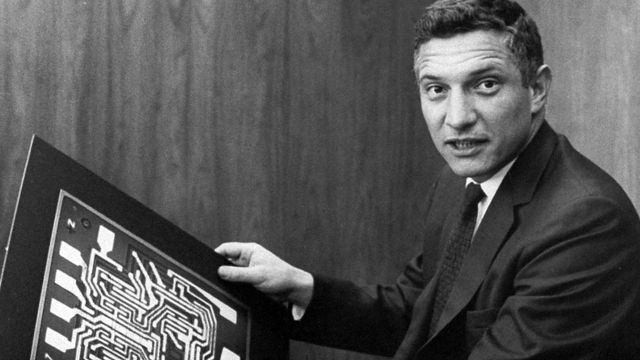
- Image: Robert Noyce with Motherboard 1959.png by Intel Free Press (CC BY-SA 2.0), via Wikimedia Commons