Norbert Wiener and Cybernetics
Abstract
Norbert Wiener was a mathematical prodigy who entered Tufts University at 11, received his Harvard PhD at 18, and spent his career at MIT developing ideas that would shape robotics, control theory, information science, and the philosophy of artificial intelligence. His 1948 book Cybernetics: Or Control and Communication in the Animal and the Machine introduced the concept of feedback loops as a universal organizing principle, applicable equally to mechanical thermostats, biological nervous systems, and social institutions. Cybernetics was also a philosophical claim: that intelligence, control, and communication shared common mathematical structure regardless of whether they occurred in silicon, neurons, or social systems. The claim was too ambitious for the science of 1948. It was also prescient in ways that became clear only decades later.
The Child Prodigy
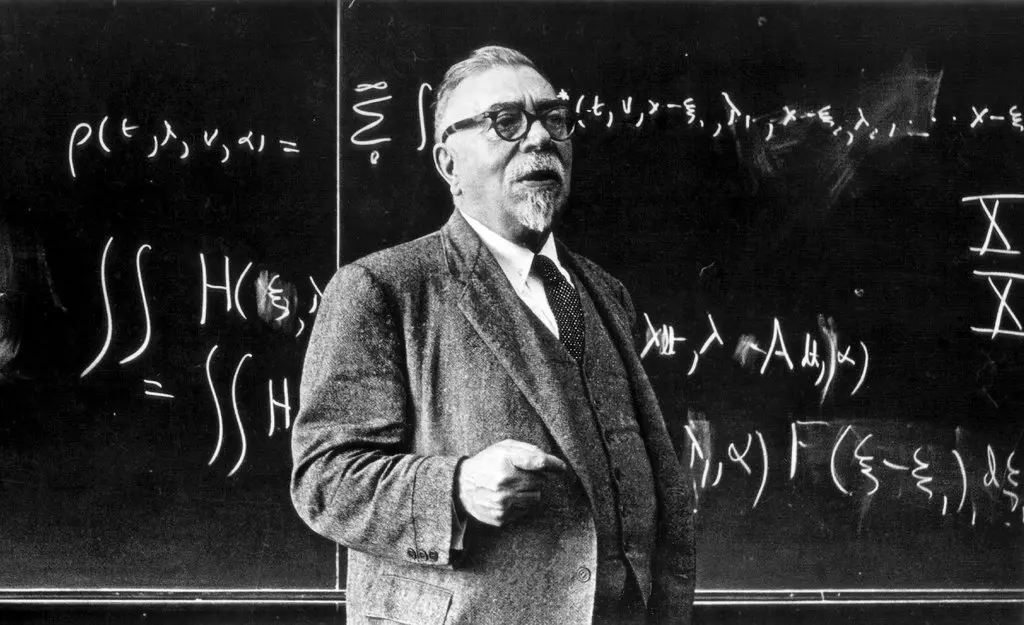
Norbert Wiener was born in Columbia, Missouri in 1894. His father, Leo Wiener, was a Harvard professor of Slavic languages who conducted an aggressive home-schooling experiment on his eldest son, forcing rigorous intellectual training from early childhood. Wiener left Ayer High School in 1906, aged 11, entered Tufts College and received his bachelor’s degree in mathematics in 1909, at 14. In his memoir Ex-Prodigy (1953) he described the training as a strain.
He then moved through graduate study in zoology at Harvard and philosophy at Cornell before returning to Harvard’s philosophy department, which awarded him a PhD in mathematical logic in June 1913, at 18, under Karl Schmidt. In 1913–14 he studied with Bertrand Russell and G. H. Hardy in Cambridge and with David Hilbert and Edmund Landau in Göttingen. By his early twenties, he had the mathematical foundations he would draw on for the rest of his career.
Wiener joined MIT’s mathematics department in 1919 and remained there until his death, on a trip to Stockholm, on March 18, 1964. His early career focused on harmonic analysis, Brownian motion, and potential theory, abstract mathematics that would later find application in signal processing and communication engineering.
The War and the Feedback Principle
World War II transformed Wiener’s research direction as it did for most American scientists. In 1940 he drafted a design for an electronic calculating machine; then he turned to gunnery. His contribution was in anti-aircraft fire control. The problem: a gunner trying to hit an aircraft must aim not where the aircraft is but where it will be when the shell arrives, perhaps a second or two in the future. The aircraft’s position must be predicted from its current trajectory. But the aircraft’s trajectory depends on the pilot’s anticipating where the gunner will aim. The gunner and the pilot are in a recursive game of prediction and counter-prediction.
Wiener’s approach was statistical: model the aircraft’s future position as a prediction problem in time series analysis, using Wiener filter theory to separate signal (predictable trajectory) from noise (random variation). The mathematical framework he developed (Wiener filtering) became fundamental to signal processing. But the work also led Wiener to a deeper question: what is the mathematical structure of purposive, goal-directed behavior?
The anti-aircraft problem was a control system: sensors track an aircraft, a predictor computes expected position, a gun is aimed and fired, and the continuing stream of tracking data corrects the prediction. This is a feedback loop, a system that uses information about its own output to adjust its behavior toward a goal. Wiener recognized that this structure was not unique to anti-aircraft systems. It described thermostats, biological reflexes, economic markets, and social institutions.
The key insight, developed with collaborators Arturo Rosenblueth (a Mexican physiologist) and Julian Bigelow (an engineer): purposive behavior is defined by feedback. A system that seeks a goal is a system that computes the difference between its current state and a target state, and uses that difference to guide future action. This is true whether the system is a servo-motor, a neuron, or a human reaching for a glass.
Rosenblueth, Wiener and Bigelow published this argument in the 1943 paper “Behavior, Purpose and Teleology” in Philosophy of Science, arguing that the concept of purpose (historically reserved for biological organisms and dismissed as unscientific when applied to machines) was a mathematically precise property that could be defined, measured, and engineered.
Cybernetics: The Book That Named a Field
The book began with a chance meeting in Paris in 1947, when the publisher Enrique Freymann asked Wiener for a short book on his ideas. Wiener wrote it in under three months, largely at Arturo Rosenblueth’s house in Mexico City, and Cybernetics: Or Control and Communication in the Animal and the Machine appeared on October 22, 1948, from one publisher in Paris and two in the United States. About half of it is demanding mathematics, yet it sold well and made Wiener a public figure; in 1956 his face was on the cover of Der Spiegel. A second edition in 1961 added chapters on learning machines, and a German translation followed only in 1962. The title introduced the term “cybernetics,” derived from the Greek kubernetes (helmsman, the one who steers), the root that also gives us “governor” and, eventually, “cyber” in all its modern forms.
The book’s central claim was that control and communication were the same phenomenon analyzed from different perspectives. A thermostat is a communication system (it reads temperature as a signal) and a control system (it acts on the temperature). A nervous system is a communication network and a control system. The mathematical theory of communication (information theory, which Shannon was developing simultaneously) was therefore also a theory of control.
Wiener proposed “cybernetics” as the name for a unified science of control and communication in both machines and animals. The book ranged across topics that would now be separated into distinct disciplines: servomechanism design, neuroscience, statistics, economics, and what we would now call artificial intelligence. The ambition was explicitly interdisciplinary: Wiener believed that the fundamental phenomena cut across disciplinary boundaries that were historical accidents.
Simultaneous with Shannon
Wiener and Claude Shannon developed complementary theories of communication in the same period, and their formulations of information entropy are mathematically similar. They knew each other and acknowledged the overlap. The difference: Shannon’s information theory focused on communication channels and encoding; Wiener’s cybernetics focused on feedback and control. Shannon’s formulation became the foundation of information theory as a discipline. Wiener’s cybernetics became the broader philosophical framework.
The Macy Conferences on Cybernetics (1946–1953), chaired by Warren McCulloch and attended by Wiener, brought together mathematicians, engineers, biologists, anthropologists, and psychologists (including John von Neumann, Margaret Mead, Gregory Bateson, and Warren McCulloch) to develop the interdisciplinary synthesis Wiener envisioned. The synthesis was never fully achieved.
Cybernetic Machines
Cybernetics was demonstrated with small machines. In 1949 Wiener had a light-seeking tricycle built at MIT, the “moth,” with two photocells, which could be made to imitate tremors of the human nervous system. In Bristol the neurologist William Grey Walter had built two robot “tortoises,” Elmer (from 1948) and Elsie, three-wheeled machines with a photocell and a two-valve circuit that steered toward light, backed away when it grew too bright, and, in Elsie’s case, returned to a hutch to recharge; the press presented them in November 1949. Walter’s Cora of 1951 learned a conditioned reflex, setting off at a whistle after ten to twenty pairings of whistle and light, and six copies of Elsie were made that year, three of them for the Festival of Britain. In Gloucester the psychiatrist Ross Ashby finished his homeostat on March 3, 1948, from four reworked RAF bomb-release units; in its first successful test on March 16 it returned by itself to equilibrium after being disturbed, a property Ashby called ultrastability. Ashby and Walter belonged to the Ratio Club, founded in 1949, whose members included Alan Turing.
Some of the ideas were older. In 1920 the Ludwigshafen inventor Fritz Lux described, in a 59-page book called Gehirn und Seele (“Brain and Soul”), a floating buoy that learned to close its inlet when a selenium cell saw a wave coming, and a relay memory that stored a 5-by-5 image.
The Social Critique: Technology and Human Control
Wiener was unusual among scientists of his generation in combining technical work with serious social philosophy. In The Human Use of Human Beings (1950), a popularized version of Cybernetics, and in God and Golem, Inc. (1964), written shortly before his death, Wiener addressed the social consequences of the automation and intelligent machines he was helping to create.
He worried that automated machines would displace workers faster than the economy could absorb them. He worried that feedback-controlled weapons would make war more automated and therefore more catastrophic. He worried that the mathematics of control, applied to social institutions, could produce systems that optimized efficiently for the wrong goals, serving the formal criteria of optimization rather than human welfare.
After World War II Wiener refused government funding and military work. In January 1947 The Atlantic Monthly printed his letter “A Scientist Rebels”, in which he refused to send one of his wartime papers to a researcher at an aircraft company working on guided missiles, and asked scientists to consider what their work would be used for.
The social critique in Wiener’s work anticipated arguments that would become mainstream in AI ethics discourse in the 2010s and 2020s: that automated systems can be precise in their optimization while being wrong about their objectives; that the people most affected by automation are rarely the people who design it; that speed and scale of automated systems can outpace human ability to understand or correct their behavior.
Influence and Aftermath
Cybernetics had immediate and lasting effects, though rarely under its own name.
Control theory (the engineering discipline concerned with the mathematical design of feedback control systems) absorbed Wiener’s filtering and prediction mathematics. Its most common device, the PID (Proportional-Integral-Derivative) controller, is older: Nicolas Minorsky analysed it for ship steering in 1922.
Systems biology and computational neuroscience grew partly from the cybernetic program of understanding biological systems through feedback and information. McCulloch and Pitts’s 1943 paper on neural networks, which modeled neurons as logical gates, came from the same circle five years before Wiener’s book; McCulloch later chaired the Macy conferences (see McCulloch and Pitts).
Artificial intelligence absorbed the cybernetic vocabulary of purposive behavior and goal-directed systems, though the first-generation AI community (McCarthy, Minsky, Simon, Newell) was skeptical of Wiener’s emphasis on analog and feedback-based approaches, preferring symbolic and rule-based computation. The tension between cybernetic (connectionist, statistical, feedback) and symbolic (logic-based, rule-based) approaches to AI ran through the field’s history until the deep learning era vindicated the connectionist approach.
In West Germany cybernetics became a cultural movement. From 1960 the journal Grundlagenstudien aus Kybernetik und Geisteswissenschaft, edited by Helmar Frank with Max Bense among its editors, printed mathematical aesthetics, cybernetic pedagogy, articles on Karl Steinbuch’s Lernmatrix, Theo Lutz’s account of his computer-generated poems (in the first issue) and, in 1964, computer graphics by Georg Nees. The philosopher Gotthard Günther argued for machine consciousness on the basis of many-valued logic, in articles for American science-fiction magazines and in Das Bewusstsein der Maschinen (1957). In London the exhibition Cybernetic Serendipity, curated by Jasia Reichardt at the Institute of Contemporary Arts, drew 60,000 visitors between August 2 and October 20, 1968 (see Computer Art and Generative Art).
The word “cybernetics” itself largely disappeared from mainstream technical discourse by the 1970s, absorbed into more specialized fields. It survived in “cyberspace” (coined by William Gibson in his short story “Burning Chrome,” 1982, and popularized in his novel Neuromancer, 1984), “cyberattack,” “cybersecurity,” and the prefix “cyber-” that now attaches to almost any digital phenomenon.
📚 Sources
- Heinz Nixdorf MuseumsForum blog, “Happy birthday, Kybernetik” (22 October 2018)
- Heinz Nixdorf MuseumsForum blog, “Vor siebzig Jahren: Die mobilen Roboter kommen” (26 November 2019)
- Heinz Nixdorf MuseumsForum blog, “Ein Gehirn im Kleinen” (15 March 2019)
- Heinz Nixdorf MuseumsForum blog, “Fritz Lux – Visionär der Kybernetik” (28 July 2020)
- Heinz Nixdorf MuseumsForum blog, “Keiner weiß, was Kybernetik ist” (26 January 2016)
- Heinz Nixdorf MuseumsForum blog, “Denk, Maschine !” (10 July 2015)
- Heinz Nixdorf MuseumsForum blog, “Kybernetik und Ästhetik” (31 July 2018)
- Wiener, Norbert: Cybernetics: Or Control and Communication in the Animal and the Machine (1948), MIT Press
- Wiener, Norbert: The Human Use of Human Beings: Cybernetics and Society (1950), Houghton Mifflin
- Wikipedia: Norbert Wiener
- Science Friday: “The ‘Rebellious Scientist’ Who Inspired Kurt Vonnegut” (Wiener’s “A Scientist Rebels”, The Atlantic Monthly, January 1947)
- Wikipedia: Proportional–integral–derivative controller (Minorsky 1922)
- Conway, Flo and Jim Siegelman: Dark Hero of the Information Age: In Search of Norbert Wiener (2005), Basic Books
- Rosenblueth, A., Wiener, N., and Bigelow, J.: “Behavior, Purpose and Teleology” — Philosophy of Science, Vol. 10, No. 1, 1943
- Galison, Peter: “The Ontology of the Enemy: Norbert Wiener and the Cybernetic Vision” — Critical Inquiry, 1994