ENIAC and the First Electronic Computers
Abstract
On February 15, 1946, the Moore School of Electrical Engineering at the University of Pennsylvania formally dedicated a machine that filled an entire room, weighed thirty tons, and consumed as much electricity as a small neighborhood. The ENIAC (Electronic Numerical Integrator and Computer) was the world’s first general-purpose electronic computer, capable of performing five thousand additions per second at a time when a skilled human with a mechanical calculator could manage a few dozen per minute. It was the product of a wartime contract, two engineers, and six women mathematicians whose programming work would be forgotten for fifty years. It was also the machine that ignited a patent dispute whose resolution would, three decades later, strip the entire American computing industry of its founding intellectual property.
The Problem That Built the Machine
The immediate origin of ENIAC was not scientific curiosity but artillery.
By 1942, the Ballistic Research Laboratory (BRL) at the Aberdeen Proving Ground in Maryland faced a problem of overwhelming scale. Every new artillery piece (every new shell type, every new elevation range, every new atmospheric condition) required a ballistic firing table: a precalculated grid of trajectories telling gunners where to aim under each possible combination of variables. A single firing table required roughly 3,000 trajectory calculations. Each trajectory took a trained human mathematician (they were called “computers,” a job title) about twenty hours to compute by hand or with an electromechanical desk calculator. The BRL employed hundreds of such human computers and was still falling behind.
Herman Goldstine, an Army lieutenant with a mathematics PhD, was the BRL’s liaison to the University of Pennsylvania. In the spring of 1943, he encountered John Mauchly, a physicist who had been arguing for years that vacuum tubes could do arithmetic electronically, at speeds no mechanical device could approach. Mauchly and his collaborator J. Presper Eckert, a twenty-four-year-old graduate student with exceptional engineering instincts, had been sketching a design. Goldstine recognized immediately what it could do for the BRL’s backlog.
On June 5, 1943, the Army signed a contract with the Moore School for $61,700 (the final cost came to about $487,000) to build what the contract called an Electronic Numerical Integrator and Computer. Mauchly would provide the conceptual framework and application theory; Eckert would build it. They had two years.
The Machine: Anatomy of a Giant
The machine that emerged between 1943 and 1945 was unlike anything previously constructed.
ENIAC occupied 1,800 square feet of floor space, roughly the footprint of a large two-bedroom apartment. It stood eight feet tall and extended nearly a hundred feet in its horseshoe configuration. It weighed 30 tons. Its components included:
- 17,468 vacuum tubes (the fundamental switching elements, prone to failure)
- 7,200 crystal diodes
- 1,500 relays
- 70,000 resistors and 10,000 capacitors
- Approximately 5 million soldered joints
  ENIAC — Physical Layout (simplified):

  ┌──────────────────────────────────────────────────────────┐
  │  Cycling unit │ Master programmer │ Printer               │
  ├───────────────┴────────────────────┴──────────────────────┤
  │                                                            │
  │  [Accumulator 1] [Accumulator 2] ... [Accumulator 20]     │
  │  (each: a 10-digit decimal register with its own adder)   │
  │                                                            │
  │  [Multiplier]  [Divider/Sq.Root]  [Function Tables ×3]    │
  │  [Constant Transmitter]  [Input/Output units]             │
  │                                                            │
  └────────────────────────────────────────────────────────────┘
  Roughly 5 million hand-soldered joints in all
  Programs stored as physical cable configurations + switch settings
ENIAC operated in decimal (not binary), using ten-state ring counters to represent digits, the electronic counterpart of the digit wheels in a mechanical adding machine. It had 20 accumulators, each capable of storing and operating on a ten-digit number. A multiplier unit used a built-in multiplication table to form partial products, one digit of the multiplier at a time. Three function table units allowed read-only lookup tables to be hand-set on rotary switches, a crude but effective substitute for stored data.
Its operating speed was startling: 5,000 additions per second, 357 multiplications per second, 38 divisions per second. A ballistic trajectory that took twenty human-hours now took thirty seconds. The machine was, by a factor of roughly 1,000, the fastest calculator on earth.
Power consumption was substantial (roughly 150 kilowatts) and the heat generated by 17,468 vacuum tubes required industrial-scale cooling. Tube failures were the operational nightmare of the early years. At those tube counts, statistical failure rates meant one tube burned out roughly every two days. Eckert’s engineering discipline kept the failure rate lower than expected through careful de-rating (running tubes at well below their rated voltages) but the machines still spent significant time in maintenance.
ENIAC was finished late in 1945, after Japan’s surrender. Its first full production problem, run in December 1945 while the machine was still secret, was not a firing table at all but a classified feasibility calculation for the Los Alamos hydrogen-bomb program. The machine was announced to the press on the evening of February 14, 1946, and formally dedicated at the University of Pennsylvania the next day, February 15, 1946, the date now commemorated annually as World Computer Day. Time described about fifty of the country’s leading scientists finishing a dinner of lobster bisque and filet mignon in the university’s Houston Hall and marching three blocks to the Moore School for the demonstration.
The Six Programmers Nobody Photographed
Among the most consequential (and most obscured) facts about ENIAC is who programmed it.
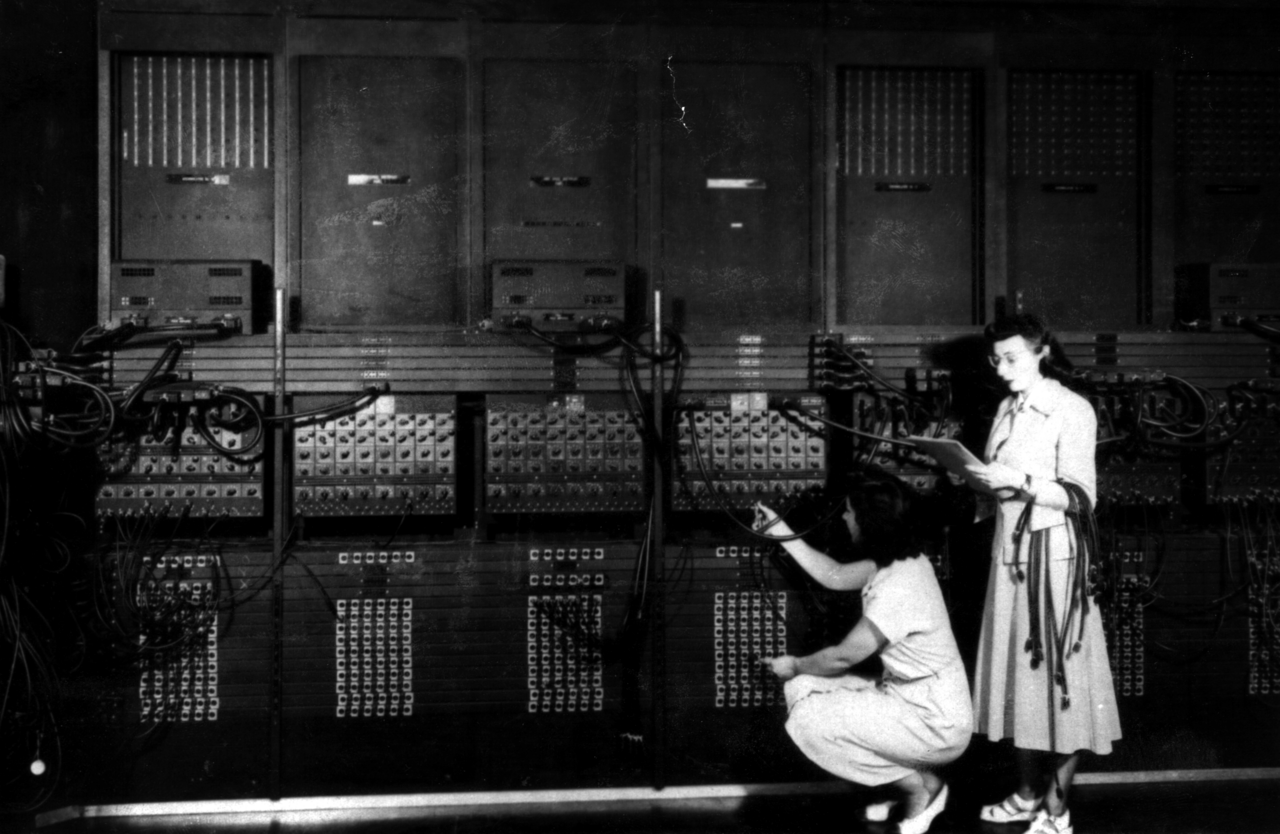
Programming ENIAC was not a matter of writing code. There was no code, no stored program, no software in any modern sense. Programming meant physically configuring the machine: routing cables between its function units, setting thousands of switches on its panels, and establishing the sequence of data flows that would carry a computation from input to output. To program a new problem, operators first had to understand the problem mathematically, decompose it into operations ENIAC could perform, and then translate that decomposition into a physical cable-and-switch configuration. Getting it right was equivalent to building a custom circuit for each application.
The Army assembled a team of six women mathematicians for this task:
- Kay McNulty (later Mauchly Antonelli), hired from a team of human computers at the Moore School
- Frances Bilas (later Spence), a mathematics graduate from Chestnut Hill College
- Jean Jennings (later Bartik), the only mathematics graduate of her class at Northwest Missouri State Teachers College
- Betty Snyder (later Holberton), whose mathematics professor on her first day at Penn had asked whether she would not be better off at home raising children
- Marlyn Wescoff (later Meltzer), hired by the Moore School as a human computer
- Ruth Lichterman (later Teitelbaum), a mathematics graduate from Hunter College
There was no programming manual. They learned ENIAC from its wiring and block diagrams, working out what each panel did.
Forgotten at the Press Conference
At the February 1946 public unveiling, the six women were present. They were not introduced. The press photographs show men in suits standing beside the machine’s panels; the women who had configured those panels for the demonstration were not identified in contemporary coverage. None of them was invited to the dedication dinner that evening. Their names did not appear in popular histories of computing for decades. Betty Holberton went on to co-design the COBOL and FORTRAN programming standards. Jean Jennings Bartik led the team that converted ENIAC to a stored-program machine in 1948. They received formal recognition (the Women in Technology International Hall of Fame) only in 1997.
For the public demonstration, the team programmed ENIAC to compute ballistic trajectories in real time, faster, it was noted for the press, than the shell itself was traveling. The calculation that had defined the project took thirty seconds. The press called ENIAC a “Giant Brain.” The team that had told the brain what to think was not mentioned.
Mauchly, Atanasoff, and the Question of Invention
The origin of ENIAC’s key electronic concepts was contested from the beginning.
Myth: ENIAC was the first electronic computer
ENIAC (1945) is routinely called “the first computer,” but the title is contested on every front. The Atanasoff-Berry Computer was operating electronically, in binary, by 1942; Britain’s Colossus (1943–44) was electronic and ran on real codebreaking work two years before ENIAC was unveiled; and Konrad Zuse’s Z3 (1941) was a working program-controlled computer, albeit electromechanical. In 1973 a U.S. federal court (Honeywell v. Sperry Rand) even voided the ENIAC patent, finding it derived from Atanasoff’s prior work. ENIAC’s genuine claim is narrower and still significant: the first general-purpose, programmable, fully electronic computer to enter sustained operation. See Myths and Misconceptions.
John Vincent Atanasoff was a physics professor at Iowa State College who, from 1937 to 1942, built with his graduate student Clifford Berry a device they called the Atanasoff-Berry Computer (ABC). The ABC was not a general-purpose machine (it was designed specifically to solve systems of simultaneous linear equations) but it incorporated several ideas that were genuinely novel: it operated electronically (vacuum tubes), computed in binary, used capacitor-based regenerative memory to store intermediate results, and separated computation from memory.
The ABC was tested successfully in 1942, but its method of storing intermediate results on paper sheets made about one error in 100,000 calculations, and the fault was never fixed. Iowa State did not patent it. When the United States entered the war, Atanasoff was transferred to other work. The machine was dismantled in 1948, when the university turned the basement into classrooms.
In June 1941, John Mauchly visited Atanasoff at Iowa State and spent several days examining the ABC and discussing its principles. Mauchly later said he found the ABC unimpressive and that his own ideas about electronic computation predated the visit. Atanasoff said Mauchly had extensively studied the machine and the documentation Atanasoff had prepared.
Eckert and Mauchly’s patent application for ENIAC was filed in 1947. It was assigned to the Sperry Rand Corporation after Remington Rand acquired their company. By the late 1960s, Sperry Rand was demanding licensing fees from every computer manufacturer in the United States on the basis of the ENIAC patent, effectively taxing the entire industry.
Honeywell, rather than pay, sued. The case (Honeywell Inc. v. Sperry Rand Corp.) was decided in 1973 by U.S. District Judge Earl Larson after 135 days of trial and examination of thousands of documents and depositions. Judge Larson found that Mauchly had derived fundamental concepts from Atanasoff’s work and that the ENIAC patent was invalid.
The Patent That Died
The ruling in Honeywell v. Sperry Rand (1973) did not resolve who invented the electronic computer. It resolved a legal question: whether the ENIAC patent was valid. Judge Larson found it was not, partly because Mauchly’s 1941 visit to Atanasoff constituted prior art disclosure, and partly on other technical grounds including prior public use. The practical effect was that electronic computing became unpatented: no single entity held intellectual property over the basic concepts. This was probably good for the industry. The engineering community, meanwhile, continues to debate Atanasoff’s place in the hierarchy of invention. The ABC was not general-purpose, not programmable, and never fully reliable. ENIAC was all three. The ideas Atanasoff developed (binary arithmetic, electronic switching, regenerative memory) were real contributions, but the leap from the ABC to ENIAC was not incremental.
The Transition: From Wiring to Stored Programs
By 1947, ENIAC was operational at Aberdeen Proving Ground, computing firing tables as originally intended. But the machine’s future was already being redefined.
John von Neumann had entered the picture in 1944 through Herman Goldstine, who had encountered von Neumann on a train platform and recognized him. Von Neumann was drawn into the ENIAC project as a consultant, quickly grasping both its capabilities and its limitations. The central limitation was the one that had defined it from the start: the program was in the wires, not in the memory. Changing programs took days of physical reconfiguration.
Von Neumann’s insight (that programs could be stored as data in the same memory that held numbers) was not wholly his own. Eckert and Mauchly had been thinking along similar lines. But it was von Neumann who wrote it up formally, in the June 1945 “First Draft of a Report on the EDVAC”, a document that circulated widely under his name alone and became the founding specification of stored-program computing. The credit dispute this created is examined in detail in The Von Neumann Architecture.
What is less often noted is that ENIAC itself was eventually converted. In 1948, Jean Jennings Bartik (one of the original six programmers) led the team that modified ENIAC to operate as a stored-program machine. The conversion involved permanently rewiring a portion of the function tables to serve as a primitive read-only memory for instructions. ENIAC ran its first stored-program calculation in April 1948, a Monte Carlo simulation of nuclear chain reactions for the Los Alamos laboratory. It was not a clean solution (the machine now ran about six times slower and lost its ability to compute in parallel), but reprogramming took hours instead of days, and the change extended ENIAC’s operational life.
UNIVAC: The Commercial Leap
While ENIAC continued operating at Aberdeen, Eckert and Mauchly had already moved on.
In March 1946 they left the Moore School (in part over a dispute with the university about who owned patents on inventions developed under government contract) and set up a partnership, the Electronic Control Company, in Philadelphia; it was incorporated as the Eckert-Mauchly Computer Corporation (EMCC) on 22 December 1947 (see UNIVAC and the Eckert-Mauchly Computer Corporation). Their goal was the UNIVAC: Universal Automatic Computer, a stored-program machine designed from the start for commercial data processing rather than ballistic calculation.
UNIVAC incorporated all the architectural lessons of ENIAC and EDVAC:
- Stored-program operation (programs and data in the same mercury delay-line memory)
- Decimal data held as six-bit characters, twelve characters to a word
- Magnetic tape for mass storage, replacing the punch cards of ENIAC
- A design explicitly intended for business and statistical applications, not just scientific computation
Funding was a chronic problem. The company sold delivery contracts before it had the capacity to build; the Census Bureau, through the National Bureau of Standards, commissioned a study in 1946 and ordered the machine in June 1948. The machine was late. Eckert and Mauchly, brilliant engineers but not businessmen, ran out of money. In 1950, Remington Rand acquired EMCC.
The first UNIVAC I was accepted by the U.S. Census Bureau on 30 March 1951, the first commercial electronic computer delivered to a non-military customer in the United States. Forty-six UNIVACs were ultimately built and sold, at prices between $1 million and $1.5 million each. In November 1952, a UNIVAC connected to a CBS television broadcast correctly predicted Dwight Eisenhower’s landslide presidential victory from early returns, a prediction the network initially suppressed because it seemed implausibly large. The broadcast made UNIVAC a household word.
Dead End: The Wire-Program Machine
ENIAC itself was a magnificent dead end.
Its decimal arithmetic, its physically wired programs, its room-scale engineering, all of it was superseded within a decade. No subsequent computer adopted ENIAC’s architecture. The decimal ring counter approach to arithmetic was abandoned for binary representations that mapped cleanly to transistor states. The function-table programming model was abandoned for stored programs that could be loaded in seconds and modified without touching hardware. The vacuum tube was abandoned for the transistor.
What ENIAC demonstrated was not an architecture but a possibility: that electronic switching devices could compute, reliably and fast, and that the resulting machines were practically useful. This was not obvious in 1943. Skeptics argued that 17,000 vacuum tubes would fail so frequently that the machine would spend more time in repair than in operation. Eckert’s de-rating strategy proved them wrong. ENIAC ran for nine years (from 1945 to 1955) a productive operational life for a first-generation machine.
The Erasure of the Women
ENIAC’s most significant dead end was not technical but historical: the near-total erasure of the six women who programmed it. For decades, popular histories described the women in photographs as “refrigerator ladies”, models hired to pose beside the machine for promotional photographs. They were not models. They were the people who made the machine compute. Betty Holberton went on to design the Sort-Merge Generator, one of the first software tools, and helped draft the COBOL and FORTRAN standards. Kay McNulty became John Mauchly’s wife and continued working on computing for decades. Jean Jennings Bartik led the stored-program conversion. Their systematic exclusion from computing history was itself a kind of technological failure: it deprived subsequent generations of role models and misrepresented what the field required and who could do it.
ENIAC was decommissioned on October 2, 1955, after running its last calculation at the Aberdeen Proving Ground. Parts of it are preserved at the Smithsonian Institution and the University of Pennsylvania. It ran for 80,223 hours of operation. In that time it solved ballistic trajectories, modeled nuclear weapons, ran weather simulations, and answered the essential question that justified its construction: yes, it is possible to build a machine that computes faster than any human can.
Everything that followed was built on that answer.
How Europe Learned of ENIAC
The February 1946 announcement made headlines in the American press, but for the world’s scientists the decisive messenger was the British mathematician Douglas Rayner Hartree. Hartree, a numerical-analysis pioneer who had built a differential analyzer at Manchester before the war, traveled to Philadelphia in 1946, worked with ENIAC firsthand, and published a two-part report in Nature that year, a short notice, “The ENIAC, an electronic calculating machine” (April 1946), followed by a detailed account, “The ENIAC, an electronic computing machine” (October 1946). For most European researchers, Hartree’s articles were the first credible technical description of electronic computing, and they helped ignite the wave of stored-program projects in Britain and on the continent, including Maurice Wilkes’s EDSAC.
The German-speaking world took note quickly as well. The first German-language report seems to have been a short item in the New York émigré paper Aufbau in March 1946; on 2 April 1946 the American-run Wiener Kurier in Vienna explained the machine at length, and on 24 October 1946 the Bern newspaper Der Bund printed a page-long account of electronic calculating machines with the familiar photograph of Eckert and Mauchly. In 1947, the ballistics expert Heinrich Pösch (then working at the French computing institute SEA) described “Eine automatische Rechenmaschine mittels Röhren” (an automatic calculating machine using tubes) in the Zeitschrift für angewandte Mathematik und Mechanik. By 1950, Der Spiegel was describing ENIAC-style machines as working in ways that were “frighteningly human”, an early specimen of the “electronic brain” anxiety that would follow computing for decades. In East Germany, the Dresden computer pioneer Nikolaus Joachim Lehmann drew the opposite engineering lesson: rather than imitate such enormous, fragile cabinets of tubes, he argued for small, robust machines and began developing his compact D1, an early step on the path toward desktop-scale computing.
Eckert himself later distilled the strangest fact about his machine: what surprised him most, he said, was that nothing like ENIAC had existed earlier, although all the necessary components had been available ten to fifteen years before.
The Computer World After ENIAC
The field met in conferences before it had departments. The first, organised by the US National Research Council at MIT on 30 and 31 October 1945, drew 84 participants; after viewing the Rockefeller Differential Analyzer they heard John Brainerd and Presper Eckert on the nearly finished ENIAC and Howard Aiken’s group, Grace Hopper among them, on the Harvard Mark I. Harvard’s second symposium on large-scale digital calculating machinery, 13 to 16 September 1949, drew more than 700 people (23 of them women) to hear about the Mark III, Whirlwind and the SWAC. By then the public had its first books on the subject, Edmund Berkeley’s Giant Brains, or Machines That Think and Douglas Hartree’s Calculating Instruments and Machines, both of 1949.
The census of machines grew quickly. Eckert and Mauchly handed their UNIVAC to the Census Bureau on 30 March 1951; the National Bureau of Standards had been running SEAC in Washington and SWAC in Los Angeles since 1950; EDVAC had stood at Aberdeen since 1949; and von Neumann’s IAS machine in Princeton, running from 1951 and dedicated in June 1952, inspired nineteen copies around the world. When nearly 900 specialists met in Philadelphia from 10 to 12 December 1951, ten American systems and the Manchester computer were on the programme. West Germany caught up through conferences of its own: the RWTH Aachen colloquium of July 1952, the first German computer conference, where the young Heinz Nixdorf listened to Konrad Zuse and Ludwig Biermann of Göttingen, whose G1 had just started; and Alwin Walther’s conference at the Technical University of Darmstadt from 25 to 29 October 1955, with 530 participants from eleven countries, including Aiken, Herman Goldstine and, for the first time in the West, the Dresden pioneer N. J. Lehmann. In 1958 the Zuse KG delivered its first Z22 to the Technical University of Berlin, two years earlier, in 1956, the German Research Foundation had set aside DM 20 million to put German-built computers into universities.
World Computer Day: Remembering the Giant
The dedication date of February 15 lives on as World Computer Day (also celebrated as ENIAC Day), and the machine’s round birthdays have become computing-history events in their own right.
The first World Computer Day under that name was organised by the computer-history charity The Compuseum on 15 February 2021, the 75th anniversary; Bill Mauchly, son of John Mauchly and the ENIAC programmer Kathleen McNulty, linked the museums that hold ENIAC hardware in a virtual reconstruction. The 2022 edition was devoted to the MOS 6502 microprocessor, which Chuck Peddle had first sold at a San Francisco trade show on 16 September 1975 for $25. Since 1996 the Heinz Nixdorf MuseumsForum in Paderborn has marked out the floor area of ENIAC’s main room and shows three original elements on loan from the Smithsonian alongside a working simulator of two ENIAC accumulators, which won the Computer Conservation Society’s Tony Sale Award in 2016.
For the 50th anniversary in 1996, students at the University of Pennsylvania re-implemented the entire 30-ton machine as “ENIAC-on-a-Chip”, a single 7.44 mm × 5.29 mm CMOS die with 174,569 transistors reproducing ENIAC’s architecture. Vice President Al Gore, then riding his “Information Superhighway” fame, attended the Penn celebration and hailed ENIAC as an ancestor of the Internet age.
The 80th anniversary in 2026 was marked by an ENIAC Day celebration at the American Helicopter Museum in West Chester, Pennsylvania (near the machine’s birthplace) with children of Eckert and Mauchly and daughters of the original programmers among the speakers, while the computer-history charity The Compuseum called on users worldwide to switch off their computers for one minute at 14:15 local time in ENIAC’s honor. Perhaps the most fitting tribute stands in a school gymnasium in Gilbert, Arizona, where 80 neurodivergent students of the PS Academy built a full-scale (non-functional) replica of the room-filling giant, every one of them carrying a phone in their pocket with computational power beyond anything ENIAC’s builders could have imagined.
📚 Sources
- Heinz Nixdorf MuseumsForum blog, “Von ENIAC zu UNIVAC” (19 December 2017)
- Heinz Nixdorf MuseumsForum blog, “70 Jahre UNIVAC” (29 March 2021)
- Heinz Nixdorf MuseumsForum blog, “Der Tag des ENIAC” (11 February 2016)
- Heinz Nixdorf MuseumsForum blog, “ENIAC auf Deutsch” (13 February 2026)
- Heinz Nixdorf MuseumsForum blog, “Computerszene 1945” (30 October 2015)
- Heinz Nixdorf MuseumsForum blog, “Computerszene 1949” (13 September 2019)
- Heinz Nixdorf MuseumsForum blog, “Gigantische Gehirne, kalkulierende Instrumente” (25 June 2019)
- Heinz Nixdorf MuseumsForum blog, “Computerszene 1951” (10 July 2026)
- Heinz Nixdorf MuseumsForum blog, “Computerszene 1952” (21 July 2017)
- Heinz Nixdorf MuseumsForum blog, “Computerszene 1955” (23 October 2020)
- Heinz Nixdorf MuseumsForum blog, “Computerszene 1958” (2 March 2018)
- Heinz Nixdorf MuseumsForum blog, “Geburtstagsfest für ENIAC” (15 February 2021)
- Heinz Nixdorf MuseumsForum blog, “15. Februar – Festtag für Computer” (15 February 2022)
- Heinz Nixdorf MuseumsForum blog, “Computer auf einem Chip” (10 December 2019)
- Eckert, J. Presper & Mauchly, John W.: “Automatic High-Speed Computing: A Progress Report on the ENIAC” — Moore School of Electrical Engineering (1945), reprinted in Annals of the History of Computing
- Goldstine, Herman H.: The Computer from Pascal to von Neumann (1972), Princeton University Press
- McCartney, Scott: ENIAC: The Triumphs and Tragedies of the World’s First Computer (1999), Walker & Company
- Fritz, W. Barkley: “The Women of ENIAC” — IEEE Annals of the History of Computing, Vol. 18, No. 3 (1996)
- Bartik, Jean Jennings: Pioneer Programmer: Jean Jennings Bartik and the Computer that Changed the World (2013), Truman State University Press
- Honeywell Inc. v. Sperry Rand Corp., 180 F.Supp. 1251 (D. Minn. 1973) — Judge Larson’s ruling invalidating the ENIAC patent
- Mollenhoff, Clark R.: Atanasoff: Forgotten Father of the Computer (1988), Iowa State University Press
- Ceruzzi, Paul E.: A History of Modern Computing (2nd ed., 2003), MIT Press — chapters 1–2 on ENIAC and first-generation machines
- Honeywell, Inc. v. Sperry Rand Corp. — Wikipedia, the 1973 ruling crediting Atanasoff and the “first computer” dispute
- Hartree, D. R.: “The ENIAC, an Electronic Calculating Machine” — Nature 157 (April 20, 1946)
- Hartree, D. R.: “The ENIAC, an Electronic Computing Machine” — Nature 158 (October 1946)
- Borchers, Detlef: “World Computer Day: 80 Jahre ENIAC” — heise online (February 15, 2026), anniversary events, European reception, Pösch, Lehmann, PS Academy replica
- ENIAC-on-a-Chip — University of Pennsylvania, Moore School (1996)