Herman Hollerith and the Punched Card
Abstract
Herman Hollerith solved a bureaucratic emergency (the 1880 US Census had taken eight years to tabulate and the 1890 census threatened to take twelve) by inventing an electromechanical system that read data encoded in holes punched in cards. A first rough population count of the 1890 census was announced after six weeks, and the full tabulation took about six years, against eight for 1880. Hollerith’s invention created the data processing industry, his company became IBM, and the 80-column punched card he standardized remained the dominant medium for data input and storage for eighty years.
The Census Problem
The United States Constitution requires a population census every ten years to apportion seats in the House of Representatives. As the population grew and as the government collected more data per person (occupation, birthplace, language, family structure) the tabulation burden grew faster than the population.
The 1880 census was tabulated by hand, by clerks working through stacks of paper, and it took until 1888 to complete, eight years, two years before the next census was due. At the observed rate of growth, the 1890 census was projected to take longer than ten years, meaning the results would be obsolete before they were published.
The Census Bureau held a competitive test in 1889, using population data from four St. Louis districts, to choose a tabulation system. Herman Hollerith’s electromechanical punched-card system captured the data in about 72 hours; the two rival hand methods (Charles Pidgin’s colored-“chip” system and William Hunt’s “slip” system) took roughly 111 and 144 hours. Hollerith’s machines were even more dramatically faster at the tabulating stage, and he won the contract.
Hollerith’s Background
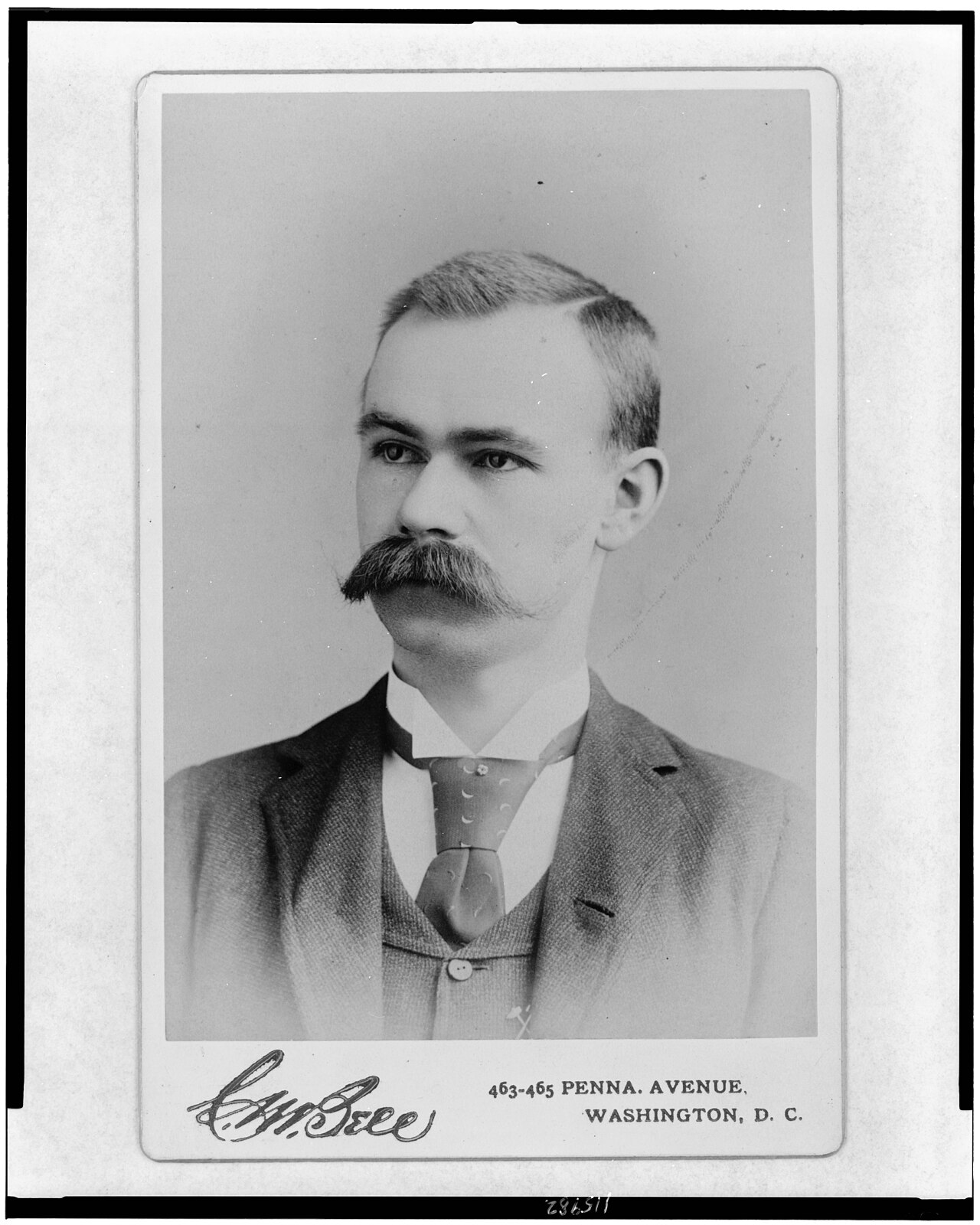
Herman Hollerith was born on February 29, 1860, in Buffalo, New York, to German immigrant parents; his father Johann Georg had been a grammar-school teacher in Speyer in the Palatinate, and about half of Buffalo’s 80,000 inhabitants then had German or Alsatian roots. He graduated from the Columbia School of Mines in 1879 and took a position at the Census Bureau, where he worked on the 1880 census and witnessed firsthand the tabulation problem. His mentor, John Shaw Billings, reportedly suggested over dinner that there ought to be a machine for doing the work.
Hollerith left the Census Bureau to teach at MIT for a year in 1882 and then work at the Patent Office in 1883, setting up on his own from 1884, during which time he developed his tabulating system. The core components:
The punched card: Data was encoded by punching holes at specific positions in a paper card. Each card represented one census record (one person). Different positions in the card encoded different data items (age, sex, occupation, birthplace. The card was not Hollerith’s invention) Jacquard looms had used punched cards since 1804 to control weaving patterns, and Babbage had proposed them for his Analytical Engine, but Hollerith’s systematic application of the concept to data rather than process control was original.
The sensing mechanism: Cards were placed one at a time in a reader that pressed the card against a grid of mercury-filled cups. Spring-loaded pins descended onto the card; where a hole existed, the pin passed through into the mercury and completed an electrical circuit. Each completed circuit actuated a mechanical counter.
The tabulating machine: Counters recorded totals as cards were processed. Multiple runs through the deck with different tabulation schemes could produce cross-tabulations, how many married women of each age worked in manufacturing, for example.
The census was taken from 2 June 1890. A rough count of the population, 62,947,714, was announced after six weeks (it was compiled from the enumerators’ family counts, not from the punched cards). The detailed tabulation ran on Hollerith’s machines and took about six years in all, two fewer than the 1880 census; the final population figure was 62,979,766.
Myth: The 1890 census was tabulated in six weeks
The six weeks belong to the rough count, which did not use the punched cards. The full tabulation took about six years; the machines saved roughly two years over 1880, not eight. See Myths and Misconceptions.
The Tabulating Machine Company
Hollerith recognized that the census was a demonstration, not a market. He founded the Tabulating Machine Company in Washington on 3 December 1896 to commercialize his patents. Early customers included the New York Central Railroad, several life insurance companies, and foreign governments (Austria-Hungary used Hollerith-type machines for its census of 31 December 1890, followed in the 1890s by Canada, Italy and Russia, which ran its 1897 census on them).
The business model was rental rather than sale: Hollerith leased the machines and sold the punched cards, creating recurring revenue from the consumable. This model (hardware leased, supplies sold) established a pattern that IBM would maintain for decades.
Hollerith had a difficult personality that created commercial problems. He was contentious with customers, resistant to feedback, and slow to improve his equipment. When the Census Bureau negotiated for the 1910 census, it found Hollerith’s prices and attitude unsatisfactory and developed competing equipment in-house. Its workshop, set up in 1907, employed James Powers, an Odessa-born engineer who had emigrated in 1889; he designed an electric keyboard punch and a sorter, used for the 1910 census, and in 1911 founded the Powers Tabulating Machine Company, whose printing tabulators read cards mechanically. Powers left in 1918; his firm went bankrupt in 1920 and was bought by Remington Rand in 1927, while its British and French offshoots merged into Powers-Samas. Hollerith sold the Tabulating Machine Company in 1911 to financier Charles Ranlett Flint, who merged it with three other companies to form the Computing-Tabulating-Recording Company (CTR).
In 1914, Flint hired Thomas J. Watson Sr. to run CTR. Watson renamed the company International Business Machines (IBM) in 1924 and built it into the dominant computing company of the twentieth century. Hollerith stayed on as a consulting engineer under a ten-year contract, with less and less influence once Watson arrived, and retired in 1921 to a farm in Maryland.
The 80-Column Card
The card Hollerith used for the 1890 census had 12 rows and 24 columns. Its size later settled at 3¼ by 7⅜ inches, the size of US paper currency between 1862 and 1923; the reuse of existing currency boxes is often given as the reason.
IBM standardized the 80-column card in 1928, a format that fit more data by shrinking the hole size and increasing column count. The 80-column card became the universal data input medium for the mid-twentieth century. Every program submitted to a mainframe computer, every batch processing job, every data file entered into early computing systems passed through punched cards.
The legacy of the 80-column card outlasted the cards themselves: the 80-character line length standard in text terminals (and still the default in many code style guides today) derives from the 80-column Hollerith card. When terminal displays defaulted to 80 characters, they were following IBM’s card format of 1928.
Info
The phrase “do not fold, spindle, or mutilate” (printed on Hollerith cards sent to individuals for self-reporting) became a rallying cry in the 1960s student free speech movement at Berkeley and elsewhere. Students wore the instruction ironically on buttons, representing their resistance to being processed as IBM cards by institutions. The specific phrase was adopted from the student experience of returning course registration cards that bore this instruction.
The Wiring Board and Programmable Data Processing
The plugboard began in Vienna. The Austrian census of 1890 was tabulated in 1891–92 with 200 punches and twelve counting machines built by the Württemberg-born mechanic Otto Schäffler, which processed 24 million cards; Emperor Franz Joseph inspected them in May 1891. On 20 September 1895 Schäffler received a secret Austrian privilege for “innovations to statistical counting machines” that replaced the fixed internal wiring with flexible cables and switchable templates, so that one evaluation could be ended and another begun by re-plugging, arguably the first practical programming of a data-processing machine. Hollerith’s own tabulator with a plugboard followed in 1906; Heinz Zemanek rescued Schäffler from obscurity with an article in 1970.
Hollerith machines were not programmable in the modern sense, but they were configurable through plugboards (also called control panels or wiring boards): panels of sockets connected by physical cables that determined how the machine processed data. To change the tabulation scheme, an operator rewired the plugboard.
This mechanical “programming” (physical connections specifying data flow) was the dominant paradigm for data processing until stored-program computers displaced batch tabulating in the 1960s. IBM’s accounting machines, sorters, and tabulators all used plugboards. The transition from plugboard configuration to stored programs is one of the underappreciated discontinuities in computing history.
Legacy
Hollerith died on November 17, 1929, wealthy from his sale of the Tabulating Machine Company but largely invisible in the public narrative of computing. IBM did not prominently acknowledge its Hollerith origins.
His direct technical legacy:
- The punched card as data medium (dominant through the 1970s)
- The 80-column standard (its shadow visible in text formatting conventions today)
- The machine rental model (IBM’s business model for fifty years)
- The creation of a data processing industry separate from scientific computing, the commercial infrastructure that made IBM’s dominance possible
Computing history focuses disproportionately on scientific firsts, first stored-program computer, first transistor machine, first programming language. Hollerith’s contribution was administrative: he made computation useful for business at a time when computation was synonymous with astronomical tables and ballistics calculations. The administrative-commercial use of computing, which generates most of the economic value that computing produces, traces its lineage to a punched card reader built for a census in 1890.
📚 Sources
- Heinz Nixdorf MuseumsForum blog, “Mit der Volkszählung fing es an” (2 June 2015)
- Heinz Nixdorf MuseumsForum blog, “Herman Hollerith – der Vater der Datenverarbeitung” (29 February 2016)
- Heinz Nixdorf MuseumsForum blog, “IBM und der Rest der Welt” (2 December 2016)
- Heinz Nixdorf MuseumsForum blog, “James Powers und seine Lochkarten” (3 March 2023)
- Heinz Nixdorf MuseumsForum blog, “Die Geburt der Programmierung” (18 September 2020)
- Wikipedia: Herman Hollerith
- Geoffrey Austrian: Herman Hollerith: Forgotten Giant of Information Processing (1982) — Columbia University Press
- Wikipedia: 1890 United States census (rough count after six weeks, not from punched cards; six years in all; final total)
- MacTutor: Herman Hollerith (consulting contract after 1911, retirement 1921)
- Census Bureau History: The 1890 Census and Hollerith
- IBM History: The Punched Card
- Wikipedia: Punched card