Gordon Moore and Moore's Law
Abstract
In April 1965, Gordon Moore (then director of R&D at Fairchild Semiconductor) wrote a four-page article for Electronics magazine observing that the number of transistors per integrated circuit had doubled every year since 1959 and predicting that this trend would continue. The article was an engineering forecast, not a law of physics. But it became something stranger and more powerful: a self-fulfilling prophecy that organized the entire global semiconductor industry around a predictable cadence of improvement, held for fifty years, and enabled the most sustained technological advance in history. By the time Moore died in 2023, the transistor he had helped put on silicon had gone from costing a dollar to less than a millionth of a cent.
A Chemist Among Engineers
Gordon Earle Moore was born in San Francisco on January 3, 1929, and grew up in Pescadero, a small coastal town south of the city where his father was a deputy sheriff. He studied chemistry (a bachelor’s degree from UC Berkeley in 1950, a PhD from Caltech in 1954) and did postdoctoral work at Johns Hopkins before a chance encounter redirected his career.
William Shockley, the co-inventor of the transistor and the most exciting figure in applied physics in the mid-1950s, was recruiting for a new company in Mountain View, California. He offered Moore a position in 1956. Moore accepted, believing (correctly) that semiconductor physics was where the most interesting problems in applied science were about to appear. He joined what became known as the Traitorous Eight: the group of engineers who left Shockley Semiconductor in 1957 to found Fairchild Semiconductor, driven out by Shockley’s erratic management style and his fixation on technical directions the group considered dead ends.
At Fairchild, Moore’s role was different from Robert Noyce’s. Where Noyce was the entrepreneur, the salesman, the cultural force who made investors want to write checks, Moore was the scientist. He worked on transistor physics and process chemistry, understanding what the materials and manufacturing steps would actually allow. He became director of R&D, the person responsible for translating technical possibilities into production realities. He was quiet, methodical, and deeply knowledgeable about every aspect of the semiconductor manufacturing process from substrate to finished device.
The quality of Moore’s mind was not the mercurial brilliance of some inventors but the relentless precision of a chemist: he wanted to know the actual mechanisms, the actual numbers, the actual limits. This quality made him a superb research director and a careful strategic thinker. It also made his 1965 observation possible, because he was the sort of person who plotted data points and looked at the trends.
The 1965 Article
In early 1965, Electronics magazine commissioned Moore to write a piece for its thirty-fifth anniversary issue predicting the future of semiconductor technology. The assignment was straightforward: what would integrated circuits look like in ten years?
Moore pulled the data on transistor counts in the most complex ICs manufactured each year from 1959 to 1964. The first circuits had one component. Then two. Then four. Then eight. The numbers had doubled, approximately, each year. Moore plotted them on a graph, extended the line to 1975, and read off the prediction: a single chip with 65,000 components would be economical to manufacture by then.
His original article was cautious, as he later acknowledged. He was predicting continuation of a trend, not explaining why the trend would continue. He wrote:
“The complexity for minimum component costs has increased at a rate of roughly a factor of two per year… Certainly over the short term this rate can be expected to continue, if not to increase. Over the longer term, the rate of increase is a bit more uncertain, although there is no reason to believe it will not remain nearly constant for at least 10 years.”
In 1975, Moore revised his prediction. New data showed the doubling period had stretched, not one year but two. He updated his estimate at the IEEE International Electron Devices Meeting, revising the doubling time to approximately every two years. This revised form (transistor density doubles approximately every two years) became the canonical statement of Moore’s Law.
The article itself was four pages in a trade magazine. It contained no formal derivation, no mathematical model, no theoretical explanation for why the trend would continue. It was an observation and an extrapolation. The power it acquired came not from its rigor but from its accuracy, and, crucially, from what happened after it was noticed.
Info
The doubling period associated with “Moore’s Law” has been quoted variously as one year (Moore’s original 1965 estimate), two years (Moore’s 1975 revision), and eighteen months (a misquotation often attributed to Moore that conflates transistor density with chip performance). The eighteen-month figure was popularized by Intel executives and journalist accounts and reflects roughly the cadence at which Intel introduced new processor generations in the 1980s and 1990s, not Moore’s actual statements.
The Law Becomes a Roadmap
The most important thing about Moore’s Law was not that it described the past. It was that the industry decided to use it to plan the future.
In the late 1970s and early 1980s, the Semiconductor Industry Association began publishing what it called the National Technology Roadmap for Semiconductors, and later, after it became international, the International Technology Roadmap for Semiconductors (ITRS). The roadmap specified what process capabilities the industry needed to achieve in each year to stay on Moore’s Law trajectory: what the minimum feature size should be, what the wafer diameter should be, what the lithography resolution needed to achieve. Equipment suppliers (the companies that made the lithography machines, the ion implanters, the chemical deposition reactors) were told in advance exactly what their tools needed to accomplish.
The effect was a coordination mechanism of unprecedented scope. Chip designers knew, years in advance, what transistor budgets they would have available when their products shipped. Equipment companies knew what specifications they needed to hit. Materials suppliers knew what purity levels would be required. The entire supply chain (from raw silicon through finished computer) could develop in parallel rather than sequentially. No single company orchestrated this coordination; it emerged from shared commitment to the roadmap.
This was what transformed Moore’s observation into a self-fulfilling prophecy. Companies that fell behind the roadmap lost business. Companies that met it prospered. The entire ecosystem had an incentive to make the doubling happen, and so the doubling happened, for fifty years.
Myth: Moore’s Law is a law of physics.
It is neither a natural law nor inevitable physics. Moore’s 1965 Electronics article was an economic and engineering observation about transistor cost and density, a forecast, not a result derived from physical first principles. What kept it true for fifty years was the industry organizing itself around it: the semiconductor roadmap (SIA, later ITRS) turned the prediction into a coordinated target everyone had a commercial incentive to hit, a self-fulfilling prophecy. Physics is what is now ending it, as feature sizes approach atomic scale and Dennard scaling has already broken down. See Myths and Misconceptions.
Intel: The Third Employee Becomes CEO
In 1968, Moore left Fairchild with Robert Noyce to co-found Intel. He served as Executive Vice President until 1975, when he became President and CEO; in 1979 he became Chairman and CEO (with Andy Grove as President), and he remained CEO until 1987.
Intel’s early success was built on memory chips: the 1103 DRAM (1970), which became the world’s best-selling semiconductor device within two years and displaced magnetic core memory in mainframes. Intel had proved that semiconductor memory could be mass-produced reliably and economically. Moore’s process chemistry background was essential to this: understanding and controlling the manufacturing process well enough to achieve acceptable yields on complex chips required exactly the kind of systematic materials knowledge he brought.
The strategic crisis of Moore’s tenure as CEO was the Japanese DRAM assault of the early 1980s. Japanese manufacturers (NEC, Fujitsu, Hitachi, Toshiba) had invested heavily in semiconductor manufacturing with government coordination and favorable financing. Their DRAM yields were higher than Intel’s. Their prices were lower. Their quality was better. By 1984, Intel was losing money on every DRAM it sold.
Moore and Andy Grove (then Intel’s President) made the decision together to exit DRAM entirely and stake Intel’s future on microprocessors. The decision required writing down hundreds of millions in inventory and capital equipment, laying off a significant portion of the workforce, and betting that the IBM PC market would grow fast enough to sustain an Intel dependent entirely on microprocessors. Moore authorized the bet. It paid out beyond any reasonable expectation.
The Intel Memory Crisis: A Failed Experiment
Before the DRAM exit, Intel attempted one intermediate strategy worth examining as a cautionary case: the Intel 2164A and its descendants, which Intel tried to manufacture at cost-competitive yields through improved process control and yield enhancement programs. Moore personally oversaw several of these programs, applying the systematic process engineering mindset he had developed at Fairchild.
The programs demonstrated that Intel could close some of the quality gap with Japanese manufacturers, but could not close it entirely while simultaneously investing in the microprocessor architecture that would define the company’s future. Resources were finite. Moore and Grove concluded that trying to compete in two different capital-intensive businesses simultaneously would result in failing at both. The memory business was sacrificed to win the microprocessor war.
Gordon and Betty Moore Foundation
Moore stepped down as Intel’s CEO in 1987 and as Chairman in 1997. He had become, by then, one of the wealthiest people in the technology industry, his Intel equity had compounded enormously as the company’s market value grew from its venture capital origins to hundreds of billions of dollars.
In 2000, Moore and his wife Betty established the Gordon and Betty Moore Foundation with an initial contribution of $5 billion in Intel stock. The foundation focused on scientific research, environmental conservation, and improving healthcare. The GBMF became one of the largest philanthropic funders of fundamental science in the United States, supporting work in astronomy, oceanography, and conservation biology that lacked the commercial applications needed to attract corporate funding.
Moore was characteristically modest about both the foundation’s goals and his own legacy. He described his investment philosophy as backing high-risk scientific work that governments and corporations would not fund, exactly the kind of long-term, speculative research that had produced the transistor and the integrated circuit in the first place.
The Law Approaches Its Limits
By the 2000s, it was becoming clear that Moore’s Law was entering a new phase. The specific limit that appeared first was not transistor size but power density: as transistors shrank, each individual transistor used less power, but the growing number of transistors per chip meant total power consumption stayed roughly constant, until around 2004, when leakage current in very small transistors caused power consumption to rise faster than could be managed. Clock speeds stopped increasing. The era of easy single-core performance scaling ended.
The industry’s response was multi-core processors: instead of making one processor faster, put two processors on the same chip, then four, then sixteen, then hundreds. This shifted the performance improvement from something that software obtained automatically (programs ran faster on faster chips) to something that required explicit software engineering. Parallelism was not automatic. Many programs did not benefit from it.
Moore himself began tempering his prediction publicly by the mid-2000s. In 2016, he acknowledged that Moore’s Law would end within a decade. The specific predictions he offered were characteristically precise: progress in lithography had slowed, the cost of each new generation of chip manufacturing equipment was rising faster than the performance gains justified, and physical limits on transistor operation were approaching.
The end came gradually rather than suddenly. By the 2020s, each new “process node” delivered smaller improvements at sharply higher cost. The transistor density numbers continued to grow, but the improvements in performance per watt that had driven the industry for fifty years were diminishing. The question of what comes after Moore’s Law (whether it is new materials, new device physics, new architectures, or simply slower progress) remained, at Moore’s death, open.
Moore died on March 24, 2023, at his home in Hawaii, at the age of ninety-four. Months later, in June 2023, Apple announced the M2 Ultra chip with 134 billion transistors. The trend he had identified fifty-eight years earlier in a four-page trade magazine article had carried transistor counts seven orders of magnitude beyond where he started.
Dead End: The End of Dennard Scaling
Moore’s Law described transistor density. A companion observation, Dennard scaling (Robert Dennard, IBM, 1974), predicted that as transistors shrank, their power consumption would scale proportionally, so a denser chip would consume the same total power as a sparser one, allowing clock speeds to increase without increasing power dissipation.
Warning
Dennard scaling broke down around 2004. Transistors shrank but their leakage current (the power lost when transistors are nominally switched off) did not scale proportionally with transistor dimensions. As transistors reached below 90nm, leakage dominated the power budget. The result was that clock frequencies, which had doubled roughly every eighteen months through the 1990s, stopped increasing after 2004. Chips became thermally constrained: running them faster generated heat faster than it could be removed. The transition from single-core performance scaling to multi-core designs was not a planned advance in processor architecture; it was a retreat to a different optimization axis forced by the physical failure of an approach that had worked for thirty years. Software written for single-threaded performance did not automatically become faster on multi-core processors, creating a decade of programming model challenges that Moore’s Law had previously made unnecessary.
The full arc of Moore’s Law and its industrial consequences is covered in The Integrated Circuit Revolution and The Semiconductor Race. Intel’s strategic history under Moore and Grove is explored in Andy Grove and Intel.
📚 Sources
- Gordon E. Moore: “Cramming More Components onto Integrated Circuits” · Electronics, Vol. 38, No. 8 (April 19, 1965) · newsroom.intel.com/wp-content/uploads/sites/11/2018/05/moores-law-electronics.pdf
- Gordon E. Moore: “Progress in Digital Integrated Electronics” · IEEE IEDM Technical Digest (1975), reprinted in IEEE SSCS Newsletter (2006) · doi.org/10.1109/N-SSC.2006.4804410
- Arnold Thackray, David C. Brock, and Rachel Jones: Moore’s Law: The Life of Gordon Moore, Silicon Valley’s Quiet Revolutionary (2015), Basic Books · Open Library
- Michael S. Malone: The Intel Trinity (2014), HarperBusiness · Open Library
- Robert H. Dennard et al.: “Design of Ion-Implanted MOSFETs with Very Small Physical Dimensions” · IEEE Journal of Solid-State Circuits, Vol. 9, No. 5 (1974) · doi.org/10.1109/JSSC.1974.1050511
- Mark Bohr: “A 30 Year Retrospective on Dennard’s MOSFET Scaling Paper” · IEEE Solid-State Circuits Newsletter, Vol. 12, No. 1 (2007) · doi.org/10.1109/N-SSC.2007.4785534
- Interview with Gordon Moore, 1995 August 18 — Silicon Genesis, Stanford University Libraries · transcript; Shockley Labs, founding Fairchild, the R&D years, Moore’s Law, and Intel
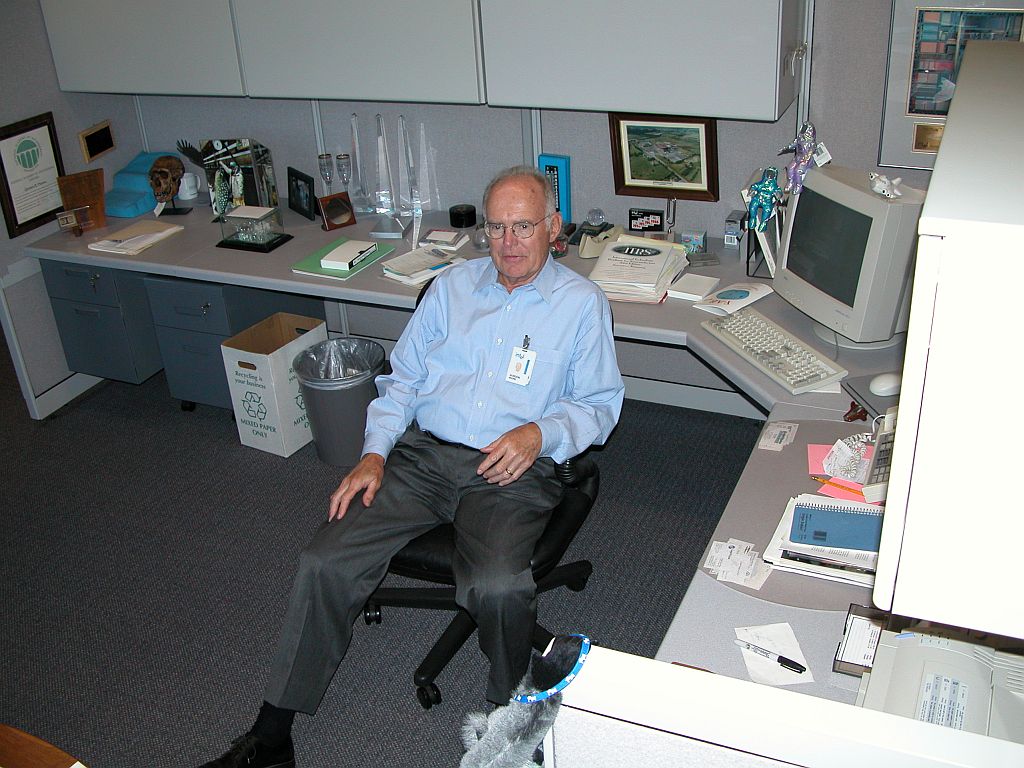
- Image: Former Intel CEO Gordon Moore in his cubicle.jpg by Intel Free Press (CC BY-SA 2.0), via Wikimedia Commons