J.C.R. Licklider and the Intergalactic Network
Abstract
J.C.R. Licklider never built a computer, never wrote an operating system, never designed a network protocol. What he did was more consequential: he wrote two papers that described the future of computing before the field knew it had a future, and then spent two years as director of ARPA’s computing office funding the people who would build it. The grants he authorized between 1962 and 1964 (to MIT, Carnegie Mellon, Stanford, UCLA, and Berkeley) seeded every major AI and interactive computing research program of the following generation. The ARPANET, the internet, the graphical user interface, time-sharing, modern AI research: all trace their institutional lineage to decisions made by a psychologist with a government budget and an unusual ability to see what computers could become.
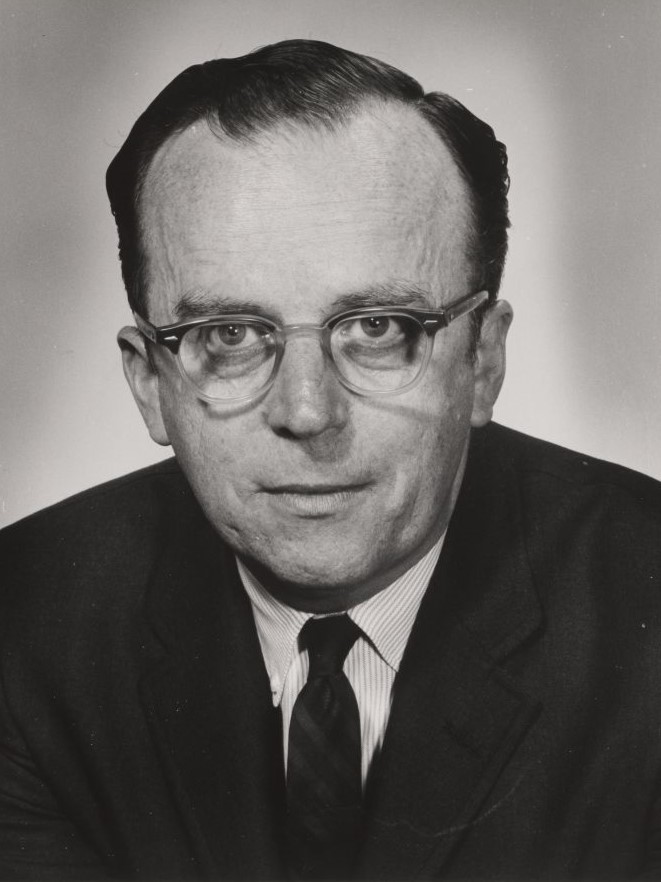
The Psychologist Who Thought About Computers
Joseph Carl Robnett Licklider was born in 1915 in St. Louis, Missouri. He was trained as a psychologist, specifically as a psychoacoustician, a researcher who studied how humans perceive sound. He completed his PhD at the University of Rochester in 1942 and spent the following decade at Harvard and then MIT’s Research Laboratory of Electronics, studying human hearing, speech intelligibility, and the psychophysics of sound.
His transition to computing was gradual and then total. At MIT in the late 1940s and 1950s, he encountered the Whirlwind computer project and the emerging community of researchers who were thinking about human-machine interaction. Licklider noticed something that was not obvious to his colleagues: the computers of the era were being used almost entirely as calculators, machines that ran batch jobs on punched cards and returned results hours later. Nobody was sitting at a terminal, interacting with a computer in real time.
Licklider found this backward. His training in human perception had given him a precise understanding of how human cognition worked, what humans were good at, what they were bad at, what required attention and what could be automated. Computers were extraordinarily fast at arithmetic but incapable of intuition. Humans were slow at arithmetic but capable of recognizing patterns, asking unexpected questions, and redirecting effort based on intermediate results. These were complementary capabilities, not competing ones. The obvious thing to do was combine them.
He spent several years thinking about how this combination might work in practice, and in 1960 he published the result.
Man-Computer Symbiosis (1960)
The paper that made Licklider’s reputation was published in the IRE Transactions on Human Factors in Electronics in March 1960, a journal nobody outside a specialist community read. Its title was “Man-Computer Symbiosis.” Its argument was radical and, once understood, obviously correct.
Licklider began with an analogy: the fig tree and the fig wasp. The tree provides the wasp with food and shelter; the wasp pollinates the tree. Neither could reproduce without the other. The relationship is mutualistic and so tightly coupled that the organisms have effectively co-evolved. Licklider proposed that humans and computers would develop a similar relationship, not a master-servant dynamic in which the computer merely executed human instructions, but a genuine collaboration in which each partner contributed what it did best.
The paper’s specific predictions were extraordinary given the state of computing in 1960:
- Interactive terminals: Humans and computers would communicate in real time, with the human directing the computation and the computer responding instantly.
- Time-sharing: A single computer would serve many users simultaneously, allocating processor time in slices so each user experienced the machine as responsive.
- Graphical displays: Computers would present information visually, not just as printed numbers.
- Natural language interaction: Eventually, humans would communicate with computers in something closer to ordinary language.
- Shared memory: A system in which both humans and computers could access and contribute to a common store of information.
In 1960, no interactive computing system existed. All computation was batch: you prepared a deck of punched cards, submitted it to an operator, and returned hours later for your printout. Licklider was describing a world that would not exist for another decade, in some cases two.
The paper’s influence was not immediate, its journal audience was small, and the ideas it described required hardware that didn’t yet exist. But it circulated in photocopies through the research community, and the people who read it tended to remember it. When the hardware arrived that made interactive computing possible, Licklider’s framework was waiting.
The Symbiosis Metaphor
Licklider’s choice of “symbiosis” rather than “tool use” or “automation” was deliberate and important. A tool is passive (it amplifies human capability but does nothing on its own. A symbiotic partner is active) it contributes capabilities the human lacks and changes the nature of the work rather than merely accelerating it. This framing predicted the trajectory of computing more accurately than the dominant view of computers as fast calculators. The symbiosis metaphor runs through every subsequent vision of human-computer interaction: Engelbart’s augmentation, Kay’s Dynabook, the graphical interface, and ultimately the AI assistant systems of the 2020s all derive from the premise that computers and humans work together rather than independently.
ARPA and the Funding of a Field
In 1962, Licklider left MIT to become the first director of the Information Processing Techniques Office (IPTO) at the Advanced Research Projects Agency (ARPA) in Washington. ARPA had been created in 1958 in response to Sputnik, funded to ensure that the US would not again be surprised by technological developments from abroad. Its mandate was deliberately broad: fund research at the frontier of possibility, without requiring near-term applications.
Licklider ran IPTO for two years. The funding decisions he made in that period constitute perhaps the highest-leverage two years in the history of computing.
His approach was unusual. Rather than funding specific projects with defined deliverables (the conventional model for government research grants) Licklider funded people and institutions. He identified researchers whose vision aligned with his own, gave them large grants with minimal constraints, and trusted them to make productive decisions. The model resembled, in some ways, a venture capital portfolio: most grants would produce modest results, but the few that succeeded would change the field.
The grants he authorized between 1962 and 1964:
Project MAC at MIT, the first large-scale time-sharing system, run by Robert Fano and Fernando Corbató. Project MAC demonstrated that dozens of users could share a single computer simultaneously, each experiencing it as responsive. Corbató had already developed CTSS (Compatible Time-Sharing System); MAC extended and institutionalized it. The project also hosted Marvin Minsky’s AI group, funding early work on artificial intelligence in an environment where AI and interactive computing researchers shared coffee, offices, and ideas.
Carnegie Mellon University: Allen Newell and Herbert Simon’s artificial intelligence research, including the Logic Theorist and General Problem Solver, the programs that had launched the AI field at the 1956 Dartmouth Conference. Licklider recognized that their work on cognition and problem-solving was central to understanding human-computer interaction.
Stanford University: John McCarthy’s AI project, which would become the Stanford AI Laboratory (SAIL), and which produced LISP and the foundational frameworks of symbolic AI.
UCLA and Berkeley, networking and interactive computing research that would eventually produce key contributors to ARPANET.
The common thread was interactive computing: systems in which humans and computers worked together in real time. Licklider’s grants created a community, researchers who knew each other, whose graduate students moved between institutions, whose ideas cross-pollinated. He also created physical infrastructure: the funded institutions acquired computers powerful enough to run time-sharing systems, terminals that researchers could use interactively, and communications connections between them.
The Intergalactic Computer Network (1963)
In April 1963, Licklider sent a memo to his colleagues at ARPA that he addressed, with characteristic humor, to “Members and Affiliates of the Intergalactic Computer Network.”
The memo described a problem: the ARPA-funded research community was using a variety of different computer systems (IBM machines, DEC machines, machines built by university groups) that could not communicate with each other. A researcher at MIT who wanted to use a program developed at UCLA had no way to access it remotely. Each institution’s computing was isolated.
Licklider proposed a solution: connect the computers. Allow programs and data at one site to be accessed from another. Establish common protocols so that different machines could exchange information. The network he envisioned would link the research computers funded by ARPA and allow researchers to share resources, programs, and results across institutions.
The memo was not a technical specification: Licklider had no engineering plan for how such a network would be built. It was a statement of the problem and a direction for its solution. But the vision it articulated was precise: a network of computers, accessible to researchers at any connected institution, sharing resources through common protocols.
Licklider left ARPA in 1964. His successors (Ivan Sutherland, then Bob Taylor) continued to develop his vision. Taylor, with Larry Roberts, eventually funded the construction of ARPANET in 1969: the first operational network connecting research computers across multiple institutions, using packet switching to route messages between nodes. ARPANET became the foundation of the internet.
The “Intergalactic Computer Network” memo was written six years before ARPANET went online. Its author had moved on by the time the network was built. But the problem it defined and the solution it indicated shaped every subsequent decision.
Computing’s Johnny Appleseed
Licklider’s contemporary and collaborator Robert Taylor described him as “computing’s Johnny Appleseed”, a man who wandered the intellectual landscape planting seeds that others harvested. The metaphor is accurate but incomplete: Appleseed planted seeds; Licklider planted seeds and then provided the water. His ARPA grants funded not just individual researchers but entire institutional ecosystems, laboratories with equipment, graduate students, and the time to pursue long-horizon research. The MIT, CMU, Stanford, and UCLA AI and interactive computing programs that his grants created trained the researchers who built the computing industry of the 1970s through 2000s. The second-order effects of his two years at ARPA extend across essentially the entire history of modern computing.
Libraries of the Future (1965)
After ARPA, Licklider returned to MIT, where he continued to think about the long-term future of computing. In 1965 he published Libraries of the Future, a book-length study commissioned by the Council on Library Resources.
The book described what Licklider called “procognitive systems”, systems that would not merely store and retrieve documents but would actively assist human cognition. He envisioned:
- Documents stored as structured information rather than printed text, accessible by content rather than by location
- Systems that could answer questions, not just retrieve documents
- Links between related concepts across documents, what Ted Nelson would independently call “hypertext” and what the World Wide Web would eventually implement
- Active assistance in the cognitive process of research, not passive provision of raw material
The book was, in some ways, more ambitious than “Man-Computer Symbiosis.” It described not just a new mode of human-computer interaction but a fundamental transformation in how humans would access and use recorded knowledge. The digital library, the search engine, and the AI research assistant are all partial realizations of what Licklider sketched in 1965.
Second Act at ARPA (1974–1975)
Licklider returned to ARPA for a second stint as IPTO director in 1974–1975. By then, ARPANET was operational and the research community he had funded in 1962–1964 had produced time-sharing, interactive computing, and the foundations of AI. His second tenure was less transformative than the first, partly because the institutional landscape was more established, partly because ARPA was operating under different political constraints in the post-Vietnam era.
He returned to MIT after his second ARPA stint and remained active in research until his death in 1990. He was awarded the Franklin Institute’s Certificate of Merit in 1990, months before his death from complications of asthma. He had never won the Turing Award, which his contributions would have justified several times over.
Dead End: The Gap Between Vision and Institution
Licklider’s clearest failure was the gap between what he envisioned and what the institutions he funded actually built.
His vision was genuinely symbiotic: computers and humans collaborating as equal partners, with the computer’s strengths compensating for human limitations and vice versa. The institutions he funded (the MIT AI Lab, the Stanford AI Lab, the CMU AI program) pursued a different vision: autonomous artificial intelligence, systems that would eventually think without human assistance. The goal was not symbiosis but replacement.
Licklider had predicted this divergence in “Man-Computer Symbiosis” itself, writing that the symbiotic phase would last until computers became capable of formulating problems as well as solving them, at which point the nature of the relationship would change fundamentally. He estimated this would take fifteen years from 1960. The estimate was optimistic about the speed of progress; the question it identified remains open in the 2020s, as large language models begin to challenge the assumption that problem formulation is uniquely human.
The interactive computing vision (real-time human-computer collaboration) was realized by a different lineage: Doug Engelbart’s NLS, Alan Kay’s Smalltalk, the Xerox PARC work, the Apple Macintosh. These systems were influenced by Licklider’s writings but developed outside the AI research programs he had funded. The tension between the symbiotic vision and the autonomous AI vision (between augmenting human intelligence and replacing it) has not been resolved.
📚 Sources
- Licklider, J.C.R.: “Man-Computer Symbiosis” — IRE Transactions on Human Factors in Electronics, HFE-1(1): 4–11 (March 1960)
- Licklider, J.C.R.: “Memorandum for Members and Affiliates of the Intergalactic Computer Network” (April 23, 1963)
- Licklider, J.C.R.: Libraries of the Future (1965), MIT Press
- Waldrop, M. Mitchell: The Dream Machine: J.C.R. Licklider and the Revolution That Made Computing Personal (2001), Viking
- Hafner, Katie & Lyon, Matthew: Where Wizards Stay Up Late: The Origins of the Internet (1996), Simon & Schuster
- Norberg, Arthur L. & O’Neill, Judy E.: Transforming Computer Technology: Information Processing for the Pentagon, 1962–1986 (1996), Johns Hopkins University Press