The Console Wars: How Hardware Battles Shaped Gaming
Abstract
For four decades, the video game console industry was shaped by a series of contests that were simultaneously technical races, marketing wars, and cultural battles over who got to define what a video game was. From Atari’s dominance and collapse, to Nintendo’s rescue of the industry, to Sony’s transformation of gaming into a mainstream entertainment medium, each generation of hardware produced a new winner and new losers, and each transition established precedents about platform exclusivity, licensing, and the relationship between hardware and software that still govern the industry. The console wars were not merely commercial competition; they were arguments about what games could be.
The Atari 2600 and the Age of the Cartridge
Before the Atari 2600, home video games were dedicated devices: a single game built into the hardware, bought once, played until boredom, and then replaced by purchasing an entirely different machine. The Atari 2600 (originally the Atari Video Computer System, released September 1977) broke this model with a simple innovation: interchangeable cartridges. The hardware was general-purpose; the software was separate. The same machine that played Space Invaders could play Pitfall!, Adventure, and Asteroids.
The 2600’s architecture was crude by any standard. Its MOS Technology 6507 processor ran at 1.19 MHz; its display was generated line by line in real time by the program, because there was no frame buffer, programmers had to synchronize their code with the electron beam of the television set, a technique called racing the beam. The constraints demanded extraordinary programming ingenuity and, paradoxically, produced some of the most creative software ever written for any platform.
By 1982 the Atari 2600 had sold around 10 million units in the US, and would reach roughly 30 million over its lifetime (production ended in 1992). Atari was a subsidiary of Warner Communications, generating hundreds of millions in revenue annually. The video game market seemed to have achieved permanent prosperity.
The most technically distinctive casualty of the era shipped its own vector display and was discontinued within two years: see Dead End: Vectrex.
The 1983 Crash
The crash arrived swiftly and almost completely destroyed the North American video game market.
The precipitating causes were structural. Atari’s commercial success attracted dozens of third-party developers who rushed games to market with minimal quality control. By 1983, thousands of cartridge titles competed for shelf space, most of them hastily made and poorly received. The E.T. the Extra-Terrestrial game, programmed in five weeks to meet a Christmas 1982 deadline, became the symbol of the era: a licensed game based on a blockbuster film, released with Atari’s full marketing support, so poorly designed that it was nearly unplayable. Atari manufactured roughly 4 million E.T. cartridges; most went unsold and were eventually buried in a New Mexico landfill, a story so emblematic that it became legend, confirmed by excavation in 2014. The Pac-Man port for the 2600 was produced in a run of 12 million cartridges for a market of about 10 million 2600 owners and sold roughly 7 million; it disappointed millions who expected arcade fidelity and received a technically compromised version that looked and sounded nothing like the coin-operated original.
Consumer confidence collapsed. Retailers cut prices; then cut prices again; then stopped stocking video games. The market fell from $3 billion in 1982 to under $100 million in 1985, a decline of 97 percent in three years. Atari lost $536 million in 1983 alone. Warner sold Atari’s consumer division for a fraction of its peak value.
The 1983 crash established a lesson the industry never forgot: low-quality software destroys consumer confidence not just in individual games but in the platform itself. The crash was not caused by consumers losing interest in video games; it was caused by consumers who could not distinguish good games from bad ones and stopped trusting the medium. The solution to this problem would come from Japan.
Nintendo’s Rescue: The Famicom and the Seal of Quality
Nintendo, a century-old Kyoto playing card manufacturer that had pivoted to video games in the 1970s, had been watching the American market collapse from a position of relative safety. In Japan, the Family Computer (Famicom), released in July 1983, was selling successfully, its 16-kilobyte game ROM, custom audio processor, and hardware sprite system produced games that looked and sounded dramatically better than the Atari 2600.
Bringing the Famicom to North America required solving the consumer confidence problem. Nintendo’s solution was institutional: the Nintendo Seal of Quality, printed on every officially licensed cartridge, guaranteed that Nintendo had reviewed and approved the game. More importantly, Nintendo enforced the seal through technical means. The NES cartridge slot included a proprietary lock-out chip (the 10NES chip) that would only authorize cartridges containing a corresponding chip licensed from Nintendo. Third-party developers who wanted to sell NES games had to pay Nintendo a licensing fee, submit their games for review, and agree to Nintendo’s production terms, including limitations on how many games they could release per year and restrictions on releasing the same game on competing platforms.
The Nintendo Entertainment System launched in North America in the fall of 1985, initially in New York City only, with Super Mario Bros. as a pack-in game. Mario (a plumber navigating a side-scrolling world, jumping on enemies, collecting coins) was designed by Shigeru Miyamoto and was unlike anything previously available on a home console. By 1988, the NES had revived the North American market and established Nintendo as the dominant force in consumer gaming; over its lifetime it sold nearly 62 million units globally.
Nintendo’s licensing model had a darker side. The restrictions on third-party developers (which courts later examined in antitrust cases) gave Nintendo extraordinary control over the NES software library and effectively made Nintendo the quality arbiter of an industry it was supposed to be hosting. Game developers who disagreed with Nintendo’s content policies, pricing requirements, or production quotas had no practical alternative platform. The power asymmetry between Nintendo and its developers was enormous, and it generated resentment that eventually fueled the rise of Sega.
The 16-Bit Wars: Sega’s Challenge
The Sega Genesis (Mega Drive in Japan) launched in North America in August 1989 with a deliberately confrontational message. Sega’s marketing positioned the Genesis as a more powerful, more sophisticated alternative to the aging NES, and more importantly, as a system for older players who had outgrown Nintendo.
Sega’s aggressive advertising in 1991 and 1992 coined what became one of the most effective marketing campaigns in gaming history: “Genesis does what Nintendon’t.” The campaign attacked Nintendo directly for producing games and a console aimed at children, positioning Sega as the choice for teenagers and adults. The Sonic the Hedgehog character, designed to be faster, cooler, and more irreverent than Mario, was the embodiment of this strategy. Sega claimed that the Genesis’s Blast Processing made it faster than the Super NES. The phrase came from producer Scott Bayless’s talk of “blasting” data into the graphics hardware with a DMA trick, in interviews before the Sega CD’s 1992 launch; the PR staff seized on the word, and the ads let viewers read it as a claim about the 68000 CPU. The technical claim was contested; the marketing impact was real.
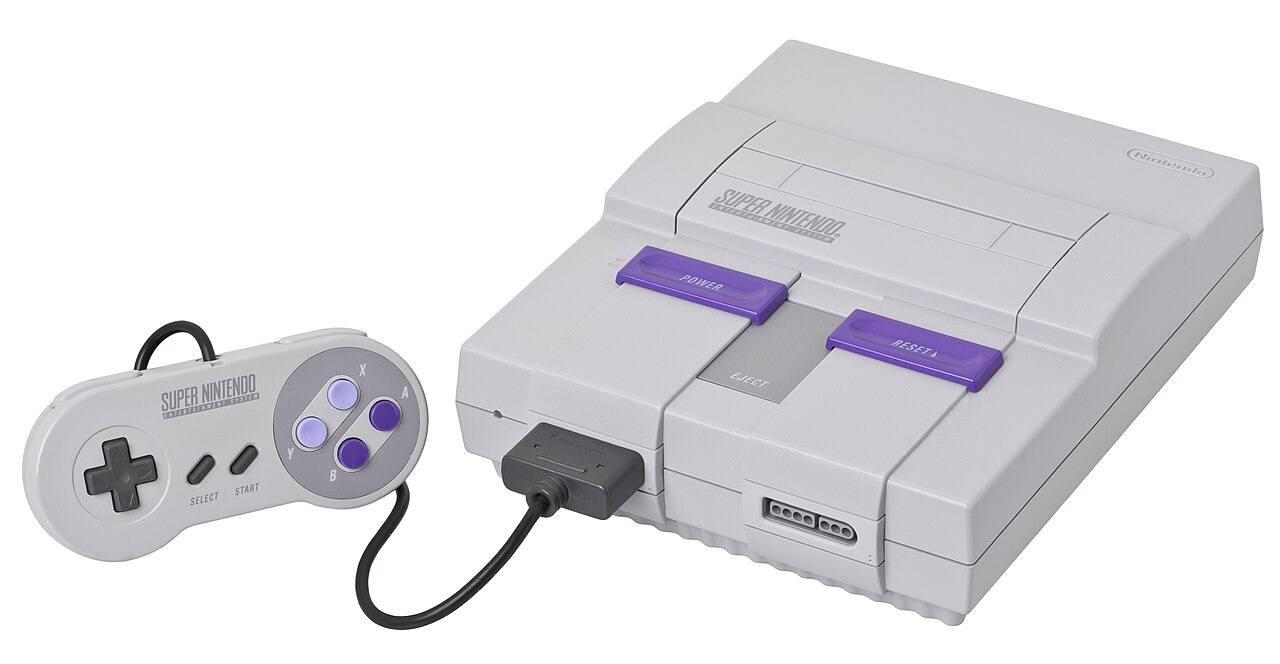
The Super Nintendo Entertainment System (SNES) launched in North America in August 1991 with superior audio hardware, better color depth, and a Mode 7 graphics mode that enabled the pseudo-3D racing seen in F-Zero and Super Mario Kart. The 16-bit era became a genuine technical competition. The Genesis was faster for action games; the SNES produced superior audio and more complex graphical effects.
By 1992, Sega held approximately 55 percent of the 16-bit console market in North America, a remarkable achievement against a company that had owned the market two years earlier. The Genesis library included Streets of Rage, Sonic the Hedgehog 2, and, crucially, the uncensored version of Mortal Kombat, a fighting game notable for graphic violence that Nintendo had censored on the SNES. Sega’s willingness to publish content Nintendo refused was both a commercial strategy and a statement about the audience it was targeting.
Sony Enters: The PlayStation Revolution
The transition to 3D gaming in the mid-1990s destroyed Sega and transformed Sony from a consumer electronics manufacturer into a gaming empire.
Ken Kutaragi, an engineer at Sony who had moonlighted with Nintendo in the late 1980s to develop the Super NES’s audio hardware (the SPC700 chip), had spent years trying to convince Sony’s leadership that video games were the future of consumer electronics. What finally gave him the opening was a public humiliation. Since 1988 Sony and Nintendo had jointly developed a CD-ROM add-on for the SNES, a machine Sony was to build and sell under the name “Play Station”. On June 1, 1991, at the Summer Consumer Electronics Show in Chicago, Sony announced the partnership on stage. The next day, at the same show, Nintendo announced it had instead signed with Sony’s rival Philips, blindsiding its partner in public. Sony had already built roughly 200 prototypes. The betrayal is what pushed Sony to abandon the add-on and, at Kutaragi’s urging, build a standalone console of its own. His persistence paid off: Sony launched the PlayStation in Japan in December 1994 and in North America in September 1995 at $299.
The PlayStation’s key technical advantages were its CD-ROM drive (enabling game budgets measured in megabytes rather than the megabits constrained by cartridge costs) and its 3D rendering hardware. Final Fantasy VII (1997), released exclusively on PlayStation by a developer who had historically shipped games on Nintendo hardware, was the system-selling moment: a sprawling, cinematic role-playing game that demonstrated what CD storage enabled. It sold 10 million copies.
Sega’s Saturn, launched in May 1995, was technically complex (two processors with difficult-to-exploit architectures) and surprised at retail in a way that alienated retailers and developers. Nintendo’s Nintendo 64 (launched in Japan in June 1996, in North America that September) retained cartridges, limiting storage and raising development costs; its launch library was excellent but sparse. Sony executed consistently across hardware, developer relations, and marketing. By 1997, the PlayStation was the dominant platform; over the full generation the N64 sold just over 30 million units against the PlayStation’s more than 100 million. The N64’s design legacy (the analog stick, four controller ports, the console first-person shooter) is covered in The Video Game Industry.
The 32-bit generation also attracted outsiders who badly misjudged the market. The strangest was Apple, whose Pippin (1996, built and sold by toy maker Bandai under license) was a stripped-down Macintosh for the living room priced at $599, double the PlayStation, with no 3D hardware and almost no games. It sold roughly 42,000 units worldwide before Steve Jobs’s return to Apple killed the licensing program behind it; see Dead End: The Apple Pippin.
The Sega Dreamcast (1998) was Sega’s final hardware attempt. It was genuinely innovative: a 56K modem built in made it the first console with internet connectivity at launch, enabling online multiplayer before the concept was mainstream. Its controller, its visual memory unit, and its library were well-designed. But Sony’s announcement of the PlayStation 2 (which would play DVD movies) made consumers unwilling to invest in a Dreamcast library that would be replaced. Sega exited the hardware business in 2001, becoming a software developer and publisher. A company that had challenged Nintendo’s market dominance had been destroyed by Sony’s market entry.
Platform Exclusives as Weapons
The PlayStation 2, launched in March 2000, became the best-selling home console of all time. Sony’s fiscal reporting stopped at about 155 million shipped in March 2012; production ran until January 2013, and in late 2024 Sony’s own PlayStation-history page put the final figure at over 160 million units. Its DVD player (which cost more at standalone retail than the PS2’s launch price of $299) was the decisive consumer value proposition in a format war between DVD and VHS. Families bought PS2s as DVD players; they played games on them as a secondary benefit. Sony had replicated the Lotus 1-2-3 playbook: bundle additional value into the package that the target market wanted anyway.
Microsoft entered the console market with the Xbox in November 2001. The Xbox was essentially a PC in a console form factor (Intel Pentium III processor, NVIDIA graphics, hard drive, broadband Ethernet) and its launch title Halo: Combat Evolved demonstrated that a console first-person shooter was viable. Microsoft used Halo as a platform exclusive (a game unavailable on competing platforms) to give consumers a reason to own an Xbox that could not be satisfied elsewhere. The platform exclusive as strategic weapon had been understood since the NES era, but Microsoft systematized it with large-scale studio acquisitions.
The Economics of Platform Exclusives
A console manufacturer sells hardware, often at a loss, to establish a platform. The platform generates revenue through licensing fees on software sold for it: typically 15–30 percent of each game’s revenue. A platform exclusive reduces that revenue on the titles themselves (the manufacturer publishes them) but increases hardware sales by creating demand from customers who want to play that specific game. The calculation depends on attach rates and platform market share: a franchise that sells 5 million copies in a market where the platform has 30 million users can justify hardware purchases by consumers who buy the console specifically for that title. Grand Theft Auto III on PS2, Halo on Xbox, and Mario on Nintendo platforms have each functioned this way. The platform exclusive is not merely a competitive tactic; it is the mechanism by which gaming platforms justify their existence to consumers who could otherwise play games on a PC.
The HD Era and the Wii’s Disruption
The PS3 vs. Xbox 360 generation (2005–2006) was dominated by competing high-definition format standards. Sony’s PS3 included a Blu-ray player; Microsoft’s Xbox 360 was HD DVD-compatible through an add-on. The PS3’s $599 launch price was the product of Blu-ray hardware costs, and it handicapped Sony in the early generation. The Xbox 360’s Red Ring of Death, a thermal design flaw that caused the GPU to separate from the motherboard, producing a failure rate estimated at 23.7 percent, cost Microsoft an estimated $1 billion in repairs and replacement units, yet did not destroy the platform because Microsoft’s customer service response was aggressive.
Nintendo’s Wii (November 2006) disrupted the contest between Sony and Microsoft by refusing to compete on their terms. The Wii’s Wii Remote, a remote-style controller with accelerometers and an infrared pointer (later enhanced by the 2009 MotionPlus add-on for true gyroscopic sensing), made playing games a physical activity. Wii Sports, the pack-in title, was designed to be immediately accessible to people who had never played a video game: grandparents, parents, children, and the nursing home residents who appeared in news stories about Wii bowling tournaments. Nintendo sold 101 million Wii units, more than the PS3 or Xbox 360, by targeting a demographic (the casual and non-gamer) that Microsoft and Sony had ignored.
The Wii’s success was temporary in a specific sense: its users were not the deeply engaged gamers who purchased fifty games per year. Wii users purchased hardware and a handful of titles; the Wii U (2012) failed commercially, and Nintendo’s handheld business (the DS line, with over 150 million units sold) became its primary revenue source. The Nintendo Switch (2017), a hybrid device that functioned as both home console and portable, was Nintendo’s successful synthesis: a device that could be a home console for engaged gamers and a portable device for casual users, sharing a single software library.
Dead End: Sega’s Hardware Business
Sega’s hardware history is computing history’s most sustained study in what happens when a company is outmaneuvered at a platform transition.
The Sega Spiral
Sega entered the 1990s as the number-one console manufacturer in North America. It exited hardware manufacturing in 2001. The path between those points illustrates how quickly competitive position can unravel in a platform business.
Sega’s fundamental problem was that it competed against itself. The Saturn was released at the same time as the Sega 32X, an add-on for the Genesis that provided limited 32-bit graphics capabilities. The 32X was discontinued within a year; consumers who had purchased it were effectively discarded. Before that, the Sega CD (1992) had added CD-ROM capabilities to the Genesis. Three incompatible Sega hardware platforms (Genesis, Sega CD, 32X) existed simultaneously in retail, each with its own game library, none fully satisfying the technical demands of the next generation. Sega’s hardware division was eating its own customer base.
The Saturn’s dual-processor architecture, designed for 2D sprite-based games that Sega expected to define the next generation, proved expensive and difficult to program for when the market moved to 3D polygons. The Dreamcast’s quality and innovation were real, but by 1998 Sony’s announcement of the PS2 had conditioned consumers to wait for the next thing rather than commit to the current one. A company that had once beaten Nintendo now could not get customers to buy hardware that was genuinely excellent. The platform business punishes inconsistency and rewards focus; Sega demonstrated both conclusions.
📚 Sources
- Sheff, David: Game Over: How Nintendo Conquered the World (1993), Random House
- Kent, Steven L.: The Ultimate History of Video Games (2001), Three Rivers Press
- Harris, Blake J.: Console Wars: Sega, Nintendo, and the Battle that Defined a Generation (2014), HarperCollins
- Kushner, David: Masters of Doom: How Two Guys Created an Empire and Transformed Pop Culture (2003), Random House
- Horowitz, Ken: Playing at the Next Level: A History of American Sega Games (2016), McFarland
- Cifaldi, Frank: “Unearthing the ET Cartridges in New Mexico” — IGN (April 26, 2014)
- Super NES CD-ROM — Wikipedia (Nintendo–Sony partnership, the 1991 CES Philips announcement, prototypes)
- “Blast Processing” — Sega Retro (the VDP DMA technique behind the term)
- “The Man Behind Sega’s ‘Blast Processing’ Gimmick Is Sorry For Creating That Ghastly Phrase” — Time Extension (September 2022)
- SquareTrade’s console failure study, reported by The Register, 3 September 2009 — the source of the 23.7 percent Xbox 360 figure
- “How the Xbox 360 ‘Red Ring of Death’ cost Microsoft $1.15 billion” — Game Developer
- Atari video game burial — Wikipedia (the September 1983 Alamogordo dump and the 26 April 2014 excavation that recovered 1,300-odd cartridges)
- List of best-selling game consoles — Wikipedia · the lifetime unit figures used here, each traced there to the manufacturer’s own reporting
- Sony: “2000 — PS2, PSP” — PlayStation history · “over 160,000,000 consoles sold worldwide since 2000”, the final PS2 figure, reported by Nintendo Life, November 27, 2024
- Kautz, Paul: “Missing Link: 30 Jahre N64 – Nintendos 3D-Wunderkiste” — heise online (June 28, 2026)
- Vor 30 Jahren: Apples Konsolen-Flop Pippin erscheint — heise online