Seymour Papert and the Children's Machine
Abstract
Seymour Papert (1928–2016) spent five years with Jean Piaget in Geneva studying how children build knowledge, then brought the question to MIT’s Artificial Intelligence Laboratory and answered it with a programming language. Logo (1967), written with Wally Feurzeig and Cynthia Solomon, and its turtle let children teach geometry to a machine and so learn it themselves. His 1980 book Mindstorms argued that children should program computers rather than be drilled by them; LEGO named its robotics kits after the book. Papert also co-wrote Perceptrons (1969) with Marvin Minsky, co-directed the AI Lab, set the 1966 “Summer Vision Project” that badly underestimated computer vision, advised Maine’s statewide school-laptop program and helped found One Laptop per Child. Logo reached millions of classrooms in the 1980s, and independent studies found little of the general thinking benefit he had promised. His learning theory, constructionism, runs through Scratch, school robotics and maker spaces.
The Gears
Seymour Aubrey Papert was born on 29 February 1928 in Pretoria, South Africa. In the foreword to Mindstorms he traced his career to a toy. “Before I was two years old I had developed an intense involvement with automobiles,” he wrote, and of all their parts the differential gear fascinated him most, because it does not follow a simple chain of cause and effect: the motion of the drive shaft is shared between two wheels in proportions that depend on what each wheel meets. Working with differentials, he later decided, did more for his mathematical development than anything he was taught in elementary school: he saw multiplication tables as gears, and equations in two variables immediately evoked the differential. No one had told him to learn about gears; there was, he wrote, “feeling, love, as well as understanding” in the relationship. The point of the essay was that a child learns most from an object he or she has chosen and can play with in the head.
He studied philosophy and mathematics at the University of the Witwatersrand in Johannesburg (BA 1949, PhD in mathematics 1952). As a student he was active against apartheid, and he left South Africa. In London in the 1950s he was a leading figure in the revolutionary socialist circle around the journal Socialist Review, and he took a second PhD in mathematics at Cambridge in 1959, supervised by Frank Smithies.
Geneva
From 1958 to 1963 Papert worked with the developmental psychologist Jean Piaget at the University of Geneva. Piaget had spent decades documenting how children construct concepts of number, space and logic in stages, not by absorbing what adults tell them but by building and revising their own mental models. Piaget is reported to have said that no one understood his ideas as well as Papert.
The years in Geneva fixed the question Papert worked on for the rest of his life. Piaget described how children learn; Papert wanted to change the materials they learned with. If children build their understanding of number by handling objects, then the objects available to them limit what they can understand. A computer, he came to believe, could be the most flexible object of all, one that could take the shape of any idea a child wanted to explore.
MIT and the AI Laboratory
Papert came to MIT as a research associate in 1963 and became professor of applied mathematics in 1967. He co-directed the Artificial Intelligence Laboratory with Marvin Minsky until 1981, and from 1974 to 1981 held the Cecil and Ida Green professorship of education.
In July 1966 Papert wrote an AI Lab memo, number 100, proposing “The Summer Vision Project”: to “use our summer workers effectively in the construction of a significant part of a visual system.” A group of students was to build, within the summer, a program that could separate objects from the background in a camera image and identify them. The task was chosen partly because it “can be segmented into sub-problems which will allow individuals to work independently.” Getting computers to recognize objects in images reliably took about half a century more and arrived with the deep-learning methods of the 2010s (see ImageNet and the Deep Learning Revolution). The memo is now quoted as the classic example of AI optimism.
With Minsky, Papert wrote Perceptrons (1969), a mathematical analysis of what single-layer neural networks could and could not compute. It proved, among other results, that a single-layer perceptron cannot determine whether a figure is connected or compute the exclusive-or of its inputs. Its negative results, fairly or not, contributed to a decade in which neural-network research lost most of its funding; that story, and Frank Rosenblatt’s later vindication, is told in Frank Rosenblatt and the Perceptron. In the same years Papert was building a programming language for children.
Logo and the Turtle

In 1967 Papert, Wally Feurzeig and Cynthia Solomon created Logo at the research company Bolt Beranek and Newman (BBN) in Cambridge, Massachusetts. Logo was a dialect of LISP with fewer parentheses, designed so that children could write programs that manipulated words and sentences.
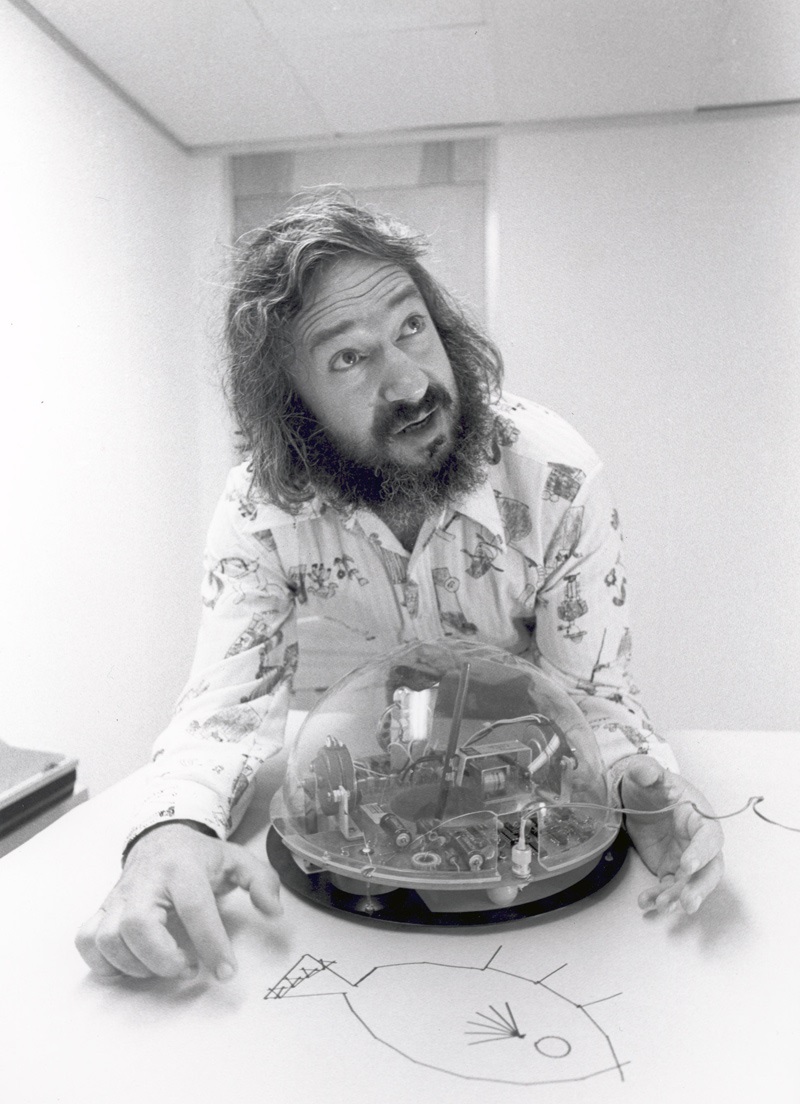
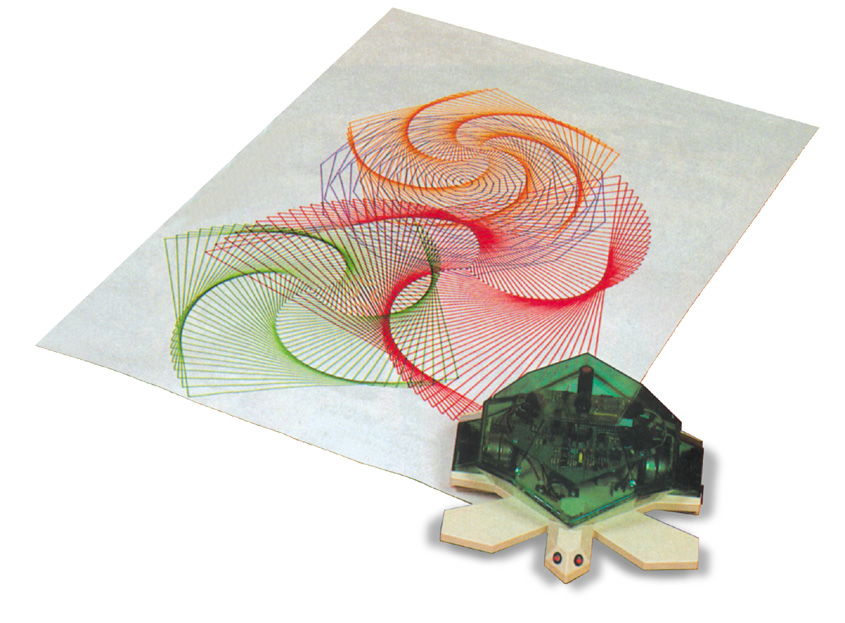
The feature that made it famous came a little later. The turtle was both a dome-shaped floor robot connected to the computer by a cable, carrying a pen that could be raised or lowered, and a small triangle on a screen; the first working floor turtle was built in 1969. Children steered it with commands like FORWARD 50 and RIGHT 90. To draw a square, a child could walk a square on the floor, notice what he or she did at each corner, and then tell the turtle to do the same. Papert called this body-syntonic reasoning: the turtle’s geometry was the geometry of the child’s own body. A child who wanted a circle discovered that “go forward a little, turn a little, repeat” makes one, an intuitive version of differential geometry.
Logo also gave Papert his favorite lesson. A program that does not work is not a wrong answer to be marked in red but an almost-right idea to be examined and fixed. Debugging, he argued, taught children that errors are information, which is how mathematicians and engineers actually work. The design goals later summarized as “low floor, high ceiling” (easy to start, hard to outgrow) became the standard for judging educational programming tools.
Through the 1970s Logo was developed and tested at MIT, at the University of Edinburgh and in Tasmania, and in the public schools of Brookline, Massachusetts, where Solomon and Dan Watt worked with classes. In 1978 MIT and Texas Instruments started a pilot at the Lamplighter School in Dallas with 50 computers for 450 pupils.
Mindstorms
Papert’s book Mindstorms: Children, Computers, and Powerful Ideas, published in 1980, made the argument to the public. In most schools, he wrote, the computer was being used to program the child, delivering drills and tests. The interesting inversion was the child programming the computer, and in doing so “both acquires a sense of mastery over a piece of the most modern and powerful technology and establishes an intimate contact with some of the deepest ideas from science, from mathematics, and from the art of intellectual model building.” He imagined a “Mathland” in which children would learn mathematics the way they learn French by living in France, and admitted that his own pupils’ experience so far was more like “spending a week or two on vacation in France than like living there.”
He named his theory constructionism: Piaget’s constructivism plus a claim about materials. People build knowledge best, he argued, when they are building something outside their heads that they can show and share, a program, a robot or a sandcastle.
The book arrived just as cheap microcomputers reached schools. Logo Computer Systems Inc. (LCSI), which Papert co-founded at the start of the 1980s, and other firms produced versions for the Apple II and the Texas Instruments TI-99/4A, and Logo spread quickly. LCSI’s LogoWriter (1985) combined it with a word processor, and its MicroWorlds (1993) modernized the environment. The Logo Foundation counts more than 300 Logo dialects.
Paris and Dakar
Papert wanted to take Logo beyond American suburbs. In 1982 he and Nicholas Negroponte joined the French journalist Jean-Jacques Servan-Schreiber and the French government in founding the World Center for Computing and Human Resources in Paris, with Papert as chief scientist. The centre set up Logo classrooms in Paris and gave Apple II computers to schoolchildren in a suburb of Dakar, Senegal. Negroponte called the plan “as audacious as … putting men on the moon.”
It did not last. “By the end of the Center’s first year, Papert had quit,” Datamation reported in 1984; the centre, the magazine wrote, had become “a battlefield, scarred by clashes of management style, personality, and political conviction.” The conservative government that took office in 1986 withdrew its support, and the centre was dissolved in July 1987. A 1983 article in Technology Review had questioned whether a project that depended on written English could work where many people could not read, and whether bringing Western computing to poor countries as a gift was itself a form of colonialism.
The Media Lab and LEGO
Back at MIT, Papert became a founding faculty member of the MIT Media Lab, which opened in 1985. He started Project Headlight at the Hennigan School, a public elementary school in the Boston neighborhood of Jamaica Plain: more than 80 computers arranged in four circles of twenty in one wing of the building, where every pupil from first to fifth grade used them for at least an hour a day.
At the Media Lab Logo became physical. From 1985 his group connected Logo to LEGO bricks, motors and sensors, so that children could build machines and program their behaviour; the Danish toy company funded the work. Papert’s students Mitchel Resnick and Fred Martin developed a “programmable brick”, a small computer inside a LEGO block. LEGO released it commercially in 1998 as LEGO Mindstorms, named after the book; from 1989 until his retirement in 1998 Papert held the LEGO Professorship of Learning Research that the company endowed. Resnick later built StarLogo (1994), and his Lifelong Kindergarten group built Scratch (begun 2003, released 2007), a block-based descendant of Logo used by millions of children (see Computer Science Education).
Laptops for Every Child
Papert believed every child should have a computer, not share one in a lab. Angus King, the governor of Maine, where Papert lived, met him to discuss computers in schools, and Papert advised a ratio of one computer per child. King proposed the Maine Learning Technology Initiative in March 2000, Papert served on the task force that examined it, and in the autumn of 2002 more than 17,000 seventh graders and their teachers received laptops, the first statewide program of its kind in the United States. Its academic effects proved hard to measure.
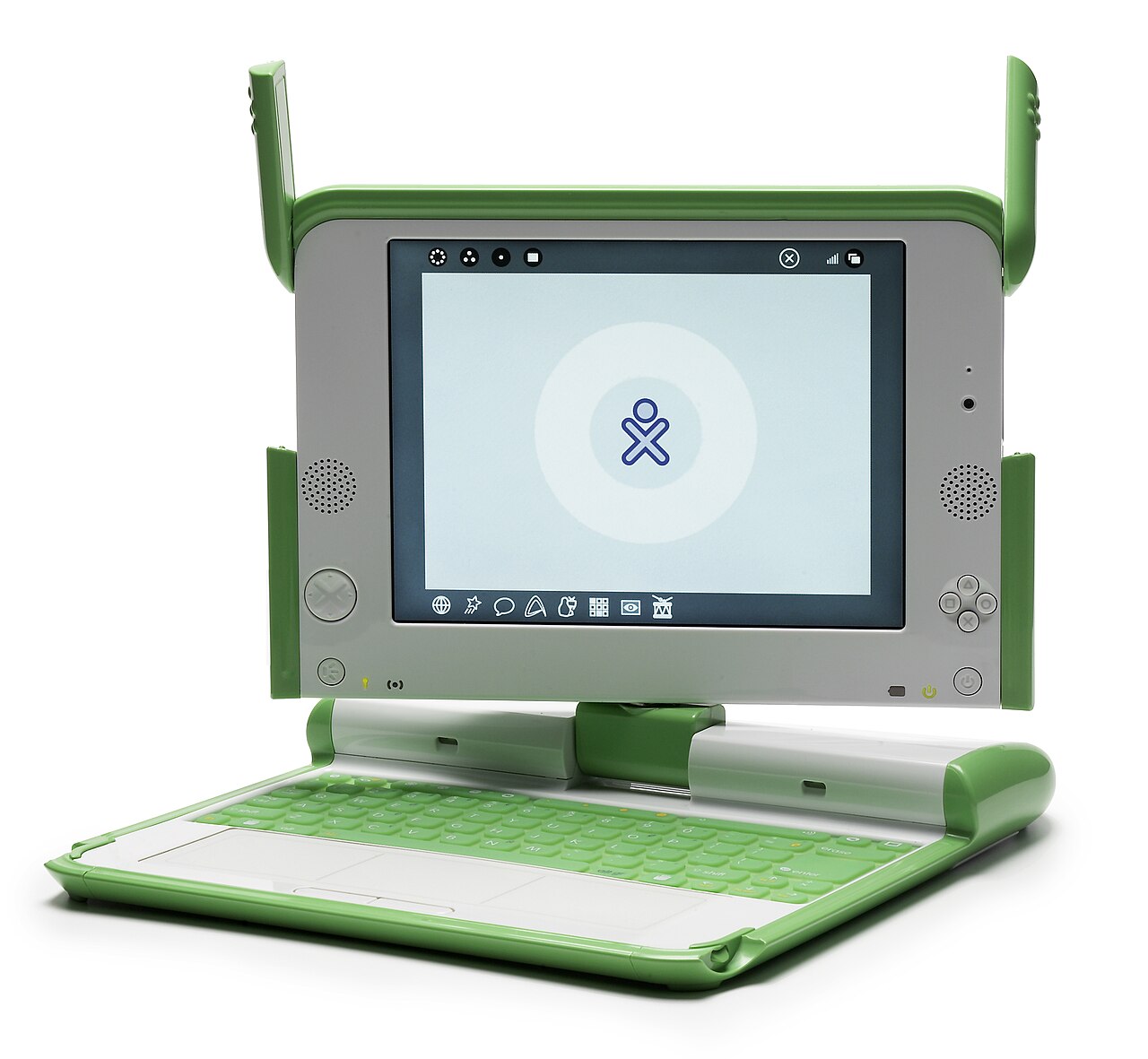
Papert and Negroponte had placed computer classrooms abroad several more times, in Costa Rica in 1986 and Cambodia in 1999, before Negroponte announced One Laptop per Child in 2005, a project Papert championed. OLPC promised a $100 laptop for children in poor countries, designed around constructionist learning. The machine, the XO, cost more and sold far fewer units than planned; its story is told in Nicholas Negroponte and The Digital Divide.
Dead End
Logo reached millions of classrooms in the 1980s, and most of what Papert promised for it did not happen there.
The first problem was evidence. Papert’s group reported on Logo mainly through anecdotes of children who blossomed with the turtle, and did not run controlled studies. When others did, the results were disappointing. Researchers at Edinburgh, including Tim O’Shea, found that Logo’s benefits appeared when researchers worked closely with children and disappeared when ordinary teachers took over, and they could find no consistent evidence of the “skill transfer and other general cognitive benefits” claimed for it. Roy Pea and D. Midian Kurland of the Bank Street College of Education studied Logo in New York schools from 1981 and found little or no difference in planning and problem-solving between children who had learned Logo and those who had not; some studies suggested that children who were already good at mathematics found programming easier, rather than the reverse. Pea also pointed out that Logo worked only with guidance, and that “any projected path toward greater competency that another person helps arrange can be thought of as a curriculum,” which Papert’s rhetoric had promised to do without.
Papert did not accept the framing. In a 1987 essay, “Computer Criticism vs. Technocentric Thinking”, he argued that asking “does Logo work?” was itself a mistake, which he called technocentrism: treating a technology as the cause of learning rather than asking what a school culture did with it. Pea published a reply the same year. The historian Morgan Ames has noted that Papert’s own early writing assumed every child would find computers compelling, which was its own technocentric belief.
The second problem was the school. Teachers added Logo to the timetable as a topic: a few weeks of turtle graphics, a test, then on to something else. Programming beyond the first commands proved hard, and machines of the time ran it slowly. Papert described the outcome in The Children’s Machine (1993): the institution of school had absorbed a foreign body by neutralizing it, turning an instrument for children to think with into another subject on which children were examined. The same pattern of adopting the device and dropping the idea recurred with later waves of classroom technology, including the laptop programs he championed.
Hanoi
On 5 December 2006, while attending the 17th ICMI Study conference on technology in mathematics education in Hanoi, Papert was hit by a motor scooter as he crossed a six-lane road with his colleague Uri Wilensky. He suffered a severe brain injury and had emergency surgery at the French Hospital in Hanoi before being flown to Boston; he later survived a serious infection as well. He relearned, slowly and only partly, to walk and to speak.
Papert was married four times, among others to the MIT sociologist Sherry Turkle; his last marriage, to the writer Suzanne Massie, lasted 24 years. He died at home in Blue Hill, Maine, on 31 July 2016, aged 88.
📚 Sources
-
Heinz Nixdorf MuseumsForum blog, “Der Geistesstürmer – zur Erinnerung an Seymour Papert” (30 August 2016) (the LEGO professorship 1989 to 1998; the Cambridge doctorate in 1959)
-
Wikipedia: Seymour Papert: education, Socialist Review, Geneva 1958–1963, MIT appointments, LCSI, marriages, accident, death
-
MIT News, “Seymour Papert, pioneer of constructionist learning, dies at 88” (1 August 2016)
-
Seymour Papert, “The Gears of My Childhood”, foreword to Mindstorms (1980)
-
Papert, S.: Mindstorms: Children, Computers, and Powerful Ideas (1980), full text and Wikipedia: Mindstorms (book)
-
Papert, S.: “The Summer Vision Project”, MIT AI Memo 100 (July 1966) and text scan
-
Logo Foundation: Logo history: BBN 1967, Edinburgh and Tasmania, Brookline, Lamplighter 1978, LCSI, LogoWriter 1985, LEGO Logo, MicroWorlds 1993, StarLogo 1994, 300 dialects
-
Wikipedia: Logo (programming language): display and floor turtles, first working turtle robot 1969
-
Morgan G. Ames, “Hackers, Computers, and Cooperation: A Critical History of Logo and Constructionist Learning”, Proc. ACM Human-Computer Interaction 2, CSCW (2018): Paris and Dakar, Datamation and Technology Review quotations, Edinburgh and Bank Street findings, Pea quotation, Costa Rica 1986, Cambodia 1999
-
Wikipedia (French): Centre mondial informatique et ressource humaine: founding 1982, Papert’s role, dissolution 1 July 1987
-
Pea, R. D., and Kurland, D. M.: “On the cognitive effects of learning computer programming”, New Ideas in Psychology 2(2) (1984) and Roy Pea: Bank Street Logo project
-
Education Week, “Seymour Papert’s ‘Microworld’: An Educational Utopia” (May 1983)
-
MIT Press, Designing Constructionist Futures, “Introduction: Fifty Years of Constructionism”: Project Headlight
-
Wikipedia: Maine Learning Technology Initiative and Hack Education, “From Lunchboxes to Laptops: How Maine Went One-to-One” (2015)
-
VOA, “Computer Guru’s Accident Highlights Vietnam’s Traffic Woes” (14 December 2006)
-
Image: Seymour Papert.jpg by Matematicamente.it (CC BY-SA 3.0), via Wikimedia Commons
-
Image: Cynthia Solomon.jpg by Cynthia Solomon (CC BY-SA 4.0), via Wikimedia Commons
-
Image: Turtle draw.jpg by Valiant Technology Ltd. (CC BY-SA 3.0), via Wikimedia Commons
-
Image: XO-Beta1-mikemcgregor-2.jpg by Mike McGregor (CC BY 2.5), via Wikimedia Commons