The Atari ST
Abstract
The Atari ST arrived in June 1985, designed in about five months by a small team under an owner in a hurry. It put a 16-bit Motorola 68000, a graphical desktop, a mouse, and 512 KB of RAM into a $799 machine at a time when an Apple Macintosh with less memory cost three times as much. In the home-computer market it fought the Commodore Amiga to a draw across Europe and lost in the United States. But one detail its rivals lacked decided its lasting place in history: two MIDI ports on the back, standard. That turned the ST into the default computer of the professional recording studio for a decade, the machine on which Cubase and the software that became Logic were born.
Five Months to Ship
When Jack Tramiel bought Atari’s consumer division in July 1984, he had just been forced out of Commodore, the company he founded. He wanted a 16-bit computer fast and cheap, and he wanted it to beat his former company to market. The engineer he handed the job was Shiraz Shivji, who had worked on the Commodore 64 before following Tramiel to Atari.
Shivji’s team designed the ST in roughly five months. The schedule shaped the machine. Rather than build custom chips the way the Amiga’s designers had, Shivji used off-the-shelf parts wherever possible and a Motorola 68000 doing most of the work directly. The name ST stood for Sixteen/Thirty-Two, after the 68000’s 16-bit external bus and 32-bit internal registers. The first model, the 520ST, shipped in June 1985, weeks before the Amiga reached buyers.
Tramiel showed the machine at the Winter Consumer Electronics Show in Las Vegas in January 1985, only months after taking over the company. Its resemblance to Apple’s computer earned it the nickname “Jackintosh”, and Atari’s advertising promised “Power Without the Price.” After first deliveries in June, it was widely available from July 1985, and by November more than 50,000 had been sold.
The Hardware
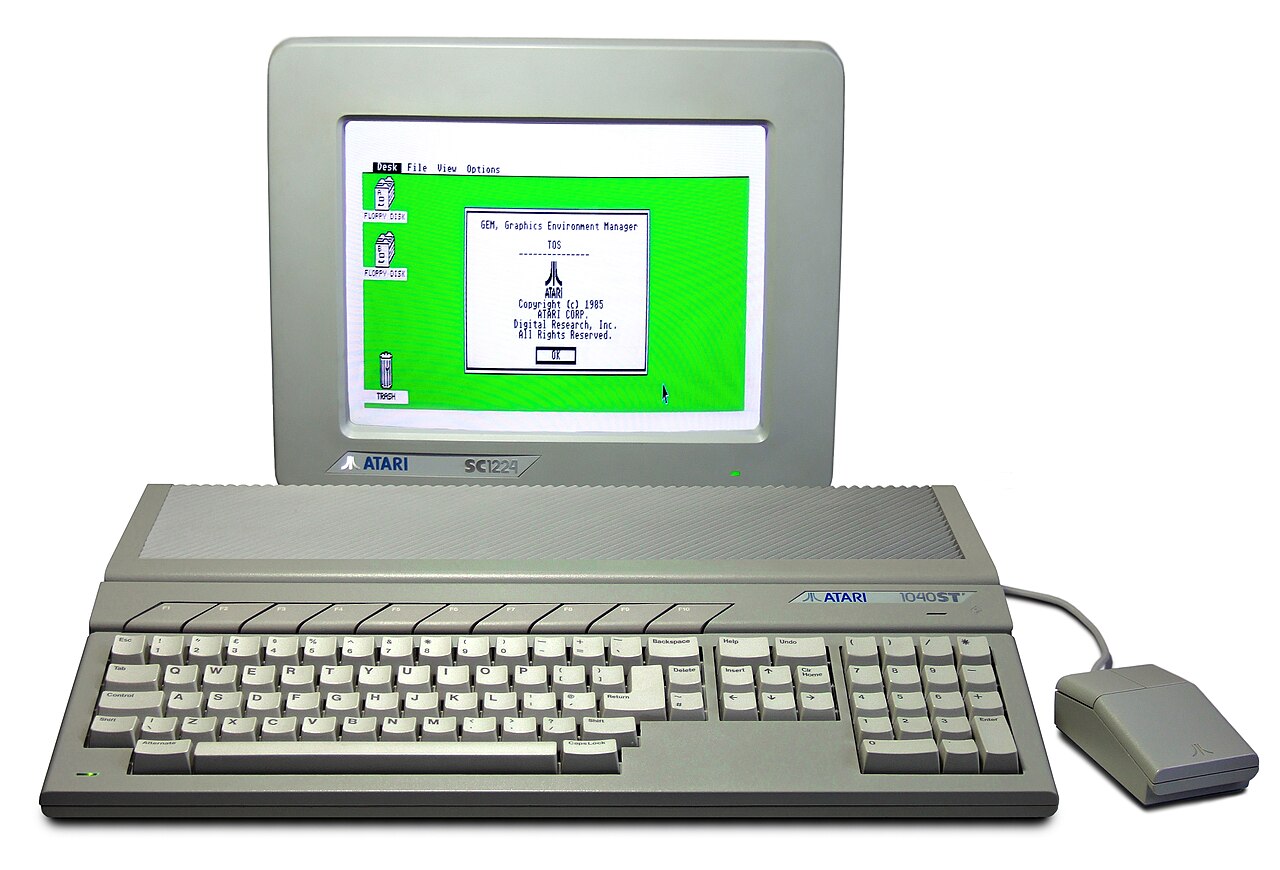
The 520ST ran a Motorola 68000 at 8 MHz with 512 KB of RAM, an external 3.5-inch floppy drive (the 1986 STF models moved it inside the case), and a mouse-driven graphical desktop. The operating system was TOS, with a windowed interface called GEM licensed from Digital Research, the company Gary Kildall had built. It sold for $799.99 with a monochrome monitor and $999.99 with a color one. The comparable Macintosh cost roughly $2,500.
GEM’s resemblance to the Macintosh brought a legal threat. In 1985 Apple accused Digital Research of copying the look and feel of its interface, and Digital Research settled rather than go to court. The settlement forced it to strip the PC version of GEM down: GEM Desktop 2.0 (March 1986) showed only two fixed, non-overlapping windows, used a different trash-can icon and dropped the window animations. Atari had done most of the development of the 68000 version and held full rights to it, so the settlement did not cover the ST, which kept the full desktop, overlapping windows and all, while PC users of GEM got the reduced one.
The 1986 1040ST carried 1 MB of RAM and was described at launch as the first computer to cross the threshold of $1,000 per megabyte. Later the Mega ST added a detached keyboard and more memory, and the STE improved graphics and sound. More than three million ST-family machines sold, most of them in Europe, where the ST and the Amiga split the market and their owners split into camps (a rivalry covered in Dead End: The Amiga).
Germany and the Desktop
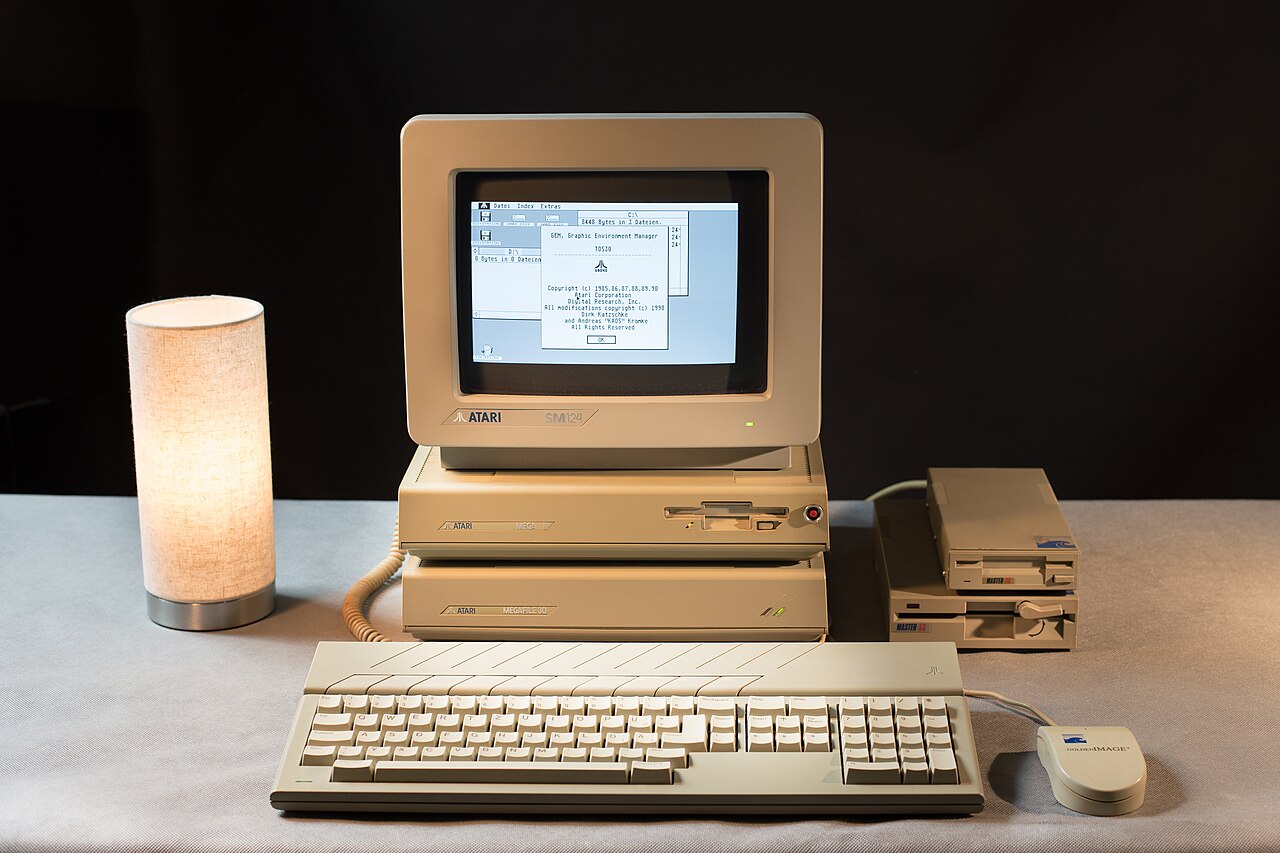
The ST did best in Europe, and nowhere better than in West Germany, where it became a common choice for desktop publishing and CAD as well as for home use. Its sharp monochrome monitor, with a resolution of 640 by 400 pixels, made it suitable for text and layout work at a fraction of the price of a Macintosh. The Mega ST of 1987 put the machine in a separate case with a detached keyboard and an internal expansion bus, and Atari sold it with an inexpensive laser printer, the SLM804, which used the computer’s own memory and processor to build the page instead of an expensive controller inside the printer. German software companies wrote desktop-publishing, typesetting and CAD programs for it, among them the layout program Calamus and the scientific word processor Signum. In German offices, schools and print shops the ST was, for a few years, a cheap alternative to the Macintosh for desktop publishing.
The MIDI Studio
The feature that mattered most was almost an afterthought. Shivji’s team put two MIDI ports on the ST, in and out, as standard equipment. MIDI, the 1983 protocol that let electronic instruments talk to one another (see Computing and Music Creation), was spreading fast, but on every other computer it required a separate interface card or box. On the ST it was already there, and the machine’s interrupt timing was steady enough to keep musical time reliably.
Software followed the hardware. Steinberg released Pro-24 and then, in April 1989, Cubase, a MIDI sequencer whose arrange-page layout still shapes how such programs look. C-Lab shipped Creator in 1987 and Notator in 1988, the latter the first sequencer with interactive real-time notation; the C-Lab team later became Emagic, and Notator’s successor became Logic, which Apple bought in 2002. Both companies established themselves in recording studios worldwide, running on a $799 computer.
Musicians used it because it worked and stayed in time. Depeche Mode ran an ST with Cubase through the sessions for Songs of Faith and Devotion (1993). The Pet Shop Boys replaced a Fairlight CMI, an instrument that had cost as much as a house, with an Atari ST. Producers kept the machines running long after they stopped making sense as general-purpose computers, because the studio setup around them worked and a working studio is not lightly rewired.
Games and Demos
The ST was also a games machine and a demo platform. Its best-selling game was Dungeon Master by FTL Games, released in December 1987, a role-playing game in which the player explored a dungeon in real time from a first-person view; it sold 40,000 copies in its first year and was copied by a generation of later games. European studios shipped hundreds of titles for the ST, often alongside Amiga versions, and its clean 68000 and predictable hardware made it a favorite of the demoscene, where programmers competed to wring effects from it that its five-month design had never anticipated.
Later Models
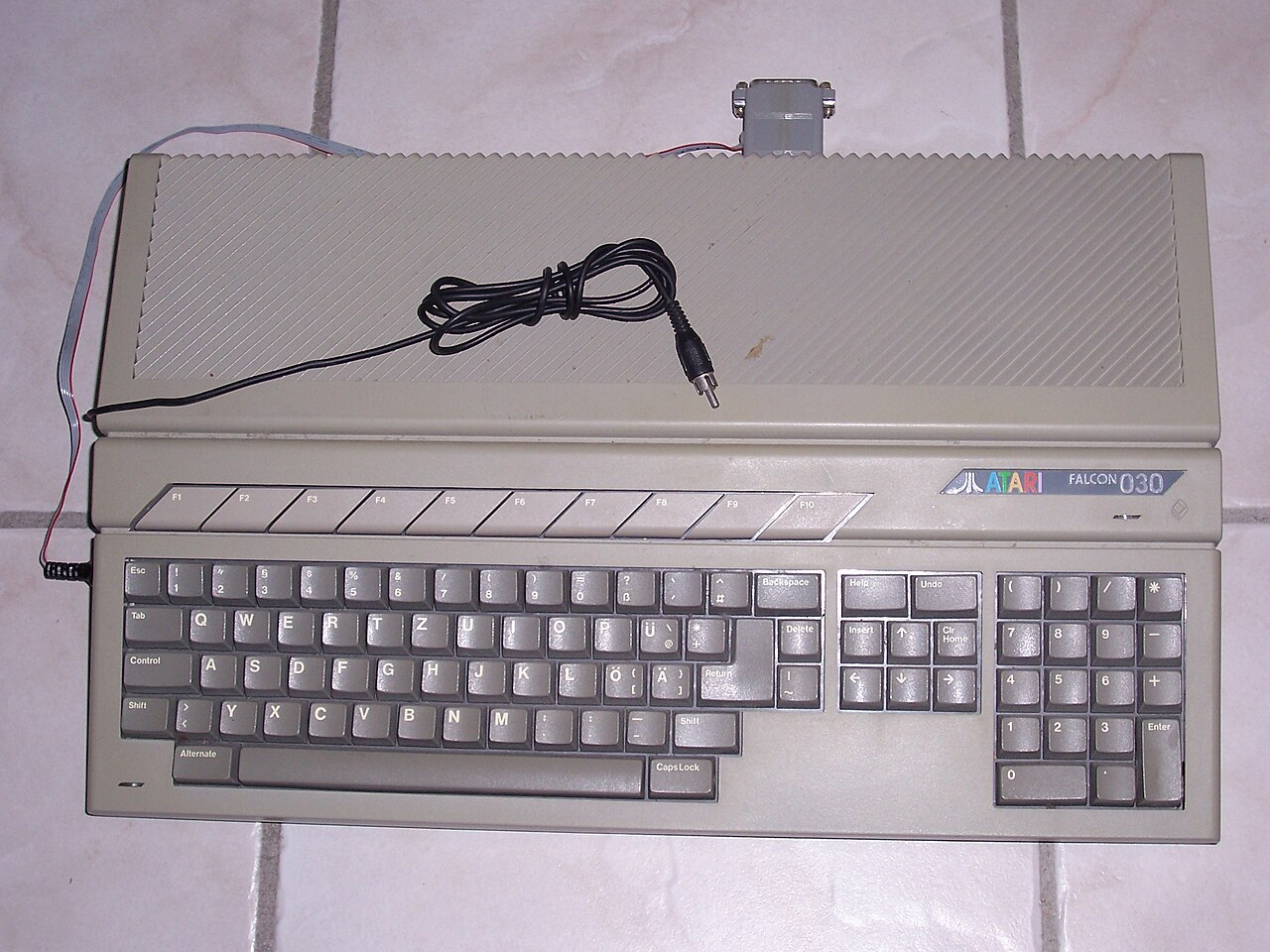
Atari kept extending the line. The STacy (1989) was a portable ST; the STE (1989) added a larger color palette, hardware scrolling and stereo digital sound to catch up with the Amiga; the TT030 (1990) was a workstation built around the faster 68030 processor. The last model, the Falcon030 of 1992, combined a 68030 with a Motorola 56001 digital signal processor, which let it record and process audio directly on a home computer, and it found a following among musicians. None of these models sold in the numbers of the original ST.
Dead End: Atari Leaves the Desk
The ST’s decline tracked the same forces that killed the Amiga. Commodity IBM PC clones grew cheaper and more capable every year, Windows gave them a usable graphical interface by 1990, and the specialized advantages of a 68000 home computer eroded from both ends. Atari, always short of cash under Tramiel, could not invest fast enough to keep pace. It discontinued the ST line in 1993 and gambled its future on the Jaguar game console, launched in November 1993. Atari reported about 100,000 Jaguars sold by the end of 1994 and roughly 125,000 by the end of 1995; total sales were at most about 250,000. In 1996 Atari Corporation merged into the disk-drive maker JT Storage, and in 1998 JTS sold the Atari properties to Hasbro Interactive. Atari had left the computer business for good.
The machine’s afterlife is in sound rather than silicon. Long after the last ST shipped, the sequencer conventions written for it (the arrange page, the piano-roll edit, real-time notation) remained the working grammar of computer music, and the software lines it launched still run, under other names, in studios that never knew where they came from.
📚 Sources
- Atari ST — Wikipedia
- Shiraz Shivji and the five-month design of the ST — Wikipedia
- “A brief history of Steinberg Cubase” — MusicRadar
- “Instrumental Instruments: Atari ST” — Red Bull Music Academy Daily (2017)
- “In 1985 the Best Music Production Computer Wasn’t a Mac or PC” — Production Expert
- “Sommer 1985: Der 16-Bit-Heimcomputer Atari 520 ST” — Elektronikpraxis 12/2025, p. 6 (sg). Print only; no online edition.
- OSnews, “Apple vs. DRI: the other look-and-feel lawsuit” and Wikipedia: GEM (desktop environment)
- Wikipedia: Cubase: first release April 1989
- Wikipedia: Logic Pro: C-Lab Creator (1987), Notator (1988), Emagic, Apple acquisition (2002)
- Sound On Sound, “Remixing Depeche Mode In Surround”: Atari/Cubase sessions of Songs of Faith and Devotion
- Wikipedia: Dungeon Master (video game)
- Wikipedia: Atari Jaguar
- A History of JT Storage / JTS (including the Atari division)
- Image: Atari Mega ST 1.jpg by Adam Podstawczyński (CC BY 4.0), via Wikimedia Commons
- Image: Atari Falcon030 100 3371.jpg by LosHawlos (CC BY-SA 3.0), via Wikimedia Commons
- Image: Atari 1040STf.jpg by Bill Bertram (CC BY-SA 2.5), via Wikimedia Commons